
Florida’s cool roof requirement is narrower than most people expect. The state energy code sets minimum reflectance and emittance values for low-sloped roofs above cooled, conditioned space in Climate Zone 1A. We found no matching statewide mandate for a typical pitched residential roof in Tampa Bay. A reflective roof is still one of the smarter upgrades you can make when your roof is due for replacement, and the numbers below show why.
This guide covers what the code says, who it reaches, which rules can affect your project (the 25% rule and permitting), and how to choose a cool roof that keeps working after years of Gulf Coast sun.
TL;DR
- The 2023 Florida Building Code (8th Edition) added a cool roof provision for low-sloped roofs directly above cooled conditioned space in Climate Zone 1A: a minimum solar reflectance of 0.63 and a three-year aged SRI of 75.
- For a pitched Tampa Bay home, a cool roof is usually a smart choice rather than a code mandate. Confirm with your local building department before you design around either assumption.
- Reflective roofs cut cooling energy, but they rarely pay off on a sound roof. Plan one for the day you replace the roof.
- Judge a product on solar reflectance and thermal emittance together, and look at the aged ratings, not just the day-one numbers.
- Hire a contractor with an active state license, and check it yourself before you sign.
Table of Contents
- What “cool roof” means in code terms
- What the Florida Building Code requires
- Why a reflective roof is worth considering anyway
- How each roofing material handles heat
- How to read a product’s cool roof ratings
- The 25% rule and your roof
- Permits, small jobs and licensing
- Our perspective: choose the cool roof at replacement, and choose the installer carefully
- Planning a replacement? Start with an inspection
- FAQ
- Sources
What “cool roof” means in code terms
A cool roof is a roof designed to reflect more sunlight and shed more heat than a conventional one. Two numbers define it:
- Solar reflectance: the fraction of sunlight the surface reflects, from 0 to 1.
- Thermal emittance: how efficiently the surface releases the heat it did absorb.
The U.S. Department of Energy describes cool roofing as a balance of these two properties and notes that many materials lose performance as they age. That is why codes and rating programs quote three-year aged values. Some also use the Solar Reflectance Index (SRI), which folds both properties into a single score.
The same DOE guide points out that both white and “cool color” products now exist for low-slope and steep-slope roofs, and that “cool” options exist for most traditional roofing materials. A cool roof does not have to be white.
What the Florida Building Code requires
The cool roof language sits in the energy volume of the code, not the roofing chapters. Florida’s analysis of changes for the 2023 (8th Edition) codes lists a new section, C303.1.5. It requires that low-sloped roofs directly above cooled conditioned spaces in Climate Zone 1A comply with Table C402.3. In that table, the Climate Zone 1A values are a minimum roof solar reflectance of 0.63 and a three-year aged SRI of 75.
The wording matters, so here is what each piece means:
| Code phrase | What it means for you |
|---|---|
| Low-sloped roof | A flat or nearly flat roof, such as a TPO or modified bitumen system on a commercial building or a flat section of a home |
| Directly above cooled conditioned space | The roof sits over air-conditioned living or working space, not an unconditioned porch or open carport |
| Climate Zone 1A | The code’s designation for the hottest, most humid zone, which covers the far south of the state |
| Three-year aged | The rating is based on the product after weathering, not fresh from the box |
The state also publishes compliance forms for the commercial energy code. They include a line for low-slope roof reflectance and emittance under Table C402.3. If you are a commercial owner or a builder, your designer will fill that form out.
What this means in Tampa Bay
The provision is written for Climate Zone 1A and for low-sloped roofs. We found no equivalent statewide requirement for a pitched shingle, tile or metal roof on a single-family home in Pinellas, Hillsborough or Pasco County. The Department of Energy’s building research does place Florida broadly in the hot-humid climate zone, but that is a research classification, not a code ruling on your address.
Three things can still change the answer for a specific project:
- The roof type. A flat roof section over conditioned space is treated differently from a pitched roof.
- The project type. New construction, additions and commercial buildings are held to the energy code more strictly than a like-for-like residential re-roof.
- Your jurisdiction. Local building departments and HOAs can add their own expectations, and the code edition in force at permit time governs.
Before you commit to a design, ask your building department which energy code provisions apply to your permit. Your contractor should be able to tell you, and should put the answer in writing.
Why a reflective roof is worth considering anyway
The code is only part of the case. The physics in Florida is simple: the sun is strong for much of the year, and a dark roof soaks it up.
Research from the Florida Solar Energy Center, summarized in a Department of Energy presentation on cool roofs, found that homes converted to white reflective roofs saw an average cooling energy reduction of 19%. Some white tile test cells showed up to a 76% reduction in summer ceiling heat flux compared with black asphalt shingles. Those are test results under specific conditions, not a promise for your house. Your savings depend on your attic insulation, duct location, roof color before and after, and how you run your air conditioner.
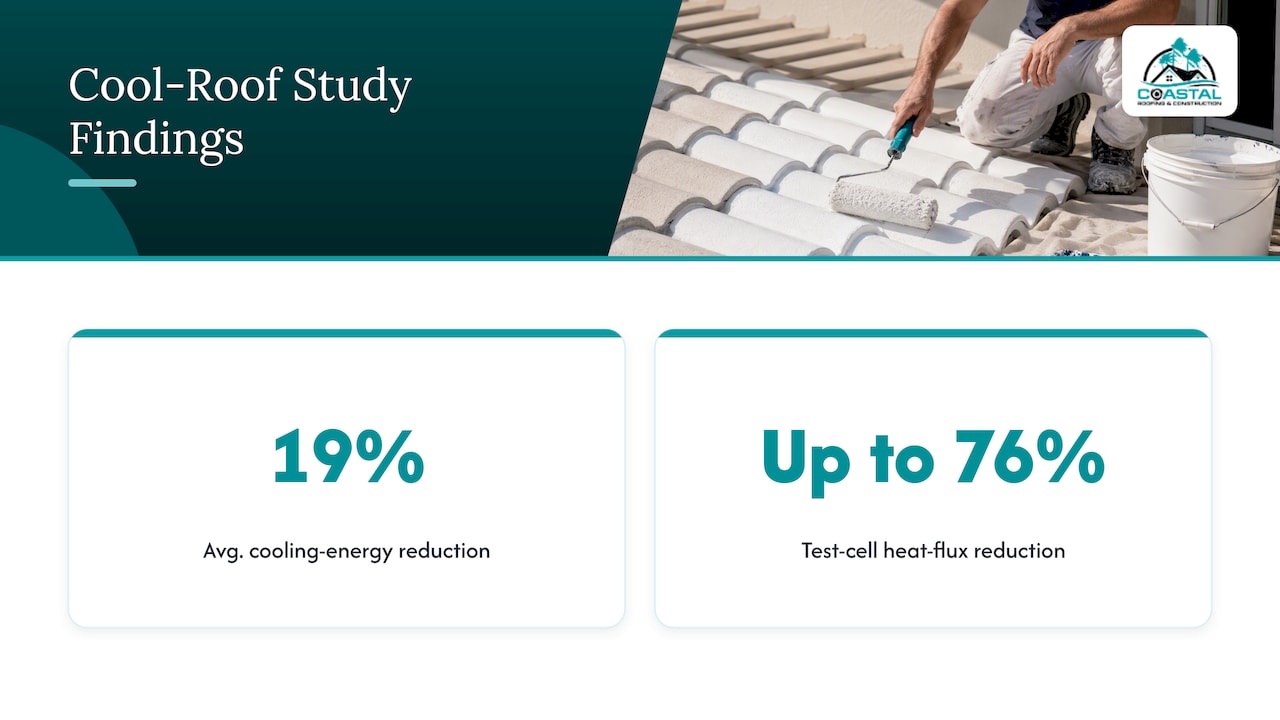
Our honest advice follows the same DOE guidance. Cool roofs are rarely cost-effective to install on a roof that is still in good shape purely for energy savings. They work best when you choose them during a scheduled replacement, when you are paying for new roofing anyway and the reflective option costs little or nothing extra.
For more on how reflective materials work and what they save, see our explainer on reflective roofing and how it saves you money, and our broader guide to energy efficient roofing for Florida homeowners.
How each roofing material handles heat
You have real choices in every material category.
Metal
A light-colored painted metal roof reflects a lot of sunlight, and metal also tends to shed heat well. One pitfall is easy to avoid. The Department of Energy cautions that high reflectance alone is not enough: for metal roofs, avoid clear coatings and choose light-colored paints so both reflectance and emittance are high. Bare or clear-coated metal can reflect well yet hold onto the heat it absorbs.
Coastal homes add a second consideration, salt air, which affects the metal and coating you pick. Our guides on metal roof colors that cut heat for coastal homes and on aluminum versus steel roofing go through both.
Tile
Concrete and clay tile are heavy and shed heat well, and light-colored or cool-color tile can add reflectance on top. They are a good fit for Florida’s long cooling season. Our page on tile roofing covers what we install.
Asphalt shingles
Standard dark shingles absorb the most heat. Lighter and cool-color shingles narrow the gap. If you are weighing shingle against tile, our tile versus shingle guide for Florida homeowners lays out the trade-offs.
Flat and low-slope systems
This is the category the state’s cool roof provision targets. White or light-colored TPO membranes are the common way to meet a reflectance requirement on a flat roof. Modified bitumen systems can be finished with reflective coatings or surfacing. If you own a commercial building or have a flat section over living space, look at our flat roofing and commercial roofing pages.
How to read a product’s cool roof ratings
When you compare products, use this checklist:
- Find the aged values. Look for the three-year aged solar reflectance and thermal emittance, not only the initial ones.
- Check both properties. Reflectance without emittance is half the story.
- Look for third-party rating. Rating programs publish the numbers so you can compare products on equal terms.
- Compare against the target. For a low-sloped roof in Climate Zone 1A, that target is a reflectance of 0.63 and an aged SRI of 75. Other programs set their own thresholds. The DOE presentation above lists example program minimums that include a 3-year aged reflectance of 0.55 and emittance of 0.75 for low-slope roofs.
- Ask about warranty and wind rating. In Florida a cool roof still has to meet the wind requirements for your location.
Color is the other practical question. A white or light roof reflects the most, but cool-color products can come close to the look you want while still reflecting more than a conventional dark version of the same color.
The 25% rule and your roof
The rule people ask about most is not a cool roof rule at all, but it affects whether you end up bringing a roof up to current standards. The Florida Building Code’s so-called 25% rule says that when more than 25% of the total roof area of an existing structure is repaired, replaced or recovered in a 12-month period, the entire roof section must be brought up to current code. That often brings in modern wind mitigation and energy efficiency requirements.
Homeowners often worry that a small repair will trigger a full replacement. State clarifications say that work on undamaged components needed for tie-off or connection between repaired and unrepaired areas is excluded from the 25% calculation. How the rule applies to your roof is decided by your local building official, so get that opinion before storm repairs or a phased re-roof.
If your roof is old and you are weighing repair against replacement, our guide on how to know when a roof needs full replacement will help.
Permits, small jobs and licensing
Roof work in Florida is permitted work. Two practical points:
- The $7,500 exemption is narrow. Under Florida Statute 553.79, certain non-structural residential repairs under $7,500 may qualify for a permit exemption as of July 1, 2026. Pinellas County’s page on permit exemptions for work under $7,500 says you must still submit a written request and get formal approval from the local building official before starting. Do not assume a roof job is exempt. Ask first.
- Check the license. Florida requires a state license from the Department of Business and Professional Regulation for anyone doing roof repair, replacement or maintenance for compensation. The state’s construction industry page defines the roofing contractor classification, and the license verification page lets you confirm that a license is active before you sign.
If you are in the city of Tampa, our walkthrough on what to upload for roof permits shows how to avoid stop work orders.
Our perspective: choose the cool roof at replacement, and choose the installer carefully
We install roofs across Pinellas, Hillsborough and Pasco counties, and the cool roof question comes up most from homeowners with a roof past 15 years old who are tired of their cooling bills. Our view is practical.
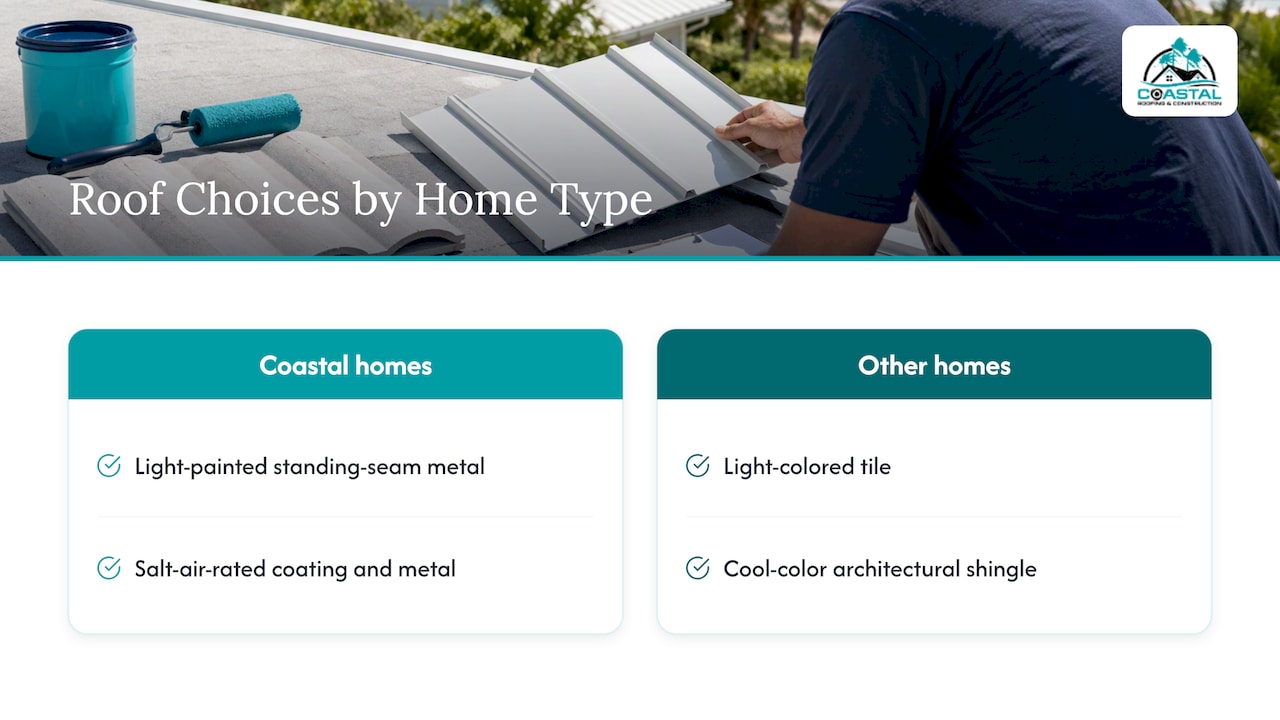
First, do not tear off a healthy roof for reflectance alone. The energy case is real, but it is strongest when the roof needs replacing anyway. Second, specify the whole system, not just a color chip. Reflectance, emittance, underlayment, fasteners and ventilation all affect how the roof performs in a Florida summer and in a hurricane. Third, match the material to the house. On waterfront and coastal homes, we lean toward standing seam metal in a light painted finish, with the coating and metal chosen for salt air. On other homes, light-colored tile or a cool-color architectural shingle may be the better fit.
Our crew is manufacturer-certified and factory-trained, including certifications with Owens Corning, GAF and Tri County Metals. That training matters when a product’s rating and warranty depend on installing it the way the manufacturer specifies. For what these credentials mean for you, see roofing certifications that matter for homeowners.
— Ryan
Planning a replacement? Start with an inspection
If your roof is more than 15 years old, or you are thinking about a metal, tile, flat or shingle replacement with better heat performance, we will inspect the roof, explain what the code and your local building department will expect, and give you honest recommendations. Look at our roof replacement and metal roofing services, or see recent projects on our portfolio page. We are licensed, insured and family-owned, and we serve Tampa Bay from Clearwater and St. Petersburg to Tampa, Brandon and Lutz.
FAQ
Is a cool roof required for homes in Florida?
The state energy code’s cool roof provision applies to low-sloped roofs directly above cooled conditioned space in Climate Zone 1A, with a minimum solar reflectance of 0.63 and a three-year aged SRI of 75. We found no statewide mandate for pitched residential roofs in Tampa Bay. Confirm with your local building department, because project type and jurisdiction matter.
Does a cool roof really lower my cooling bill?
Often, yes. Florida Solar Energy Center research found an average 19% cooling energy reduction in homes converted to white reflective roofs. Your result depends on insulation, ductwork and your starting roof color, so treat that figure as a test result, not a guarantee.
What is the 25% rule for roofs in Florida?
If more than 25% of the roof area of an existing structure is repaired, replaced or recovered within 12 months, the entire roof section must be brought up to current code. Work needed to tie repaired areas to undamaged areas is excluded from that calculation. Your local building official makes the final call.
Do roofing contractors need to be licensed in Florida?
Yes. Anyone performing roof repair, replacement or maintenance for compensation must hold a state license from the Department of Business and Professional Regulation. You can check that a license is active on the state’s MyFloridaLicense portal before signing a contract.
Can a metal roof be a cool roof?
Yes, if it has the right finish. Choose a light-colored paint rather than a clear coating, so the roof has both high solar reflectance and high thermal emittance. Check the product’s aged ratings before you buy.
Sources
- Analysis of Changes for the 8th Edition (2023) Florida Codes, Energy Conservation
- Florida Energy Code compliance form C402-2023
- Guide to Cool Roofs, U.S. Department of Energy
- Cool Roofs presentation, U.S. Department of Energy
- Energy Retrofit Field Study and Best Practices, Hot-Humid Climate
- Florida Building Code modification text on the 25% rule
- Florida Building Commission staff analysis on tie-off work
- Pinellas County: permit exemptions for work under $7,500
- Florida DBPR Construction Industry
- Florida DBPR: how to verify a license