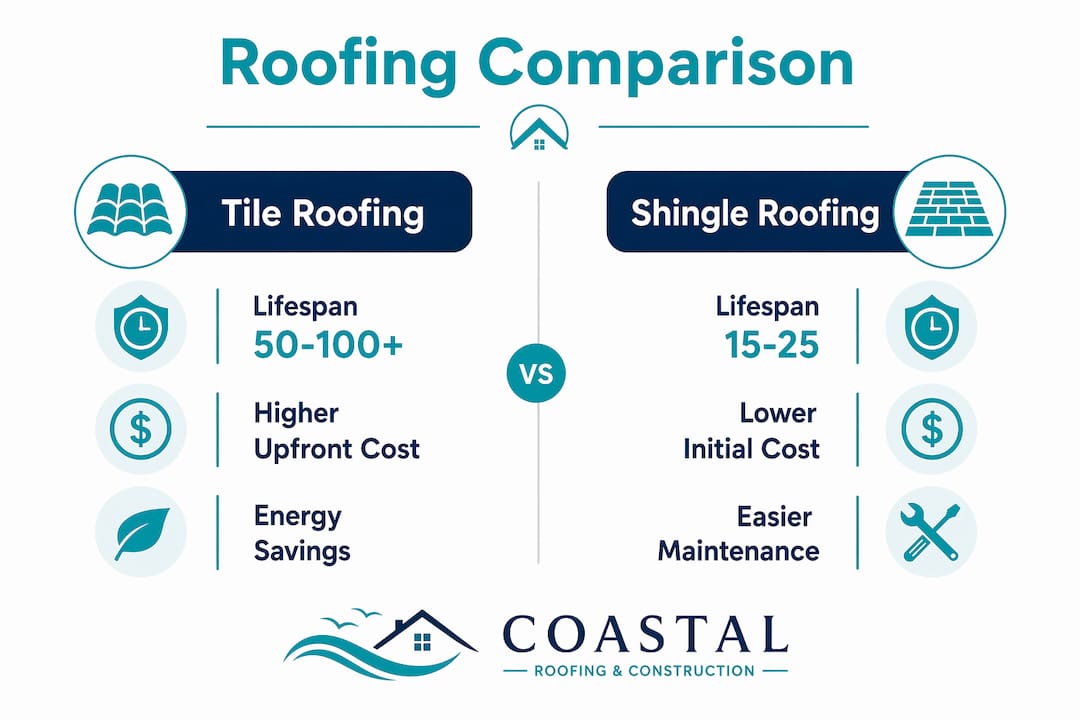
Tile roofing is defined as a heavy, rigid roofing system made from clay or concrete that delivers lifespans of 50–100+ years, while asphalt shingle roofing is a lightweight composite system that typically lasts 15–25 years at a significantly lower upfront cost. For Florida homeowners, this tile roofing vs shingle comparison comes down to more than price. It involves structural capacity, hurricane resistance, energy performance, and long-term return on investment. Tile costs 40–60% more than shingles upfront, but its lifespan and energy savings can make it the more economical choice over decades. Coastalroofingfla installs both systems throughout Tampa Bay and helps homeowners evaluate which material fits their home, budget, and goals.
What are the cost differences between tile and shingle roofs in Florida?
The upfront price gap between tile and shingle roofing is significant and worth understanding before you commit. Tile roofing runs $10–$49 per square foot installed, while asphalt shingles cost $3–$12 per square foot. On a 1,500 sq. ft. home, tile can total $21,708–$74,016 or more, compared to a fraction of that for shingles.
That price difference reflects more than just materials. Tile is heavier and requires specialized labor. Installation takes longer because terracotta and concrete tiles are set individually, which drives up labor hours. If your home’s framing was not built to handle tile weight, you may also face structural reinforcement costs before a single tile goes on the roof.
Here is where the long-term math shifts in tile’s favor:
- Insurance savings: Florida carriers may offer 5%–15% premium discounts for tile roofs due to superior fire and wind resistance. Over a 50-year tile lifespan, those savings compound significantly.
- Replacement frequency: Shingles need full replacement every 15–25 years. A tile roof installed today may never need full replacement during your ownership.
- Maintenance costs: Tile maintenance focuses on underlayment and individual broken tiles, not full-system replacement.
Pro Tip: Get a structural assessment before pricing tile installation. If your home needs framing upgrades, factor that into your total budget comparison with shingles.
The honest answer is that shingles win on day-one cost. Tile wins on decade-three cost. Your decision depends on how long you plan to stay in the home.
How do durability and lifespan compare between tile and shingle roofing?
Tile roofing outlasts shingle roofing by a wide margin. Clay tiles last 50–100+ years and concrete tiles last 30–50+ years, while asphalt shingles typically reach 15–25 years before requiring replacement. Centuries-old clay tile roofs still function today in Mediterranean and Spanish-style architecture, which tells you something about the material’s ceiling.
The durability gap shows up in several specific ways:
- Rot and insect resistance: Tile does not rot and provides no food source for insects. Asphalt shingles can degrade from algae, moss, and moisture over time.
- Fire resistance: Clay and concrete tile carry a Class A fire rating, the highest available. Most standard asphalt shingles carry Class A ratings too, but tile achieves it without any chemical treatment.
- Wind resistance: Properly installed tile roofs perform well in high-wind events. Florida’s hurricane codes recognize this, which is why tile is common in coastal construction.
- UV degradation: Florida’s sun is relentless. Asphalt shingles become brittle and lose granules under prolonged UV exposure. Tile is largely unaffected by UV over its lifespan.
One durability factor homeowners often miss: the underlayment beneath tile wears out every 20–30 years. The tiles themselves may last a century, but the waterproof membrane underneath does not. Replacing underlayment means removing and re-laying tiles, which adds to life-cycle cost. The tile lifespan claim of 50–100 years is real, but it depends on at least one underlayment replacement cycle.
Pro Tip: When budgeting for a tile roof, set aside a reserve for underlayment replacement around year 20–25. It is a predictable cost, not a surprise.
Shingles are easier to maintain and inspect. Homeowners can safely walk on asphalt shingles for minor checks. Tile roofs require a professional because tiles crack if walked on incorrectly, and a cracked tile creates a water intrusion point. That fragility is the trade-off for tile’s extraordinary longevity.
What energy efficiency benefits do tile roofs offer in Florida’s climate?
Tile roofs reduce cooling costs in Florida by up to 20% compared to asphalt shingles. The mechanism is twofold: thermal mass and ventilation. Clay and concrete tiles absorb heat slowly and release it gradually, which buffers attic temperature swings. The curved profile of barrel tiles also creates natural air gaps between the tile and the roof deck, allowing heat to escape rather than transfer into the living space.
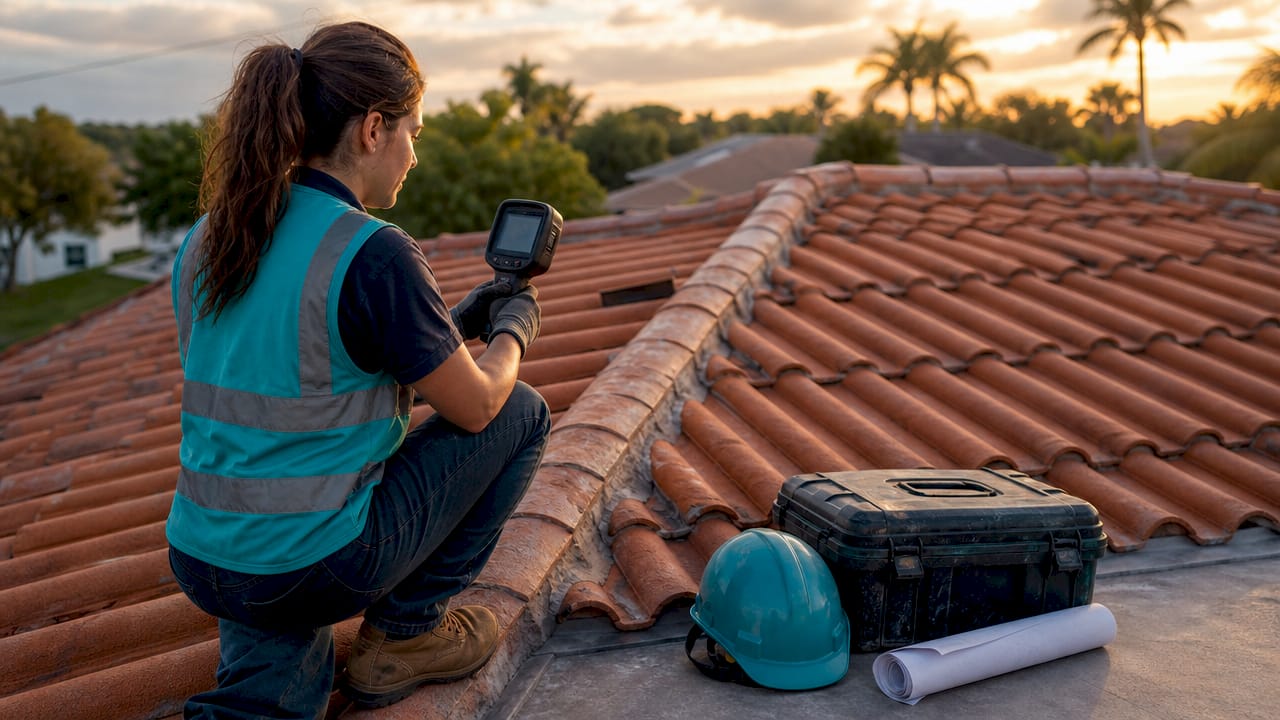
The numbers are meaningful for Florida homeowners. Attic temperatures under tile run 10–20°F cooler than under asphalt shingles on the same summer day. In a state where air conditioning runs nine months a year, that temperature difference translates directly into lower utility bills.
| Feature | Tile roofing | Asphalt shingles |
|---|---|---|
| Thermal mass | High | Low |
| Ventilation gap | Yes (curved profile) | No |
| UV reflectivity | Higher (light colors) | Moderate |
| Cooling cost reduction | Up to 20% | Baseline |
| Attic temp advantage | 10–20°F cooler | Standard |
Shingles offer some energy efficiency options, particularly reflective “cool roof” shingles with higher solar reflectance ratings. These narrow the gap with tile but do not close it entirely. The thermal mass advantage of clay and concrete is a physical property that no coating fully replicates.
Energy savings and insurance discounts together contribute to tile’s long-term cost-effectiveness despite higher upfront prices. For a Tampa Bay home running central air conditioning heavily from april through october, the cooling savings alone can offset a meaningful portion of the price premium over 20 years.
What structural and installation factors affect tile versus shingle roofing?
Weight is the defining structural difference between tile and shingle roofing. Tile roofs weigh 600–1,000 lbs per square (a roofing “square” equals 100 sq. ft.), while asphalt shingles weigh 200–400 lbs per square. That weight difference is not cosmetic. It determines whether your home’s framing can support the roof without modification.
Homes built in Florida after the mid-1990s are often engineered for tile weight, particularly in coastal communities where tile is the dominant roofing style. Older homes, or homes originally built with shingles, may need framing reinforcement before tile installation. That structural upgrade adds cost and time to the project.
- Installation speed: Shingle installation typically completes in one day for a standard home. Tile installation takes longer because each tile is set individually, and mortar or mechanical fastening requires curing time.
- Contractor specialization: Tile installation requires trained crews with experience in layout, fastening patterns, and flashing integration. Not every roofing contractor has this expertise.
- Maintenance access: Shingles are accessible for homeowner inspection. Tile roofs require a professional who knows how to distribute weight across tiles without cracking them.
- Repair complexity: Replacing a single broken tile is straightforward for a trained technician. Matching color and profile on older tile systems can be challenging if the original product line is discontinued.
Pro Tip: Ask your contractor for documentation that your home’s framing meets the load requirements for tile before signing any contract. This protects you from unexpected structural costs mid-project.
The tile roof’s weight requires structural reinforcement in homes not originally designed for it. Skipping this step creates long-term structural risk. Coastalroofingfla conducts a full assessment of framing capacity before recommending tile on any existing home.
How do tile and shingle roofs affect home value and insurance in Florida?
Tile roofs add measurable resale value to Florida homes. Buyers in Tampa Bay, Clearwater, and St. Petersburg recognize tile as a premium material. A tile roof signals longevity, which reduces the buyer’s concern about near-term replacement costs. That confidence shows up in offers.
Insurance is where tile’s financial advantage becomes concrete:
- Florida carriers recognize tile’s Class A fire rating and high wind resistance.
- Premium discounts of 5%–15% are available from many insurers for tile-roofed homes.
- Over a 50-year tile lifespan, those annual savings accumulate into a substantial offset against the higher installation cost.
- Some Florida insurers require proof of roof age and material before issuing or renewing policies. A new tile roof removes that friction entirely.
Shingles carry their own insurance advantages when installed to current Florida Building Code standards. Impact-resistant shingles, rated Class 4 by UL 2218, qualify for discounts with some carriers. The discount is typically smaller than tile’s, but it is real and worth requesting.
The Tampa Bay roof replacement guide from Coastalroofingfla covers Florida-specific code requirements in detail, including hurricane strap requirements that apply to both tile and shingle systems. Quality installation matters as much as material choice. A tile roof installed without proper fastening or underlayment integration will not perform to its rated lifespan, and it will not qualify for the insurance discounts that make tile financially compelling.
Key Takeaways
Tile roofing outlasts shingles by decades and delivers lower long-term costs through energy savings and insurance discounts, but shingles remain the right choice for homeowners with budget constraints or homes not engineered for tile weight.
| Point | Details |
|---|---|
| Lifespan gap is decisive | Clay tile lasts 50–100+ years; asphalt shingles last 15–25 years before full replacement. |
| Upfront cost favors shingles | Tile costs $10–$49 per sq. ft. installed; shingles run $3–$12 per sq. ft. |
| Energy savings favor tile | Tile roofs can cut cooling costs by up to 20% in Florida’s climate. |
| Structural check is mandatory | Tile weighs 600–1,000 lbs per square and may require framing upgrades before installation. |
| Insurance discounts reward tile | Florida carriers offer 5%–15% premium reductions for tile roofs with Class A fire and wind ratings. |
What I’ve learned after years of Florida roofing projects
The most common mistake I see Florida homeowners make is treating this as a pure price comparison. They get the shingle quote, get the tile quote, see the gap, and choose shingles without running the 20-year math. That math almost always favors tile for homeowners who plan to stay put.
The second mistake is underestimating the structural conversation. I have seen projects where a homeowner committed to tile, then discovered mid-process that their 1970s framing needed significant reinforcement. That is a solvable problem, but it needs to be on the table before you sign a contract, not after.
What surprises most homeowners is the maintenance reality of tile. People assume tile is set-it-and-forget-it. It is not. The tiles themselves are extraordinarily durable, but the underlayment beneath them has a 20–30 year service life. Planning for that replacement cycle is part of owning a tile roof responsibly.
My honest recommendation: if your home was built or engineered for tile, and you plan to own it for more than 10 years, tile is almost always the better investment. If your budget is tight or your home needs structural upgrades to support tile, quality architectural shingle options from manufacturers like Owens Corning and GAF deliver strong performance at a fraction of the cost. The right answer depends on your specific home, not a generic rule.
— Ryan
Coastalroofingfla helps Florida homeowners choose the right roof
Choosing between tile and shingle roofing is a decision that affects your home’s performance, value, and maintenance costs for decades. Coastalroofingfla works with homeowners across Pinellas County, Hillsborough County, and Pasco County to evaluate structural capacity, budget, and long-term goals before recommending a material.
The team at Coastalroofingfla is manufacturer-certified with Owens Corning, GAF, and Tri County Metals, and installs both concrete and clay tile systems alongside premium architectural shingles. Every project starts with an honest assessment, not a sales pitch. Explore recent tile and shingle projects in the roofing portfolio, or request a consultation for residential roof replacement tailored to your Florida home.
FAQ
How long does a tile roof last compared to shingles in Florida?
Clay tile lasts 50–100+ years and concrete tile lasts 30–50+ years, while asphalt shingles typically last 15–25 years. Florida’s UV exposure and storm activity accelerate shingle wear, making the lifespan gap even more pronounced in this climate.
Is tile roofing worth the extra cost in Florida?
Tile’s higher upfront cost is offset by a longer lifespan, cooling cost reductions of up to 20%, and insurance premium discounts of 5%–15% from Florida carriers. For homeowners planning to stay in their home long-term, tile typically delivers a better return on investment than shingles.
Do I need structural upgrades to install tile on my existing Florida home?
Tile roofs weigh 600–1,000 lbs per square, compared to 200–400 lbs per square for shingles. Homes not originally engineered for tile weight may require framing reinforcement before installation, which adds to the total project cost.
Can homeowners inspect tile roofs themselves?
Tile roofs require professional inspection because tiles crack if walked on incorrectly. Asphalt shingles can be safely walked on by homeowners for minor visual checks. Always hire a trained technician for tile roof inspections to avoid creating water intrusion points.
What is the biggest hidden cost of tile roofing?
The underlayment beneath tile wears out every 20–30 years and must be replaced, which involves removing and re-laying the tiles. This predictable maintenance cost is separate from the tile’s own lifespan and should be budgeted for when calculating the total cost of tile roof ownership.