
Florida homeowners have more roof upgrade options than ever, and the best choices come down to three categories: material swaps (architectural shingles, standing-seam metal, tile), performance add-ons (premium underlayment, hurricane straps, ventilation), and energy integrations (cool roofs, rooftop solar, BIPV). Each upgrade carries different storm ratings, salt-corrosion tolerances, and maintenance demands, so the right pick depends on your structure, your budget, and how close you are to the coast.
Quick shortlist for Tampa Bay and Gulf Coast homes:
- Architectural asphalt shingles (impact-rated Class 4): best entry-level upgrade
- Standing-seam metal: top storm resilience, 50-year-plus lifespan
- Clay or concrete tile: premium look, heavy load, verify framing first
- TPO or modified-bitumen membranes: flat and low-slope applications
- Self-adhering underlayment + synthetic base sheet: hidden but high-impact
- Cool/reflective coatings: cut cooling loads, ENERGY STAR and CRRC-rated options available
- Rooftop PV or building-integrated PV (BIPV): energy offset plus potential tax credits
Coastal Roofing & Construction installs all of these systems across Pinellas, Hillsborough, and Pasco Counties, certified by Owens Corning, GAF, and Tri County Metals.
Table of Contents
- What are the best roofing material examples for Florida homes?
- Performance upgrades worth adding during any roof replacement
- Energy and technology upgrades that cut your cooling bills
- Typical cost ranges, lifespans, and ROI for Florida homeowners
- How to choose the right upgrade and what to ask your contractor
- What to expect during the project and after installation
- Which upgrade fits your situation? Quick scenarios and next steps
- Key Takeaways
- A Tampa Bay contractor’s honest take on what actually matters
- Ready to upgrade? Here is how Coastal Roofing & Construction can help
- Useful sources to verify ratings, codes, and incentive programs
What are the best roofing material examples for Florida homes?
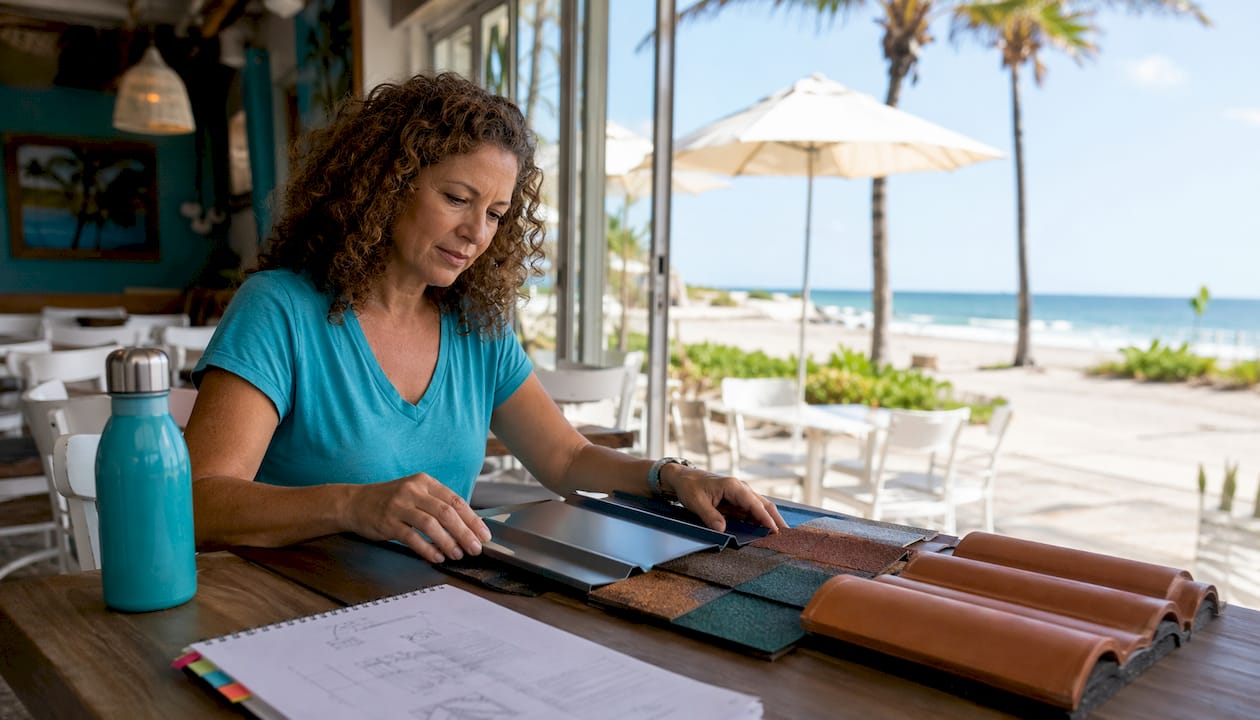
The types of roofing materials available for Florida homes range from budget-friendly asphalt to long-lived metal and tile. Here is how each performs on the coast.
| Material | Installed Cost ($/sq ft) | Lifespan (yrs) | Wind/Hurricane Resistance | Maintenance | Energy Performance | Weight |
|---|---|---|---|---|---|---|
| Architectural asphalt shingles | mid-range cost | moderate lifespan | Good (Class F/H rated) | Low–moderate | Moderate (cool-roof granules available) | Light |
| Impact-resistant shingles | moderate cost | moderate lifespan | Excellent (Class 4 impact) | Low | Moderate | Light |
| Standing-seam metal | higher cost | long lifespan | Excellent (concealed fasteners) | Very low | High (reflective finishes) | Light–medium |
| Clay tile | premium cost | long lifespan | Very good (130+ mph rated) | Low | Moderate | Heavy |
| Concrete tile | higher cost | moderate to long lifespan | Very good | Low–moderate | Moderate | Heavy |
| Synthetic slate/composite | moderate cost | moderate lifespan | Good–very good | Low | Moderate | Light–medium |
| TPO membrane (flat) | moderate cost | moderate lifespan | Good (mechanically fastened) | Low | High (white membrane) | Light |
| Modified bitumen (flat) | moderate cost | moderate lifespan | Moderate | Moderate | Moderate | Medium |
Architectural asphalt shingles are the most common steep-slope choice in America, and for good reason: they cost less upfront, install quickly, and impact-rated variants meet ASTM D7158 Class H (150 mph) wind tests. On the Gulf Coast, look for algae-resistant granules to fight Florida’s humidity.
Standing-seam metal is the strongest all-around performer for coastal Florida. Concealed fasteners eliminate the leak points that exposed-fastener panels create, and a Kynar-coated steel or aluminum panel resists salt corrosion for decades. The hurricane-resistant roofing case for metal is hard to argue with.
Clay and concrete tile look beautiful on Mediterranean and Spanish-style homes, and they carry impressive wind ratings. The catch: tile is heavy, and replacing a shingle roof with tile requires a structural engineer to verify your framing can handle the added dead load before you commit.
Pro Tip: Before choosing tile, ask your contractor for a written framing assessment. Reinforcing rafters or trusses to support tile can add $3,000–$8,000 to the project, and skipping this step creates a structural risk.
Flat-roof membranes (TPO, modified bitumen) are the go-to for low-slope sections common on Florida additions and commercial buildings. TPO’s white surface doubles as a cool-roof solution with no extra coating needed.
Performance upgrades worth adding during any roof replacement
A roof replacement is a rare opportunity to add improvements that are costly or impossible to retrofit later. These are the upgrades that matter most in Florida.
- Self-adhering eave and valley membranes. Self-adhering ice and water protectors at valleys, penetrations, and eaves create a secondary water-shedding layer that catches what wind-driven rain pushes under primary shingles. Non-negotiable on coastal homes.
- Premium synthetic underlayment. Synthetic base sheets outperform felt in tear resistance and moisture resistance. They also hold up better during the days between deck exposure and final shingle installation.
- Upgraded starter and ridge systems. Starter strips with sealant strips bond the first and last shingle courses, the two most vulnerable points in a high-wind event.
- Deck reinforcement. If your deck shows soft spots, delamination, or rot, replace it now. Skipping deck repairs to save money is the most common cause of premature roof failure.
- Hurricane straps and clips. Metal connectors that tie rafters to the top plate dramatically improve uplift resistance. Many Florida insurance carriers offer premium discounts for documented strap installation.
- Balanced attic ventilation. Proper intake (soffit) and exhaust (ridge) ventilation prevents thermal stress that degrades shingles from the inside out. It also reduces cooling loads, sometimes enough to downsize HVAC equipment over the building’s life.
- Higher-grade flashing. Galvanized or aluminum step flashing at chimneys, skylights, and walls is where most leaks originate. Upgrade to heavier-gauge material while the deck is exposed.
Pro Tip: Print this list and bring it to every contractor meeting. Ask each bidder to include or explicitly exclude each item in their written scope. A quote that omits underlayment upgrades or hurricane straps is not an apples-to-apples comparison.
Energy and technology upgrades that cut your cooling bills
Florida’s sun is both a challenge and an asset. The right energy upgrades turn your roof into a net contributor to your home’s efficiency.
| Option | Typical Added Cost | Energy Benefit | Storm Resilience | Best Fit |
|---|---|---|---|---|
| Cool/reflective coating | moderate cost | High (reduces heat gain) | Neutral | Flat and low-slope roofs |
| High-SRI shingles/metal | minor cost premium | Moderate | Same as base material | Steep-slope |
| Rooftop PV panels | higher cost system | High (offsets grid use) | Moderate (rack-mounted) | Any pitch |
| Building-integrated PV (BIPV) | higher cost than rack mount | High | Better profile, lower drag | New construction/full replacement |
| Tubular skylights/daylighting | moderate cost each | Moderate (reduces lighting load) | Low risk if properly flashed | Any |
Cool roofs and high-SRI materials are the fastest payback option for most Florida homeowners. One modeling study found that combining R-30 roof insulation with a cool roofing material delivered a 19.8% reduction in heating energy and a 17.1% reduction in total energy. In a state where air conditioning runs nine months a year, that compounds fast.
Rooftop PV panels are rack-mounted above the existing roof surface, which makes them easier to install and service but adds wind-load considerations. BIPV tiles integrate directly into the roof profile, reducing aerodynamic drag in high-wind events. Both qualify for the federal residential clean energy tax credit (verify current availability with a tax professional). Solar roofing costs run materially higher per square foot than conventional materials, so the payback calculation depends heavily on your utility rates and roof orientation.
Building codes and green programs increasingly reference ENERGY STAR and CRRC labels when setting cool-roof performance requirements. Ask your contractor for the Solar Reflectance Index (SRI) value of any material they propose.
For more on how reflective surfaces work in practice, see what reflective roofing does for your energy bills.
Typical cost ranges, lifespans, and ROI for Florida homeowners
| Material | Installed Cost ($/sq ft) | Lifespan (yrs) | Key ROI Driver |
|---|---|---|---|
| Architectural asphalt shingles | $4–$8 | 25–30 | Low upfront cost, insurance discounts for impact-rated |
| Standing-seam metal | $7-16 | 50+ | Longevity, low maintenance, insurance savings |
| Clay/concrete tile | $10–$25 | 50-year-plus | Curb appeal, durability (verify structural cost) |
| TPO flat membrane | $5–$10 | 20–30 | Cool-roof energy savings, low maintenance |
The biggest ROI lever for most homeowners is not the most expensive material. Impact-rated shingles and a documented hurricane-strap installation often generate measurable insurance premium reductions that offset the upgrade cost within a few years. Standing-seam metal costs more upfront but typically outlasts two or three asphalt roofs, making the lifetime cost competitive.
Pro Tip: Budget 10–15% above your base quote for hidden work: deck repair, ventilation corrections, and structural reinforcement for tile. These items are almost always discovered once the old roof comes off, and a contractor who doesn’t mention them upfront is not giving you a complete picture.
A new roof is also one of the strongest return-on-investment home improvements available to Florida homeowners, particularly when paired with energy upgrades.
How to choose the right upgrade and what to ask your contractor
Start with wind rating and structural capacity, then layer in energy goals and aesthetics. Here is a practical framework:
- Wind rating first. Florida’s coastal zones require materials rated for 130–160 mph or higher. Confirm Miami-Dade County product approval or a comparable high-wind NOA (Notice of Acceptance) for any material you consider.
- Structural capacity second. If you want tile, get a framing assessment before you price anything else. If your trusses can’t carry the load, tile is off the table unless you budget for reinforcement.
- Energy goals third. If cooling costs are your primary concern, prioritize high-SRI materials, attic ventilation, and insulation upgrades. Add solar only after the building envelope is optimized.
- Aesthetics and maintenance last. Pick the material that fits your home’s style and the maintenance level you’ll actually commit to.
Questions to ask every contractor:
- Are you licensed and insured in Florida? (Request license number and certificate of insurance.)
- Are you a manufacturer-certified installer for Owens Corning, GAF, or Tri County Metals?
- Do the products you’re proposing carry Miami-Dade County approval or an equivalent high-wind rating?
- What written workmanship warranty do you offer, and what does the manufacturer warranty cover?
- Can you provide an itemized scope with materials, underlayment, and all performance upgrades listed separately?
- What is the realistic project timeline, including permit wait time?
Ask for documentation of manufacturer certifications, photos of similar local installs, and at least two recent references from coastal projects. A contractor who hesitates on any of these is worth reconsidering. For a deeper look at Florida’s climate impact on shingles, that third-party resource covers the humidity and UV degradation patterns specific to this state.
What to expect during the project and after installation
| Project Type | Typical Duration | Main Disruption Points |
|---|---|---|
| Shingle replacement | 1–3 days | Noise, debris, driveway access |
| Standing-seam metal install | 3–7 days | Longer lead time for custom panels |
| Tile replacement | 3–7 days | Structural work adds time if needed |
| Flat-roof re-cover (TPO) | 1–3 days | Odor from adhesives |
| Solar integration | 1–3 days (after roofing) | Electrical inspection required |
Permits are required for virtually every roof replacement in Florida. Your contractor should pull the permit; if they ask you to pull it yourself, that is a red flag. Notify your homeowner’s insurance carrier once the new roof is complete, and ask about premium adjustments for wind-rated or impact-resistant systems.
Post-installation, Florida’s maintenance priorities are straightforward. Rinse salt deposits from metal and tile surfaces after major storms, check flashings and sealants annually, clear soffit vents and gutters every season, and schedule a professional inspection every two to three years. A step-by-step roof renewal workflow for Florida homeowners can help you plan the scheduling side.
Pro Tip: Keep a copy of your permit, warranty documents, and manufacturer certification paperwork in a home file. Insurance adjusters and future buyers will ask for them.
Which upgrade fits your situation? Quick scenarios and next steps
- Budget-minded upgrade: Impact-rated architectural shingles (Class 4) with self-adhering valley membranes and hurricane straps. Lowest upfront cost, strong insurance discount potential, and a 25–35-year lifespan.
- Maximum storm resilience: Standing-seam metal with concealed fasteners, self-adhering underlayment at all eaves and valleys, hurricane clips, and balanced attic ventilation. The closest thing to a set-it-and-forget-it roof in Florida.
- Energy-first: High-SRI shingles or white TPO membrane, R-30 attic insulation, balanced ventilation, and rooftop PV. Pair with the federal clean energy tax credit (verify current availability).
- Resale-focused: Clay or concrete tile on a structurally verified home, or standing-seam metal. Both carry strong curb appeal and long lifespans that buyers notice.
Next steps:
- Schedule a professional roof inspection to document current condition and identify hidden issues.
- Get two to three written, itemized quotes. Require each contractor to list underlayment, ventilation, and performance upgrades separately.
- Request proof of manufacturer certifications (Owens Corning, GAF, Tri County Metals) and Miami-Dade product approvals.
- Ask about financing options and check current federal and Florida state incentive availability before signing.
- Schedule a pre-start meeting to confirm scope, timeline, and permit status.
Key Takeaways
Florida roof upgrades deliver the most value when wind rating, structural capacity, and energy performance are prioritized together, not treated as separate decisions.
| Point | Details |
|---|---|
| Wind rating comes first | Require Miami-Dade approval or a high-wind NOA for any material in Florida’s coastal zones. |
| Hidden upgrades matter most | Self-adhering membranes, hurricane straps, and balanced ventilation extend roof life more than surface material alone. |
| Cool roofs cut real costs | Combining R-30 insulation with cool roofing material modeled a 19.8% reduction in heating energy and a 17.1% reduction in total energy use. |
| Budget for surprises | Add 10–15% above base quotes for deck repair, ventilation corrections, and structural work. |
| Coastal Roofing & Construction | Manufacturer-certified with Owens Corning, GAF, and Tri County Metals, serving Tampa Bay homeowners with standing-seam metal, tile, shingle, and flat-roof systems. |
A Tampa Bay contractor’s honest take on what actually matters
Most homeowners come to us focused on the surface material, which is understandable. But after years of working on coastal homes from Madeira Beach to Palm Harbor, the pattern is clear: the roofs that fail in Florida storms almost never fail because of the shingle brand. They fail because the underlayment was standard felt, the valleys had no self-adhering membrane, or the hurricane straps were never installed in the first place.
Salt air accelerates every weak point. A fastener that would last 20 years inland corrodes in five on a waterfront home. That is why manufacturer certifications with Owens Corning, GAF, and Tri County Metals matter beyond the marketing. Those programs require specific installation standards, not just product use, and they back the warranty when something goes wrong.
My honest recommendation: spend less time comparing shingle colors and more time comparing what each contractor puts under the shingles. The hidden components are where the real upgrade happens.
Ready to upgrade? Here is how Coastal Roofing & Construction can help
If you have worked through this guide and want a licensed, certified contractor to assess your home, Coastal Roofing & Construction is the direct path to a properly scoped, warrantied roof replacement in the Tampa Bay area.
The team is manufacturer-certified with Owens Corning, GAF, and Tri County Metals, and every project includes written workmanship and manufacturer warranty documentation. Before signing with any contractor, request their license number, certificate of insurance, itemized scope, and proof of Miami-Dade or high-wind product approvals.
Browse recent completed projects to see standing-seam metal, tile, and shingle installations on local coastal homes, or go straight to the residential roof replacement page to request a quote and schedule your inspection.
Useful sources to verify ratings, codes, and incentive programs
- NRCA Roofing Materials Guide: nrca.net/roofing-guidelines/roofing-materials — material specifications and structural guidance
- Rutgers NJ Green Building Manual (Roof Replacements): greenmanual.rutgers.edu — energy modeling, insulation, and life-cycle upgrade guidance
- IKO Upselling Roof Upgrades: iko.com/na/blog/upselling-roof-upgrades — underlayment and eave protection technical notes
- ENERGY STAR Cool Roofs: energystar.gov — certified cool-roof products and SRI benchmarks
- Cool Roof Rating Council (CRRC): coolroofs.org — independent SRI and reflectance ratings
- Miami-Dade County Product Approval: miamidade.gov/building — search NOA approvals for specific products
- Florida Building Code (FBC): floridabuilding.org — current wind speed maps and permit requirements by county
Verify current federal and state incentive availability, permit requirements, and product approval status with your local county building department and a qualified tax professional before making purchasing decisions.