
Hurricane resistant roofing options are systems engineered to withstand high winds, wind-driven rain, and impact from debris during severe storms. Standing seam metal roofing leads the category with wind ratings up to 180 mph, exceeding Category 4 standards. Concrete tile, Class H architectural shingles, and fully adhered TPO membranes round out the top choices recognized by the Florida Building Code, Miami-Dade Notice of Acceptance (NOA), and ASTM testing standards. This guide ranks each material by tested performance, explains what the ratings mean for your home, and covers the installation details that determine whether a roof survives a storm or fails before its limits are reached.
1. Standing seam metal roofing: the top-rated hurricane roof material
Standing seam metal roofing is the highest-rated storm proof roofing material available for residential use. Wind ratings reach 180 mph, which places it above the Category 4 threshold on the Saffir-Simpson scale. That performance comes from a concealed clip system that locks panels together without exposed fasteners, eliminating the most common point of wind entry.
Post-hurricane studies confirm this real-world advantage. Standing seam systems remained intact after Hurricane Ian in 2022, showing the lowest claim frequency and damage costs among all residential roofing materials. The interlocking panel design distributes uplift forces across the entire roof deck rather than concentrating stress at individual fastener points.
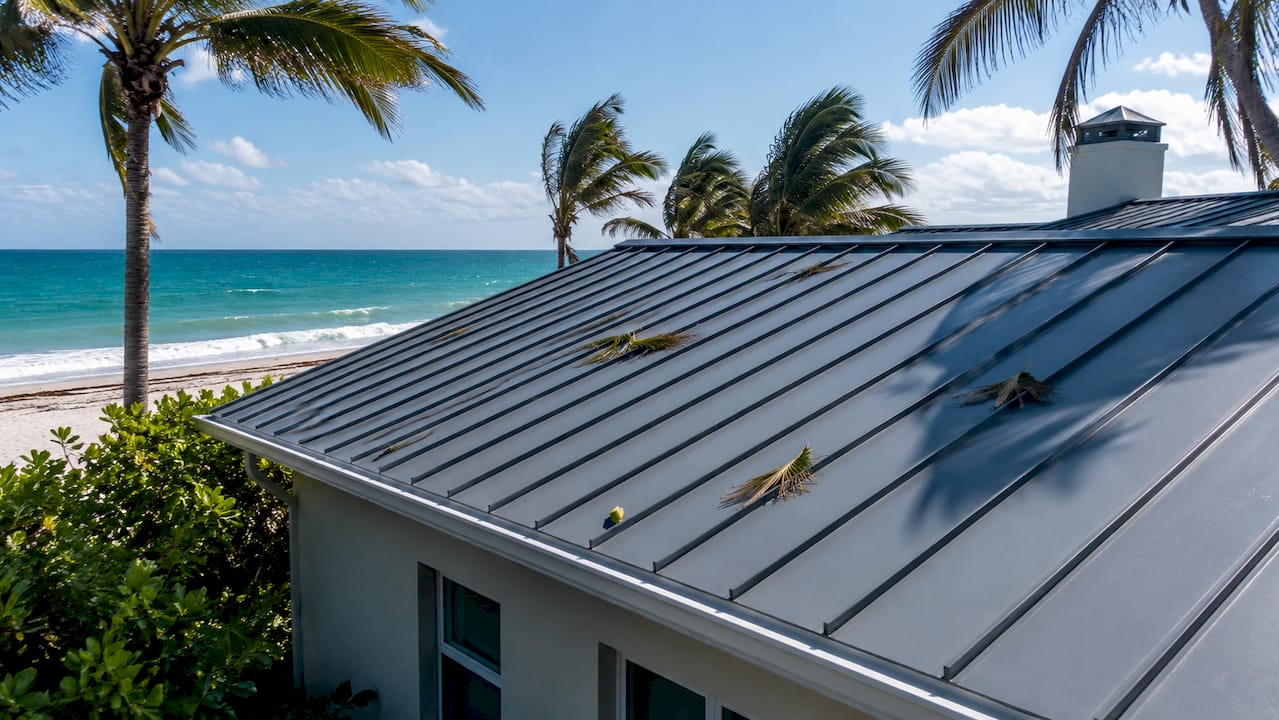
Mechanical fasteners in metal roofs maintain protection after repeated weather events, unlike adhesives or granule-based systems that degrade over time. This makes standing seam the most durable long-term investment for homeowners in hurricane-prone coastal areas like Tampa Bay, Clearwater, and St. Petersburg.
Pro Tip: Ask your contractor for the specific Miami-Dade NOA number for the panel system they plan to install. A legitimate standing seam product will have a published test report you can look up before signing any contract.
2. Concrete and clay tile roofing
Concrete and clay tile roofing is the second-strongest option for hurricane zones, with wind ratings reaching 130–150+ mph when mechanically fastened. Mortar-set tile performs poorly in high winds because the bond degrades over time. Mechanically fastened tile, where each piece is screwed or nailed directly to the deck, is the only method that meets Florida High-Velocity Hurricane Zone (HVHZ) standards.
Clay tile adds significant weight to the roof structure, which actually helps resist uplift in moderate wind events. The tradeoff is that the roof deck and framing must be engineered to carry that load. Concrete tile offers similar wind performance at a lower weight and cost, making it the more common choice for new construction in Pinellas and Hillsborough counties.
Both materials carry long lifespans and hold up well against Florida’s UV exposure and salt air. Tile roofing also qualifies for insurance discounts in many Florida counties when installed to code, which offsets part of the higher upfront cost.
3. Class H architectural shingles for hurricane zones
Standard architectural shingles are not hurricane resistant roofing options. Only Class H rated shingles, tested to withstand winds of 110–150 mph, qualify for use in Florida’s wind-exposure categories. The “H” designation comes from ASTM D3161 and D7158 testing protocols, which simulate sustained wind loads rather than just peak gusts.
Three-tab and standard architectural shingles fail below 110 mph under wind uplift conditions. They lose granules after hail and wind exposure, which accelerates deterioration between storms. Class H shingles use a six-nail fastening pattern and a reinforced adhesive strip to resist tab lifting at the edges where failure typically begins.
Owens Corning and GAF both manufacture Class H shingles certified for Florida’s wind zones. Coastal Roofing & Construction installs these products under manufacturer certifications, which unlocks the strongest warranty coverage available and ensures the installation method matches the tested assembly.
4. How wind ratings and hurricane rated roofing explained
Wind ratings are not marketing numbers. They come from standardized laboratory tests conducted under ASTM, UL, or Miami-Dade protocols that simulate sustained wind pressure on a full roof assembly. A product’s rating applies only when the entire system, including the deck, underlayment, fasteners, and trim, is installed exactly as tested.
| Material | Wind Rating | Lifespan | Maintenance Level |
|---|---|---|---|
| Standing seam metal | Up to 180 mph | 40–70 years | Low |
| Concrete/clay tile | 130–150+ mph | 30–50 years | Low to moderate |
| Class H architectural shingles | 110–150 mph | 25–30 years | Moderate |
| Fully adhered TPO membrane | Miami-Dade NOA rated | 20–30 years | Low to moderate |
| Synthetic tile/shake | Varies by product | 30–50 years | Low |
The table shows why material selection alone does not guarantee performance. A standing seam panel rated to 180 mph installed with the wrong clip spacing will not perform to that rating. The assembly must match the tested configuration exactly.
Pro Tip: Never compare wind ratings between an exposed fastener metal panel and a standing seam system. Exposed fastener panels typically rate 110–140 mph and are not suitable for HVHZ areas. Always confirm which metal roof type is being quoted.
5. Miami-Dade NOA and Florida Product Approval: what they mean for your roof
Miami-Dade NOA and Florida Product Approval are the two compliance benchmarks that determine whether a roofing product is legal to install in Florida’s hurricane zones. These certifications are mandatory in HVHZ areas and confirm that the product has been tested as a complete assembly, not just as an individual component.
Inspectors do not simply check whether a product has an approval number. They verify:
- Fastener type, size, and spacing match the approved assembly
- Underlayment product and installation method match the test report
- Trim and flashing details at eaves, rakes, and ridges follow the approved drawings
- Roof-to-wall connections meet the structural requirements of the local wind speed map
Keeping NOA and Florida Product Approval documentation in the job file is the single most effective way to prevent permit delays and failed inspections. Contractors who cannot produce this documentation before work begins are a serious red flag.
Non-compliance is expensive. Rework to correct fastener patterns or replace non-approved underlayment after installation can cost more than the original material savings. Verify your contractor’s documentation before the first nail goes in.
Pro Tip: Search the Florida Department of Business and Professional Regulation’s product approval database using the contractor’s stated approval number. It takes two minutes and confirms the product is current and valid.
6. Why roof design and installation quality determine hurricane performance
Roof shape affects wind performance as much as material selection. Hip-style roofs with a minimum 30-degree slope are more aerodynamic than gable roofs and deflect wind more effectively across all four sides. Gable roofs create a flat vertical surface that catches wind directly, increasing uplift pressure on the roof deck.
Post-hurricane assessments consistently identify the same failure points:
- Eave and rake edges where wind gets underneath the roofing material
- Ridge caps that lift and allow water infiltration
- Roof-to-wall connections that pull away from the top plate
- Deck panels that separate from rafters when fastener spacing is too wide
Failures at eaves and rakes initiate before the material itself reaches its rated limit. This means a roof rated to 150 mph can fail at 100 mph if the trim installation is incorrect. The material rating is a ceiling, not a guarantee.
A well-installed moderate-slope hip roof with Class H shingles will outperform a poorly installed standing seam metal roof in a real hurricane. The rating on the product data sheet means nothing if the assembly does not match the tested configuration. Installation quality is not a secondary consideration. It is the primary one.
Coastal Roofing & Construction’s residential metal roof installation process includes verified fastener patterns, approved underlayment, and trim details that match the tested assembly for every project.
7. Additional options for flat roofs, budgets, and complex roof shapes
Fully adhered TPO membranes are the correct choice for flat and low-slope roof sections. Tested to Miami-Dade NOA standards, fully adhered TPO bonds directly to the roof deck without mechanical fasteners exposed to wind uplift. This makes it one of the most reliable storm proof roofing systems for commercial buildings and Florida homes with low-slope additions.
Synthetic roofing products engineered to mimic tile offer a middle-ground option. They weigh less than concrete or clay, which reduces structural load requirements, and some carry higher impact resistance ratings than natural tile. Performance varies significantly by manufacturer, so Miami-Dade NOA verification is non-negotiable before selecting any synthetic product.
Standard asphalt shingles and wood shakes are not suitable for hurricane zones. Wood shakes absorb moisture, warp, and lose structural integrity quickly in Florida’s climate. Standard shingles, as noted earlier, fail below the wind speeds Florida homeowners regularly experience during named storms.
Consider each alternative based on your specific situation:
- Fully adhered TPO: Best for flat roofs, low-slope sections, and commercial buildings requiring Miami-Dade NOA compliance
- Synthetic tile: Best for homeowners who want tile aesthetics with lower structural load and improved impact ratings
- Class H shingles: Best for budget-conscious homeowners replacing a steep-slope roof who cannot yet invest in metal or tile
- Avoid: Three-tab shingles, standard architectural shingles without Class H rating, and wood shakes on any Florida home
For homes with complex roof shapes, multiple penetrations, or mixed slopes, Coastal Roofing & Construction recommends a professional roof inspection before selecting a material. Complex geometry creates more edge exposure, which increases the importance of trim and flashing details.
Key takeaways
The most effective hurricane resistant roofing system combines a high-rated material, a code-compliant assembly, and verified installation by a contractor who holds current Miami-Dade NOA documentation.
| Point | Details |
|---|---|
| Standing seam leads on wind ratings | Ratings up to 180 mph make it the strongest option for Florida hurricane zones. |
| Assembly compliance beats material selection | A product’s wind rating only applies when installed exactly as tested and approved. |
| Roof shape affects performance | Hip roofs with a 30-degree or greater slope deflect wind better than gable designs. |
| NOA documentation prevents costly rework | Inspectors verify fastener patterns and underlayment against the approved assembly. |
| Budget options exist with real limits | Class H shingles and fully adhered TPO provide code-compliant protection at lower cost. |
What I’ve learned after years of roofing Florida homes through hurricane season
The question I hear most often is: “Which material is best?” The honest answer is that the material is only half the decision. I’ve seen standing seam metal roofs fail because a contractor used the wrong clip spacing. I’ve also seen well-installed Class H shingles survive storms that destroyed neighboring roofs with higher-rated materials put on by crews who didn’t follow the approved assembly.
What actually separates a roof that survives from one that doesn’t is documentation and installer discipline. Before any material goes on a Florida home, I want to see the Miami-Dade NOA number, the approved assembly drawing, and confirmation that the crew has installed that specific system before. Manufacturer claims mean very little without a certified approval behind them.
The other thing homeowners consistently underestimate is roof shape. A hip roof with a 30-degree slope and Class H shingles will outperform a gable roof with standing seam metal in many real-world storm scenarios. Aerodynamics matter. If you’re building new or doing a full replacement, talk to your contractor about roof geometry before you talk about materials.
My practical advice: get the compliance documents before you sign, verify the approval number in the state database, and schedule a post-installation inspection to confirm the assembly matches the test report. A roof that passes inspection is a roof that was built to perform.
— Ryan
Coastal Roofing & Construction: hurricane-rated roofs for Tampa Bay homeowners
Coastal Roofing & Construction specializes in standing seam metal roofing and tile roof installations built to Florida’s HVHZ standards across Pinellas, Hillsborough, and Pasco counties. Every project includes full Miami-Dade NOA and Florida Product Approval documentation managed from permit application through final inspection.
Coastal Roofing & Construction holds manufacturer certifications with Owens Corning, GAF, and Tri County Metals, which means the installation method matches the tested assembly on every job. Browse the completed project portfolio to see recent metal and tile installations across the Tampa Bay area, or visit the residential roofing services page to request a consultation and get a detailed estimate for your home.
FAQ
What is the best roofing material for hurricane resistance?
Standing seam metal roofing is the top-rated material for hurricane zones, with wind ratings up to 180 mph and the lowest damage frequency in post-storm assessments. Concrete and clay tile mechanically fastened to the deck is the second strongest option, rated at 130–150+ mph.
What does Miami-Dade NOA mean for a roofing product?
Miami-Dade NOA (Notice of Acceptance) certifies that a roofing product has been tested as a complete assembly and meets the wind load requirements for Florida’s High-Velocity Hurricane Zones. Inspectors verify that the installed assembly matches the approved test configuration exactly.
Are metal roofs actually better in hurricanes than shingles?
Yes. Standing seam metal roofs use concealed clips and interlocking panels that resist wind uplift far more effectively than shingles. Even Class H architectural shingles, the strongest shingle option, max out at 150 mph, while standing seam systems are rated to 180 mph.
Does roof shape affect hurricane performance?
Hip-style roofs with a minimum 30-degree slope perform significantly better in hurricanes than gable roofs. The aerodynamic shape deflects wind on all four sides and reduces uplift pressure on the roof deck and edges.
What is the difference between standing seam and exposed fastener metal roofing?
Standing seam uses concealed clips that allow thermal expansion and eliminate exposed fastener points, achieving wind ratings up to 180 mph. Exposed fastener metal panels typically rate 110–140 mph and are not suitable for Florida’s HVHZ areas.
Recommended
- Tampa Bay Roof Replacement Guide – Coastal Roofing & Construction LLC %Roof %Replacement
- Residential Roof Replacement in Florida | Coastal Roofing & Construction
- Residential Roof Repair in Florida | Coastal Roofing & Construction
- Residential Metal Roof Installation in Florida | Coastal Roofing & Construction