
Aluminum wins for homes near salt air because it resists rust outright, while coated steel usually wins inland because it costs less and resists dents better. The right answer depends on your distance from the coast, your hail and snow exposure, and whether your framing can handle the metal’s weight. Workmanship and the ancillary materials your installer chooses often matter as much as the metal itself.
TL;DR:
- Aluminum typically costs $6 to $12 per square foot installed, versus steel at $3.50 to $7, with aluminum carrying a 20% to 35% premium.
- Steel can rust where its coating is breached, so coastal bids should specify Galvalume, compatible aluminum or stainless steel flashings, fasteners, and curbs.
- For hail exposure, compare panel thickness: installers recommend aluminum at least 0.040 inch thick, while steel commonly comes in 24 or 26 gauge.
- Check the specific finish’s Solar Reflectance Index when comparing estimates, because color and coating affect reflectivity more than the underlying metal does.
- Ask for manufacturer certification, references from similar climates, and separate warranty terms for panel defects, finish fading, and coating perforation before signing.
Table of Contents
- What Aluminum Roofing Is and Why It Resists Corrosion
- What Steel Roofing Is and Why Coatings Matter
- Aluminum vs Steel: Cost, Corrosion, Weight, and More
- How to Choose Between Aluminum and Steel for Your Roof
- Why Installation Quality Often Matters More Than Metal Choice
- A Practical Take on Picking Between Aluminum and Steel
- Coastal Roofing & Construction: Matching the Right Metal to Your Home
- FAQ
- Sources
What Aluminum Roofing Is and Why It Resists Corrosion
Aluminum roofing panels are typically made from alloys like 3003 or 3105, formed into standing seam panels or shingle-style profiles. Unlike steel, aluminum does not rely on a separate coating to fight corrosion. It forms a thin oxide layer on its surface that seals out moisture and regenerates when scratched, which is why aluminum roofing does not rust even after years of salt spray exposure.
That corrosion behavior makes aluminum a common choice for homes within a mile or two of open water, where airborne salt attacks unprotected metal fast.
Aluminum also weighs considerably less than steel for the same panel size, which can matter during a reroof if your existing framing was never designed for a heavier system. The lighter weight means less structural reinforcement and easier handling on steep or complex rooflines.
A few practical traits to know before you spec aluminum:
- Aluminum has a higher coefficient of thermal expansion than steel, so panel length and clip spacing need careful engineering to avoid oil-canning.
- The metal is softer than steel, so it dents more easily under hail impact; many installers recommend a minimum panel thickness of 0.040 inch in hail-prone areas.
- Factory-applied PVDF (Kynar-type) finishes add cost but improve color retention and reflectivity over bare or anodized aluminum.
- Installed costs typically run about $6 to $12 per square foot, with higher-end finishes pushing toward the top of that range.
What Steel Roofing Is and Why Coatings Matter
Steel roofing panels get their corrosion resistance entirely from a metallic coating bonded to the base metal, usually Galvalume (an aluminum-zinc alloy coating, also called AZ) or traditional galvanized zinc. The steel itself has no inherent rust resistance, so the coating is the whole defense. Once that coating is scratched through to bare steel, rust can start at that exact spot, which is the main failure mode engineers watch for in coated-steel roofing systems.
Steel panels commonly come in 24-gauge or 26-gauge thicknesses, with the lower number indicating thicker, stiffer metal. Thicker gauges hold up better against hail impact and foot traffic abrasion, which is part of why steel tends to dent less visibly than aluminum under similar impact loads.
Steel’s stiffness also makes it a strong fit for long roof spans, heavy snow loads, and high-wind regions. However, steel panels are heavier than aluminum, so older framing should be checked before committing.
- Steel is generally the least expensive common metal roofing option, typically installed for about $3.50 to $7 per square foot.
- Properly specified 55% aluminum-zinc coated steel systems have shown service lives beyond 60 years under best-practice installation.
- Galvanized (zinc-only) coatings generally offer shorter protective life than Galvalume in the same environment.
- Steel’s rigidity reduces oil-canning risk compared to aluminum panels of the same length.
Aluminum vs Steel: Cost, Corrosion, Weight, and More
Cost is usually the first question, and aluminum commonly runs 20% to 35% more than a comparable steel system once installation is included. That premium buys corrosion resistance that doesn’t depend on an intact coating, which matters most within a few miles of saltwater.
Pro Tip: If your home sits within view of the water or in a high-humidity coastal pocket, budget for aluminum even if the upfront quote stings. Coating failures on steel near salt air tend to show up years sooner than they would inland.
Durability evidence favors both metals under the right conditions. A field study of unpainted 55% Al-Zn coated steel found many systems with coating life projected at 79 years or more when installed to best practices. Aluminum’s self-healing oxide layer gives it a different durability profile: it doesn’t degrade from coating breach the way steel can, but it dents more readily.
On hail resistance, thicker gauges and panel thicknesses matter more than metal type alone. A thicker aluminum panel resists denting better than a thinner one, and a thicker steel panel resists denting better than a thinner one. Dents in either metal are usually cosmetic rather than structural, but visible dents on a coastal or custom home affect resale appeal.
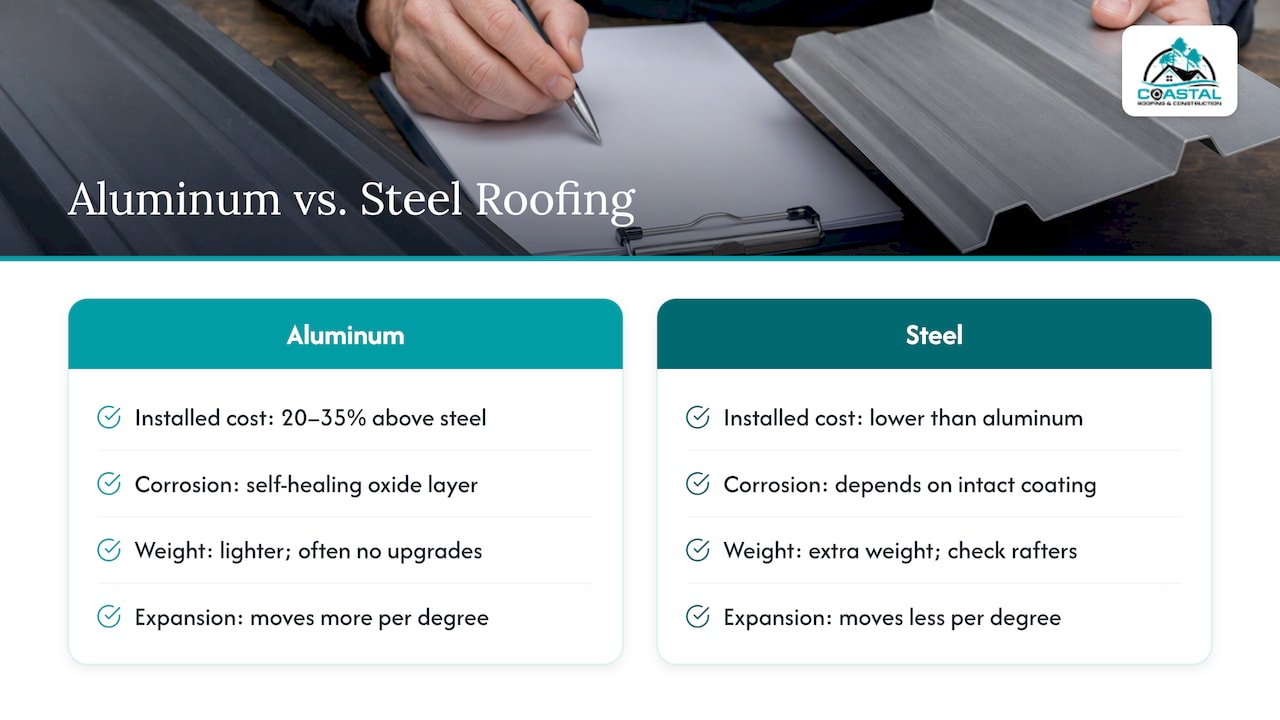
Weight differences carry real structural implications. Steel’s extra weight can require verifying rafter spacing on an older home, while aluminum’s lighter profile often reroofs over existing structure without upgrades.
Thermal reflectivity depends far more on the factory finish and color than on whether the base metal is aluminum or steel. Check the CRRC Solar Reflectance Index rating for the specific finish you’re considering rather than assuming one metal is automatically “cooler” than the other.
Thermal expansion affects both metals, but aluminum moves more per degree of temperature change. A clip system and fastener spacing engineered for that movement prevents the wavy “oil-canning” look that shows up on poorly detailed panels. Ancillaries matter just as much: mixing incompatible metals in flashings, curbs, or fasteners can trigger galvanic corrosion, so best practice calls for aluminum or stainless steel curb materials rather than welded galvanized steel.
How to Choose Between Aluminum and Steel for Your Roof
Start with your climate, not the price sheet. If you’re within a mile or two of saltwater or live in a humid coastal pocket, lean aluminum. If you’re inland with hail or heavy snow exposure, coated steel’s stiffness and lower cost usually make more sense.
Every bid you collect should spell out specific items, not just “metal roof”:
- The exact alloy or coating spec (3105 aluminum, AZ55 Galvalume, or galvanized).
- Panel thickness or gauge, matched to your hail and wind exposure.
- Fastener and clip type, confirmed compatible with the panel metal.
- Flashing and curb materials, specified as aluminum or stainless rather than mismatched galvanized steel.
- Sealant brand and expected service life.
- Finish warranty length separate from the panel warranty.
Ask prospective installers how many standing seam coastal projects they’ve completed and whether they carry manufacturer certifications for the system you’re buying. Warranty language often separates panel defects, finish fading, and coating perforation into different terms and lengths, so read each one rather than assuming “lifetime” covers everything.
Pro Tip: Request references specifically for homes in your climate zone, not just any metal roofing job. A contractor’s coastal track record tells you more than a generic portfolio.
Why Installation Quality Often Matters More Than Metal Choice
A properly chosen metal still fails early if the installer skips the details. Manufacturer-certified, factory-trained crews follow the fastening patterns, clip spacing, and sealant specs that keep warranties valid and prevent the coating or oxide layer from being compromised during installation.
The ancillaries deserve the same attention as the panels. Stainless or aluminum fasteners, compatible curb materials, and the right sealants prevent the galvanic corrosion that undercuts an otherwise good metal choice, a point we cover in more depth in our guide to coastal fasteners and finishes.
- Factory certification reduces installation defects that void manufacturer warranties.
- Compatible ancillary materials prevent galvanic corrosion between dissimilar metals.
- Complex flashing details, multiple roof penetrations, or steep slopes usually warrant an onsite inspection rather than a remote estimate.
A Practical Take on Picking Between Aluminum and Steel
Most homeowners spend too much energy hunting for the objectively “best” metal and not enough on the installer’s track record. Climate should drive your first decision, coastal sites favor aluminum’s corrosion resistance, inland sites favor steel’s value and stiffness, but the second decision, who installs it and how, often determines whether that roof reaches its full service life or fails early at a flashing seam.
Request an onsite estimate before locking in a material. A real inspection catches framing, slope, and exposure details that no general comparison can.
— Ryan
Coastal Roofing & Construction: Matching the Right Metal to Your Home
We install both aluminum and coated steel roofing systems and tailor each project around your home’s exposure, not a one-size answer. Our team is factory-trained and manufacturer-certified, which means your standing seam system goes on with the fastener patterns, clip spacing, and ancillary materials the manufacturer requires to honor the warranty.
We’re licensed, insured, and family-owned, and we’ve built our reputation on coastal metal roofing work designed to withstand salt air and summer storms. Whether you already know you want aluminum or you’re still weighing steel’s cost advantage, we’ll walk your roof and give you a straight recommendation based on your home, not a generic pitch.
- We handle standing seam metal roofing installs for custom homes, waterfront properties, and standard residential reroofs.
- Our crews are factory-trained on proper ancillary specs, flashing details, and coastal fastener choices.
- We also install tile, shingle, and flat roofing systems for homeowners comparing materials beyond metal.
If you’re planning a custom build with a complex roofline, our partners at Bayfair Custom Homes cover gable and roofline design considerations worth reviewing before you finalize your metal spec. Ready to get a straight answer for your property? Request a roof replacement estimate and we’ll walk you through the right metal for your exposure and budget.
FAQ
What are the advantages and disadvantages of a metal roof?
Metal roofing generally outlasts asphalt shingles, resists fire and wind damage well, and reflects heat better when finished with reflective coatings. The tradeoffs include a higher upfront cost than shingles, the need for correctly specified fasteners and ancillaries to avoid corrosion, and a learning curve for installers unfamiliar with standing seam systems.
What is the average price for a 3 ft by 10 ft metal roof section?
For a 30 square foot section, steel typically costs about $105 to $210 installed, based on the $3.50 to $7 per square foot range. Aluminum typically costs about $180 to $360 installed for the same area, based on the $6 to $12 per square foot range.
Does an aluminum roof rust?
No, aluminum roofing does not rust because it forms a protective oxide layer on its surface rather than relying on a separate coating. That layer reseals itself when scratched, which is why aluminum holds up well in coastal and high-salt environments.
Why don’t more houses use metal roofs?
Metal roofing costs more upfront than asphalt shingles, which remain the default for many budget-conscious builds and reroofs. Metal also requires installers experienced with standing seam systems and correct ancillary specs, and not every contractor carries that training or certification.
Is aluminum or steel better for a coastal home?
Aluminum is generally the better choice for coastal homes because it resists corrosion without depending on an intact coating, which matters in salt-heavy air. Coated steel can still work near the coast if the coating, fasteners, and ancillaries are specified correctly, but aluminum carries less long-term corrosion risk in that environment.
Sources
- Aluminum vs Steel Roofing: Cost, Lifespan & Pick
- Service Life Assessment of Low-Slope Unpainted 55% Al-Zn Alloy Coated Steel Standing Seam Metal Roof Systems (Executive Summary)
- CRRC SRI guidance / Solar Reflectance Index document
- Comparison of Metal Choices for Roofing Systems