
A metal roof “gauge” is just the panel’s thickness, and lower numbers mean thicker metal. For most homes, the real choice comes down to 24 gauge or 26 gauge: 24 for standing seam roofs, coastal exposure, or high-wind zones, and 26 for a cost-conscious install in a milder climate. Everything else, from panel profile to paint system, matters too, but gauge is where the decision starts.
TL;DR:
- A 24-gauge metal roof is generally required in high-wind or coastal areas, offering better resistance to dents, wind uplift, and oil-canning compared to 26 gauge.
- Twenty-six gauge is suitable for inland, moderate climate residential projects, providing cost savings of roughly 8 to 15 percent over 24 gauge, with adequate performance for many standard applications.
- Thicker panels like 24 gauge are more durable but often come with an increased installation cost, which becomes justified in extreme weather zones or when specific engineering standards apply.
- Aluminum panels tend to be thicker than steel in raw dimension but are softer and more prone to cosmetic dents, especially at higher gauges like 29.
- Verification of actual panel thickness should involve checking the manufacturer’s data sheet or a micrometer reading, as gauge labels alone can be misleading.
Table of Contents
- What Does Metal Roof Gauge Actually Mean?
- Which Gauge Fits Your Roof: 22, 24, 26, or 29?
- 24 vs 26 Gauge: How to Actually Decide
- Beyond Gauge: What Else Determines Roof Performance
- How to Verify the Gauge You’re Actually Getting
- How Coastal Roofing & Construction Approaches Gauge Selection
- Balancing Durability, Cost, and Curb Appeal
- Get the Right Gauge Installed the First Time
- Sources
- FAQ
What Does Metal Roof Gauge Actually Mean?
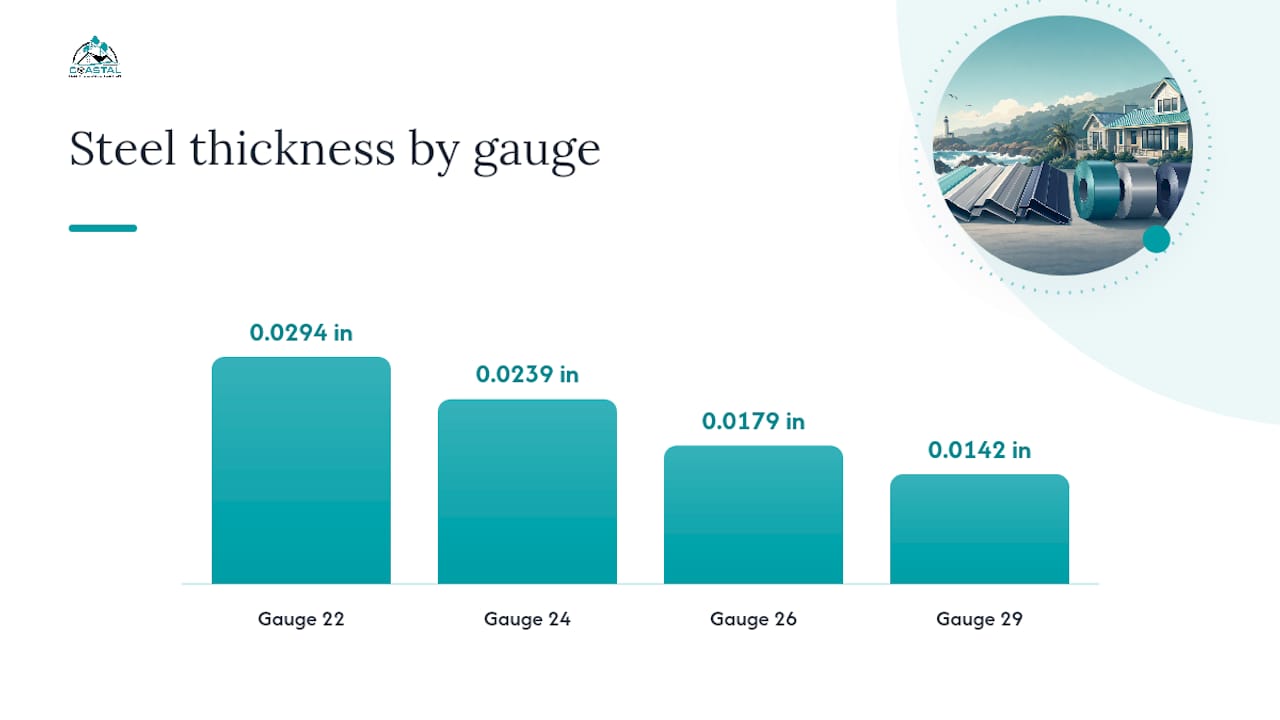
Gauge numbering feels backward the first time you see it, and that’s because it’s a legacy manufacturing measurement, not a logical scale. The number refers to how many sheets of that thickness stack up to a fixed reference dimension, so a higher gauge number means a thinner sheet. Common gauges run from 29, the thinnest, to 22, the thickest, with 24 and 26 sitting in between as the workhorses of residential roofing.
Thickness drives three things you can actually feel and see on a roof: weight, rigidity, and how well a panel resists dents from hail or debris. A thicker panel resists oil-canning (that wavy, rippled look on flat panel areas) and holds its shape better under foot traffic or wind uplift. Steel and aluminum aren’t directly interchangeable on this scale either. Aluminum panels are typically specified in decimal inches, often .032 to .040 inches for residential work, rather than steel gauge numbers, and aluminum is often thicker in raw dimension than steel yet softer and more prone to cosmetic denting.
Here’s how the common gauges stack up in decimal steel thickness:
| Gauge | Approximate Thickness (inches) | Typical Feel |
|---|---|---|
| 22 | 0.0294 | Heavy, rigid, commercial-grade |
| 24 | 0.0239 | Solid, standard for standing seam |
| 26 | 0.0179 | Lighter, common residential standard |
| 29 | 0.0142 | Thin, budget or outbuilding grade |
Which Gauge Fits Your Roof: 22, 24, 26, or 29?
Each gauge has a place, but not every gauge belongs on a primary residence. Here’s how they typically get used:
- 22 gauge: Reserved mostly for commercial and mechanically seamed systems where wind loads, foot traffic, or engineering codes demand extra rigidity. The added cost only makes sense when the application actually requires that load capacity.
- 24 gauge: The go-to for standing seam panels, coastal properties, and high-wind regions. Many engineered standing seam systems are tested and specified at 24 gauge as the minimum, which is why it shows up so often on luxury coastal homes.
- 26 gauge: The most common gauge on exposed-fastener residential panels, and it balances cost against performance well in moderate inland climates. It typically runs 8 to 15 percent cheaper than 24 gauge, which is why it’s the default for many standard installs.
- 29 gauge: Fine for a barn, shed, or agricultural building. It’s thin enough that hail, ladders, and foot traffic can leave lasting marks, so it has no business on a main residence.
24 vs 26 Gauge: How to Actually Decide
This is the comparison that matters most, because it’s the one nearly every homeowner and builder actually faces. A 24-gauge panel runs roughly 27 to 30 percent thicker than 26 gauge, and that percentage isn’t just a spec sheet number. It shows up as noticeably less oil-canning on wide flat panel runs, better resistance to dents from hail or falling limbs, and a stiffer feel underfoot during installation or maintenance walks.
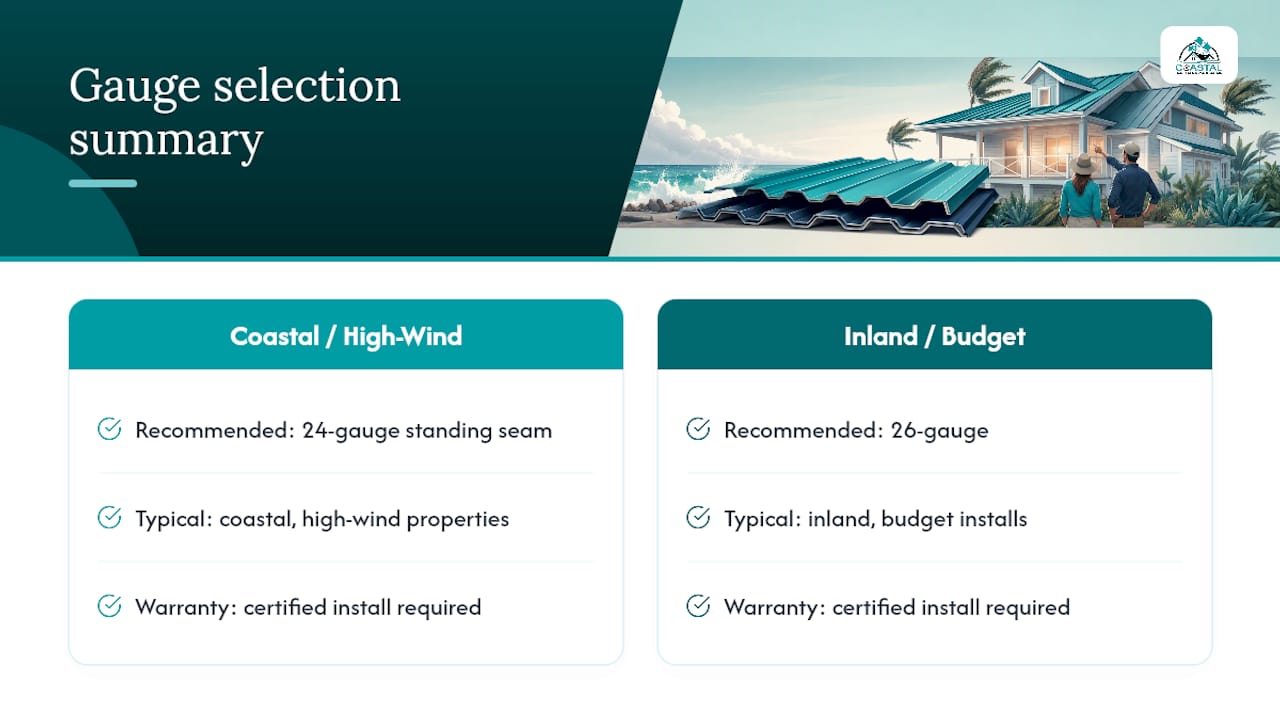
Cost tells the other half of the story. Twenty-six gauge saves money upfront, and on an inland roof with a simple profile and moderate weather exposure, that savings is real and defensible. But once you’re near saltwater, in a high-wind zone, or specifying a standing seam system with an engineered load chart, 24 gauge often becomes less of an upgrade and more of a requirement, since many manufacturers won’t publish wind-load engineering for their standing seam profiles below that thickness.
Run through this checklist before locking in a gauge:
- Panel profile: Standing seam almost always favors 24 gauge; exposed-fastener panels have more flexibility to run 26.
- Climate exposure: Coastal salt air, hail-prone regions, and high-wind counties push the decision toward 24 gauge.
- Aesthetic tolerance: If a rippled panel surface bothers you, thicker metal minimizes that risk on long, flat runs.
- Budget: If the roof is inland, low-slope wind exposure, and cost matters most, 26 gauge is a legitimate, well-tested choice.
Pro Tip: If you love the clean look of standing seam but want to control cost, ask your installer about narrower panel widths. Oil-canning risk drops significantly on shorter spans even at 26 gauge, since it’s the flat, wide areas that ripple most.
Beyond Gauge: What Else Determines Roof Performance
Gauge sets a baseline, but it doesn’t work alone. A thick panel installed poorly, or paired with the wrong finish, can underperform a thinner one installed correctly. Consider these variables alongside gauge:
- Panel profile and span: Wider, flatter panels are more prone to oil-canning regardless of gauge, while ribbed or striated profiles hide minor waviness.
- Paint system: PVDF coatings (like Kynar 500) hold color and resist chalking far longer than SMP coatings, which affects long-term curb appeal more than an extra gauge step would.
- Installer quality: Clip spacing, underlayment choice, and flashing detail work determine whether a roof performs to spec, no matter what the panel thickness says.
- Climate specifics: Salt air accelerates corrosion differently on aluminum versus steel, while snow load and thermal expansion change fastener and clip requirements in colder regions.
How to Verify the Gauge You’re Actually Getting
Marketing language on a quote isn’t a guarantee. Confirm the real thickness with these steps:
- Read the decimal thickness on the manufacturer’s product data sheet, not just the gauge label, since gauge standards can shift slightly between metal types.
- Ask for a mill certificate or take a micrometer reading on delivered panels if precision matters for your project.
- Check the paint and coating specs listed alongside the thickness, since best practice favors documented specs over vendor claims.
- Request engineering documentation for wind-load or snow-load ratings if your jurisdiction or insurer requires it.
How Coastal Roofing & Construction Approaches Gauge Selection
Ryan and the team at Coastal Roofing & Construction are manufacturer-certified installers who weigh gauge against real site conditions, not just a spec sheet. On coastal and high-wind properties, that usually means recommending 24-gauge standing seam; on inland budget-focused installs, 26 gauge often does the job. Certified installation keeps warranty coverage intact either way.
Balancing Durability, Cost, and Curb Appeal
For most homeowners, 24 or 26 gauge covers the decision, and the right pick depends on exposure and budget more than personal preference. My advice: pull the manufacturer’s data sheet before you sign anything, and get a quote from a certified installer who can walk your roof and factor in wind zone, panel profile, and slope. A site visit catches details a spec sheet never will.
— Ryan
Get the Right Gauge Installed the First Time
Choosing between 24 and 26 gauge only pays off if the installation matches the engineering behind it, and that’s where Coastal Roofing & Construction earns its keep across the Tampa Bay coastline. Certified installers specify panel gauge, profile, and finish based on a home’s wind zone and exposure, then provide installation aimed at preserving manufacturer warranties.
Whether you’re weighing a full roof replacement or specifying a new standing seam metal roof for a coastal build, request a quote and we’ll walk the roof with you before recommending a gauge. Visit our metal roofing service page or reach out to schedule an on-site inspection.
Sources
- Metal Roofing Panel Gauges Explained: 22, 24, 26, and 29 Gauge Compared | Metal America
- 24 vs. 26-gauge Metal Roofing: Which Steel Thickness Is Best For You? | Sheffield Metals
- Metal roof metals: properties and applications | InspectAPedia
FAQ
What Is Better, a 24 or 26 Gauge Metal Roof?
Neither is universally better. 24 gauge is preferred for standing seam, coastal, and high-wind installs, while 26 gauge is a cost-effective standard for moderate climates and exposed-fastener panels.
What Gauge Should My Metal Roof Be?
Most residential roofs use 24 or 26 gauge steel. Choose 24 gauge if you’re near saltwater, in a high-wind zone, or installing standing seam, and 26 gauge if you’re inland with a simpler panel profile and a tighter budget.
What Is Thicker, 26 or 29 Gauge Metal Roofing?
26 gauge is thicker than 29 gauge. Twenty-nine gauge is the thinnest common option and is generally suited to sheds and agricultural buildings rather than primary residences.
Can You Walk on a 26 Gauge Metal Roof?
Yes, but carefully. 26-gauge panels are less rigid than 24 gauge, so foot traffic should stay near supported framing and avoid concentrated weight on flat panel spans to prevent denting.
Does Coastal Roofing & Construction Install Both 24 and 26 Gauge Metal Roofs?
Both gauges are commonly specified and installed depending on home’s location, wind exposure, and panel profile, with certified installation intended to preserve manufacturer warranty coverage.