
For homes within a few blocks of salt spray, aluminum standing seam with a PVDF or Tedlar-protected finish and marine-grade fasteners is the safest long-term choice. Farther inland, Galvalume with a high-quality PVDF finish holds up well and costs less. The one rule that overrides every other decision: match your metals and use 316 stainless fasteners, because mixing dissimilar metals is what actually kills coastal roofs. The sections below cover materials, coatings, fastening, wind ratings, maintenance, and warranties in that order.
TL;DR:
- Within 1,500 feet of breaking surf, aluminum standing seam with PVDF coating and 316 stainless fasteners is essential for durability.
- Distant inland, Galvalume with PVDF remains suitable, but fasteners and flashings must still avoid dissimilar metals.
- Proper fastener choice and matching metals, especially near water, are critical to prevent corrosion and early failure.
- Coastal exposure varies based on wind direction, elevation, and vegetation, requiring more conservative material specs if in doubt.
- Regular maintenance, including annual inspections and water rinses, extends the lifespan of coastal metal roofs up to 40-50 years when properly specified.
Table of Contents
- Recommended Materials at a Glance for Coastal Metal Roofing
- Materials Compared: Aluminum, Galvalume, Stainless, Copper, and Zinc
- What Coatings Actually Protect Against Salt and UV
- Profiles and Fasteners: Where Most Coastal Roofs Actually Fail
- How Close to the Water Changes What You Should Buy
- Wind Ratings and Building Codes for Coastal Roofs
- Maintenance and Realistic Lifespan on Salt-Air Roofs
- Warranties and Documents to Request Before You Sign
- What Coastal Roofing & Construction Sees in the Field
- Why Distance-Based Specification Beats Generic Advice
- Get a Coastal-Ready Metal Roof Specified Right the First Time
- Sources
- FAQ
Recommended Materials at a Glance for Coastal Metal Roofing
Before you call a contractor or start pricing panels, know your zone. Distance from the water changes almost everything about what you should specify, and getting it backward is the single most expensive mistake homeowners make on this decision.
Here’s the quick version:
- Within roughly 1,500 feet of breaking surf: aluminum standing seam, PVDF or Tedlar film finish, aluminum-compatible flashings, and 316 stainless steel fasteners throughout.
- 1,500 feet to about one mile: Galvalume with a PVDF finish is generally acceptable, provided fasteners and flashings still avoid dissimilar-metal contact.
- Beyond a mile: standard Galvalume products with a quality paint system perform well and cost less.
- Fasteners: 316 stainless near the water; 304 stainless can work farther inland, but never mix carbon steel screws with aluminum panels.
- Profile: concealed-clip standing seam outperforms exposed-fastener panels in wind uplift and long-term watertightness, which matters more the closer you sit to open water.
The cost gap between these tiers is real but often smaller than homeowners expect. Aluminum systems typically run higher upfront than Galvalume, but the lifecycle math tends to favor aluminum in the harshest zones once you account for avoided repairs, repainting, and the fastener corrosion that plagues underspecified roofs. A roof that lasts 40 to 50 years instead of 20 to 25 changes the math on a waterfront property fast, especially when replacement means scaffolding, tear off, and disruption to a home you actually live in.
If your property sits somewhere between two zones, in a bay pocket, or gets hit by unusual crosswinds off open water, the smarter move is to spec one tier more conservative than the map suggests.
Materials Compared: Aluminum, Galvalume, Stainless, Copper, and Zinc
Every metal roofing substrate handles salt air differently, and the differences aren’t cosmetic. They determine whether your roof lasts 20 years or 50.
Aluminum resists corrosion because it forms a thin oxide layer that essentially seals itself the moment it’s exposed to air. That layer doesn’t wear away in salt spray the way painted steel can, which is why Galvalume vs Aluminum Roofing for Coastal Homes identifies aluminum as the safer substrate in the closest salt-spray zones. It doesn’t depend on a sacrificial coating to protect a steel core. It’s also lighter and easier to form into standing seam profiles, though it dents more easily than steel under impact.
Galvalume, a coated steel made of roughly 55% aluminum, 43.4% zinc, and 1.6% silicon, protects its steel core through a sacrificial coating rather than an inert surface. That coating does the corrosion fighting for the steel underneath, and it works well outside the harshest salt zones when paired with a strong PVDF finish. Push it too close to breaking surf, though, and the coating degrades faster than manufacturers design for.
Stainless steel, specifically 316 grade, is essentially inert to chloride exposure and is the gold standard for fasteners, flashing, and trim in severe exposure zones. It’s rarely used for full roof panels because of cost, but for hardware, it’s non-negotiable within the closest zones.
Copper and zinc develop a protective patina over time and can outlast every other option on this list, sometimes exceeding a century of service. They’re premium choices, both in price and aesthetic, and make sense on architecturally significant homes where the cost is justified by design intent rather than pure performance need.
A red flag worth knowing: some contractors present “coated steel” as interchangeable with aluminum in near-shore installations. It isn’t. A sacrificial coating eventually sacrifices itself, and in the Coastal Corrosion Risk Guide, salt deposition decays sharply with distance. That’s exactly why the thresholds in this article exist.
What Coatings Actually Protect Against Salt and UV
The substrate matters, but the finish on top of it determines how the roof looks in year 15 and whether it holds color instead of fading to chalk.
PVDF finishes, sold under names like Kynar 500 and Hylar 5000, are the industry benchmark. A true PVDF system contains at least 70% PVDF resin, and that concentration is what gives it superior color retention and chalking resistance compared to lower-grade paint systems. On a coastal roof, where UV exposure and salt combine to degrade cheaper finishes fast, this isn’t a cosmetic upgrade. It’s the difference between a roof that looks new at year 20 and one that looks tired at year 8.
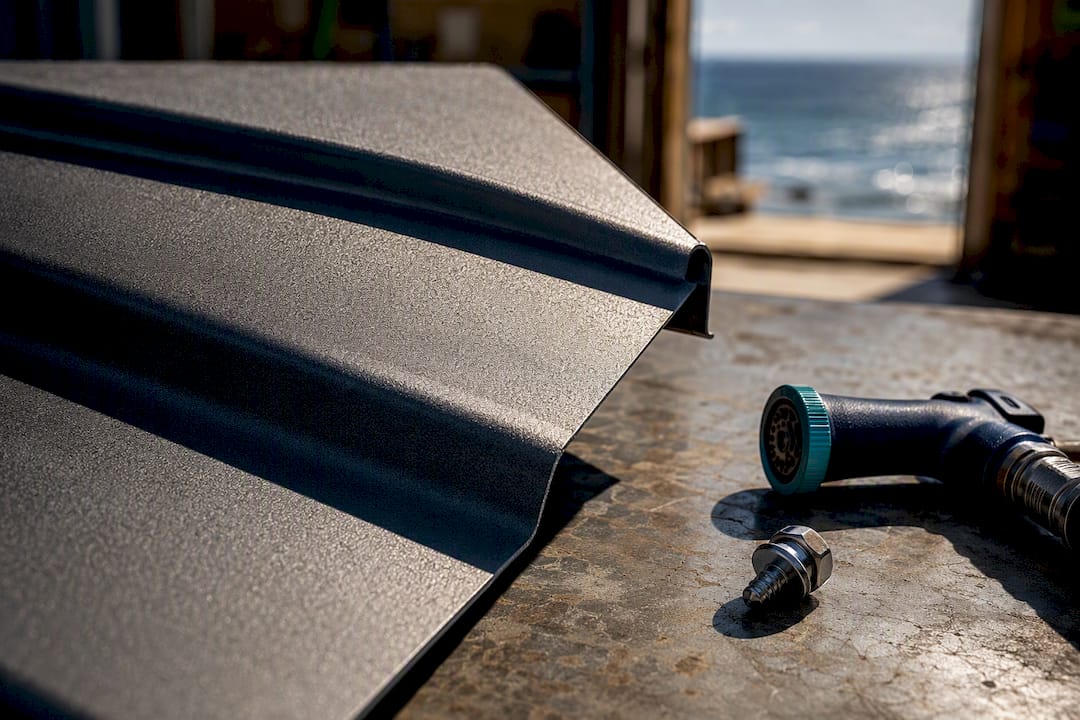
Tedlar® PVF film, laminated over a Galvalume substrate as seen in products like COASTALUME™, takes a different approach. Rather than a sprayed-on paint layer, it’s a factory-applied film bonded to AZ60 Galvalume steel, engineered specifically for coastal exposure and warrantied to that standard.
A few things worth knowing before you sign anything:
- SMP (silicone-modified polyester) and standard polyester finishes cost less upfront but chalk and fade faster, and most manufacturers rate their coastal service life well below PVDF.
- Ask specifically for the resin percentage in any “PVDF” quote. Anything under 70% isn’t a true PVDF system regardless of the marketing language.
- Demand written finish warranty language that spells out distance clauses and any required rinse schedule. A warranty that’s silent on coastal exposure usually means it doesn’t apply to yours.
Profiles and Fasteners: Where Most Coastal Roofs Actually Fail
Panel profile and fastener choice decide whether your roof survives its first major hurricane season, and they’re where installation quality matters more than material quality.
Concealed-clip standing seam systems consistently outperform exposed-fastener panels in wind uplift testing because the clips distribute load across the panel rather than concentrating stress at individual screw points, a distinction confirmed in coastal metal roofing performance data. Exposed fasteners, by contrast, create hundreds of penetration points where sealant eventually fails and salt-laden moisture finds a way in.
Here’s what to verify before installation starts:
- Fastener grade matches exposure zone. 316 stainless near the water, 304 acceptable farther inland, never plain carbon steel on a coastal job.
- No dissimilar-metal contact. Copper flashing against aluminum panels, or Galvalume trim against a stainless clip, sets up galvanic corrosion that eats through the less noble metal.
- Clip spacing matches the wind zone, not a generic inland spec sheet.
- Seam type is confirmed on the shop drawings, not assumed from a sales brochure.
Field data from coastal roofing specialists consistently points to one root cause of early failure: the wrong fasteners or incompatible metals, not the panel material itself.
Pro Tip: Walk the site with your contractor before signing anything and ask them to point out exactly which fastener and flashing metals they plan to use where two different materials meet. If they can’t answer specifically, get a second bid.
How Close to the Water Changes What You Should Buy
Salt doesn’t stop at some invisible line. It decays with distance from the water, and that decay curve is the entire basis for zone-based specification.
Most coastal guides use three rough bands: within about 1,500 feet of breaking surf (severe exposure), 1,500 feet to a mile (high exposure), and beyond a mile (moderate to low exposure), a framework detailed in the Coastal Corrosion Risk Guide. These aren’t arbitrary. Airborne chloride concentration measured near shorelines drops off fast as you move inland, and salt deposition is a well-documented factor in coastal exposure assessments from NOAA’s Office for Coastal Management.
But raw distance isn’t the whole story. A few local factors can shift your real exposure up or down:
- Prevailing wind direction can push salt spray much farther inland than distance alone suggests, especially on exposed points.
- Elevation matters. A home on a bluff catches more airborne salt than one tucked behind a dune at the same distance from water.
- Bay-facing homes generally see less severe exposure than open-ocean-facing ones, even at the same distance.
- Dense vegetation between the roof and the water can meaningfully reduce salt deposition.
If you’re unsure which zone applies, spec one tier more conservative. The incremental material cost is usually small compared to replacing a roof a decade early.
Wind Ratings and Building Codes for Coastal Roofs
A roof’s wind rating isn’t a single number on a spec sheet. It’s the product of substrate, seam type, clip spacing, and fastener pattern all working together, tested as a system rather than as individual parts.
Standing seam systems with concealed clips achieve higher tested uplift ratings than exposed-fastener panels, largely because the clip design distributes wind load rather than concentrating it at fastener points. That matters directly for code compliance in hurricane-prone areas, where local building departments require documented product approvals tied to design wind speed.
Before signing a contract, ask your contractor for:
- The product approval or test report (often a Miami-Dade NOA or Florida Product Approval number) that matches the exact panel, clip, and fastener combination being installed, not a generic version of the product.
- The installation envelope, meaning the clip spacing and fastener pattern the tested rating actually requires.
- Written confirmation that the permit and code compliance documentation matches your specific wind zone and exposure category.
A test report for a different clip spacing or panel gauge than what’s going on your roof is close to meaningless. Insist on the exact match.
Maintenance and Realistic Lifespan on Salt-Air Roofs
Even the best coastal spec needs upkeep, but the upkeep is lighter than most homeowners assume.
Here’s a realistic cadence:
- Annual inspection, plus a walk-through after any major storm to check for lifted panels, damaged flashing, or fastener backing out.
- Fresh-water rinse two to four times a year in severe exposure zones, using a garden hose rather than a pressure washer, which can strip finish or force water under seams.
- Check fastener heads and flashing joints specifically for early rust streaking, which usually signals the wrong fastener grade was used somewhere.
Watch for chalking on the finish, sealant that’s gone brittle around penetrations, and any staining that suggests two incompatible metals are in contact somewhere on the roof.
Service life varies widely by choice. A well-specified aluminum standing seam with PVDF can reasonably run 40 to 50 years in severe exposure. Galvalume with PVDF in moderate zones often lands in the 30 to 40 year range. Underspecified systems, wrong fasteners, painted steel too close to the surf, can fail in a fraction of that time regardless of what the brochure promised. Our metal roof maintenance checklist walks through the inspection points in more detail.
Pro Tip: Keep dated photos from every rinse and inspection. If a warranty claim ever comes up, documented maintenance is often the deciding factor in whether a manufacturer honors coastal coverage.
Warranties and Documents to Request Before You Sign
Coastal metal roof warranties come in three separate layers, and confusing them is how homeowners end up unprotected: the substrate warranty (covering rust-through or perforation), the finish warranty (covering chalking, fading, and color retention), and the workmanship warranty (covering installation quality, which comes from the contractor, not the manufacturer).
Coastal exclusions hide in the fine print more often than homeowners expect. Some finish warranties cap coverage at a specific distance from breaking surf, up to 300 feet for certain products, and require documented rinse maintenance to stay valid. Miss that requirement and the warranty can be voided entirely.
Before you sign, request:
- The technical data sheet for the exact panel and finish, not a general product brochure.
- Written finish specification, including PVDF resin percentage or film type.
- Test reports matching your specific wind zone.
- A written coastal warranty statement confirming your property’s distance from the water is covered.
Insist your contract names the specific fastener grade, the exposure statement for your site, and clear acceptance criteria for finish appearance at handoff.
What Coastal Roofing & Construction Sees in the Field
Manufacturer-certified installation matters more on coastal jobs than almost anywhere else, because the failure modes aren’t visible until years later. Coastal Roofing & Construction’s crews are factory-trained through certifications including Tri County Metals, which shapes how we spec every standing seam job along the Gulf Coast.
The mistakes we catch most often on inspections of other contractors’ work: mismatched fasteners driven straight through aluminum panels, copper flashing set against Galvalume trim, and finish grades sold as “premium” that turn out to be standard polyester once you check the data sheet. Every one of these is preventable with the right documentation up front.
On our own coastal projects, we document exposure zone, fastener grade, and finish spec in writing before installation starts, and we confirm the manufacturer’s coastal warranty terms match the site’s actual distance from the water rather than assuming coverage applies.
Why Distance-Based Specification Beats Generic Advice
The roofing industry loves blanket statements: “metal roofs last 50 years,” “aluminum is always better,” “Galvalume is fine everywhere.” None of that holds up once you’re within a mile of open water, and the gap between generic advice and site-specific specification is exactly where premature roof failures come from.
What the research actually supports is narrower and more useful: distance from salt water predicts corrosion risk better than almost any other single factor, and the fix is choosing substrate, finish, and fasteners to match that specific distance rather than a national average. Most homeowners get this backward. They shop by price per square foot first and exposure zone second, when it should be the other way around.
If there’s one thing worth prioritizing above all else, it’s fastener and flashing compatibility. A homeowner can overspend on a premium aluminum panel and still watch the roof fail early because a contractor used the wrong screws. That’s not a materials problem. It’s a specification and installation discipline problem, and it’s the one variable most sales conversations skip entirely.
— Ryan
Get a Coastal-Ready Metal Roof Specified Right the First Time
Reading about corrosion zones and fastener grades is one thing. Getting a written, site-specific specification is another, and that’s where Coastal Roofing & Construction earns its keep. As a roofing contractor, crews spec standing seam systems against a property’s actual exposure zone, not a generic sales sheet, and document every material choice in writing before work starts.
A consultation with our team starts with a site exposure assessment: how close you sit to open water, what your prevailing wind exposure looks like, and what that means for substrate, fastener grade, and finish. From there, you get a written specification, a realistic timeline, and confirmed coastal warranty terms before a single panel goes on the roof. Browse our standing seam metal roofing services or look through recent roof replacement projects in the area. If you’re planning a broader coastal home update, our partners at One Day Doors & Closets cover coastal design details worth pairing with a new roof. When you’re ready, request a metal roof assessment and get a specification built for your exact spot on the coast.
Sources
- NOAA Office for Coastal Management
- COASTALUME™ coated steel — U. S. Steel
- Coastal Corrosion Risk Guide — Gulf Coast Metal Roof Guide
- Galvalume vs Aluminum Roofing for Coastal PBC Homes — 561roofers
FAQ
What Type of Metal Roofing Is Best for Coastal Areas?
Aluminum standing seam with a PVDF or Tedlar film finish is generally the safest choice within about 1,500 feet of breaking surf, since aluminum doesn’t depend on a sacrificial coating. Galvalume with a strong PVDF finish works well farther inland.
What Is the Average Price for a 3 ft by 10 ft Metal Roof Section?
Pricing varies significantly by substrate, finish, and region, and a section that small isn’t typically quoted on its own since coastal metal roofing is priced per square and installed as a full system. Ask a local contractor for a site-specific quote based on your exposure zone and chosen material.
What Is the Biggest Problem With Metal Roofs Near the Coast?
The most common failure comes from mismatched fasteners or flashing metals causing galvanic corrosion, not from the roofing panel material itself. Using 316 stainless fasteners and avoiding dissimilar-metal contact prevents most of this.
How Much Does a 2,000 Sq Ft Metal Roof Cost?
Cost depends heavily on substrate and finish, with aluminum PVDF systems commanding a premium over standard Galvalume, and coastal-grade fasteners and flashing adding to the total. A written, site-specific quote from a manufacturer-certified installer is the only reliable way to price your exact specification.