
Yes, you can usually get a metal roof approved by your HOA, but only if the product and your submission line up with the association’s written standards or the board’s adopted specifications. Most rejections trace back to two things: a homeowner who skipped the paperwork trail, or an HOA that leaned on vague “aesthetic harmony” language instead of a real rule.
Before you call a contractor or pick a color, do this first: pull your recorded CC&Rs, the separate Architectural Guidelines if your community has them, and the ARC or Architectural Modification Request (AMR) form. Those three documents tell you what’s actually required, not what a neighbor assumes is required.
Once you have them in hand, move through this short list:
- Gather manufacturer product specs and a written quote from a licensed roofing contractor.
- Request or prepare a full-size sample panel and physical color chips, not just a digital swatch.
- Note the exact date you plan to submit, and pick a delivery method (certified mail or dated email) you can point to later if the HOA misses its response deadline.
- Read your governing documents cover to cover, specifically the roofing and exterior-materials sections.
- Confirm whether your ARC operates independently or needs full board ratification for major changes.
- Start your submission packet while the paint is still wet on your contractor quote, timelines slip fast once the board gets involved.
Key Takeaways
Getting a metal roof approved by your HOA comes down to matching a tested, documented product to your community’s written standards and giving the ARC nothing to question.
| Point | Details |
|---|---|
| Pull your governing documents first | Get the recorded CC&Rs, Architectural Guidelines, and ARC/AMR form before contacting a contractor. |
| Build a complete packet | Include product approvals, a full-size sample panel, color chips, and a home rendering to avoid delays. |
| Track your deadline | Submit by certified mail or dated email and calendar the response window in your CC&Rs. |
| Demand written denials | Request a denial that cites the specific CC&R or Guideline section, then appeal to the full board if it’s missing. |
| Never install before approval | Skipping ARC sign-off or permits risks fines, forced removal, and liens regardless of how strong your case is. |
| Work with a certified installer | Coastal Roofing & Construction prepares ARC documentation and installs to match manufacturer-tested assemblies across the Tampa Bay area. |
Table of Contents
- How HOAs Get (and Don’t Get) Power Over Your Roof
- Why Metal Roofing Wins Over an ARC Once You Show the Numbers
- Complete ARC Submission Checklist for a Metal Roof Request
- Picking a Profile, Color, and Manufacturer the Committee Will Approve
- Coordinating With Your Contractor and the Manufacturer
- How Long Approval Takes and What Happens If the HOA Misses Its Deadline
- If Your ARC Denies the Request: Your Appeal Playbook
- Why Skipping ARC Approval or Permits Is a Costly Mistake
- Technical Reference Sheet for Your ARC Packet
- What a Contractor Wishes Every Homeowner Knew Before Filing
- How Coastal Roofing & Construction Supports Your ARC Application
- Sources
How HOAs Get (and Don’t Get) Power Over Your Roof
An HOA’s authority to approve or deny your metal roof comes from one place: the recorded Covenants, Conditions, and Restrictions, plus any Architectural Guidelines the board has separately adopted. If a rule isn’t written down somewhere in those documents, the board is on shaky ground enforcing it, no matter how firmly a committee member insists metal roofs “don’t fit the neighborhood.”
This distinction matters more than most homeowners realize. A CC&R clause that says roofing materials must be selected from an enumerated approved list, or that explicitly excludes metal panels, gives the HOA real teeth. A clause that just says exterior changes must “maintain the visual harmony of the community” is far weaker, and courts and HOA dispute resources have repeatedly noted that vague aesthetics language alone is often insufficient to sustain a denial.
The Architectural Review Committee, sometimes called the ARC or the architectural modification committee, typically operates under authority delegated to it by the board through the governing documents. It reviews applications, checks them against the written standards, and either approves, denies, or kicks the decision up to the full board for larger or contested requests. The committee doesn’t get to invent new rules on the spot, its job is to apply the ones already on paper.
Florida homeowners have an extra layer of protection worth knowing about. Under Florida’s HB 293, which took effect in May 2024, HOAs must adopt written hurricane protection specifications and cannot deny a qualifying hurricane protection measure, including a compliant metal roof, if it meets those specifications and applicable building codes. The board can still regulate appearance, but the rules have to be written down and applied consistently.
An HOA’s authority is only as strong as the words in its governing documents. No specific citation, no enforceable denial.
Pro Tip: Always ask for any denial in writing, and insist it cite the exact CC&R or Guideline section the board relied on. If they can’t produce one, you likely have grounds to challenge the decision.
Why Metal Roofing Wins Over an ARC Once You Show the Numbers
Committees don’t approve products because they sound modern, they approve them because the paperwork backs up the claims. When you build your packet, lean on the facts an ARC can independently verify rather than general marketing language.
- Wind uplift and design pressure (DP) ratings that meet or exceed your county’s building code requirements.
- Class A fire rating, which matters in wildfire-adjacent or dense-canopy communities.
- A 40 to 70 year service life claim backed by the manufacturer’s own warranty documentation.
- Reflective coatings that reduce attic heat gain and lower cooling costs, a point that resonates with boards focused on long-term maintenance costs.
- Compliance with hurricane protection standards where local storm exposure is a known community concern.
Boards that sit in hurricane-exposed regions respond especially well to wind and impact performance data, since a metal roof failure during a storm becomes the HOA’s problem too when debris damages neighboring properties. Keep every claim tied to a document you can hand over, a spec sheet, a test report, a warranty card. Adjectives don’t move committees. Certifications do.
Complete ARC Submission Checklist for a Metal Roof Request
A weak submission gets tabled for “more information,” which restarts your clock. A complete one gets a decision. Build your packet around these categories.
Administrative documents:
- Completed AMR or ARC application form with your full contact information and parcel details.
- Copy of your contractor’s license and current insurance certificate.
- A written project timeline, from expected start date to substantial completion.
- Proof of your building permit application, or a note that permitting will follow HOA approval.
Product and technical documentation:
- Manufacturer product approval documentation, such as ICC-ES reports, Miami-Dade NOA, or Florida Product Approval numbers tied to the exact panel profile you’re installing.
- DP or wind rating test reports specific to that product and fastening pattern.
- Manufacturer installation instructions and the written warranty terms.
Samples and visuals:
- A full-size sample panel, often 24 inches, since many community guidelines explicitly require a full-width sample for physical review rather than a photo or a swatch card.
- Physical color chips matched to the manufacturer’s published palette.
- A rendering or visualization showing the proposed roof on your actual home, not a stock photo of a similar house.
- Two or three photos of comparable installations, ideally from nearby homes or similar architectural styles.
Contractor documentation:
- Signed scope of work with clearly stated start and finish dates.
- Proof of manufacturer-certified installer status, when the product line offers that certification.
Submission logistics: package everything into a single PDF where possible, deliver it by both email and certified mail, and explicitly request a written response by the deadline stated in your governing documents. Attach a one-page cover letter stating the product, manufacturer, approval numbers, and a line confirming the proposal complies with the community’s adopted standards.
Two short templates help here. Your packet cover checklist should list every document by name with a checkbox, so the committee sees at a glance that nothing is missing. Your AMR cover letter can be as simple as: “This request proposes installation of [manufacturer/product], approved under [ICC-ES/NOA/Florida Product Approval number], meeting or exceeding the wind and fire performance standards referenced in Section [X] of the Architectural Guidelines. A full-size sample panel and color chips are enclosed for committee review.”
Pro Tip: Number every page of your packet and reference those numbers in your cover letter. Committees review a lot of paperwork, and a well-labeled submission gets less pushback simply because it’s easier to follow.
Picking a Profile, Color, and Manufacturer the Committee Will Approve
Not every metal roof looks the same, and that’s your advantage. If your community’s Guidelines favor a traditional look, a stone-coated metal shingle or tile-profile panel often clears review faster than a standing seam panel, purely on visual grounds. Match the roofline pitch and shadow lines of neighboring homes wherever the product line allows it.
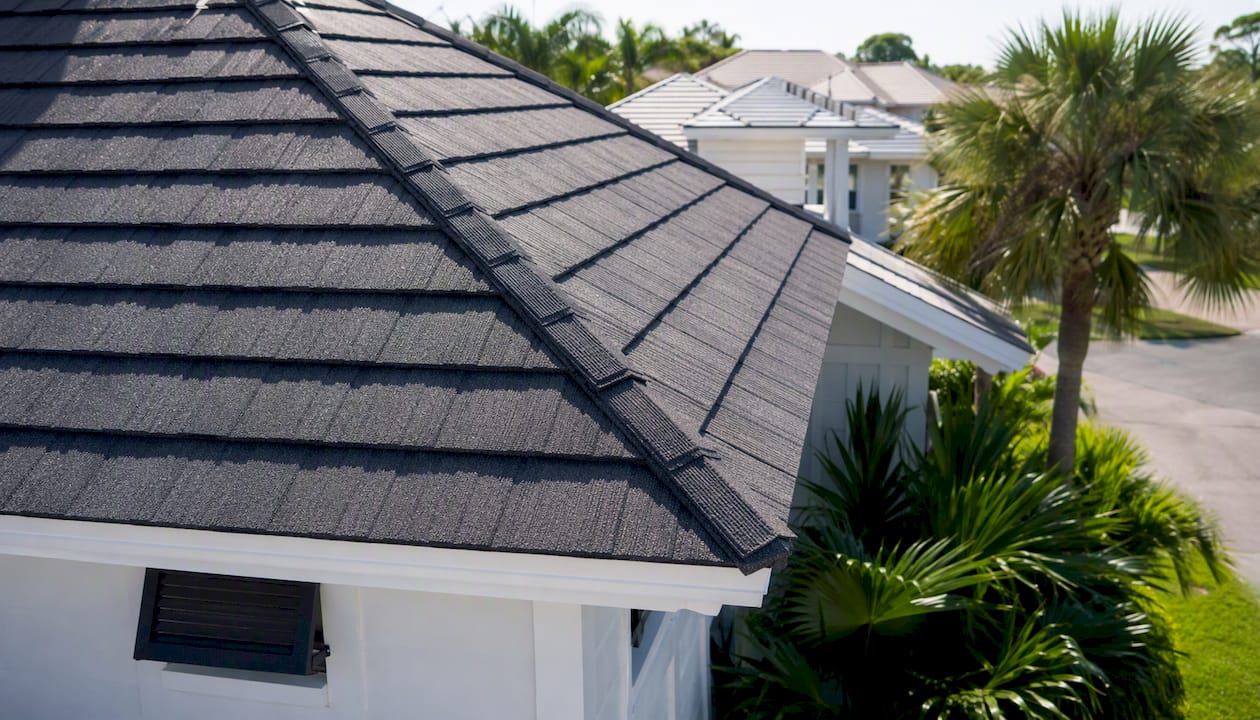
Color choice matters just as much as profile. Boards tend to approve subdued, low-reflectivity tones (charcoal, weathered bronze, muted terracotta) over bright or high-contrast colors, even when the underlying product is identical. If your community already has a list of board-approved colors for other materials, ask whether the metal manufacturer offers a close match, that single detail can turn a contested review into a rubber stamp.
Whatever profile and color you choose, make sure it corresponds to an actual tested assembly with its own approval documentation. Manufacturer visualizer tools and product literature with color renderings have proven effective at helping committees picture the finished result rather than guessing from a spec sheet, and that same documentation is often exactly what the ARC will ask you to attach.
Committees approve what they can picture. A rendering that shows your actual house, not a generic sample photo, does more to move a vote than another page of technical specs.
One warning that gets overlooked: if the HOA asks for a nonstandard attachment method, an unusual color coating, or a modified fastening pattern to satisfy an aesthetic preference, check with the manufacturer before agreeing. Deviating from the tested, warrantied assembly can void your product warranty even if the change satisfies the board.
Pro Tip: Ask your contractor for the manufacturer’s exact approved color and profile list before you fall in love with a look. It’s much easier to pick from what’s already tested and warrantied than to request an exception later.
Coordinating With Your Contractor and the Manufacturer
The ARC packet is only half the job. The other half is making sure what actually goes on your roof matches every document you submitted, because a mismatch between the tested assembly and the installed one creates problems for your warranty, your wind rating, and your standing with the committee if there’s ever a post-installation inspection.
Start with the installer’s credentials:
- Confirm active state contractor licensing and current liability insurance.
- Verify manufacturer-certified training specific to the panel profile you’re installing, not just general metal roofing experience.
- Ask for two or three references from installations using the identical product and assembly.
Photo documentation protects everyone. Before the crew touches the deck, photograph the substrate condition. During installation, photograph clip and fastener spacing at intervals, since these details determine your actual wind rating regardless of what the box says. Stage a photo of the sample panel next to the finished section so the ARC (or a future buyer’s inspector) can confirm the installed product matches what was approved.
This isn’t paperwork for paperwork’s sake. Installation manuals from major manufacturers explicitly define attachment details, clip spacing, and flashing requirements that determine whether the assembly performs at its tested rating, and deviating from those specs, even slightly, can knock a roof out of its DP rating category. The ARC’s aesthetic preferences should never override those installation requirements, if a committee member asks for something that conflicts with the manufacturer’s tested details, that’s a conversation for your contractor, not a compromise you make on-site.
Pro Tip: Ask your installer for a written installation checklist, then attach it to your ARC packet. Committees respond well to seeing exactly how quality will be verified before the first panel goes up.
How Long Approval Takes and What Happens If the HOA Misses Its Deadline
Most ARC reviews land somewhere in the 30 to 60 day range, assuming your packet is complete on the first submission. Requests that need full board approval, involve a variance, or get flagged for additional documentation can stretch to 60 or 90 days. Build that buffer into your renovation timeline before you commit to a contractor start date.
Document everything from the moment you submit. Note the exact delivery date, keep your certified mail receipt or your email send confirmation, and calendar a follow-up date if you haven’t heard back by the stated deadline in your governing documents.
Here’s the part most homeowners don’t know: many CC&Rs, and some state statutes, include automatic approval or “deemed approval” clauses that trigger if the board or ARC fails to respond within its own stated window. If your documents include this language and the deadline passes with no written response, you have a real argument that your request is automatically approved, but you need to invoke it in writing, not just assume it.
A short follow-up letter works well here: “Our submission dated [date] was delivered via [method] and remains without a written response as of [date], exceeding the [X]-day review period specified in Section [X] of the Architectural Guidelines. Please confirm in writing whether this request is deemed approved under that provision, or provide the committee’s specific written objection.”
Pro Tip: Set a calendar reminder for the day your response window closes. Boards rarely track their own deadlines as carefully as you should track them for them.
If Your ARC Denies the Request: Your Appeal Playbook
A denial isn’t the end of the process, it’s the start of a different one. The first move is always the same: request the denial in writing, and insist it cite the specific CC&R or Guideline section the board relied on. A verbal “the committee doesn’t think it fits” is not a denial you can act on or appeal against.
- Send a short, specific request: “Please provide the written denial of my [date] submission, including the exact document, section number, and quoted language the committee relied upon.”
- Compare the cited language against your original packet. Often the denial cites a concern, like color or profile, that your submission already addressed with a sample or rendering.
- Gather whatever documentation the denial says was missing and resubmit, or move directly to a formal appeal if the citation itself looks weak or nonexistent.
- Request a hearing before the full board, bringing your product approvals, sample panel, and any comparable-home photos you didn’t include the first time.
Lack of a specific documentary basis is the single biggest weakness in most HOA denials. If the board can’t point to exact language, their position rarely holds up.
Beyond the board appeal, homeowners have a few escalation paths depending on where they live. Some states have statutes specifically protecting certain roofing upgrades, Texas Property Code § 202.011 addresses shingle roofing variances, for example, and Florida’s HB 293 does similar work for hurricane protection measures that meet code. Mediation through a state’s HOA dispute resolution program is usually faster and cheaper than litigation, and an attorney consultation makes sense once you’re facing a denial that seems to conflict with your state’s statutory protections.
One practical note that saves homeowners real money: don’t install before your appeal is resolved. Installing first and appealing later weakens your position on every front, legal, financial, and practical, and it hands the board an easy argument that you acted in bad faith regardless of how strong your underlying case is.
Why Skipping ARC Approval or Permits Is a Costly Mistake
Installing without approval feels tempting when a project has already dragged on for months. It’s also one of the more expensive mistakes a homeowner can make in this process.
- Formal violation notices, which typically come with a compliance deadline and escalating fines for each day the violation continues.
- Forced removal and reinstallation at your own expense if the board wins enforcement, meaning you pay for the same roof twice.
- Liens placed against your property for unpaid fines or association legal costs.
- Litigation risk if the dispute escalates and the HOA pursues a court order for compliance.
HOA approval and a municipal building permit are two entirely separate requirements, and getting one does not exempt you from the other. Your local building department still needs to review and permit the installation regardless of what your ARC decided, skipping that step risks a stop-work order even on a project the HOA fully blessed.
The safest sequence is boring but reliable: submit, wait for a written response, appeal if necessary, and only then schedule installation. Every shortcut around that order shifts risk onto you.
Technical Reference Sheet for Your ARC Packet
Committees and building officials both look for specific proof points, and having them organized in one place speeds up review on both fronts.
- DP (design pressure) rating documentation from certified test reports specific to your panel and fastening pattern, not a generic manufacturer brochure number.
- Assembly-level approval, meaning ICC-ES reports, Miami-Dade NOA, or Florida Product Approval numbers tied to the exact combination of panel, clips, and underlayment you’re installing, since component approvals and full-assembly approvals are not interchangeable.
- Photo documentation covering the substrate before installation, clip and fastener spacing during installation, flashing details at valleys and penetrations, and finished conditions at eaves and ridges.
- Confirm the exact product model and profile match the approval number on file, not just the manufacturer’s general product line.
- Verify the FORTIFIED technical bulletin’s requirement that the installed assembly match the tested assembly exactly, since any deviation can disqualify the home from that designation and complicate insurance discounts tied to it.
- Keep a copy of the installation manual referenced in your product’s approval documentation, in case the ARC or a future inspector asks how a specific detail was executed.
What a Contractor Wishes Every Homeowner Knew Before Filing
The single biggest predictor of a smooth ARC review isn’t the product you choose, it’s how completely you document it. Committees rarely reject metal roofing on principle anymore, they reject incomplete submissions and then get accused of bias against the material itself.
Boards made up of volunteers, most of whom have no roofing background, respond to things they can see and touch. A full-size sample panel outperforms a spec sheet every time, because it turns an abstract material decision into a concrete one. A photo of a similar metal roof three doors down does more to calm aesthetic concerns than any paragraph of marketing copy ever will. And a certified product approval number, cross-checked against the exact profile being installed, closes the door on the “we’re not sure this meets code” objection before anyone raises it.
The friction point that trips up otherwise well-prepared homeowners is timing. They submit a beautiful packet, then get frustrated when the board takes six weeks to respond and assume something’s wrong. Nothing’s wrong, that’s often just how long volunteer committees take, especially for a material outside their usual review pattern. Building that delay into your renovation schedule from day one avoids a lot of unnecessary stress and prevents rushed decisions later.
If there’s one diplomatic move that pays off consistently, it’s requesting an informal conversation with a committee member before the formal submission. Asking what concerns they anticipate, and addressing those concerns directly in your packet, turns the formal review into a confirmation rather than a negotiation.
How Coastal Roofing & Construction Supports Your ARC Application
Preparing a complete ARC packet while also vetting contractors and comparing metal panel profiles is a lot to manage on top of a full-time job and a family schedule. Coastal Roofing & Construction handles the technical half of that equation directly, pulling the correct product approval documentation, providing full-size sample panels, and supplying the manufacturer-certified installation photos your committee will ask to see.
Because the team holds manufacturer certifications with Tri County Metals and works throughout Pinellas, Hillsborough, and Pasco counties, every standing seam or architectural metal roof installed carries documentation that matches the tested assembly your ARC packet references, not a mismatched substitute that jeopardizes your warranty or your wind rating. That coordination also extends to permitting, since your local building department requires its own review regardless of what your HOA decides.
If you’re weighing metal roofing options for a Tampa Bay area home currently under HOA or ARC review, request a consultation and product walkthrough. Coastal Roofing & Construction will help you match a profile and color to your community’s Guidelines, assemble the technical documentation your committee expects, and schedule installation once your approval is in hand.
Sources
- FH-2019-01 Metal Panel Roof Coverings (FORTIFIED technical bulletin)
- Can Your HOA Deny a Metal Roof? Your Rights and How to Fight Back
- How to Get HOA Approval for a Metal Roof (DECRA blog)
A note on legal matters: this article offers general guidance, not legal advice. HOA authority, deemed approval clauses, and homeowner protections vary by state and by the specific language in your governing documents, so confirm your rights with your CC&Rs, your state’s HOA statutes, or a licensed attorney before relying on any appeal strategy described here.
This article is general information, not a substitute for advice from a qualified lawyer. Consult a qualified legal professional about your own circumstances before acting on anything here.