
Yes, metal roofs can perform well at the coast when you specify coastal-rated panels and finishes, pair them with corrosion-resistant fasteners, and keep up a regular inspection and rinse routine. FEMA guidance and NRCA fastener standards back this up. Start by checking whether your fasteners are Type 316 stainless or a heavy-coated AZ60/PVF finish.
TL;DR:
- Installing coastal-rated panels like AZ60 Galvalume with PVF finishes or Type 316 stainless fasteners is essential for near-shore metal roof longevity.
- Salt spray and moisture cause ongoing corrosion, especially on fasteners and concealed clips, with sheltered areas corroding faster due to limited rinsing.
- Homes within 1,500 feet of breaking surf face the highest risk, requiring upgraded materials and regular freshwater rinses at least twice annually.
- Mismatched fasteners or uncoated cut edges significantly increase corrosion risk and should be addressed immediately when detected.
- Proper maintenance, including inspection and prompt fastener replacement, often outperforms premium materials in extending roof lifespan.
Table of Contents
- How Salt Air Damages Metal Roofs
- How Close to the Ocean Does It Matter?
- Which Metals and Coastal Finishes Work Best
- Fasteners, Flashings, and Galvanic Corrosion: Fix This First
- Inspection, Cleaning, and Maintenance Checklist for Coastal Roofs
- What to Ask Your Roofer: Specs and Warranty Questions
- Our Experience With Coastal Metal Roofing Specs
- Why Material Specs Matter More Than Brand Names
- Request a Coastal Roof Assessment
- FAQ
- Sources
How Salt Air Damages Metal Roofs
Airborne chlorides from ocean spray settle on metal surfaces, and once moisture is present, they kick off an electrochemical reaction that eats away at coatings and base metal. This isn’t a one-time event. Wet and dry cycles concentrate salt on the surface each time moisture evaporates, leaving behind a more corrosive residue than constant exposure would.
Sheltered spots, where salt collects, but rain rarely reaches to rinse it off, often corrode faster than wide-open areas that get regular wash downs from storms. The smallest parts suffer first: fasteners, clips, and connectors corrode faster than the panels they hold down, and FEMA’s technical bulletin warns that this can compromise the structural load path long before the panels themselves show visible wear.
- Chlorides plus moisture trigger ongoing electrochemical breakdown of metal surfaces.
- Wet/dry cycling concentrates salt, often making sheltered areas worse than exposed ones.
- Fasteners and clips typically fail before the roof panels do.
How Close to the Ocean Does It Matter?
Distance from breaking surf is one of the clearest predictors of corrosion risk, though terrain and wind direction matter too. A technical note on coastal construction points to a rough band of 300 to 3,000 feet as the zone where salt exposure meaningfully affects material choice, with roughly 1,500 feet often treated as the threshold for severe exposure.
- Severe exposure covers homes within about 1,500 feet of breaking surf or a high-salt bay, where upgraded materials are worth the cost.
- Moderate exposure applies farther inland but still within reach of prevailing onshore winds, where standard coastal coatings usually suffice.
- Sheltered exposure describes homes shielded by dunes, buildings, or elevation changes, where corrosion risk drops even at similar distances from shore.
Wind direction and elevation shift these bands significantly. A home on a low lot facing prevailing onshore winds can see more corrosion than a home closer to the water but shielded by higher ground.
Which Metals and Coastal Finishes Work Best
Material choice is the single biggest lever you control before installation even begins. Aluminum resists rust by nature since it doesn’t contain iron, making it a reliable coastal option. Heavier-coated Galvalume, specifically AZ60, paired with a PVF film such as Tedlar, is another proven route.
Coastalume, a manufacturer product built on this combination, pairs AZ60 Galvalume steel with a Tedlar PVF film specifically to resist salt spray and extend finish life in close coastal zones.
Coastalume’s manufacturer specifications state its AZ60-plus-PVF system is designed for warranty coverage in exposures as close as 300 feet from breaking surf, illustrating how a thicker aluminum-zinc coating combined with a nonporous film reduces salt-related finish failures.
For the most aggressive exposures, stainless steel panels become worth considering. Type 316 stainless, which contains added molybdenum, resists chloride pitting significantly better than Type 304 and is generally preferred within that same 1,500-foot severe-exposure band.
- Aluminum and AZ60 Galvalume with PVF film are proven options for most coastal distances.
- Type 316 stainless outperforms Type 304 in the harshest salt exposure.
- Cut-edge protection matters: exposed, uncoated edges on cut panels corrode first.
Warranty language often excludes damage within a certain distance of breaking surf unless you’ve specified the coastal-rated finish, so read the fine print before you sign.
Fasteners, Flashings, and Galvanic Corrosion: Fix This First
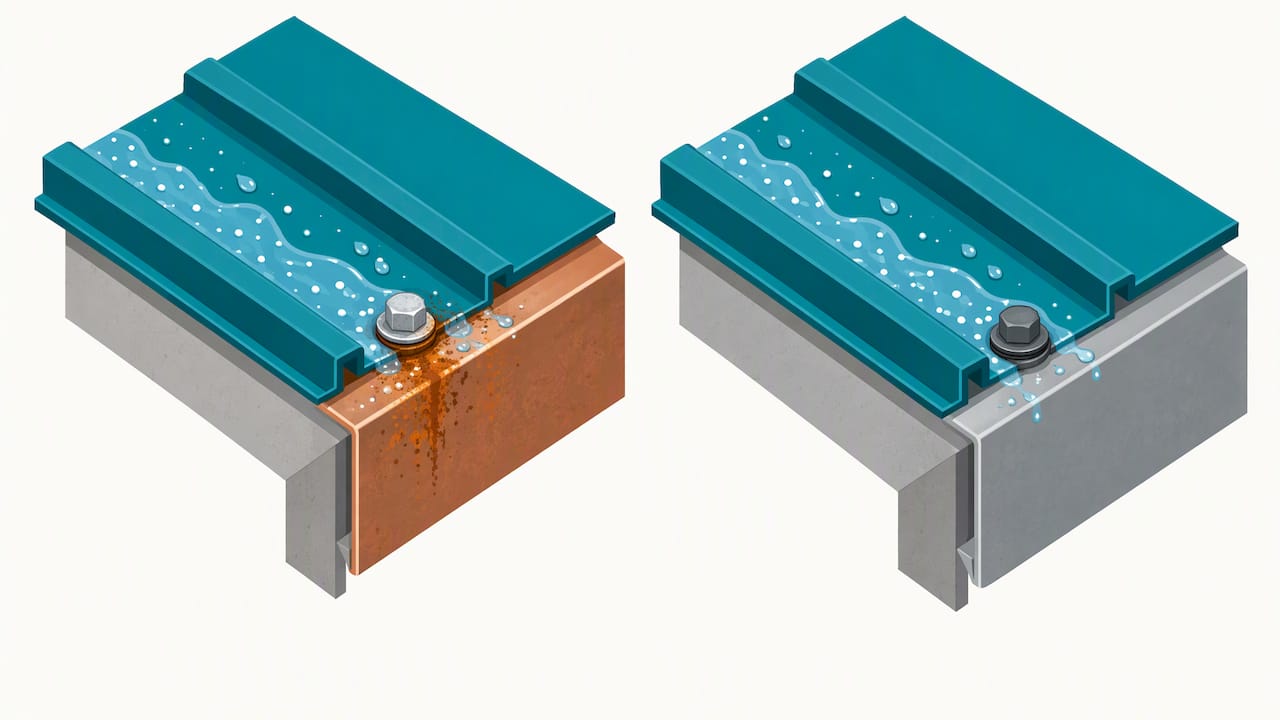
Galvanic corrosion happens when two dissimilar metals touch in the presence of salt-laden moisture: the more reactive metal corrodes rapidly while the other is protected. This is why mismatched fasteners on a coastal roof often fail years before the panels do. EPCoat’s guidance on dissimilar-metal pairings recommends matching fastener material to panel material, or at minimum using a compatible coating system.
NRCA guidance points to ASTM A153 for hot-dip galvanizing and ASTM F1667 for driven fasteners, and recommends Type 304 or 316 stainless for maximum resistance depending on exposure class.
- Eave screws and ridge clips see the most wind-driven moisture and salt buildup.
- Concealed clips corrode unnoticed since they’re hidden until a panel loosens.
- Soffit flashings trap salt-laden runoff in tight spaces with poor drainage.
Pro Tip: Replace degraded fasteners as soon as you spot rust bleed or pitting; waiting until a leak appears usually means the clamping force has already failed.
Inspection, Cleaning, and Maintenance Checklist for Coastal Roofs
A coastal metal roof needs a maintenance rhythm that inland roofs don’t. MBCI’s manufacturer guidance recommends fresh-water rinsing a couple of times per year for roofs within roughly 1,500 feet of breaking surf, since rainfall alone doesn’t remove settled salt effectively.
- Inspect twice yearly and after every major storm, photographing fastener heads, flashing seams, and any discoloration for warranty records.
- Rinse with fresh water a couple of times a year in close coastal zones, focusing on sheltered areas where salt accumulates.
- Avoid abrasive pressure washing, which can strip protective coatings; a soft wash with mild detergent is safer for finish longevity.
- Replace individual fasteners or flashing sections as soon as pitting appears, reserving full roof replacement for widespread panel-level failure.
A partner resource on roof cleaning cadence covers soft-wash techniques that apply well to salt-exposed roofing, including why marine layers demand more frequent attention than typical rainfall patterns.
Pro Tip: Keep dated photos from every inspection; many coastal finish warranties require documented maintenance history before they’ll honor a claim.
What to Ask Your Roofer: Specs and Warranty Questions
Before signing a contract, get specifics in writing rather than taking general reassurances at face value.
- Ask for the exact fastener type (Type 304 or 316 stainless, or G185 hot-dip galvanized) and confirm it matches your exposure class.
- Request the panel coating system by name, such as AZ60 Galvalume with PVF/Tedlar finish, along with cut-edge protection details.
- Get the warranty language in writing, including any distance-based coastal exclusions or setbacks from breaking surf.
- Confirm the installer carries manufacturer certification and factory training, plus current liability insurance.
Our metal roof installation page walks through the specs we document for coastal projects, and our dedicated page on coastal metal roofing within 1,500 feet covers exposure-specific guidance in more depth.
Our Experience With Coastal Metal Roofing Specs
We are factory-trained and experienced with standing seam metal roofing as a specialty for coastal homes. On close-to-shore installs, clients often choose AZ60 Galvalume with PVF finishes or Type 316 fasteners when located inside the 1,500-foot severe-exposure band.
Why Material Specs Matter More Than Brand Names
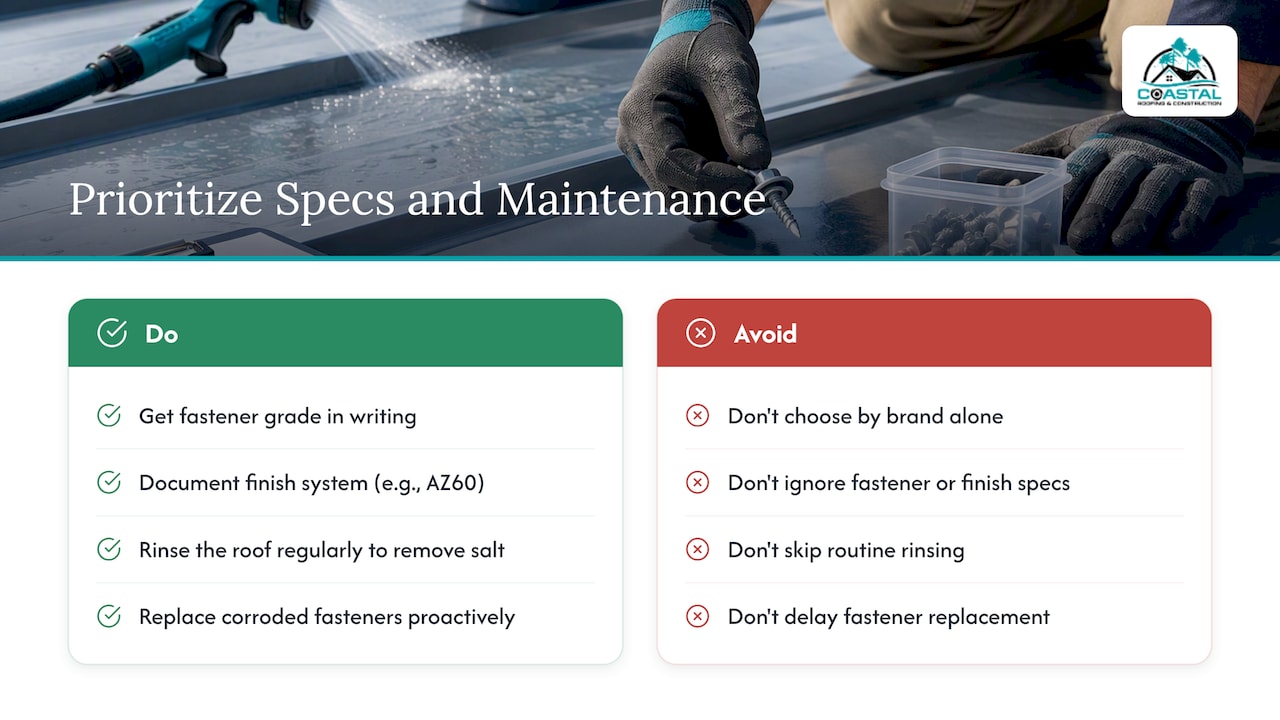
The conventional advice on coastal roofing tends to fixate on brand reputation or panel thickness, when the two factors that actually determine how long a roof lasts are the fastener grade and the finish system, not the headline material. A roof framed as “metal” without specifying AZ60, PVF, or Type 316 fasteners tells you almost nothing about how it will hold up 800 feet from breaking surf.
Homeowners also underestimate maintenance. A roof installed with excellent materials but never rinsed will still accumulate salt in sheltered corners, and a modest roof with disciplined fastener replacement can outlast a premium system that’s ignored for a decade. If you take one thing from this guide, prioritize getting the fastener and finish specs in writing before you worry about which manufacturer’s name is on the panel.
— Ryan
Request a Coastal Roof Assessment
If you’re weighing materials or wondering whether your current fasteners are holding up, we offer coastal site assessments that look specifically at exposure class, fastener condition, and finish wear. Our metal roofing services cover standing seam installations built around AZ60 and PVF specifications, and when a roof has reached the point where repair no longer makes sense, our roof replacement page outlines what that process looks like for Gulf Coast properties.
Reach out to schedule an inspection and get a written specification recommendation for your property’s exposure level.
FAQ
How long does a metal roof last at the beach?
Lifespan depends heavily on the finish and fastener specification rather than the base metal alone. A roof built with AZ60 Galvalume and PVF finish, paired with Type 316 fasteners and a consistent rinse routine, tends to hold up far longer in close coastal zones than one without those upgrades.
What is the biggest problem with metal roofs near the coast?
Fasteners and small connectors corrode faster than the panels themselves, often compromising the structural connection before the roof surface shows visible wear. FEMA’s technical bulletin specifically flags this as a coastal risk that standard inland fastener specs don’t address.
How do I remove saltwater corrosion from a metal roof?
Light surface salt is best removed with a fresh-water rinse rather than abrasive pressure washing, which can strip protective coatings. For established corrosion or rust bleed at fasteners, replacement of the affected hardware is usually more effective than attempting to clean it away.
What type of metal roof is best for coastal areas?
Aluminum and AZ60 Galvalume with a PVF finish such as Tedlar are proven choices for most coastal distances, while Type 316 stainless fasteners are recommended within the most severe exposure zones, generally inside 1,500 feet of breaking surf.
How often should I rinse a metal roof near the ocean?
Manufacturer guidance recommends a fresh-water rinse a couple of times per year for roofs within roughly 1,500 feet of breaking surf, since rainfall alone doesn’t remove settled salt effectively in sheltered areas.
Sources
- Corrosion protection for metal connectors and fasteners in coastal areas (FEMA technical bulletin)
- NRCA guidance on fasteners and corrosion (Focusing on fasteners)
- Coastalume metal roofing and siding panels (Metal Alliance)