
Aluminum roofing is a lightweight, corrosion-resistant metal roofing system formed into standing seam panels, corrugated sheets, or replica shingles, and it’s the material most roofing professionals reach for first on coastal and high-humidity properties. Three things set it apart from the rest of the metal roofing category:
- Salt-air performance. Aluminum forms a self-healing oxide layer that re-seals after a scratch, making it uniquely suited to Florida Gulf Coast conditions where coated steel can fail at cut edges.
- Weight advantage. At roughly one-third the weight of steel, aluminum opens the door to overlay installations that skip a full tear-off, cutting both labor cost and disruption.
- Long service life when the system is right. A properly specified aluminum roof with a PVDF finish meeting AAMA 2605 and factory-certified installation can last 50–100+ years. The system, not just the panel, determines that outcome.
Standards that matter here: AAMA 2605 (premium coating specification), UL 2218 (impact resistance), and Class A fire ratings from UL. When you see those on a proposal, you’re looking at a real system, not just a panel.
Key Takeaways
Aluminum roofing’s 50–100+ year service life is achievable only when the finish meets AAMA 2605, the fasteners are corrosion-compatible, and the installation is factory-certified.
| Point | Details |
|---|---|
| Coastal suitability | Aluminum’s self-healing oxide layer makes it the top metal roofing choice near salt air, outperforming coated steel at cut edges. |
| Finish spec is critical | Require AAMA 2605 PVDF (Kynar or Hylar) on any coastal or Florida installation; polyester finishes degrade far faster in UV and humidity. |
| Lifespan range | A properly specified and installed aluminum roof lasts 50–100+ years; the lower end reflects finish or installation shortcuts. |
| System, not just panel | Underlayment, stainless fasteners, flashing details, and seam locking determine real-world performance as much as the panel itself. |
| Coastal Roofing & Construction | Manufacturer-certified and factory-trained, serving Tampa Bay with standing seam aluminum systems built to Florida’s coastal and hurricane standards. |
Table of Contents
- What aluminum roofing material actually is at the material level
- How aluminum resists corrosion, and why coatings still matter
- Which aluminum roofing profiles are available, and what each one delivers
- How aluminum compares to steel, copper, and asphalt shingles
- What to expect from aluminum roofing performance and durability
- Why installation quality determines whether your aluminum roof actually lasts
- Aluminum roofing costs, warranties, and long-term ROI
- Aluminum roofing advantages and disadvantages
- How to choose aluminum roofing: a 3-step plan
- What installers wish homeowners knew about aluminum roofing
- Coastal Roofing & Construction installs aluminum roofing systems built for Florida
- Sources
What aluminum roofing material actually is at the material level
Aluminum roofing starts as coiled aluminum sheet, typically alloyed for roofing applications. The two alloys you’ll see most often on residential quotes are 3003 and 3105. Both offer good corrosion resistance and formability; 3105 has slightly higher strength and is the more common choice for standing seam panels. Neither will rust, which is the baseline advantage over uncoated or lightly coated steel.
Residential panels typically run .032 inch (thinner, more economical, suitable for most low-wind applications) or .040 inch (stiffer, better dent resistance, preferred in hail-prone or high-traffic areas). Thicker gauge costs more but holds its shape better under foot traffic during installation and under hail impact afterward.
The word “system” comes up constantly among experienced installers because the panel is only one component. A complete aluminum roofing system includes:
- Underlayment: A self-adhering or synthetic underlayment rated for the local wind zone, installed before panels go down.
- Flashings and trim: Aluminum or compatible metal at every penetration, valley, eave, and ridge. Mismatched metals here cause galvanic corrosion.
- Fasteners: Stainless steel or aluminum fasteners only near salt air. Galvanized steel fasteners corrode and stain panels within a few years in coastal Florida.
- Sealants: Butyl-based sealants at laps and penetrations, compatible with the panel finish.
- Factory finish: Applied at the coil level before roll-forming, not painted on-site.
A few terms you’ll see on quotes:
- Coil: The raw aluminum roll before it’s formed into panels.
- Standing seam: A panel system where seams rise above the panel face and are mechanically locked, hiding fasteners.
- Panel profile: The cross-sectional shape of the panel (rib height, width, seam style).
- PVDF finish: A fluoropolymer coating applied at the factory, the premium standard for color retention and corrosion resistance.
How aluminum resists corrosion, and why coatings still matter
Aluminum’s corrosion resistance comes from chemistry, not a coating. When aluminum contacts oxygen, it instantly forms aluminum oxide on the surface. That oxide layer is dense, tightly bonded, and self-repairing: scratch it, and it re-forms within seconds. This is fundamentally different from steel, which relies on a zinc or zinc-aluminum metallic coating that, once breached at a cut edge or scratch, exposes bare iron to rust.
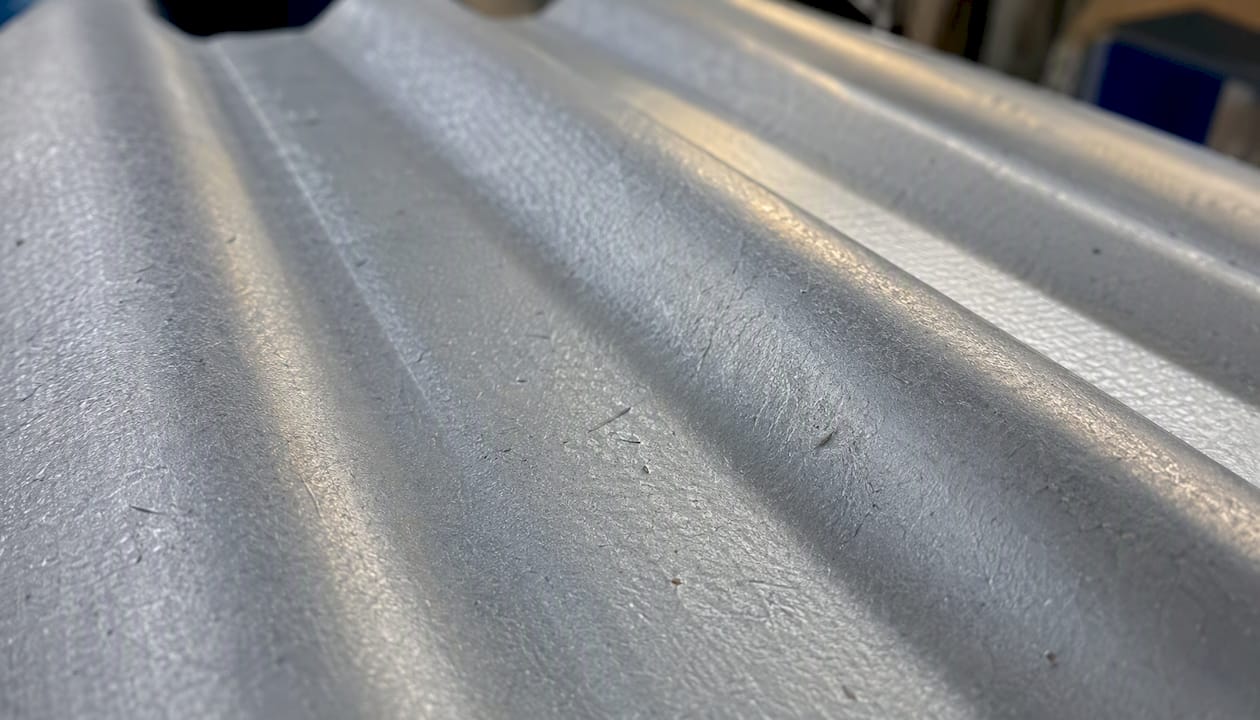
That said, the oxide layer alone isn’t enough for a 50-year roof. Color retention, chalk resistance, and long-term gloss depend entirely on the factory-applied finish.
PVDF (polyvinylidene fluoride) coatings, sold under the brand names Kynar and Hylar, are the industry benchmark for premium metal roofing. The specification that confirms you’re getting a true premium finish is AAMA 2605, which sets minimum performance thresholds for color retention, chalk resistance, and adhesion after accelerated weathering. Roofing professionals consistently point to PVDF and AAMA 2605 compliance as the non-negotiable standard for coastal and extreme-weather installations.
For a home in Clearwater, Madeira Beach, or anywhere along Tampa Bay, the coating spec matters as much as the alloy. Salt air, UV intensity, and humidity in Florida push finishes harder than most climates. Warranty exclusions to watch for: some manufacturer warranties exclude “marine environments” or “within X miles of salt water” unless you specify a coastal-grade finish. Read that language before signing.
Pro Tip: Ask every bidder for the AAMA test report number and the coating manufacturer’s technical data sheet. A legitimate PVDF finish will have both. If a contractor can’t produce them, the finish spec is probably polyester, not PVDF.
Additional coating questions worth asking:
- Is the finish 70% PVDF or a lower-percentage blend?
- Does the warranty transfer to a new owner if you sell the home?
- What’s the chalk and fade warranty term, and what does it cover (replacement vs. touch-up)?
- Is there a separate corrosion warranty, and does it cover the substrate or only the finish?
Which aluminum roofing profiles are available, and what each one delivers
Profile choice affects appearance, leak resistance, wind performance, and whether an overlay installation is feasible. Here’s how the main options compare:
- Standing seam: Panels lock together at raised seams, concealing all fasteners. Best leak resistance, highest wind performance, and the cleanest modern look. Works well as an overlay on solid decking. The premium choice for coastal Florida homes.
- Exposed-fastener corrugated / R-panel: Lower material and labor cost, faster to install. Fasteners penetrate the panel face and rely on neoprene washers that degrade over time. Suitable for agricultural buildings and some commercial applications. Less ideal for high-wind coastal residential use.
- Interlocking aluminum shingles: Individual shingles that interlock on all four sides. Good wind resistance, easier to repair a single damaged piece, and a more traditional appearance than standing seam. Works as an overlay in many cases.
- Metal slate, shake, and tile replicas: Formed aluminum panels shaped to mimic clay tile, cedar shake, or slate. Deliver the look of traditional materials at a fraction of the weight. Overlay-friendly on homes where tile or slate weight would require structural reinforcement.
For most residential metal roof installations in the Tampa Bay area, standing seam is the strongest performer in high-wind and salt-air conditions. Replica profiles make sense when HOA rules or architectural character require a specific look. Exposed-fastener panels are rarely the right call for a primary residence near the coast.
How aluminum compares to steel, copper, and asphalt shingles
| Material | Corrosion / coastal suitability | Weight impact | Installed cost range | Expected lifespan | Dent / hail resistance | Energy performance | Recyclability |
|---|---|---|---|---|---|---|---|
| Aluminum | Excellent; self-healing oxide, no rust | Light (approx. 1/3 of steel) | $10–$20+ per sq. ft. installed | 50–100+ years | Moderate; cosmetic dents, UL 2218 Class 4 achievable at .040 | High reflectivity; cool-roof eligible | Fully recyclable, high recycled content |
| Steel (Galvalume/coated) | Good inland; cut edges vulnerable near salt air | Heavier than aluminum | $10–$15 per sq. ft. installed | 40–70 years | Better than aluminum at same thickness | Reflective with right finish | Recyclable |
| Copper | Excellent; patinas naturally | Similar to aluminum | $30–$40+ per sq. ft. installed | 100+ years | Soft; dents easily | Moderate reflectivity | Fully recyclable |
| Asphalt shingles | Poor; absorbs moisture, degrades in salt air | Heavier than metal per square | $4–$8 per sq. ft. installed | 15–30 years | Low; Class 4 impact shingles available | Low reflectivity; absorbs heat | Largely landfill waste |
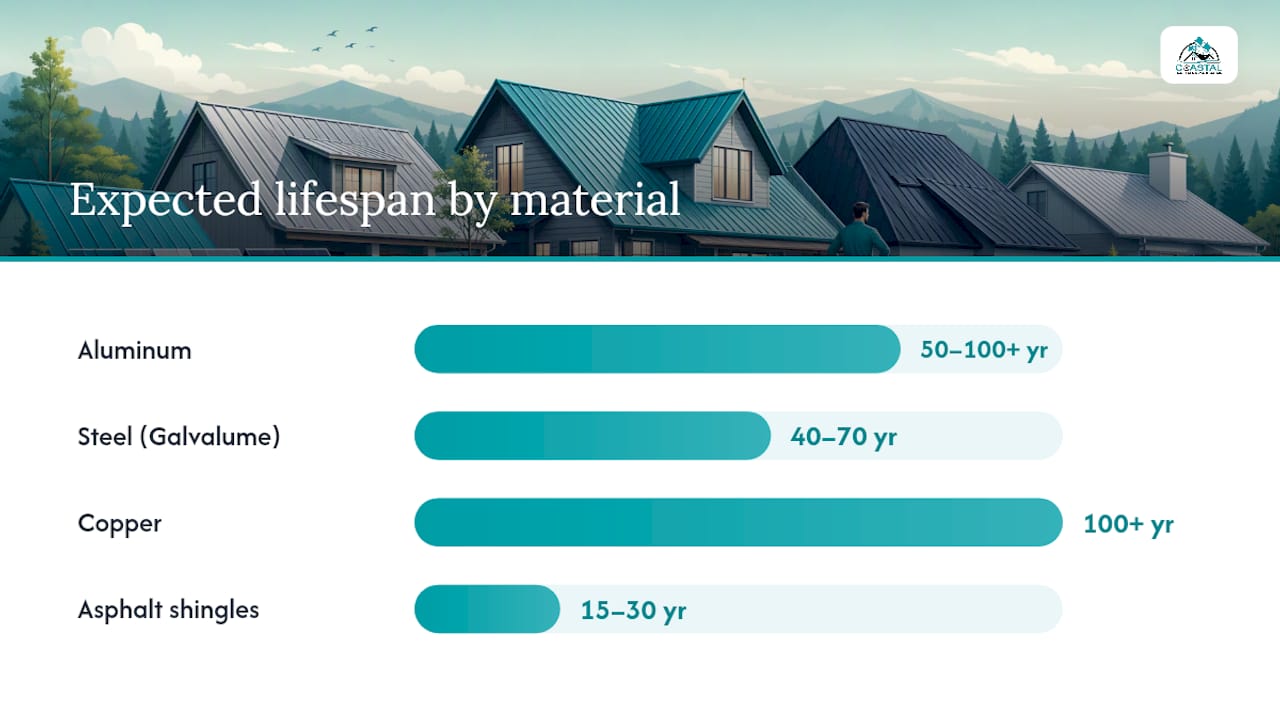
The decision rules are fairly clear. A coastal home in Florida, especially within a few miles of salt water, is the strongest case for aluminum. Aluminum doesn’t rust and its oxide layer re-forms after a scratch, which is a meaningful advantage over steel in that environment. Steel makes more sense for inland, budget-focused projects where salt air isn’t a factor and the lower installed cost justifies the shorter lifespan. Copper is an architectural choice for historic homes or premium accent applications where budget is secondary. Asphalt shingles remain the lowest upfront cost, but their 15–30 year lifespan and poor salt-air performance make them a poor long-term value on a coastal Florida property.
What to expect from aluminum roofing performance and durability
A properly installed aluminum roof with a PVDF finish can last 50–100+ years depending on finish quality, gauge, and installation. The lower end of that range reflects thinner gauges, lower-grade finishes, or installation shortcuts. The upper end reflects .040 aluminum, AAMA 2605 PVDF finish, and a factory-certified installation with correct flashings and underlayment.
Lifespan anchor: A well-specified aluminum roof with PVDF coating and certified installation typically delivers 50–100+ years of service, compared to 15–30 years for asphalt shingles in Florida’s climate.
Key performance points to understand before you buy:
- Denting. Aluminum is softer than steel of the same thickness. Hail and foot traffic can leave cosmetic dents, but those dents don’t compromise waterproofing. Specifying .040 gauge instead of .032 meaningfully reduces dent visibility. For UL 2218 Class 4 impact resistance (the highest rating), confirm the specific panel and gauge combination has been tested, not just the alloy.
- Fire resistance. Most aluminum roofing systems qualify for a Class A fire rating when installed over a solid deck with a compliant underlayment. Confirm the assembly rating, not just the panel material, since the underlayment and deck contribute to the tested assembly.
- Wind performance. Standing seam aluminum systems routinely achieve wind warranties of 130 mph or higher when installed per manufacturer specs. In Florida, where building codes in coastal counties require high wind resistance, this matters for both permitting and insurance.
- Thermal expansion. Aluminum expands and contracts more than steel with temperature swings. Standing seam systems accommodate this with floating clip attachments. Exposed-fastener systems don’t, which is one reason they’re less suitable for large residential panels in Florida’s heat.
For a hurricane-resistant roofing system in the Tampa Bay area, standing seam aluminum with a tested wind rating and proper edge flashings is among the strongest options available.
Why installation quality determines whether your aluminum roof actually lasts
The panel is the least variable part of an aluminum roofing project. What separates a 50-year roof from a 20-year roof is almost always installation quality, and specifically the details that don’t show once the job is done.
Critical installation items that affect real-world performance:
- Underlayment selection: A self-adhering modified bitumen or high-temp synthetic underlayment rated for the local wind zone. Standard felt is inadequate under metal in Florida’s heat.
- Fastener metallurgy: Stainless steel or aluminum fasteners only. Galvanized fasteners near salt air corrode within years and stain panels. This is a common cost-cutting shortcut that shows up as rust streaks and panel damage.
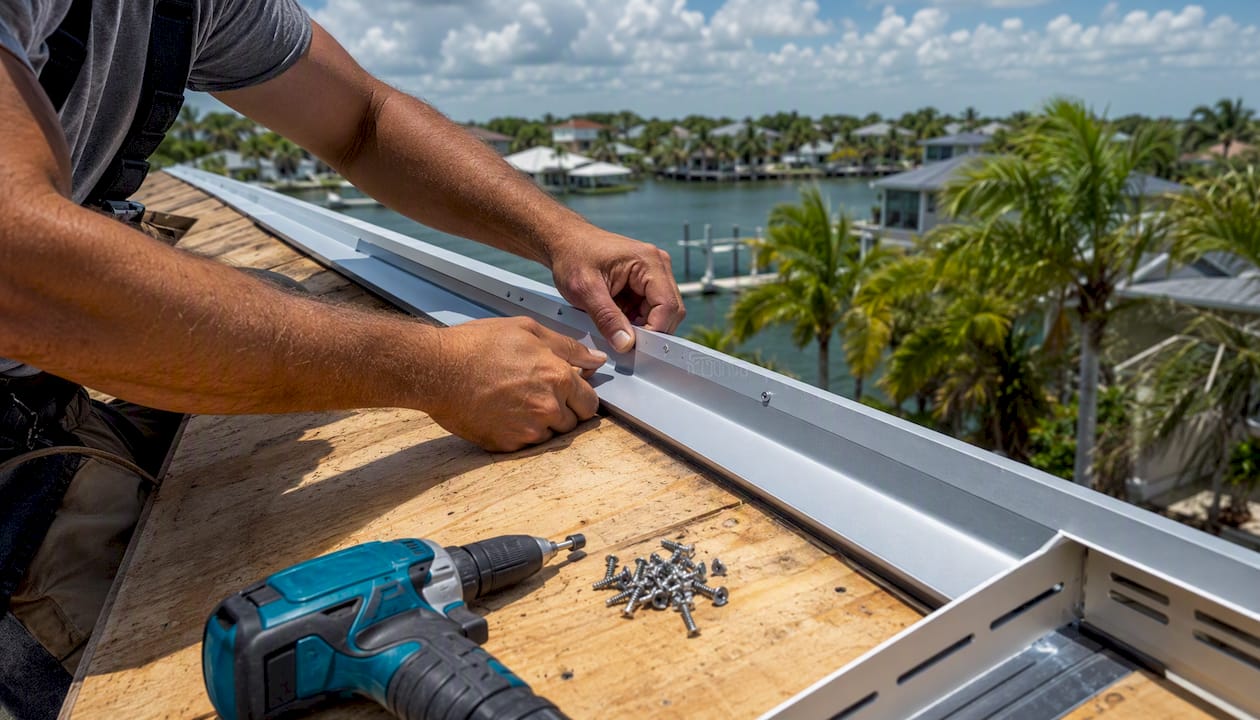
- Flashing details: Every penetration, valley, hip, ridge, and eave needs properly formed aluminum or compatible metal flashing. Undersized or improperly lapped flashings are the most common source of leaks on otherwise good metal roofs.
- Seam locking: Standing seam panels must be mechanically seamed to the correct engagement depth. Under-seamed panels can lift in high winds.
- Expansion allowances: Panels need room to move. Fasteners that restrict thermal movement cause oil-canning (visible waviness) and can crack sealants at penetrations over time.
Pro Tip: On coastal jobs, pay specific attention to drip edge and eave flashing details. These are chronically under-specified on Florida roofs, and water driven by hurricane-force winds enters at the eave before it enters anywhere else. Ask your contractor to show you the eave flashing detail on a completed project.
Common installation pitfalls to watch for when vetting contractors:
- Using galvanized fasteners near salt water
- Installing panels without adequate underlayment
- Skipping or undersizing valley flashings
- Failing to account for panel expansion at penetrations
- No manufacturer-certified training or documentation
When choosing a roofing contractor, ask specifically about manufacturer certification, factory training documentation, and whether the workmanship warranty is transferable. A contractor certified by the panel manufacturer has been trained on that system’s specific installation requirements, which matters more than general roofing experience alone. Manufacturer-certified installation is what unlocks the full material warranty and, in many cases, the transferable workmanship warranty that adds value when you sell.
Aluminum roofing costs, warranties, and long-term ROI
Aluminum roofing costs more upfront than asphalt shingles and most steel options. That’s the honest starting point. Whether that premium is justified depends on how long you plan to own the home and where it sits.
Main cost drivers:
- Panel profile (standing seam costs more than exposed-fastener)
- Alloy and gauge (.040 vs. .032)
- Finish specification (AAMA 2605 PVDF vs. polyester)
- Roof complexity (hips, valleys, penetrations add labor)
- Tear-off vs. overlay (overlay saves significant labor cost when the deck is sound)
- Local labor rates (Florida coastal markets run higher than inland)
Typical installed cost ranges (these are general market ranges, not quotes):
- Exposed-fastener aluminum: roughly $10–$14 per square foot installed
- Standing seam aluminum: roughly $14–$20+ per square foot installed
- Asphalt shingles (for comparison): roughly $4–$8 per square foot installed
Warranty checklist: Material warranties and workmanship warranties are separate documents. A 40-year paint warranty from the coating manufacturer covers color and chalk, not leaks. A workmanship warranty from the installer covers labor and installation defects. Transferable warranties add resale value; ask for that language in writing before signing. Confirm whether the material warranty requires certified installation to remain valid, because most premium manufacturers require it.
ROI framing: The aluminum premium makes the most sense when: (1) the home is within a few miles of salt water, (2) you plan to own for 15+ years, (3) an overlay is feasible (eliminating tear-off cost narrows the gap with shingles significantly), or (4) energy savings from reflective roofing are a priority. Aluminum reflects solar heat and many products qualify for ENERGY STAR or cool-roof programs, which can reduce cooling loads meaningfully in Florida’s climate. Over a 30-year horizon, the combination of avoided replacements and lower cooling costs often closes the gap with asphalt’s lower upfront price.
Aluminum roofing advantages and disadvantages
Advantages:
- Doesn’t rust; self-healing oxide layer performs in salt air without sacrificial coatings
- Lightweight, roughly one-third the weight of steel, enabling overlay installations and reducing structural load
- Long service life: multiple decades with proper coating and installation
- Fully recyclable and commonly contains high recycled content, reducing landfill waste compared to asphalt
- High solar reflectivity; eligible for ENERGY STAR and cool-roof designations
- Available in standing seam, shingle, and replica profiles to suit most architectural styles
- Strong wind resistance in standing seam configurations
Disadvantages:
- Higher upfront cost than asphalt shingles and most steel options
- Softer than steel; more susceptible to cosmetic denting from hail and foot traffic
- Higher thermal expansion rate than steel; requires floating clip systems in standing seam to avoid oil-canning
- Finish quality is critical; a polyester finish on aluminum performs no better than a polyester finish on steel
- Requires compatible (stainless or aluminum) fasteners and flashings; mixed metals cause galvanic corrosion
Direct answers to common questions:
- Is aluminum roofing a good choice? For coastal Florida homes, yes, it’s among the strongest long-term choices available. For inland, budget-focused projects, steel or architectural shingles may offer better value.
- How long does aluminum roofing last? 50–100+ years with PVDF finish and certified installation; shorter with lower-grade finishes or installation shortcuts.
- Is it more expensive than shingles? Yes, roughly 2–3 times the installed cost, but with a lifespan 2–4 times longer and no salt-air degradation.
How to choose aluminum roofing: a 3-step plan
Before calling contractors, work through this decision checklist:
- Coastal exposure: Within 5 miles of salt water? Aluminum is the clear choice over steel.
- Budget window: Can you absorb $14–$20+ per square foot installed? If not, explore whether an overlay reduces the gap.
- Roof slope: Standing seam requires a minimum slope (typically 3:12 or steeper for most systems). Confirm with your contractor.
- Desired lifespan: Planning to own 20+ years? The aluminum premium pays off. Shorter horizon? Architectural shingles may make more financial sense.
- Local hail and wind risk: Tampa Bay’s hurricane exposure makes high wind ratings a priority. Confirm the system’s tested wind rating, not just the panel material.
Step 1: Gather roof-specific facts and photos. Measure or estimate your square footage, note the number of penetrations (vents, skylights, chimneys), photograph existing flashings and eave conditions, and confirm your deck type (plywood, OSB, or skip-sheathing). This information lets contractors price accurately and identify overlay feasibility.
Step 2: Request system-level proposals from certified installers. Ask each bidder to specify the alloy and gauge, finish specification (AAMA 2605 PVDF or lower), underlayment type, fastener material, and flashing details. A proposal that lists only “aluminum standing seam” without these specifics is incomplete. Refer to roof upgrade options to understand what a full system proposal should include.
Step 3: Compare finish specs, warranties, and references. Line up the AAMA finish spec, material warranty term, workmanship warranty term, and transferability side by side. Ask for two or three references on similar coastal projects and call them. The contractor who can produce AAMA test documentation, manufacturer certification credentials, and transferable warranty language is the one worth hiring.
Documents to collect from every bid: AAMA 2605 finish specification sheet, UL 2218 impact test report for the specific panel/gauge, wind warranty in mph, material warranty (paint and substrate separately), and workmanship warranty with transferability language.
What installers wish homeowners knew about aluminum roofing
Most homeowners research aluminum roofing by comparing panels. That’s the wrong starting point. The panel is the commodity. What actually determines whether your roof performs for 50 years or 20 is the finish spec and the installation quality, in that order.
The PVDF coating question is the one most homeowners skip. A polyester finish on aluminum will chalk and fade within 10–15 years in Florida’s UV environment. An AAMA 2605 PVDF finish on the same panel will hold color and gloss for 30+ years. That difference costs maybe $1–$2 per square foot more at the panel level, but it’s the single highest-return specification upgrade you can make.
On the installation side, the detail that gets skipped most often on coastal jobs is the eave and drip edge flashing. Contractors who are experienced inland sometimes undersize these details because they’ve never seen what hurricane-driven rain does at the eave. In Tampa Bay, that’s a mistake that shows up during the first named storm.
For maintenance, a metal roof maintenance inspection every 2–3 years is enough for most aluminum systems. Focus on sealant condition at penetrations, flashing lap integrity, and any debris accumulation in valleys. The panels themselves rarely need attention; it’s the accessories that age first.
Coastal Roofing & Construction is manufacturer-certified and factory-trained, with direct experience installing standing seam aluminum systems on waterfront and coastal properties throughout the Tampa Bay area. That certification matters because it’s what unlocks the full manufacturer warranty and ensures the installation follows the tested system specs, not a contractor’s improvised interpretation of them.
Coastal Roofing & Construction installs aluminum roofing systems built for Florida
If you’ve read this far, you already know that aluminum roofing’s performance comes down to two things: the coating spec and the installation. Coastal Roofing & Construction delivers both. As a manufacturer-certified, factory-trained contractor serving Pinellas, Hillsborough, and Pasco counties, we install premium metal roofing systems designed specifically for Florida’s coastal environment, including standing seam aluminum with AAMA 2605 PVDF finishes, correct coastal-grade fasteners, and properly detailed eave and flashing systems.
We handle the full process: roof inspection, system selection, manufacturer-certified installation, and storm-damage restoration. Every project comes with transferable warranty documentation and honest guidance on whether aluminum, tile, or another system is the right fit for your home. To see the quality of our work firsthand, browse our recent roofing projects. Ready to get a specific estimate for your home? Request a roof replacement estimate and we’ll walk you through your options with no pressure and no guesswork.
Sources
When reviewing proposals or checking manufacturer claims, these are the specific sources worth consulting:
- Aluminum Roofing Explained: Rust-Proof, Light & Recyclable
- Aluminum vs Steel Roofing: Cost, Lifespan & Pick
- Aluminum Roof Guide for Homeowners: Costs and Care
- How Long Does a Metal Roof Last? A Complete Homeowner’s Guide