
A separate roof deductible in Florida is a policy endorsement that applies only to roof claims, capped by law at the lesser of 2% of your Coverage A dwelling limit or 50% of your roof’s replacement cost. Insurers that offer this endorsement must disclose it on the page directly behind your declarations page, in boldfaced type at least 18 points high. If you don’t remember signing off on one, check that page tonight.
TL;DR:
- The separate roof deductible is capped at the lower of 2% of your Coverage A limit or 50% of your roof’s replacement cost, protecting homeowners with smaller or older roofs.
- Insurers are required to disclose the endorsement in bold 18-point type immediately behind the declarations page; absence of this disclosure questions enforceability.
- The homeowner’s actual out-of-pocket cost depends on both the Coverage A limit and roof replacement cost, with the lower figure applying when calculating the deductible.
- Most roof claims are paid in two stages: first as ACV minus depreciation, then with the final RCV payment after proof of deductible payment is provided.
- Licensing and proper documentation from certified contractors streamline the claims process and help prevent delays or claim denial due to improper proof or missing details.
Table of Contents
- How Roof Deductibles Work in Florida
- Statutory Limits Homeowners Should Verify
- Calculating Your Real Dollar Exposure
- How Insurers Pay Roof Claims
- What to Do After Roof Damage
- Why a Licensed Contractor Matters for Your Claim
- A Contractor’s Honest Take on Roof Deductible Claims
- Get an Inspection Before You File Another Claim Estimate
- Where This Information Comes From
- Sources
How Roof Deductibles Work in Florida
Florida homeowners policies can carry up to four separate deductible categories, and mixing them up is how people end up shocked at claim time.
- Standard AOP (all-other-perils) deductible: a flat dollar amount that commonly ranges within typical policy amounts, that applies to non-wind, non-hurricane losses like a burst pipe or fallen tree limb.
- Wind/hail deductible: often a percentage-based deductible written into the policy for windstorm losses that don’t meet the hurricane trigger.
- Hurricane deductible: triggered specifically when the National Hurricane Center issues a hurricane watch or warning for your area, per Florida Statute 627.4025.
- Separate roof deductible: an optional endorsement applying to roof damage regardless of cause, distinct from the hurricane trigger window.
Insurers generally won’t stack these. If your separate roof deductible endorsement applies to a loss, the policy usually blocks a second deductible, like the hurricane deductible, from applying to that same claim.
Statutory Limits Homeowners Should Verify
Florida Statute 627.701 authorizes insurers to offer separate roof deductibles, but it doesn’t give them a free hand. The cap is fixed: whichever is lower, 2% of your Coverage A limit or 50% of the roof’s replacement cost.
That “lesser of” language matters more than most homeowners realize, because it protects owners of smaller or older homes from a deductible that would otherwise eat half their claim.
By the numbers: insurers must disclose a separate roof deductible election in boldfaced type no smaller than 18 point, placed on the page immediately behind your declarations page. If that disclosure isn’t there in that format, question whether the endorsement is enforceable, and ask your agent to point to it directly.
Calculating Your Real Dollar Exposure
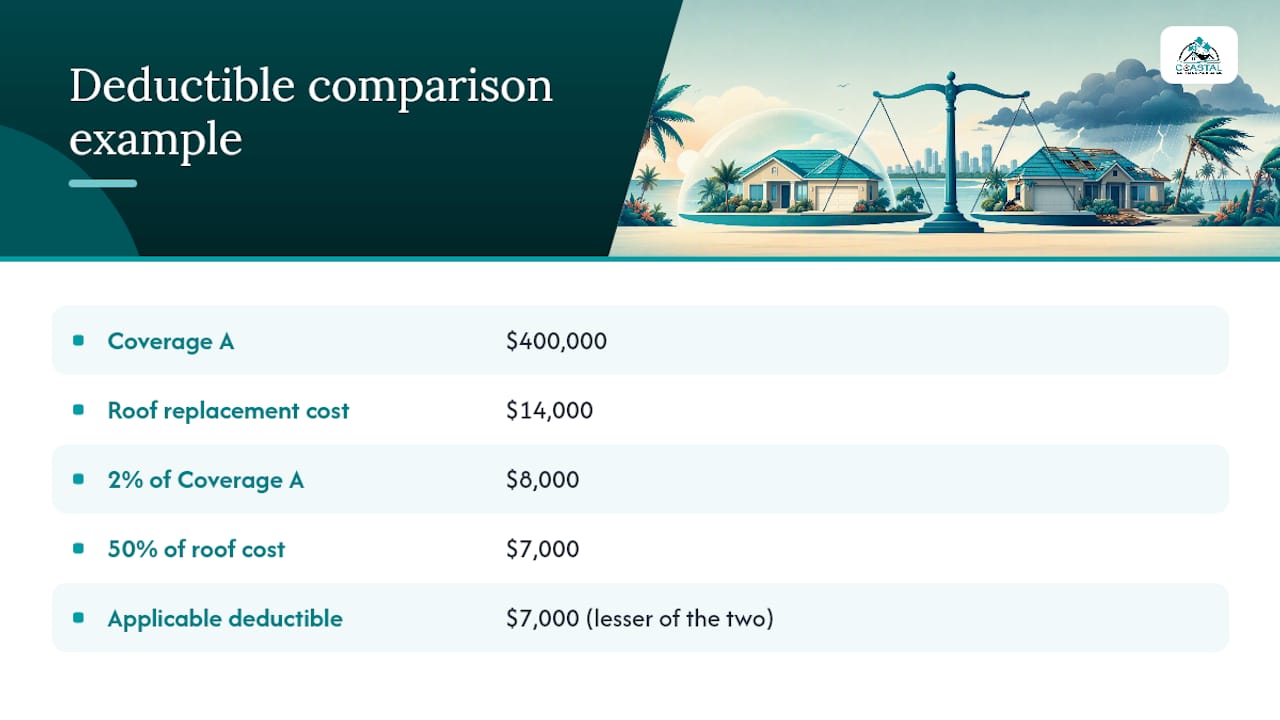
Coverage A is your dwelling replacement value, and it’s the number every percentage deductible is measured against. The statutory cap limits the separate roof deductible to the lesser of 2% of your Coverage A limit or 50% of your roof’s replacement cost.
Now apply the “lesser of” rule. If that $400,000 home has a roof that would cost $14,000 to replace, 50% of that cost is $7,000, which is lower than the $8,000 figure from the 2% calculation. The homeowner owes $7,000, not $8,000, because the statute requires the smaller number to apply. Always run both calculations before assuming the percentage figure is final.
How Insurers Pay Roof Claims
Most Florida roof claims get paid in two stages, and understanding the gap between them saves you from a cash-flow surprise mid-repair.
- ACV (actual cash value) is what you typically get first: replacement cost minus depreciation for the roof’s age and wear.
- RCV (replacement cost value) is the full repair cost, and insurers release the difference, called recoverable depreciation, only after the work is done.
- Some older endorsements use a fixed reimbursement table tied to roof age rather than a straight ACV/RCV split, so read your endorsement language closely.
- Before releasing that final depreciation payment, insurers commonly demand proof you actually paid your deductible, not just that the contractor completed the work.
That proof-of-payment step trips up more homeowners than any other part of the process, largely because contractors sometimes offer to “waive” the deductible as a sales tactic. Insurers scrutinize those arrangements closely, and a waived deductible can delay or jeopardize your final payout.
What to Do After Roof Damage
Move fast, but move carefully. Florida’s claims process runs on real deadlines, and documentation gaps are the most common reason payments stall.
- Photograph the damage immediately, with date stamps, before any temporary repairs.
- Tarp exposed areas to prevent further damage, since insurers expect reasonable mitigation.
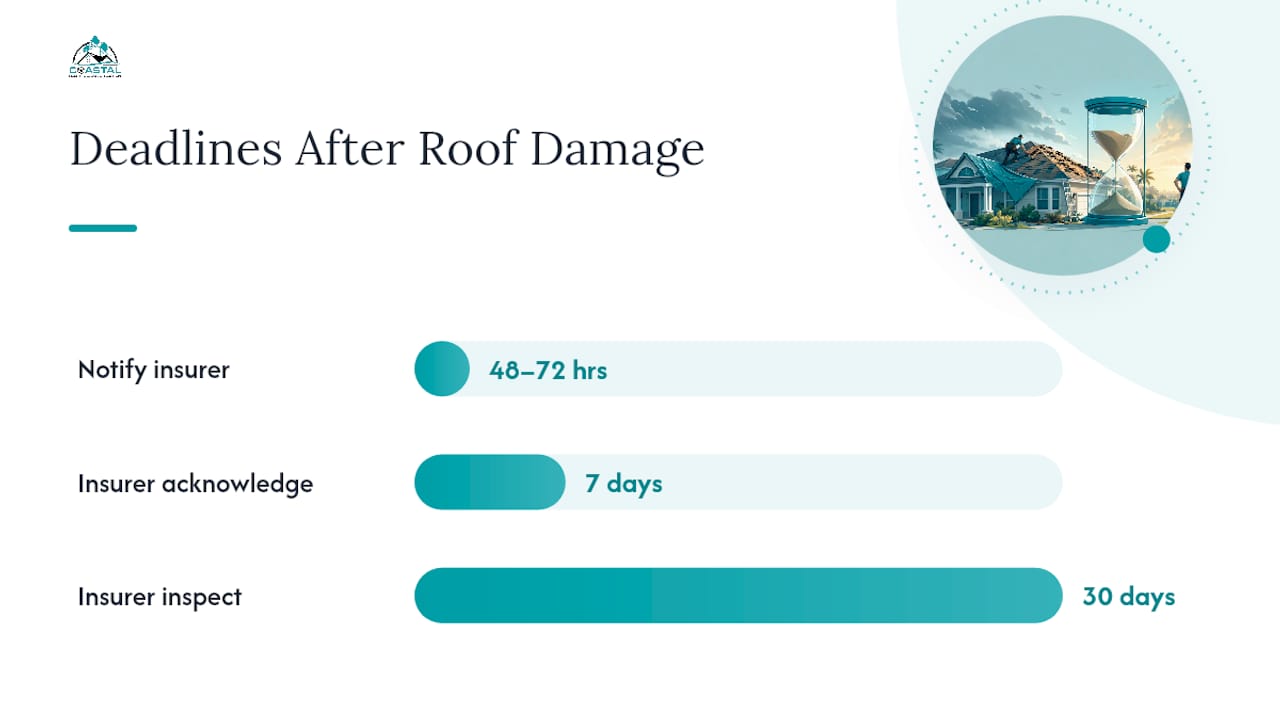
- Notify your carrier within 48 to 72 hours; insurers generally must acknowledge the claim within 7 days and inspect within 30 once you’ve submitted proof of loss.
- Gather your declarations page, a written contractor estimate, and eventually a canceled check or receipt showing your deductible payment.
Pro Tip: Keep every receipt tied to the deductible payment itself, not just the total invoice. Insurers want to see the deductible amount paid separately, and a lump-sum receipt without that breakdown is a common reason final payments get delayed.
Misjudging which deductible applies before a storm even hits is one of the most common and costly mistakes homeowners make, and it’s worth catching before you’re standing under a tarp.
Why a Licensed Contractor Matters for Your Claim
A licensed roofing contractor does more than swing a hammer during a claim dispute. A documented scope of work, a timely inspection report, and code-upgrade estimates give your adjuster the paper trail insurers actually respond to. Contractors who provide stamped invoices and itemized deductible receipts make the proof-of-payment step, the one that holds up so many final RCV payments, straightforward instead of a scramble.
A licensed roofing contractor with manufacturer certifications serves Pinellas, Hillsborough, and Pasco counties, including Clearwater, St. Petersburg, Tampa, and Palm Harbor. That combination of certification and documentation experience is exactly what an adjuster wants to see attached to a claim file.
A Contractor’s Honest Take on Roof Deductible Claims
We help homeowners document damage, produce the scope and estimates adjusters ask for, and generate the payment records insurers require before they release final funds. What we won’t do is pretend to be your lawyer. If an insurer denies a legitimate claim or misapplies a deductible, that’s a conversation for a licensed attorney or the Florida Department of Financial Services, not your roofer. Start with a proper inspection so you know exactly what you’re dealing with before you call anyone else.
— Ryan
Get an Inspection Before You File Another Claim Estimate
Homeowners can obtain a documented, code-aware inspection from a manufacturer-certified crew that understands what Florida adjusters want to see on paper.

That’s the real gap in most claims. Homeowners get an estimate that lists damage but skips the code-upgrade costs and photo documentation insurers use to justify a payout. Services include storm damage restoration, roof replacement, and repair across Pinellas, Hillsborough, and Pasco counties, providing itemized, stamped paperwork to support deductible payment proof. If your roof took a hit this season, start with a residential roof replacement consultation or browse recent completed projects before you pick up the phone.
Where This Information Comes From
- Florida Statutes 627.701: the statute authorizing and capping separate roof deductibles.
- Florida Statute 627.4025: defines hurricane deductible trigger rules.
- Roof payment schedules and the coverage trap: how ACV, RCV, and proof-of-payment interact.
Sources
- 2022 Florida Statutes: 627.701
- Florida Statute 627.4025 (hurricane deductible trigger rules)
- Roof payment schedules: The Florida homeowner’s coverage trap
- Roof damage insurance claims in Florida (practical guide)