
Most chimney leaks are not the chimney itself. They start where the chimney meets the roof, and failed flashing is the usual culprit. Other common causes are a cracked crown, worn mortar joints, a missing cap or a missing cricket behind a wide chimney. The fix depends on which one it is, so the first job is to find where the water is getting in, then stop the damage inside while you arrange a proper repair.
This guide walks through the causes, the warning signs inside and outside the house, what to do the day you notice a leak, what repairs typically cost, and how Florida homeowners should think about insurance.
TL;DR
- Flashing, the metal that seals the chimney to the roof, is the most common place for a chimney leak to start. The crown, mortar, cap and bricks come next.
- Stains on the ceiling near the chimney, damp attic wood, peeling paint or rusty nail tips point to a flashing leak.
- Take photos, contain the water, tarp if it is safe to do so, keep receipts and call your insurer if storm damage is involved.
- Caulk and roofing cement are short-term patches. A lasting repair usually means properly installed step and counter flashing.
- Typical flashing repair costs run from a few hundred dollars to about $1,800, and more if the roof underneath is damaged.
Table of Contents
- Why chimneys leak more than any other part of the roof
- The common causes of a chimney roof leak
- Is it normal for a chimney to leak in heavy rain?
- Signs of a chimney flashing leak
- What to do first when you find a leak
- Roofer or mason: who fixes what?
- Patch or replace: how flashing gets repaired
- How much does it cost to fix a chimney leak?
- Will homeowners insurance cover a chimney leak?
- Preventing the next chimney leak
- Our perspective
- Need a chimney leak looked at?
- FAQ
- Sources
Why chimneys leak more than any other part of the roof
A chimney is a big masonry box pushing up through a sloped roof that shifts, heats and cools differently from the brick. Every side of it needs a watertight joint. The American Society of Home Inspectors notes that chimney flashings are more complex than other roof flashings and a common source of roof leaks. A contractor with more than 40 years of experience, Tim Carter, puts the share of roof leaks that happen at flashings well above 90%. That is one person’s estimate rather than a measured study, but it matches what roofers see on the job: the field of a roof rarely leaks first. The joints do.
Three things make the chimney joint hard to keep tight:
- Movement. The roof and the chimney expand, contract and settle independently, so a rigid seal eventually cracks.
- Sun and weather. Sealants dry out and flashing metal corrodes.
- Geometry. Water running down the slope slams into the uphill side of the chimney and has to be diverted around it.
In Tampa Bay, add salt air, summer downpours and tropical storm winds that push rain sideways against the brick. Those conditions are hard on any roof penetration.
The common causes of a chimney roof leak
Failed or poorly installed flashing
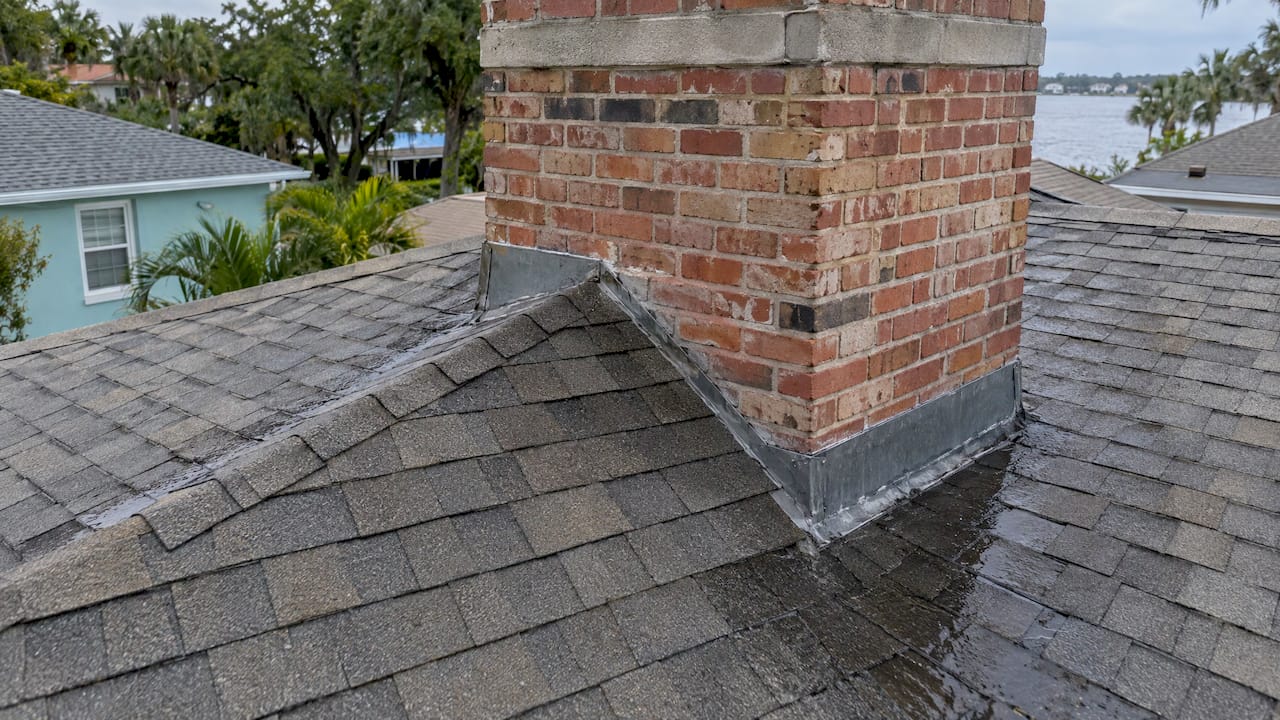
Flashing is layered metal. Step flashing is woven into the shingles along the sides, a back (or saddle) piece handles the high side, and counter flashing is set into the masonry and laps over the base flashing. Leaks show up when:
- Edges lift or pull away from the brick
- Metal rusts through or develops pinholes
- Pieces go missing after a storm
- A previous repair relied on a bead of sealant instead of counter flashing
The last one is common. A guide to chimney flashing repair points out that caulk and roofing cement on flashing tend to fail because sun degrades the sealant and the roof and chimney move independently.
Missing cricket behind a wide chimney
A cricket (also called a saddle) is a small peaked structure built on the uphill side of the chimney. It splits the water flow so it travels around the chimney instead of pooling behind it. Wide chimneys without one collect water and debris, and the flashing behind them is under constant stress.
Cracked chimney crown
The crown is the slab of concrete or mortar across the top of the chimney. If it is cracked, water seeps into the masonry and travels down. The leak can show up inside the house far from where the crack is.
No chimney cap
Without a cap, rain falls straight into the flue. One technical guide notes that the absence of a chimney cap lets rain and snow fall directly into the chimney. Caps also keep out leaves and animals.
Deteriorated mortar and porous brick
Over time, mortar joints crumble and bricks absorb water. A wall that soaks up rain in a heavy storm can let moisture reach interior framing, even when the flashing is perfect.
Condensation and leaks that are not chimney leaks
Sometimes moisture appears near the chimney because of condensation inside the flue, or because a nearby roof valley, vent pipe or skylight is leaking and the water simply runs along the rafters. If the flashing and masonry look sound, ask for a full roof inspection rather than another round of patching at the chimney.
Is it normal for a chimney to leak in heavy rain?
No. A chimney should stay dry in any rain your roof is built to handle. That said, a leak that only appears in a hard storm is a useful clue. Heavy rain is usually wind-driven, so water hits the vertical face of the brick and runs down to the roof joint, and it can arrive faster than the roof sheds it. Both put pressure on the flashing, crown and mortar at the same time. A chimney that stays dry in light rain and drips in a storm has a weakness; it is not behaving normally.
To narrow down the source, note:
- Where the stain is. Directly below the chimney points to flashing or crown. A stain several feet away may mean water traveling along a rafter.
- When it appears. Only in wind-driven rain suggests flashing or masonry. Any rain suggests a cap, crown or major flashing gap.
- Whether it gets worse. A stain that grows after each storm means water is still entering.
Signs of a chimney flashing leak
You do not have to climb onto the roof to spot the warning signs. Do not walk on a wet roof, and use binoculars or a phone zoom from the ground.
Outside
- Dark streaks or stains on the brick or roof below the chimney
- Rust lines or discoloration on the flashing
- Gaps, lifted edges or missing pieces of flashing
- Dried, cracked or peeling sealant along the joint
- A crumbling crown or open mortar joints
Inside
According to the same flashing repair guide, signs include:
- Water stains on ceilings or walls near the chimney
- Damp or dark attic framing and roof sheathing
- Peeling paint or bubbling drywall
- Rusty nail tips in the attic
Check the attic on a dry day with a flashlight, around the chimney chase. Dark, damp wood or a musty smell near the chimney is a strong sign. Our guide to locating a roof leak after a storm covers containment and tracing in more detail.
What to do first when you find a leak
The goal in the first 24 hours is to limit damage and protect your options.
- Contain the water inside. Move furniture, put a bucket under drips and, if a ceiling is bulging, carefully poke a small hole to release the water into a bucket. Do this only when it is safe.
- Document everything. Take dated photos and video of the stains, the attic and, from the ground, the chimney and roof.
- Make reasonable temporary repairs. The Florida Department of Financial Services advises homeowners to document damage with photos and make reasonable emergency repairs such as tarping, and to keep all receipts.
- Report storm-related damage promptly. The same guide says to report a claim to your insurance company or agent right away.
- Do not climb onto a wet roof. A tarp on a steep or slick roof is a job for a professional.
- Get a licensed roofer to inspect. The state advises homeowners to verify that contractors are licensed and check for complaints with the Department of Business and Professional Regulation before signing anything.
After a storm, be careful with door-to-door offers. Florida’s consumer guidance says to avoid signing documents you do not fully understand and to be wary of anyone soliciting repair work after a storm.
Roofer or mason: who fixes what?
The split is simple.
| Problem | Who usually handles it |
|---|---|
| Step, counter or base flashing | Roofer |
| Missing cricket | Roofer (with carpentry) |
| Wet shingles or decking around the chimney | Roofer |
| Cracked crown | Mason or chimney specialist |
| Crumbling mortar or bricks | Mason |
| Chimney cap and flue issues | Chimney specialist |
Because the flashing is where roof and masonry meet, the best repairs happen when someone looks at both. A roofer who can inspect the whole roof system will also tell you whether the water you see is coming from the chimney at all.
Patch or replace: how flashing gets repaired
Caulk and roofing cement are the quick fixes, and they have their place as a short-term measure until a crew can get there. As noted above, they often fail because the joint keeps moving.
A lasting repair typically involves:
- Removing the old flashing and the shingles around the chimney
- Checking the underlayment and roof deck for rot, and replacing damaged sections
- Installing new base and step flashing, layered with the shingles
- Setting counter flashing into a cut mortar joint (a reglet) so it laps over the base flashing
- Adding a cricket if the chimney is wide enough to need one
- Sealing, then inspecting the crown and cap
Flashing metal matters too. Aluminum and galvanized steel are the usual choices, and copper costs more and lasts longer. In coastal Florida, ask your contractor how the metal will stand up to salt air.
Repair is reasonable when the damage is local: a lifted corner, a failed seam, a section of missing flashing. Full replacement makes sense when the metal is rusted throughout, the previous work was done with sealant alone, or the water has already soaked the decking. If the roof surrounding the chimney is near the end of its life, it is often smarter to replace flashing as part of a roof replacement, so the new flashing is integrated with new roofing instead of tied into old shingles. Our guide on how to know when a roof needs full replacement explains how to make that call.
How much does it cost to fix a chimney leak?
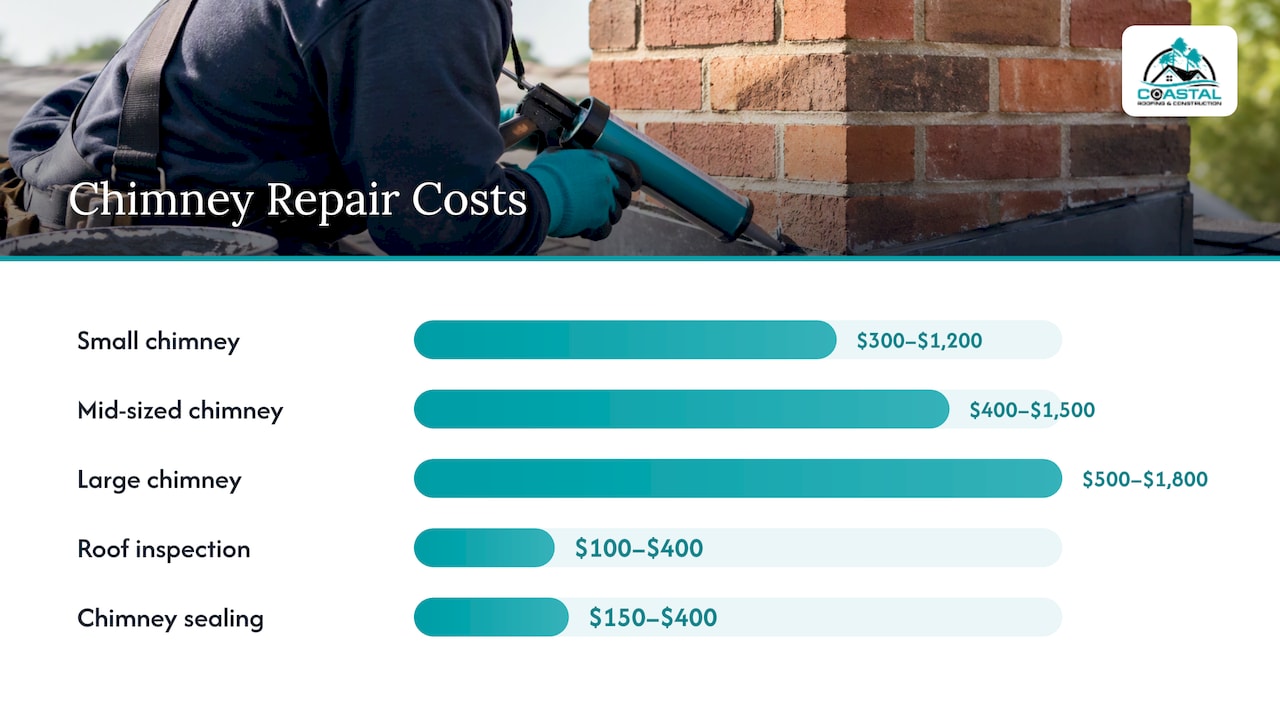
Cost depends on the cause, the chimney’s size and how easy the roof is to reach. HomeGuide’s 2026 estimates put chimney flashing repair at $300 to $1,800 on average, with minor resealing as low as $200 and full replacement on large chimneys reaching $1,800 or more. It lists these ranges by chimney size:
| Chimney size | Average flashing repair cost |
|---|---|
| Small | $300 to $1,200 |
| Mid-sized | $400 to $1,500 |
| Large | $500 to $1,800 |
The same source puts roof inspections at $100 to $400 and sealing a chimney at $150 to $400. These are national averages, and Tampa Bay prices vary with roof pitch, material and access. A tile roof, for example, needs tiles lifted and reset around the chimney, which takes more labor than shingles.
The costs that surprise people are hidden ones: rotted decking, wet insulation, ceiling repair and mold. Catching a leak early keeps the repair at the flashing level. We do not publish fixed prices because the right number comes from looking at the roof, and we give written estimates after an inspection.
Will homeowners insurance cover a chimney leak?
It depends on the cause, and your policy language controls the answer. A few points from authoritative sources help frame the conversation:
- The Insurance Information Institute says homeowners are responsible for roof maintenance and replacement due to normal wear and tear. A leak from flashing that simply aged out is usually a maintenance item.
- Storm damage is a different story. If wind tore flashing away or a falling limb damaged the chimney area, a claim may be appropriate, so report it promptly.
- In Florida, the hurricane deductible may differ from your standard deductible after a storm, so read your declarations page before deciding whether a claim makes sense.
- Insurers in Florida may use drones or satellite imagery for roof inspections rather than sending someone onto the roof.
- The Triple-I toolkit also notes insurers may ask for proof of routine inspections and professional maintenance, and may charge more or refuse coverage based on what they find.
For Tampa Bay specifics, see our pages on roof insurance claim timelines and the Florida roof deductible. Dated photos, a written inspection report and receipts for emergency work make any claim conversation easier.
Preventing the next chimney leak
- Inspect twice a year and after major storms. A regular roof inspection schedule catches lifted flashing and cracked sealant before water gets in.
- Check the cap and crown whenever someone is on the roof.
- Keep the area clear of leaves and debris that hold moisture against the flashing.
- Insist on counter flashing rather than surface sealant in any repair.
- Ask about a cricket if your chimney is wider than about 30 inches. Your roofer can confirm what the local building code requires.
- Repoint mortar before joints open far enough to admit water.
Our perspective
Chimney leaks are one of the most avoidable roof problems we see, and one of the most commonly misdiagnosed. Homeowners often call about a stain on the ceiling and have already been told to put sealant around the chimney. Sealant is cheap, and it looks like a fix on the day it goes on. In Florida’s sun and storms, it rarely stays one.
When we inspect a chimney leak, we look at the whole roof system: the flashing, the shingles or tile around the chimney, the decking underneath and the attic. Our crews are factory-trained and certified with Owens Corning, GAF and Tri County Metals, which matters here because flashing is only as good as the way it is layered into the roof around it. Whether the roof is shingle, tile, or standing seam metal, the chimney joint has to be detailed for that material.
Our honest advice: if your roof is older than 15 years and the chimney is leaking, ask whether it makes sense to repair the flashing or fold it into a larger project. Sometimes a targeted repair is the right answer. When the roof around it is worn out, new flashing on old roofing just moves the problem. We would rather tell you that after an inspection than sell you a patch.
Ryan
Need a chimney leak looked at?
If water is showing up near your chimney, we can inspect the flashing, the roof around it and the attic, and give you a clear recommendation. We serve homeowners across Pinellas, Hillsborough and Pasco counties, from St. Petersburg and Clearwater to Tampa, Brandon and Odessa. See our residential roof repair service, or if the roof is nearing the end of its life, our roof replacement options.

We are licensed, insured and family-owned, and our estimates come after an inspection, not before. You can start at coastalroofingfla.com.
FAQ
Where do chimneys usually leak?
Most often at the flashing where the chimney meets the roof, especially on the uphill side where water collects. Other common spots are the crown, the cap, deteriorated mortar joints and porous brick. Water can travel along rafters, so the stain inside may not sit directly under the leak.
Can I fix chimney flashing myself?
Sealant can hold for a short time, but it is a temporary measure, and working on a roof carries a real fall risk. A durable repair involves removing shingles, layering new metal and cutting counter flashing into the masonry. We recommend having a licensed roofer handle it, particularly on steep, wet or tile roofs.
How urgent is a chimney roof leak?
Treat it as urgent. Water that keeps entering can soak insulation and decking and lead to rot and mold. Contain the water, photograph the damage, arrange temporary protection if it is safe and book an inspection quickly. If a storm caused it, notify your insurer right away.
Will insurance cover a leak around my chimney?
That depends on the cause and your policy. Wear and tear is generally the homeowner’s responsibility, while sudden storm damage may be covered. Florida policies can carry a separate hurricane deductible, so check your declarations page and talk to your agent before filing.
How much does chimney flashing repair cost?
National estimates run from about $300 to $1,800 depending on chimney size, flashing material and roof access. Hidden damage to the decking or interior raises the total. A written estimate after an on-site inspection is the only reliable number for your home.
Sources
- Chimney Flashings, American Society of Home Inspectors
- Where Your Roof Leaks & Chimney Crowns, Ask the Builder
- Chimney Flashing Repair: Leak Signs, Crickets and Costs
- What to Expect After Filing a Homeowners Claim, Florida Department of Financial Services
- Natural Disaster guide, Florida Department of Financial Services
- How Your Roof Influences Your Home and Business Insurance, Insurance Information Institute
- How Much Does Chimney Flashing Repair Cost? HomeGuide