
Book regular professional roof inspections in Tampa, including checks before tropical storm season and after any major storm. Put drainage, flashing, penetrations, attic moisture and visible decking at the top of the list. Dated photos and written findings from a professional visit also protect your warranty and support an insurance claim if damage ever happens.
TL;DR:
- Follow the manufacturer’s timing requirements; after storm season, clear debris, check for corrosion or failing sealant, and update the roof record.
- After a major storm, photograph roof and interior conditions with timestamps, record the date, and wait for a professional inspection before permanent repairs.
- Match the inspection to the roof material: check shingle granule loss, tile displacement, metal fasteners and corrosion, or membrane seams and ponding water.
- Check from the ground and attic, but leave roof walking, pressure washing, and major flashing repairs to a licensed roofer; call promptly for active leaks.
- Clean gutters at least twice yearly, more often beneath overhanging trees, and check drains on flat roof sections after heavy rain.
Table of Contents
- Your annual roof maintenance schedule and inspection checklist
- What each roof type needs most
- What to do after a storm
- Safe homeowner checks and when to call a licensed roofer
- Gutters, drains, vegetation and attic moisture
- What annual roof maintenance costs in Tampa
- Maintenance timing for commercial roofs in Tampa
- Our perspective on inspection depth and recordkeeping
- How we help with inspections, maintenance and storm response
- FAQ
- Sources
Your annual roof maintenance schedule and inspection checklist
Florida’s disaster-resilience guidance lays out a seasonal approach that fits Tampa well, including important details on hurricane construction for new homes in Tampa. Inspect before the wet and tropical season, again after any major storm, and once more when storm season ends. Your roof manufacturer’s requirements set the exact timing. For a deeper look at timing and insurance, our twice-yearly inspection guide and our 12-month Florida roof plan walk through it month by month.
Here is how the year breaks down:
- Spring, before tropical season: clear gutters, inspect flashing, check attic ventilation and moisture, and tighten or secure anything loose.
- After a major storm: photograph exterior and interior conditions, log the date, and hold off on permanent repairs until an inspector has looked.
- After storm season ends: remove accumulated debris, clear drainage, look for corrosion or failing sealant, and update your roof record.
Routine chores fill the gaps between those visits:
- Clean gutters regularly, and more often near trees.
- Remove debris from valleys and low spots.
- Trim limbs that overhang or rub the roof.
- Watch for algae or mold streaking.
A thorough annual visit covers every part of the roof system. Florida’s Hurricane Retrofit Guide calls for checking these components:
- Roof surface and valleys
- Flashing and sealants around vents, skylights, chimneys and walls
- Shingles, tile, metal seams and fasteners, or membrane seams, depending on your roof
- Gutters, downspouts, scuppers and drains
- Roof edges, soffits and fascia
- Attic ventilation and moisture
- Visible decking or structural concerns
Pro Tip: Take the same photos from the same spots every year. A side-by-side record shows whether a stain or lifted edge is new, growing or already repaired.
What each roof type needs most
Annual maintenance is not one universal chore list. Florida’s roof-specific checklists, including its membrane and built-up roof guidance, show that each assembly fails in its own way, so your inspection should match what is on your house.
Shingle roofs
- Lifted, cracked, curled or missing shingles
- Granule loss, often visible as bare patches or grit in the gutters
- Sealed edges and intact flashing
- Maintenance steps your shingle manufacturer expects, which also protect your warranty
Tile roofs
- Broken or displaced tiles and damaged ridge caps
- Flashing condition
- Underlayment-related symptoms, such as stains below a cracked tile
- Walking the roof only if you are a professional, because tile breaks underfoot
Our tile roof maintenance guide lists the hurricane-ready checks worth requesting.
Metal roofs
- Seams, fasteners and penetrations
- Edge details and panel anchorage
- Corrosion and sealant condition
- Exposed fasteners, which can back out over time
Florida’s metal roof inspection guidance treats these items as the key inspection points.
Low-slope and membrane roofs
- Seams and flashing anchorage
- Ponding water after rain
- Drains and scuppers
- Rooftop equipment details
What to do after a storm
What you capture in the first hours after a storm shapes your repair and insurance options later. Work through these steps in order:
- Stay safe. Skip the roof and stay clear of downed lines or hanging debris.
- Photograph the exterior from the ground: shingles, tiles, panels, gutters, soffits and fascia.
- Photograph the interior, including ceilings and the attic, with timestamps on every image.
- Write down the date, the storm and what you saw.
- Contain active leaks only if you can do it safely, for example with a bucket or a tarp inside.
- Call a professional to inspect before making permanent repairs.
Manufacturer-oriented guidance treats prevention as recordkeeping plus timely correction. Owens Corning’s maintenance checklist points the same way: recurring photos and written findings show whether a condition is new, worsening or already fixed. Inspectors use that baseline to separate fresh storm damage from long-term wear.
Pro Tip: Photograph valleys, penetrations, flashing, gutters, soffits and any repaired spots individually. Component-level photos are far more useful to an adjuster than a single wide shot of the house.
Safe homeowner checks and when to call a licensed roofer
You can do plenty between professional visits without ever climbing a ladder. This Old House recommends ground-level monitoring and attic checks, and advises against walking roofs or pressure washing.
Safe tasks for you:
- Scan the roof from the ground for missing, lifted, cracked or heavily weathered material.
- Check the attic for stains, damp insulation or daylight coming through.
- Photograph anything suspicious.
- Clean gutters from the ground or a low, stable ladder.
- Watch for tree limbs rubbing or overhanging the roof.
Leave these to a licensed roofer:
- Walking on the roof
- High-ladder shingle or tile work
- Pressure washing
- Major flashing repairs
Call a professional right away for ceiling stains of unknown origin, exposed sheathing or missing decking, signs of structural damage, or any active leak after a storm.
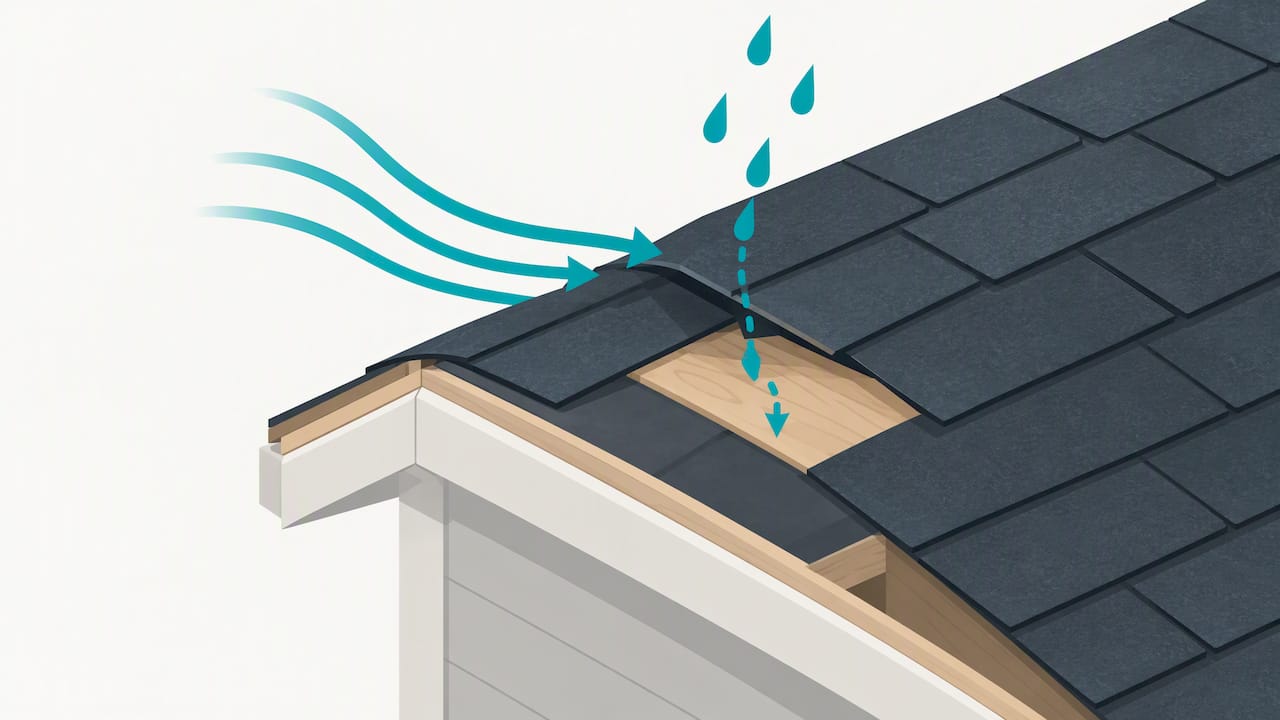
Why a small defect matters: Florida’s retrofit guidance warns that losing even one piece of roof sheathing can open the door to wind and water, so treating a visible cover defect as the whole problem can be costly.
Gutters, drains, vegetation and attic moisture
Most Tampa roof trouble starts with water that has nowhere to go. A blocked gutter overflows onto fascia and soffits. A clogged scupper on a flat section leaves water standing on the membrane, and ponding stresses seams and edges over time.
- Gutters and downspouts: clean them at least twice a year, and more often if trees overhang the roof. Overflow lines, sagging runs and water marks on fascia are your warning signs.
- Drains and scuppers: after every heavy storm, confirm water drains off low-slope areas rather than lingering.
- Vegetation: trim limbs back from the roof, clear valleys of leaves and needles, and remove organic buildup before it holds moisture against the surface.
- Attic moisture: keep vents unblocked and check for damp insulation. A professional can tell condensation from a true roof leak, which changes the repair entirely.
What annual roof maintenance costs in Tampa
We don’t publish a flat price for maintenance, and we would rather tell you that than quote a number that doesn’t fit your roof. What a visit costs depends on the size of the roof, its pitch and height, the material, how many penetrations and valleys it has, and whether the work is a standalone inspection or a full maintenance plan with cleaning and minor repairs.
A few things reliably push the number up or down:
- Roof type: tile and metal take more time and care to inspect than a simple shingle roof, and low-slope sections add drain and seam checks.
- Access: steep or multi-story roofs need more equipment and labor.
- Scope: a visual inspection with photos and a written report costs less than a plan that bundles gutter cleaning, sealant touch-ups and debris removal.
- Condition: a roof with documented, ongoing care tends to need smaller fixes than one that has gone untouched for years.
The best comparison is cost against what neglect can produce. Treating a small cover defect as the whole problem is one of the costliest mistakes, since a single lost piece of sheathing can lead to large interior damage. Ask us for an inspection quote on your specific roof, and we will give you a straight answer on what the visit covers.
Maintenance timing for commercial roofs in Tampa
Commercial roofs follow the same logic as homes, with a few differences in scale and structure. Many commercial buildings have flat or low-slope assemblies, which means seams, flashing anchorage, drains, scuppers and rooftop equipment matter even more than they do on a pitched residential roof. Florida’s membrane and built-up roof guidance names those same items as the focus.
A practical rhythm for a commercial property looks like this:
- Once a year at minimum: a full professional inspection of surface, seams, flashing, drains, edges and equipment curbs.
- Before tropical season: clear drains and scuppers, remove debris, and secure loose items on the roof.
- After every significant storm: a documented check for ponding, displaced flashing and damage around rooftop units.
- After storm season: debris removal, a corrosion and sealant review, and an update to the roof record.
Timelines depend on building size and access, so a small retail roof may take a single visit while a larger property is planned in phases. Follow the roof manufacturer’s requirements for exact timing, and keep a running file of photos and findings. If your property has flat sections, our commercial roofing team can build the schedule around your building.
Our perspective on inspection depth and recordkeeping
Most people judge a roof by what they can see from the driveway, and that is exactly where inspections go wrong. Florida’s guidance makes the point that the covering, sheathing, framing, vents, edges and wall connections work as one system. A report that only counts worn shingles can miss the failure path behind a large interior loss. We look at the deck, edges, fasteners and roof-to-wall connections, and we keep records that line up with manufacturer expectations. After a visit, you get clear next steps.
— Ryan
How we help with inspections, maintenance and storm response
We turn the schedule above into something you can simply book. Our team is manufacturer-certified and factory-trained, and we work across the Tampa Bay area. Here is what we offer:
- Roof inspections
- Preventative roof maintenance
- Storm damage restoration
- Roof repairs
- Replacement when an inspection shows repair is no longer enough, through our roof replacement service
Schedule a visit, and we will inspect the roof, document what we find and explain your options in plain terms. Ready to get started? Book your roof inspection through our services page.

FAQ
How long does a roof usually last in Florida?
It depends on the material, the installation and how well the roof is maintained. Florida’s heat, humidity and storms are hard on every roof type, which is why annual inspections and prompt repairs matter. Ask a licensed roofer to assess your specific roof rather than relying on a generic number.
Is $30,000 too much for a roof?
Not necessarily. Roof cost depends on size, pitch, material, access and the condition of the deck underneath. The better test is whether the quote itemizes the scope, including decking and flashing, so you can compare it fairly. We provide estimates after an inspection.
How much does a metal roof cost for a 2,000 square foot home?
The price varies with panel type, roof complexity and the work needed on the deck and flashing. We do not publish a flat price for metal roofing, so the reliable way to get a number is an on-site inspection and written estimate. See our metal roofing page for what we install.
Does a metal roof lower your insurance in Florida?
Sometimes, but it depends on your insurer and how the roof is installed and documented. Ask your insurance company which roof features and inspection records it credits. Keeping dated photos and written inspection findings gives you the paperwork to support those conversations.