
Florida homeowners should walk their roofline once a month, book a full professional inspection every spring before June 1 and again every fall, and call for an inspection after any storm with strong winds. This rhythm catches small problems before they become emergency replacements and creates the documentation insurers want for mitigation discounts. A licensed roofing contractor can handle both the spring and fall inspections for Tampa Bay homeowners who want that paperwork done right.
TL;DR:
- Florida homeowners should conduct monthly roof walkarounds and schedule professional inspections every spring and fall to catch small issues before storm season.
- The storm season from June 1 to November 30 makes pre-season inspections and repairs critical, especially before June when insurance coverage cannot be increased.
- Mitigation upgrades like roof-to-wall clips and impact-rated shutters can lower insurance premiums and must be documented during inspections for eligibility.
- Regular checks for wind damage, algae buildup, and material wear are essential, with specific attention to shingle granules, cracked tiles, and ponding water on flat roofs.
- Homeowners should book inspections early, especially in April and May, to ensure documentation is completed before storm warnings, reducing risk and insurance complications.
Table of Contents
- Why Florida needs a seasonally tailored roof plan
- Month-by-month roof maintenance checklist for Florida homeowners
- Quick monthly, quarterly, and biannual roof checklists
- When to call a professional and what the inspection covers
- Wind mitigation upgrades that can lower insurance premiums
- Common Florida roof damage and material-specific care
- How Coastal Roofing & Construction supports this schedule
- What most homeowners get wrong about roof timing
- Schedule an inspection with a local Tampa Bay roofing contractor
- Where these figures and rules come from
- Sources
- FAQ
Why Florida needs a seasonally tailored roof plan
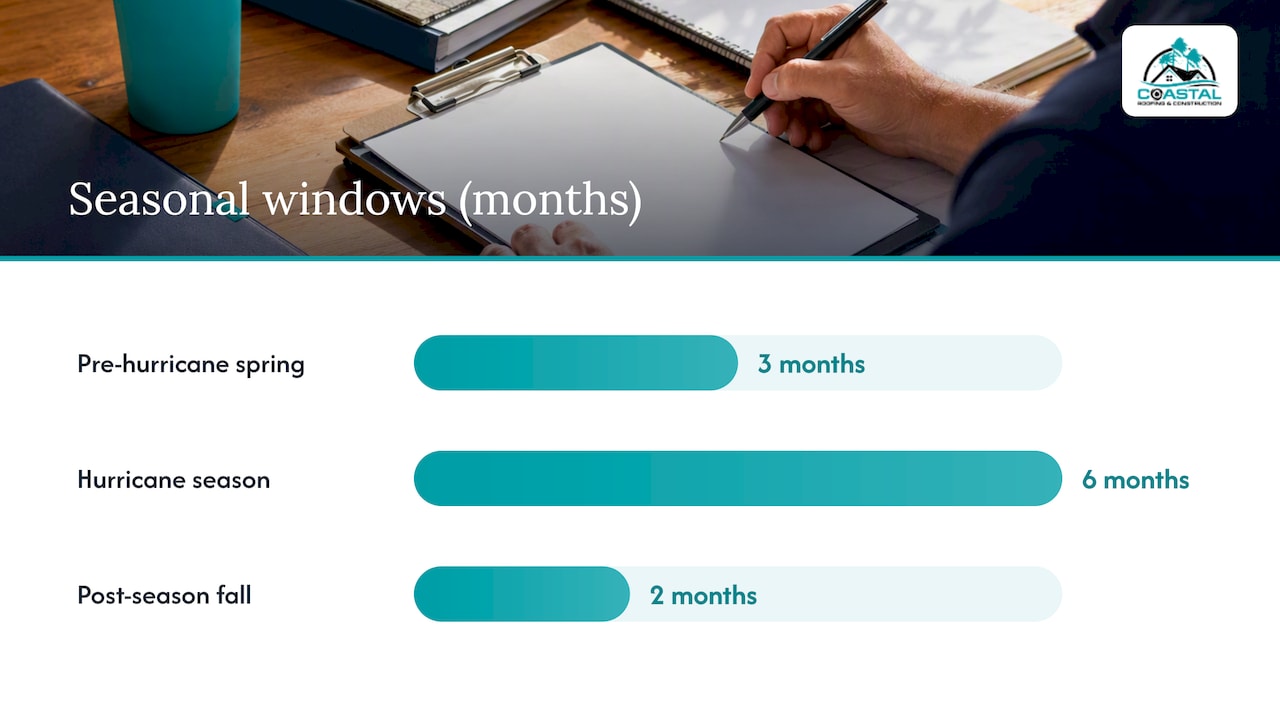
Florida roofs age differently than roofs almost anywhere else in the country. The Atlantic hurricane season runs from June 1 to November 30, with activity peaking in early September, which means every roof on the Gulf Coast faces roughly six months of wind, driving rain and pressure changes every single year. That timeline shapes the entire maintenance calendar: work has to happen before the season opens, not during it.
The other half of the problem is slower and quieter. Intense UV exposure breaks down asphalt shingle granules and dries out sealants, while Florida’s humidity feeds algae and mildew growth on shaded or north-facing slopes almost year round. Neither issue causes a sudden leak, but both shorten a roof’s working life if ignored.
That combination of storm risk and climate wear is why the maintenance calendar splits into two primary windows:
- Spring (March through May): pre-hurricane preparation, full inspection, and repair of anything found before storm season opens.
- Fall (November through December): post-season assessment to catch storm fatigue, loosened fasteners and hidden leaks before winter.
Everything else on this schedule, the monthly walkarounds and quarterly checks, exists to support those two windows rather than replace them.
Month-by-month roof maintenance checklist for Florida homeowners
A full year of roof care breaks down into manageable steps. Most months only need a homeowner’s eyes and a pair of binoculars; a handful call for a licensed contractor.
- January: Do a visual walkaround from the ground, checking for missing or lifted shingles and debris in valleys. This is a DIY task that takes about 15 minutes.
- February: Clean gutters and downspouts of leaves and roof grit before spring rains start. DIY, unless the roof has steep pitches or multiple stories.
- March: Schedule the spring professional inspection now, before contractor calendars fill up ahead of hurricane season. This is the month to book, not necessarily the month the inspection happens.
- April: Complete the full professional roof inspection, including flashing, attachment points and roof-to-wall connections. This is a pro-only task and the best month to also request wind mitigation documentation.
- May: Finish any repairs flagged in April and confirm mitigation paperwork is filed before June 1. Mixed DIY and pro, but treat this as a hard deadline, not a suggestion.
- June: Trim overhanging branches and re-check attic insulation and ventilation for moisture stains. DIY for trimming; call a pro if you find staining.
- July: Inspect after any named storm, even a near miss, looking for lifted shingles or tiles and soft spots underfoot. DIY visual check, pro inspection if anything looks off.
- August: Confirm storm-watch supplies are ready: tarps, contractor contact numbers, and a list of recent roof work for reference. DIY prep task.
- September: Expect the season’s peak activity and treat any storm with sustained winds over roughly 50 mph as an automatic trigger for a professional inspection. Pro-only after a real storm.
- October: Photograph the roof from all four sides for your records, even if nothing happened this month. DIY, and keep the photos with your insurance file.
- November: Book and complete the fall post-season inspection, checking for storm fatigue and loosened fasteners the summer may have caused. Pro-only.
- December: Clean gutters again, seal any minor gaps around vents or skylights, and file the year’s documentation. DIY for cleaning and sealing; pro-only if a leak has already appeared.
April and May carry the heaviest weight on this calendar. Anything left unresolved once hurricane season opens on June 1 remains unresolved until the storm passes, since Florida law prevents adding or increasing coverage once a storm watch or warning is issued.
Quick monthly, quarterly, and biannual roof checklists
Not every month needs a deep inspection. A short, repeatable routine covers most of the year.
Monthly (15 minutes):
- Walk the perimeter and scan the roofline for missing, curled or lifted material.
- Clear gutters and downspouts of debris so water has somewhere to go.
- Check the attic for water stains, daylight gaps or a musty smell.
Quarterly (30 to 45 minutes):
- Check attic ventilation and insulation for compression or moisture.
- Look for lifted or cracked flashing around chimneys, skylights and vent pipes.
- Inspect soffits and fascia for soft spots or peeling paint.
Biannual (professional, timed to April and November):
- Full roof covering inspection tied to the spring pre-hurricane and fall post-season windows.
- Wind mitigation documentation update if anything on the roof has changed since the last filing.
The April and November timing is not arbitrary. It lines up with the two windows described above and gives homeowners a paper trail that matches what insurers ask for during claims or renewal.
When to call a professional and what the inspection covers
A monthly walkaround catches obvious problems, but some situations call for a licensed inspector every time. Book a professional inspection each spring and fall as a baseline, and always after a storm with sustained winds over roughly 50 mph, since damage like displaced ridge caps or lifted tiles is often invisible from the ground.
A proper roof inspection documents:
- Roof covering condition, age and material type.
- Attachment strength at deck, truss and roof-to-wall connections.
- Flashing condition around penetrations, valleys and roof-to-wall joints.
- Secondary water resistance where applicable.
- Photo documentation and itemized reporting for insurance files.
A completed Uniform Mitigation Verification Inspection Form stays valid for five years if the roof is unchanged, which turns a single inspection into a multi-year line item on a windstorm policy. A new version of that form applies to inspections completed on or after April 1, 2026, so homeowners due for renewal should confirm which version their inspector is using.
Wind mitigation upgrades that can lower insurance premiums
Mitigation work does two jobs at once: it strengthens the roof against wind, and it can qualify a home for lower windstorm premiums. Florida homes built to the 2001 Building Code or later automatically qualify for a substantial windstorm discount, and older homes can close part of that gap with documented upgrades.
Common upgrades include:
- Roof-to-wall clips or straps, which the Florida Department of Financial Services notes can support wind resistance up to roughly 100 mph when installed correctly.
- Secondary water resistance barriers under the roof covering.
- Hip roof shapes, which generally shed wind better than gable designs.
- Impact-rated shutters and reinforced garage doors, which protect the structure that holds the roof down.
Each of these items has its own line on the Uniform Mitigation Verification Form, so an inspector needs to see and photograph the work directly. Confirm any contractor performing mitigation upgrades is licensed in Florida, and plan the work for spring so it is finished and documented before June 1.
Common Florida roof damage and material-specific care
Florida’s climate produces a fairly predictable list of problems: wind-lifted tiles, granule loss on aging shingles, algae streaking on shaded slopes, and flashing or fascia damage where water collects. Recognizing these early keeps small fixes from becoming full replacements.
- Shingle roofs: Watch for granule buildup in gutters and curling edges; DIY visual checks are fine, but resealing and replacement are pro-only.
- Tile roofs: Cracked or slipped tiles need a pro, since walking on tile improperly can cause more damage.
- Metal roofing: Check fastener heads and seams for corrosion; this is largely a pro job given roof pitch and panel spacing.
- Flat roofs: Look for ponding water after rain, which signals a drainage problem a professional should address quickly.
How Coastal Roofing & Construction supports this schedule
Licensed and insured family-owned roofing contractors in Tampa Bay are often built around manufacturer certifications with Owens Corning, GAF and Tri County Metals.
- Spring and fall roof inspections with photo documentation for insurance files.
- Mitigation-related repair work and roof repair for items found during a checkup.
- Roof replacement when an inspection shows a roof is past the point of repair.
What most homeowners get wrong about roof timing
Most Florida homeowners treat roof maintenance as a reaction to a leak instead of a calendar item, and by the time a stain shows up on the ceiling, the damage underneath has usually been building for months. The bigger mistake is waiting until June to schedule a spring inspection, when contractors are already booked solid and insurers will not add coverage once a storm warning is active. File your mitigation paperwork in April, not August.
— Ryan
Schedule an inspection with a local Tampa Bay roofing contractor
Local roofing contractors can handle the inspections, documentation and repair work this schedule calls for, assisting Tampa Bay homeowners with managing the paperwork.

- Spring and fall roof inspections timed to hurricane season.
- Repairs and mitigation upgrades identified during a checkup.
- Roof replacement for roofs beyond the point of cost-effective repair.
Homeowners across Pinellas, Hillsborough and Pasco Counties can reach out through our services page to book a spring or fall inspection before the next window closes.
Where these figures and rules come from
These sources back the schedule, timing and discount figures used above:
- NOAA Tropical Cyclone Climatology: official Atlantic hurricane season dates and peak timing.
- Florida CFO: Premium Discounts for Hurricane Loss Mitigation: windstorm discount rules and mitigation form guidance.
- Florida DFS Mitigation Guidance: roof-to-wall connection and clip/strap standards.
- Florida Inspection Services: roof condition inspections: what a professional inspection documents and why.
Sources
- Tropical Cyclone Climatology
- Premium Discounts for Hurricane Loss Mitigation
- Mitigation | Plan Prepare Protect
- Roof condition inspections — Florida Inspection Services
FAQ
What is the new law in Florida about roofs?
Florida updated the Uniform Mitigation Verification Inspection Form, with a new version applying to inspections completed on or after April 1, 2026. Homeowners renewing insurance around that date should confirm which version their inspector uses.
What is the 25 percent rule for roofs in Florida?
Roofing rules that reference a repair percentage vary by local building code and have changed in recent years, so homeowners should confirm the current requirement with their county building department or a licensed roofing contractor before assuming a specific threshold applies.
What is the 15 year roof rule in Florida?
Some Florida insurers require a roof inspection or a minimum remaining life certification once a roof passes a certain age, often cited around 15 years, before renewing or issuing a policy. This varies by carrier, so homeowners should check their specific policy terms rather than assume a single statewide rule.
How often does a roof have to be replaced in Florida?
There is no fixed statewide replacement age; timing depends on material, installation quality and how consistently the roof has been maintained. A shingle roof kept on the spring and fall inspection schedule described above tends to reach the upper end of its expected lifespan rather than failing early.