
Report roof damage to your insurer right away and start documenting everything with photos, video, and receipts. Florida statute s. 627.70132 sets a notice deadline after a loss, and the Homeowner Claims Bill of Rights sets insurer response windows. Acting fast protects your claim and your timeline.
TL;DR:
- File even minor roof damage, because Florida hurricane deductibles apply per calendar year and an early claim documents losses if another storm adds damage.
- Photograph roof and interior damage before temporary repairs, then keep dated images, receipts, and a licensed contractor’s written report with measurements and an itemized estimate.
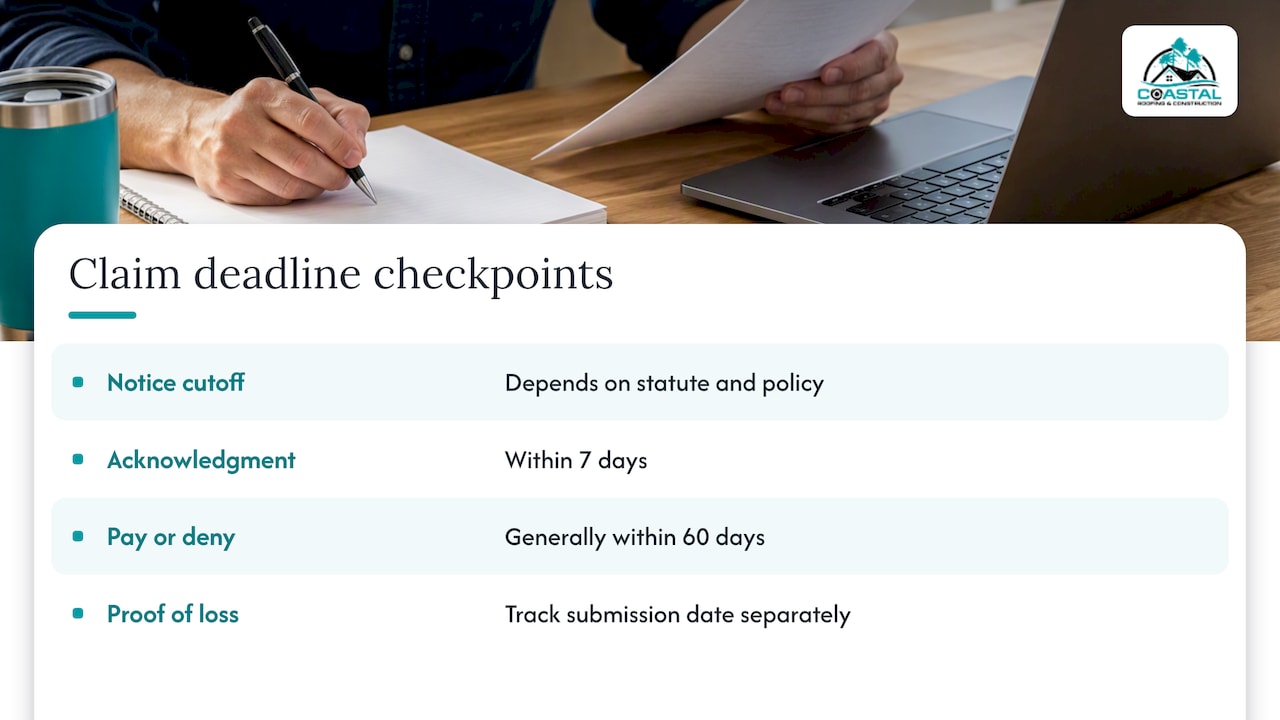
- Florida insurers must acknowledge claims within 7 days and generally pay or deny them within 60 days, while statutory notice deadlines vary by claim type.
- If more than 25% of a roof section needs repair within 12 months, building code requirements may require updates to the entire affected section.
- If the insurer denies or underpays the claim, request a reinspection with new evidence, then consider mediation through Florida’s Department of Financial Services.
Table of Contents
- Step-by-step filing checklist: from discovery to formal claim submission
- Documenting damage: photos, reports, receipts, and how to organize evidence
- Florida deadlines and rules that affect your claim
- Preparing for the adjuster inspection
- When a claim is denied or underpaid: practical remedies
- Realistic timelines: how long each claim stage typically takes
- Contractor perspective: what we see working in Tampa Bay claims
- How we can help with your roof insurance claim
- FAQ
- Sources
Step-by-step filing checklist: from discovery to formal claim submission
Before you pick up the phone, gather your policy number, the approximate date and time the damage occurred, and a basic description of what happened. Insurers may ask for these details, and having them ready can help the call go smoothly.
Even if the damage looks minor or seems to fall under your hurricane deductible, file anyway. The Homeowners’ Insurance Toolkit notes that hurricane deductibles apply per calendar year, so a documented claim now can matter if another storm adds damage later in the same year. Filing also creates a record that counts toward meeting that deductible.
Once you report the loss, decide whether to request a contractor inspection before or alongside the insurer’s adjuster visit. A professional roof inspection gives you an independent record of the damage that you can compare against the adjuster’s findings.
Follow this sequence:
- Call your insurer or use their online portal to report the loss and get a claim number.
- Photograph and video all visible damage before making any temporary repairs.
- Schedule a licensed roofing contractor’s inspection for an independent damage assessment.
- Request the insurer’s adjuster inspection and confirm the appointment in writing.
- Submit any requested proof-of-loss form along with your documentation.
Pro Tip: Save every email and text exchange with your insurer in one folder labeled with your claim number so you can find it instantly if a dispute comes up later.
Documenting damage: photos, reports, receipts, and how to organize evidence
Strong documentation is what separates a smooth claim from a drawn-out dispute. Adjusters and claims staff move faster when they can verify damage without guesswork.
- Take wide shots showing the full roof section alongside marked close-ups of specific damage points, all with date stamps.
- Photograph interior ceilings and walls if you have any signs of leaking, since water intrusion often supports the exterior damage claim.
- Keep every receipt for temporary repairs, tarping, or materials, and note who performed the work and when.
- Ask your contractor for a written inspection report with measurements, photos, and an itemized repair or replacement estimate.
- Log every call and email with your insurer, noting the date, the representative’s name, and your claim number.
A storm damage inspection checklist can help you organize this evidence before the adjuster ever arrives.
Florida deadlines and rules that affect your claim
Florida law sets deadlines for reporting roof damage. Check the statute and your policy for the applicable deadline. Under s. 627.70132, deadlines apply to initial, reopened, and supplemental claims. Check the statute and your policy for the applicable deadline.
The Homeowner Claims Bill of Rights requires insurers to acknowledge your claim within 7 days and generally pay or deny it within 60 days, with interest potentially owed on late payments. Insurers must also provide a copy of an estimate after generating it.
Separately, Florida’s building code includes a rule often called the roof-section repair rule: under certain conditions, code requirements may mean bringing an entire roof section up to current standards, which can affect whether a claim involves repair or replacement.
Mark key dates on your calendar: the day you reported the loss, any acknowledgment deadline, any proof-of-loss submission date, and the applicable notice cutoffs.
Preparing for the adjuster inspection
The person who inspects your roof depends on who they work for. A company adjuster is a direct insurer employee, an independent adjuster is contracted by the insurer but not on staff, and a public adjuster is hired by you to represent your interests. Knowing which one you’re dealing with helps you understand whose priorities are at the table.
Before the visit, have these ready:
- Your photo and video log organized by date.
- Any contractor inspection report and itemized estimate.
- Records of prior roof maintenance or repairs.
- A list of specific questions about areas you’re concerned the adjuster might miss.
Pro Tip: Walk the roof perimeter with the adjuster when it’s safe to do so, and take your own photos during the visit so you have a record that matches theirs.
Always ask for a written copy of the adjuster’s estimate and inspection notes. If something seems off compared to your contractor’s findings, raise it immediately rather than waiting for the settlement letter.
When a claim is denied or underpaid: practical remedies
A denial or lowball offer isn’t the end of the process. Florida gives homeowners several formal paths to push back.
- Request a reinspection and submit any new documentation, such as an updated contractor estimate.
- Consider hiring a public adjuster, who typically works on a percentage of the settlement, and verify their license through the Florida Office of Insurance Regulation.
- File a complaint or request mediation through Florida’s Department of Financial Services, which offers no-cost neutral evaluation for many claims.
- Consult legal counsel if you notice patterns like repeated lowball offers or unexplained delays that suggest bad faith handling.
Each step builds a stronger record, so keep adding evidence rather than waiting passively between escalations.
Realistic timelines: how long each claim stage typically takes
Most non-disaster claims follow a predictable rhythm: acknowledgment within about a week, an inspection scheduled within two to three weeks, an estimate shortly after, and payment or denial typically within 60 days under the Homeowner Claims Bill of Rights.
Supplemental claims, permit requirements, or a 25% rule determination can add weeks or months to that timeline since they often require additional documentation and review.
- Follow up with your insurer if you haven’t heard back within the applicable acknowledgment window.
- Put every follow-up request in writing and reference your claim number.
- Contact Florida DFS if delays stretch well past the 60 day expectation.
- Submit any written proof-of-loss promptly, since incomplete paperwork is a common cause of delay.
If water intrudes through a damaged section before repairs begin, a partner resource on water-damaged hardwood triage covers interior mitigation, which can help limit secondary damage while your roof claim moves forward.
Contractor perspective: what we see working in Tampa Bay claims
After Tampa storms, we consistently see the same pattern: homeowners who photograph damage immediately and get a licensed inspection early have smoother claims than those who wait. An itemized estimate from a manufacturer-certified installer tends to answer an adjuster’s scope questions before they become disputes, because it documents exactly what the repair or replacement requires and why.
— Ryan
How we can help with your roof insurance claim
We offer roof inspections for Tampa Bay homeowners navigating a claim, backed by manufacturer certifications with Owens Corning, GAF, and Tri County Metals. Hiring a licensed, certified contractor matters because insurers rely on detailed, accurate scope documentation when they evaluate repair versus replacement.

- We provide documented roof inspections that give you an independent record for your claim file.
- We provide estimates for roofing work.
- We help address roof damage while your claim is pending.
- We complete licensed repair and replacement work once your claim is approved.
If you’re dealing with storm damage right now, schedule a roof inspection with our team and get documentation that supports your claim from day one.
This article is general information, not a substitute for advice from a qualified financial advisor. Consult a qualified financial professional about your own circumstances before acting on anything here.
FAQ
What is the new law in Florida about roofs?
Florida’s statute s. 627.70132 sets notice deadlines for initial, reopened, and supplemental roof claims. Check the statute and your policy for the applicable deadline. These notice requirements apply across Florida, so check the statute and your policy promptly to understand how they affect your claim.
How long does a roof insurance claim take?
Under the Homeowner Claims Bill of Rights, insurers must acknowledge your claim within 7 days and typically pay or deny it within 60 days.
Should I file an insurance claim for a roof?
Yes, filing is usually worthwhile even if the damage looks minor, since hurricane deductibles apply per calendar year and a documented claim can matter if later storms add cumulative damage. Filing also creates a formal record that protects you if the damage worsens over time.
What is the 25% roof rule in Florida?
The 25% rule comes from the Florida Building Code and applies when more than 25% of a roof section needs repair within a 12 month period. Depending on the circumstances, code requirements may call for bringing the affected section up to current standards, which can affect the scope of repairs.
What should I do if my roof claim is denied?
Start by requesting a reinspection and submitting any new documentation, such as an updated contractor estimate. You can also request mediation through Florida’s Department of Financial Services or consult legal counsel if the denial pattern suggests unfair claims handling.
Sources
-
[Statutes & Constitution
:View Statutes
:Online Sunshine](https://www.leg.state.fl.us/Statutes/index.cfm?App_mode=Display_Statute&URL=0600-0699%2F0627%2FSections%2F0627.70132.html)