
A standard professional roof inspection in Tampa costs around $136 on average, with most homeowners paying somewhere between $96 and $191. Drone and infrared inspections run higher, and if you need an insurance-grade wind mitigation or four-point form, expect to pay more for the added documentation insurers require.
TL;DR:
- Standard visual inspections cost $96 to $191, while drone checks run $155 to $405 and infrared scans cost $405 to $610 for hidden moisture.
- Contractor estimates are often free, but signed insurance forms usually cost extra; eligible homeowners may receive free mitigation inspections through My Safe Florida Home.
- Wind mitigation forms remain valid for up to five years, but inspections after April 1, 2026, must follow revised documentation rules and use qualified signers.
- Homes below about 2,500 square feet often receive flat fee quotes, while larger, steep, tiled, or multi plane roofs may require custom pricing.
- Before booking, confirm the inspector can sign the required form, provide a signed photo report, and document fees, scope, and reinspection terms.
Table of Contents
- Local price bands: standard, drone, and infrared inspections
- Free inspections vs paid certifications: what homeowners should expect
- Insurance-grade inspections: OIR-B1-1802, four-point forms, and who can sign them
- What your inspection report includes and how to use it
- How roof size, material, and complexity affect your estimate
- How to choose a qualified roof inspector in Tampa
- Our approach to roof inspections at Coastal Roofing & Construction
- Schedule a roof inspection with Coastal Roofing & Construction
- FAQ
- Sources
Local price bands: standard, drone, and infrared inspections
The method an inspector uses to check your roof drives most of the price difference. A standard walk-the-roof visual inspection is the least expensive option, averaging $136 in the Tampa area, with a typical range of $96 to $191. This is the right choice for routine maintenance checks, pre-sale evaluations, or a general health check after a storm.
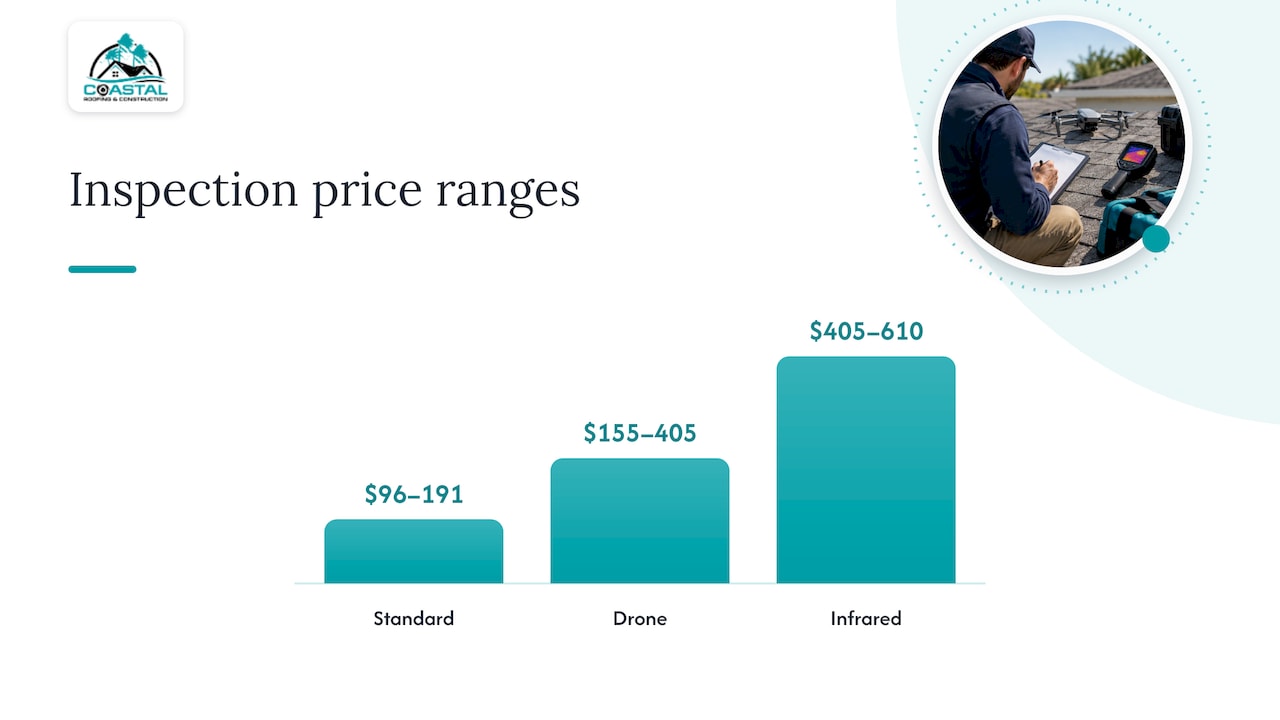
Drone inspections cost more because they require specialized equipment and a trained operator, with local prices ranging from $155 to $405. Infrared thermography sits at the top of the price range, typically costing $405 to $610, since it detects moisture trapped under roofing materials that a visual check would miss entirely.
Several factors push these baseline prices up or down:
- Roof size: more square footage means more time spent documenting the surface, fasteners, and flashing.
- Pitch and story count: steep or multi-level roofs require safety equipment and slow down the inspection.
- Material: tile and metal roofs take longer to walk and photograph than asphalt shingles.
- Access: roofs surrounded by landscaping, pools, or tight property lines add setup time.
- Complexity: multiple valleys, skylights, chimneys, and dormers each add inspection points.
To give you a rough sense of scale, a straightforward 1,000-square-foot single-story asphalt shingle roof typically lands at the low end of the standard range. A 1,700-square-foot roof with moderate pitch sits closer to the middle of that range. A 2,000-square-foot roof with multiple roof planes or a second story pushes toward the higher end, and a 3,000-square-foot roof, especially one with tile or metal, often requires the inspector to quote a custom fee rather than a flat rate. These are illustrative scenarios to help you anticipate cost, not quoted prices.
Free inspections vs paid certifications: what homeowners should expect
“Free inspection” and “paid certification” mean different things, and mixing them up leads to surprises. A free estimate usually means a contractor walks your roof, takes a few photos, and gives you a verbal or written assessment with the goal of quoting repair or replacement work. A paid certification means a licensed professional completes a formal, signed document, often an insurance form, that follows a specific state format and carries legal weight with your insurer.
Common scenarios that typically come at no cost:
- A contractor evaluating storm damage before quoting repairs.
- A pre-purchase walkthrough offered as part of a larger roofing consultation.
- A routine maintenance check offered to existing customers.
Scenarios that almost always require a paid fee include any signed wind mitigation form, a four-point inspection for insurance underwriting, or a certification requested for a real estate closing.
The My Safe Florida Home Program can cover free hurricane mitigation inspections and offer matching grants for qualifying homeowners, which can offset or eliminate the cost of a wind mitigation inspection entirely. Eligibility depends on factors like your home’s insured value and construction date, so check current program requirements before assuming you qualify.
Insurance-grade inspections: OIR-B1-1802, four-point forms, and who can sign them
If your goal is a lower windstorm premium or your insurer requires proof of your roof’s condition, you need a specific type of inspection rather than a general walkthrough. The Uniform Mitigation Verification Inspection Form, known as OIR-B1-1802, documents features like your roof’s age, covering, deck attachment, and opening protection so your insurer can calculate wind mitigation credits. A revised version of this form (Rev. 04/26) took effect April 1, 2026, and it includes more specific documentation requirements than the prior version, which means homeowners ordering inspections after that date should expect more detailed photo and measurement requirements.
Not just anyone can sign this form. Qualified signers include licensed home inspectors with hurricane mitigation training, licensed general, building, or residential contractors, professional engineers, and architects, and your insurer retains the right to independently verify any submitted form. Contractors may authorize qualified direct employees to conduct the inspection in limited circumstances, but the inspector must personally inspect the structure, and insurers can request proof of the signer’s qualifications at any time.
A four-point inspection, which covers your roof, electrical, plumbing, and HVAC systems, is a separate form insurers often require for older homes before issuing or renewing a policy.
| Inspection type | Typical fee range | Validity |
|---|---|---|
| Standard visual inspection | $96 to $191 | No formal expiration |
| Drone inspection | $155 to $405 | No formal expiration |
| Infrared thermography | $405 to $610 | No formal expiration |
| Wind mitigation (OIR-B1-1802) | Paid certification fee | Up to five years |
Because a completed wind mitigation form stays valid for up to five years, keep a copy on hand for policy renewals or when switching insurers. Resubmitting an expired or missing form means paying for a new inspection you might otherwise have avoided.
What your inspection report includes and how to use it
A thorough report is more than a checklist. It typically opens with an executive summary of the roof’s overall condition, followed by dated photographs of every major area, condition ratings for materials and components, an estimate of remaining useful life, and a prioritized list of repairs ranked by urgency.
Good inspectors document specific details that matter for both safety and insurability:
- Flashing condition around chimneys, vents, and roof-to-wall transitions, where leaks most often start.
- Fastener type and spacing, which affects wind mitigation credits and structural integrity.
- Ventilation adequacy, since poor airflow shortens shingle life and promotes moisture buildup.
- Underlayment condition, checked wherever it’s visible at edges or penetrations.
- Evidence of past or active leaks, including staining, soft decking, or mold in the attic.
Our article on common issues professionals identify during an inspection walks through how these findings typically show up on a real roof.
Pro Tip: Ask for the full photo set, not just the summary report. A detailed photo log gives your insurer and any contractor a clear record if you need repairs or want to dispute a claim denial later.
Use your report to negotiate repairs with a seller, support an insurance claim, or plan a maintenance budget before small issues become expensive ones.
How roof size, material, and complexity affect your estimate
Inspectors price jobs one of two ways: a flat fee for straightforward homes, or a per-square-foot rate once a roof passes a certain size or complexity threshold. Most single-family homes under about 2,500 square feet fall into flat-fee territory, while larger or more intricate roofs shift to custom quotes.
Material matters as much as size. Tile roofs cost more to inspect because walking on them risks cracking individual tiles, which slows the inspector down considerably. Metal roofs require careful attention to seams and fastener points, adding time even on a simple layout. A steep pitch or a second story adds safety rigging and more careful movement across the surface, both of which extend the inspection.
To estimate your own likely cost range before requesting quotes:
- Note your roof type: asphalt shingle, tile, metal, or flat.
- Count your stories and estimate your roof’s pitch.
- Get a rough square footage from your property records or a prior appraisal.
- Add a premium to your estimate if you have tile, a steep pitch, or more than one roof plane.
This quick math won’t replace an actual quote, but it keeps you from being surprised when a complex roof costs more than a neighbor’s simple one.
How to choose a qualified roof inspector in Tampa
Not every inspector can deliver every type of report, so match the inspector to your need before you book anything.
- Verify the license. Check Myfloridalicense to confirm the inspector holds an active license and ask directly whether they’re authorized to sign an OIR-B1-1802 or four-point form if you need one.
- Confirm insurance coverage. Ask for proof of liability insurance and workers’ compensation before anyone gets on your roof.
- Ask about deliverables up front. Confirm you’ll receive a signed PDF report with photos, not just a verbal summary.
- Clarify pricing and reinspection policy. Ask what happens if your insurer rejects the form or requests additional documentation.
- Get everything in writing. Insist on a written scope of work, listed fees, expected deliverables, and a timeline before the inspection date.
Useful questions to ask directly: “Do you personally sign the OIR-B1-1802?” “Will I get a signed PDF and full photo set?” and “What’s your fee if I need a reinspection?”
Pro Tip: Get your quote and scope in writing before scheduling. A vague verbal quote is the most common source of disputes once the final invoice arrives.
Our approach to roof inspections at Coastal Roofing & Construction
We’re licensed, insured, and manufacturer-certified through programs with Owens Corning, GAF, and Tri County Metals, which shapes how we evaluate every roof we inspect. Every inspection comes with a photo-backed report, and when a homeowner needs insurance-grade documentation, we can prepare it with the detail insurers expect.
We choose the inspection method based on what your roof and your goals require: a standard visual inspection for routine checks, drone coverage for hard-to-access or steep roofs, and infrared thermography when hidden moisture is a concern. After every inspection, we provide a written estimate, an itemized list of repair priorities, and a clear next step, whether that means a simple repair, a mitigation form, or a conversation about full replacement.
— Ryan
Schedule a roof inspection with Coastal Roofing & Construction
If you’re ready to get a straight answer on your roof’s condition, we make it easy to start. Visit our residential roof inspection page to schedule a standard inspection, or explore our full roof inspection services if you need drone, infrared, or insurance-grade documentation.
We serve homeowners throughout Tampa Bay, including Clearwater, St. Petersburg, Brandon, Palm Harbor, and surrounding Gulf Coast communities, with crews who handle everything from the first inspection through full roof replacement if your roof needs it. If your inspection reveals it’s time for a new roof, our roof inspection San Diego resources can help you understand the replacement process and material options.
FAQ
What is the average cost of a roof inspection in Florida?
A standard roof inspection in the Tampa, Florida area averages $136, with most homeowners paying between $96 and $191. Specialized drone or infrared inspections cost more due to the added equipment and documentation involved.
What is the 25% roof rule in Florida?
This term often refers to building code provisions that address how much of a roof can be repaired before full replacement rules apply, and the specifics depend on your local jurisdiction and the Florida Building Code. Check with a licensed contractor or your local building department for how this applies to your specific property.
How much does a typical roof inspection cost?
A typical professional roof inspection in the Tampa area costs about $136 on average, with a range of roughly $96 to $191 depending on roof size and complexity. Drone and infrared inspections cost more, and insurance-grade certifications like wind mitigation forms carry their own separate fees.
How much does it cost to roof a 1,500 sq ft house in Florida?
Roof replacement costs vary widely based on material choice, roof pitch, and local labor rates, so there’s no single published figure that applies to every home. For an accurate number on your specific property, request a written estimate through our roof replacement services page.
Do I need a wind mitigation inspection every year?
No. A completed wind mitigation inspection form is valid for up to five years, so keep your signed copy on file for renewals or when switching insurance carriers.
Sources
- How Much Does Roof Inspection Cost in Tampa, FL?
- Mitigation Notices, Inspections and Forms | Consumer Services | Florida Department of Financial Services
- Wind mitigation resources | Florida Office of Insurance Regulation
- Mitigation | Plan Prepare Protect Are You Disaster Ready | Office of the Insurance Consumer Advocate | Florida Department of Financial Services