
A roofing subcontractor is an independent trade business hired by a prime contractor or general contractor to perform a defined roofing scope under a written subcontract agreement. The homeowner never signs a contract with the subcontractor directly. The prime contractor holds that relationship and remains legally responsible for the work.
Three situations where a subcontractor typically enters the picture:
- Peak-season capacity: A prime contractor wins more jobs than its own crew can handle and brings in a sub to cover the overflow without adding permanent payroll.
- Specialty work: Standing seam metal roofing, clay tile, or spray polyurethane foam (SPF) requires skills and certifications most general crews do not carry.
- Manufacturer-certified installations: Products like Owens Corning’s TotalProtection or GAF’s System Plus warranty require factory-trained installers. Manufacturer warranties often require certified applicators, and using a non-certified crew can void that coverage entirely.
OSHA 29 CFR Part 1926 Subpart R governs fall protection for roofing operations and applies to every worker on the roof, whether they are a direct employee or a subcontractor’s crew member.
Table of Contents
- What does a roofing subcontractor actually do on the job?
- Subcontractor vs. roofing contractor vs. employee: how they differ
- Pros and cons of using roofing subcontractors
- Where to find roofing subcontractors: channels that actually deliver
- How to vet a roofing subcontractor before you sign anything
- Subcontract agreement essentials: clauses you must include
- Insurance, bonds, and liability: what you need to verify
- Typical rates and payment structures for roofing subcontract labor
- How to coordinate a roofing subcontractor on site from kickoff to closeout
- How Coastal Roofing & Construction manages subcontractors on Tampa Bay projects
- Key Takeaways
- Why subcontracting is an operational asset, not just a liability
- Coastal Roofing & Construction: certified local expertise for Tampa Bay homeowners
- Authoritative sources and further reading
What does a roofing subcontractor actually do on the job?
The scope varies by project, but most roofing subcontractors specialize in one or two of these areas:
- Metal roofing: — Standing seam panels, metal shingles, or exposed-fastener systems requiring specialized tooling and training.
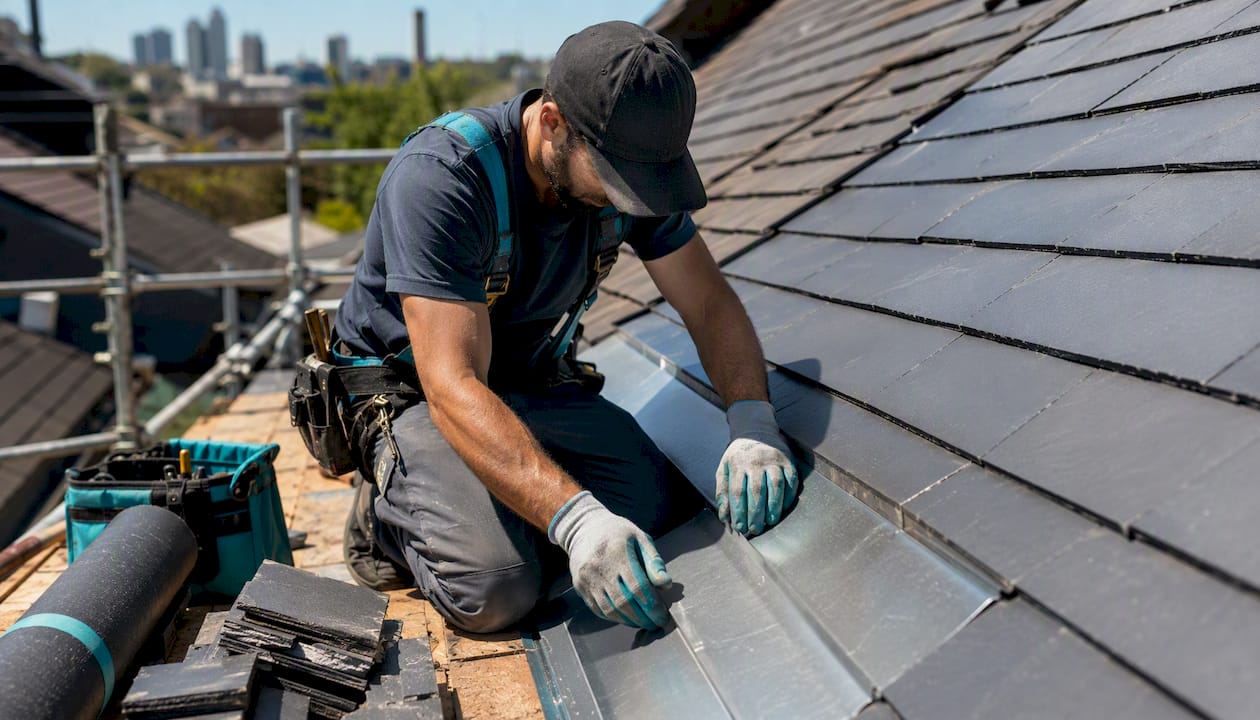
Operationally, a roofing subcontractor functions as an independent business. They supply their own labor, tools, and often materials. They carry their own insurance, manage their own payroll, and answer to the prime contractor, not the property owner.
Who pulls permits? Usually the prime contractor or GC, since they hold the license of record with the property owner. Licensing requirements vary by state, and in Florida, the contractor of record must hold a valid state license. The subcontractor may need their own license depending on the scope and local jurisdiction, so understanding permit and inspection responsibilities before work begins prevents costly surprises.
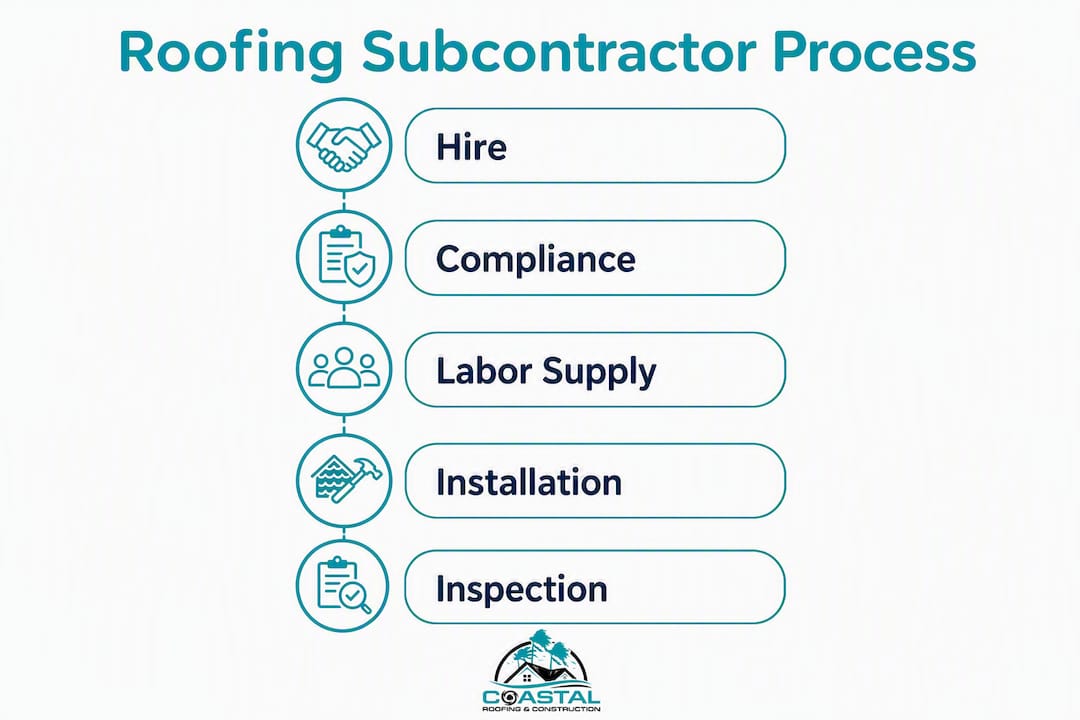
Subcontractor vs. roofing contractor vs. employee: how they differ
The contractual chain is the clearest way to see this. The property owner signs with the prime contractor. The prime contractor signs a separate subcontract with the roofing subcontractor. An employee, by contrast, is on the prime’s payroll, supervised daily, and covered under the prime’s workers’ compensation policy.

The IRS uses behavioral control, financial control, and the type of relationship to determine whether a worker is an employee or an independent contractor. Misclassifying an employee as a subcontractor is a federal and state compliance risk. The Department of Labor’s FLSA misclassification guidance makes clear that economic dependence, not just a contract label, determines status.
Practically speaking:
| Dimension | Subcontractor | Employee |
|---|---|---|
| Contract | Holds a subcontract with the prime | On prime’s payroll |
| Supervision | Works to scope; manages own crew | Directly supervised |
| Insurance | Carries own GL and workers’ comp | Covered under prime’s policy |
| Warranty responsibility | Defined in subcontract | Prime’s responsibility |
| Tax treatment | Independent contractor; responsible for own taxes | Receives W-2 |
Pro Tip: If a subcontractor works exclusively for you, uses only your tools, and follows your daily schedule, a court may reclassify them as an employee regardless of what the contract says. Review the relationship annually with a labor attorney, especially in Florida where construction misclassification enforcement has increased.
Pros and cons of using roofing subcontractors
Advantages worth knowing:
- Scalability: You can staff up for a storm-season surge without adding permanent headcount.
- Specialty certifications: Manufacturer-certified installers for GAF, Owens Corning, or Tri County Metals are often only available through specialty subcontractors.
- Cost flexibility: Subcontract labor is a variable cost. You pay per project, not per week.
- Speed: An experienced sub crew can mobilize faster than recruiting and onboarding new employees.
Real disadvantages to plan for:
- Liability exposure: Courts and regulators often hold the prime contractor accountable even when a subcontractor caused the loss. One-time vetting is not enough.
- Quality control: You are not supervising the crew directly. Without daily field checks, workmanship gaps can reach the final inspection.
- Second-tier labor risk: A subcontractor may bring in their own crews. If those workers are uninsured, the prime contractor absorbs the exposure.
- Warranty complications: Non-certified installers can void manufacturer warranties, which is a significant liability on high-value roofing systems.
When to prefer a subcontractor over a direct hire: specialty scope, short-duration projects, and situations where the manufacturer certification requirement makes a specific installer non-negotiable. For ongoing, high-volume work where you need consistent quality control, building an in-house crew often makes more financial sense over time.
Where to find roofing subcontractors: channels that actually deliver
Not all sourcing channels are equal. Here is what each one is genuinely good for:
Manufacturer certified-applicator lists are the best starting point for specialty work. GAF, Owens Corning, and similar manufacturers maintain directories of credentialed installers. If the job requires an NDL warranty, this list is non-negotiable. Check roofing certifications that matter before you start calling.
NRCA (National Roofing Contractors Association) directories connect you with members who have agreed to professional standards. Useful for finding established businesses rather than informal crews.
Local roofing supply houses are an underrated channel. Counter staff at ABC Supply, Beacon, or similar distributors know which crews are buying regularly and which ones have gone quiet. That buying activity is a proxy for how busy and financially stable a sub is.
Contractor networks and referrals remain the highest-trust channel. A recommendation from a GC who has worked with a sub on three jobs carries more weight than any online listing.
Trade labor platforms (such as BuildZoom or similar contractor-matching services) offer speed and volume, which is useful during storm-season surges when you need crews fast. Vet them more carefully, not less, because the platform’s screening varies.
For certified specialist work, go to manufacturer lists first. For capacity during a high-volume period, supplier contacts and contractor networks get you there faster.
How to vet a roofing subcontractor before you sign anything
This checklist applies whether you are a homeowner hiring through a GC or a prime contractor building your sub roster.
Pre-screen steps:
- Verify the contractor’s state license through the Florida Department of Business and Professional Regulation (DBPR) or your state’s equivalent licensing board.
- Confirm manufacturer certifications for the specific product being installed. A GAF-certified installer for shingles is not automatically certified for TPO membrane.
- Request references from at least three recent projects of similar scope and call them. Ask specifically about schedule adherence and how punch-list items were handled.
- Ask for photos of completed work, not just a portfolio PDF. Recent, dated job photos are more useful.
- Check OSHA compliance history and ask about fall-protection training. OSHA 29 CFR Part 1926 Subpart R sets the minimum standard for roofing fall protection at 6 feet or more.
Insurance verification steps:
- Request a certificate of insurance (COI) before any work begins. A COI alone is not sufficient. Require additional insured status and verify that the policy covers roofing and high-altitude operations, since some policies exclude them.
- Confirm active workers’ compensation coverage. Industry practice calls for at least $1 million per occurrence in general liability and active workers’ comp covering roofing operations.
- For large projects, call the carrier directly to confirm the policy is active and that the additional insured endorsement is in place.
Red flags that should stop the conversation:
- Evasive answers about who is actually working the job (second-tier crews).
- Expired COI or refusal to name you as additional insured.
- Unwillingness to accept flow-down clauses or permit responsibility.
- No verifiable license or manufacturer certification for the specified scope.
Subcontract agreement essentials: clauses you must include
A handshake and a price per square is not a subcontract. Written subcontract agreements are the primary tool for managing subcontractor risk, and the clauses below are the ones that actually matter when something goes wrong.
| Clause | What it protects | What to watch for |
|---|---|---|
| Scope of work | Defines exactly what the sub is and is not doing | Vague scope creates change-order disputes |
| Change order procedure | Controls cost and schedule changes | Verbal approvals lead to unpaid claims |
| Payment schedule | Ties payments to milestones | Avoid large upfront deposits without a lien waiver |
| Flow-down of prime obligations | Passes quality, permit, and code requirements to the sub | Missing this leaves the prime holding compliance risk |
| Insurance requirements | Sets minimum GL (often at least $1 million per occurrence), workers’ comp, and additional insured | Specify roofing operations coverage explicitly |
| Indemnity and defense | Allocates liability for sub-caused losses | Must comply with state anti-indemnity laws |
| Warranty terms | Defines sub’s workmanship warranty period | Align with manufacturer warranty requirements |
| Lien waiver procedures | Protects owner from double payment | Condition final payment on conditional/unconditional waiver |
| Prohibition on lower-tier subcontracting | Prevents unapproved second-tier crews | Require written approval for any sub-subcontractor |
| Termination for cause/convenience | Gives prime leverage to remove unsafe or underperforming crews | Define cure period and notice requirements |
Flow-down clauses deserve special attention. They pass the prime contract’s quality standards, permit compliance requirements, and safety obligations directly to the subcontractor. Without them, a sub can claim they were unaware of a code requirement the prime was contractually bound to meet.
Pro Tip: Indemnity language must be tailored to your state’s anti-indemnity statute. Florida, Texas, and California each have different rules about what a subcontractor can be required to indemnify. Broad indemnity clauses that work in one state can be unenforceable in another. Have a construction attorney review this clause before you use the contract.
Insurance, bonds, and liability: what you need to verify
Insurance and surety bonds are not the same thing, and confusing them is an expensive mistake.
| Coverage type | What it does | Who it protects |
|---|---|---|
| General liability insurance | Pays for third-party property damage or bodily injury claims | Prime contractor and property owner |
| Workers’ compensation | Covers medical costs and lost wages for injured workers | Injured workers; shields prime from direct claims |
| Completed operations coverage | Covers claims arising after the job is finished | Prime contractor and owner for post-completion defects |
| Performance bond | Guarantees the subcontractor completes the contracted scope | Property owner and prime contractor |
| Payment bond | Guarantees the sub pays its own suppliers and laborers | Suppliers and lower-tier workers; prevents liens |
Insurance defends against claims; a surety bond guarantees contractual performance to the owner. Both are worth requiring on high-value or high-risk jobs.
A COI is a snapshot, not a guarantee. The policy could be cancelled the day after the certificate is issued. For any project above a moderate dollar threshold, call the carrier directly to confirm active status and that the additional insured endorsement is on file. Verify that the policy does not exclude roofing or high-altitude work, since those exclusions appear more often than most contractors expect.
Second-tier subcontracting is the hidden liability most prime contractors do not catch until a claim arrives. If your sub brings in an uninsured crew and one of those workers is injured on your job site, you may be the party of record. Contractually prohibit unapproved lower-tier subcontracting and condition final payment on written confirmation that no unapproved crews worked the project.
Typical rates and payment structures for roofing subcontract labor
Roofing subcontract labor is typically priced one of three ways: per roofing square (100 square feet), per man-hour, or as a crew day rate. Per-square pricing is the most common for installation work because it ties payment directly to production. Hourly rates appear more often for repair work or specialty flashing where output is harder to measure in squares.
Rate ranges vary significantly by market, scope, and certification level. A basic tear-off and shingle installation crew in a mid-cost market will price differently than a manufacturer-certified standing seam metal crew in a coastal Florida market. Specialty certifications, material complexity, and local labor demand all move rates materially. Get at least three bids for any subcontract scope and evaluate them against a consistent set of criteria rather than defaulting to the lowest number.
Common payment structures:
- Progress payments tied to milestones: Payment released at tear-off completion, deck inspection, and final installation sign-off. This is the most risk-balanced approach for both parties.
- Retainage: Withholding 5–10% of each progress payment until final completion and lien waiver delivery. Standard on commercial projects; less common on residential but worth considering for large jobs.
- Material deposit: Reasonable for specialty materials with long lead times (standing seam panels, custom tile). Keep it proportional to actual material cost.
- Final payment conditioned on lien waivers: Never release the final payment without a conditional or unconditional lien waiver from the subcontractor and, on larger jobs, from their material suppliers.
Always confirm that the sub’s COI is current before releasing any payment. An expired policy at payment time is a signal worth investigating before the check goes out.
How to coordinate a roofing subcontractor on site from kickoff to closeout
Kickoff (day one, before anyone touches the roof):
- Confirm crew identity against the roster the sub submitted. Anyone not on the list does not work the job until the sub provides written authorization and proof of coverage.
- Verify that the COI and additional insured endorsement are current. Do not assume yesterday’s check is still valid.
- Walk the scope with the sub’s supervisor. Point out sensitive areas: landscaping to protect, gutters, HVAC equipment, and any access restrictions.
- Confirm the change order procedure. Any scope change requires written approval before work proceeds.
Daily coordination:
- Require a daily sign-in sheet. It documents who was on site and is your first line of defense if a worker injury claim surfaces later.
- Designate a single point of contact on both sides. Multiple communication channels create conflicting instructions.
- Your supervisor has authority to stop unsafe work immediately. Document the stop-work order in writing.
Closeout:
- Walk a formal punchlist with the sub’s supervisor before releasing the final payment milestone.
- Collect all warranty paperwork, manufacturer registration forms, and inspection sign-offs before the crew demobilizes.
- Obtain conditional lien waivers at each progress payment and an unconditional lien waiver at final payment.
- File all documentation (COIs, rosters, lien waivers, warranty registrations) in a project folder. Manufacturer warranty claims and insurance claims both require this paper trail.
How Coastal Roofing & Construction manages subcontractors on Tampa Bay projects
Coastal Roofing & Construction operates as a licensed, insured, family-owned contractor in the Tampa Bay area, and the company’s subcontractor program reflects the liability realities of Florida’s coastal construction environment.
Every subcontractor working under Coastal Roofing & Construction must carry current general liability and workers’ compensation insurance, with the company named as additional insured. Manufacturer certifications are verified for the specific product being installed, not just the product category. A GAF-certified crew for shingles does not automatically qualify for a standing seam metal scope, and the company enforces that distinction on every project.
Field controls include daily crew rosters, on-site supervision, and documented sign-in procedures. Flow-down clauses in every subcontract pass the prime contract’s quality and permit compliance requirements directly to the sub, so there is no ambiguity about who is responsible for code adherence.
For homeowners, this matters because the contractor you hire is accountable for every worker on your roof, whether they are a direct employee or a subcontractor. Coastal Roofing & Construction’s manufacturer certifications with Owens Corning, GAF, and Tri County Metals mean that warranty coverage stays intact regardless of which certified crew performs the installation. You can review completed projects and the company’s residential roofing work to see the quality standard that field controls are designed to protect.
Key Takeaways
A roofing subcontractor is an independent trade business hired under a written subcontract agreement, and the prime contractor remains legally responsible for every worker on the job, whether employed directly or subcontracted.
| Point | Details |
|---|---|
| Definition | A roofing subcontractor holds a subcontract with the prime, not the property owner, and supplies their own labor and insurance. |
| Vetting checklist | Verify state license, manufacturer certifications, COI with additional insured status, and references before signing anything. |
| Contract essentials | Require flow-down clauses, lien waiver procedures, and a prohibition on unapproved lower-tier subcontracting in every subcontract. |
| Insurance vs. bonds | Insurance defends against claims; a surety bond guarantees performance. Both are worth requiring on high-value jobs. |
| Coastal Roofing & Construction | Licensed, manufacturer-certified, and operating in Tampa Bay with daily field controls and flow-down subcontract requirements on every project. |
Why subcontracting is an operational asset, not just a liability
Most contractors treat subcontracting as a necessary risk to manage. The smarter frame is to treat it as a core operational capability that, when managed well, protects margins, reputation, and license continuity.
The contractors who get burned by subcontractors are almost always the ones who skipped the written contract, accepted a COI without verifying additional insured status, or looked the other way when a sub brought in an unapproved crew. None of those failures are inherent to subcontracting. They are process failures that a disciplined operation eliminates.
Train your field supervisors to run daily rosters and stop-work authority as standard practice, not as a response to a problem. Write enforceable contracts with state-specific indemnity language reviewed by a construction attorney. Condition every payment on current insurance and lien waivers. These are not complicated steps. They are the difference between a subcontractor program that scales your business and one that generates claims.
The prime contractor is the party of record in the eyes of regulators, courts, and insurers. That accountability does not transfer to the subcontractor just because a contract says it does. Own the process, and subcontracting becomes one of the most flexible tools in your business.
Coastal Roofing & Construction: certified local expertise for Tampa Bay homeowners
If you would rather skip the subcontractor vetting process entirely and hire a single licensed contractor who manages every aspect of your roof, Coastal Roofing & Construction is that contractor for Tampa Bay homeowners.

Coastal Roofing & Construction is licensed, insured, and manufacturer-certified with Owens Corning, GAF, and Tri County Metals, covering standing seam metal roofing, architectural shingles, tile, and flat roofing systems built for Florida’s coastal climate. Every project comes with direct communication from the team, documented field controls, and warranty coverage that stays intact because certified installers complete the work.
Serving Pinellas, Hillsborough, and Pasco Counties, including Clearwater, St. Petersburg, Tampa, and surrounding Gulf Coast communities. Request a roof replacement estimate or explore recent completed projects to see the standard of work your home deserves.
Authoritative sources and further reading
Use these sources to go deeper on specific legal, insurance, or code questions:
- OSHA 29 CFR Part 1926 Subpart R — Fall Protection for Roofing: The primary federal standard for roofing fall protection. Consult this for safety compliance questions and OSHA inspection preparation.
- IRS Topic 762 — Independent Contractor vs. Employee: Use this to verify worker classification before signing subcontract agreements.
- DOL FLSA Misclassification Guidance: The Department of Labor’s framework for determining economic dependence and employment status.
- Managing Subcontractor Risk for Florida Roofing Companies: Florida-specific insurance requirements, liability traps, and best practices. Best source for COI verification and second-tier subcontracting risk.
- Key Subcontract Provisions Every Roofing Contractor Should Prioritize: Practical guidance on contract clauses, flow-downs, and termination provisions. Consult before drafting or reviewing a subcontract.
- Roofing Subcontractors: Role, Risk, and Accountability Standards: Covers manufacturer warranty requirements and OSHA compliance standards for subcontractors.
- What It Means to Be a Bonded Roofing Contractor: Clear explanation of surety bonds vs. insurance for roofing work.
- Coastal Roofing & Construction — Roofing Contracts Explained for Homeowners: Practical breakdown of contract clauses and homeowner protections in plain language.
- Protecting Roofing Contractors from Hidden Labor Risks: Covers daily documentation practices and payment conditioning as risk-control tools.
This article provides general information about roofing subcontracting practices and is not legal, insurance, or professional advice. Verify current licensing requirements, insurance minimums, and contract law with your state licensing board and a qualified construction attorney.