
Get at least three written bids from licensed, insured contractors within a two-week window. That single discipline separates homeowners who get a fair deal from those who overpay or end up with a roof that fails in five years. The NRCA recommends 3–5 quotes collected within that tight timeframe so you’re comparing current market pricing, not bids separated by weeks of material cost fluctuation.
Here’s what those bids need to contain before you can compare them honestly:
- A written, itemized scope of work covering every task from tear-off to cleanup
- Specific material brands, product lines, and shingle tiers (not just “architectural shingles”)
- Labor breakdown including tear-off, installation, site protection, and disposal
- Project timeline with start and estimated completion dates
- Warranty documentation: both manufacturer and workmanship, as separate legal documents
- Proof of contractor licensing and active insurance (general liability and workers’ compensation)
- Permit responsibility clearly assigned to the contractor
- Decking repair pricing method: per sheet, per square foot, or a defined allowance
Never choose on lowest price alone. A bid significantly below others often signals omitted work, inferior materials, or uninsured labor. The right evaluation compares bids line-by-line across at least eight critical variables, watches for red flags in both the document and the contractor’s behavior, and weighs best overall value: materials, workmanship, timeline, and warranty coverage together.
Table of Contents
- What a roofing bid should actually contain
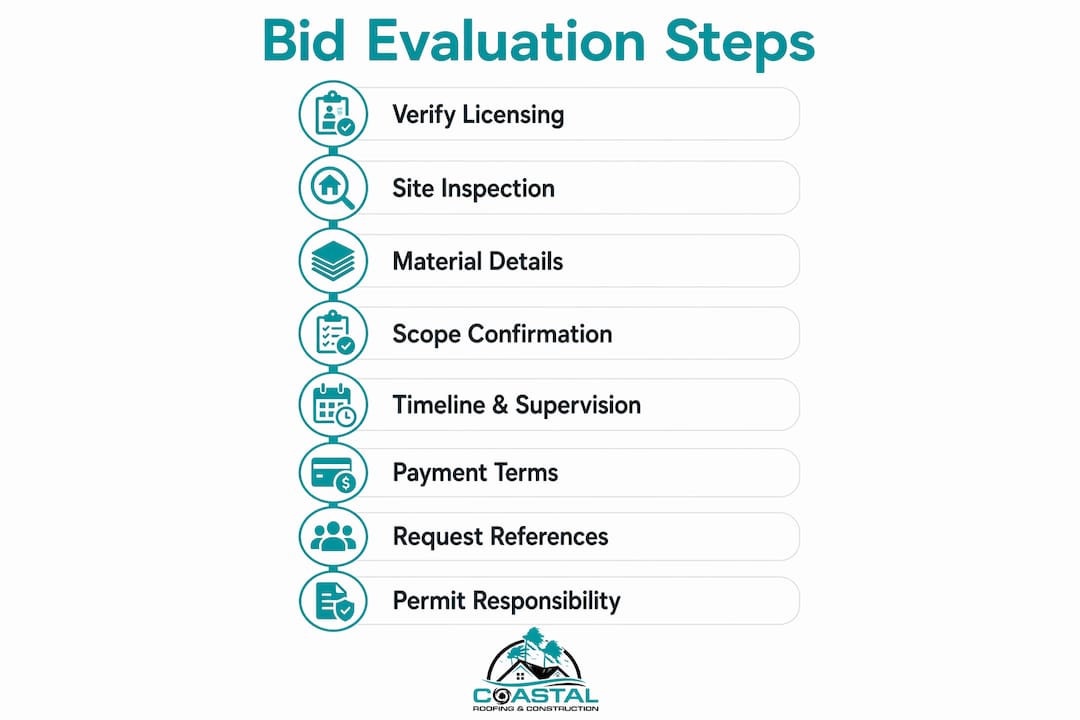
- 1. Verify licensing and insurance before anything else
- 2. Confirm a physical site inspection before bidding
- 3. Ask about manufacturer certifications
- 4. Clarify material brands, product lines, and warranty coverage
- 5. Ask about project timeline, crew, and supervision
- 6. Discuss payment terms and deposit limits
- 7. Request references from recent, similar jobs
- 8. Clarify permit responsibilities in writing
- How to compare roofing bids side by side
- Red flags and trust signals: what to watch for
- Expert perspective on evaluating roofing bids
- Key Takeaways
- Coastal Roofing & Construction: detailed bids, certified installation, and no surprises
What a roofing bid should actually contain
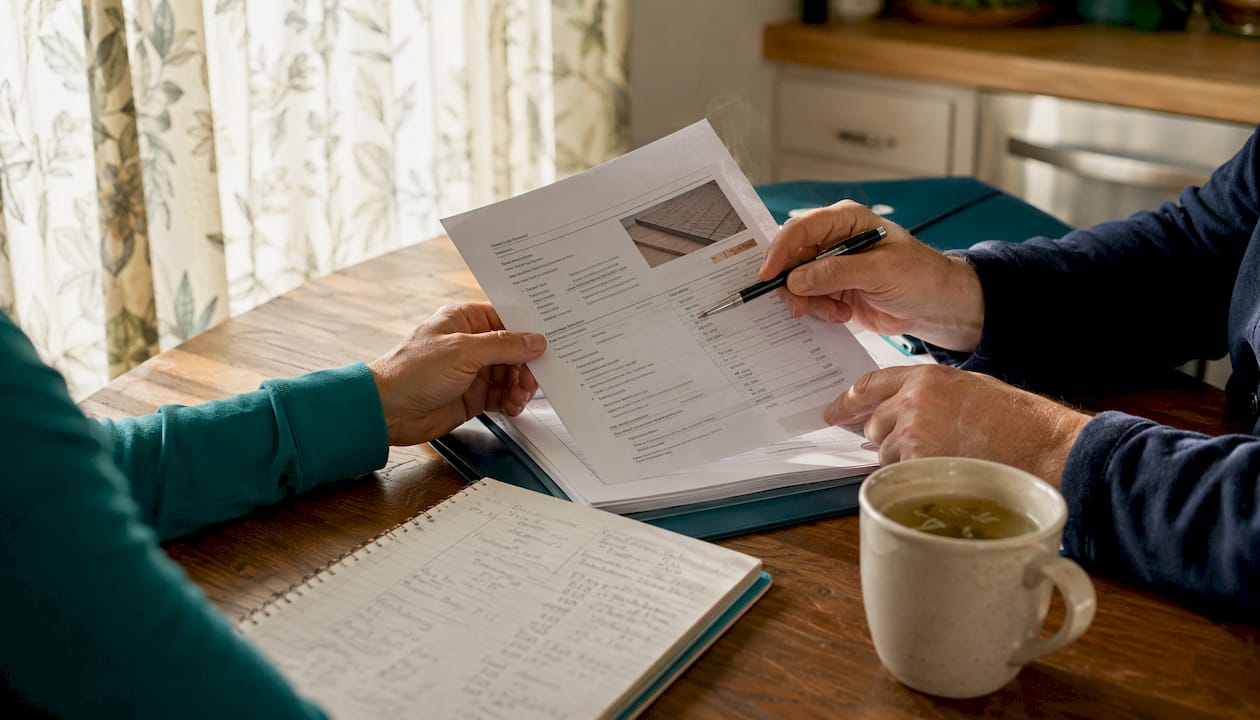
Most homeowners glance at the total and move on. That’s the wrong move. Two bids priced at $18,000 and $22,000 can represent completely different roofs once you read what’s actually included. A proper roofing proposal must detail licensing, insurance, scope, material brands, and warranty terms before it’s worth taking seriously.
The written scope of work
The scope is the contract before the contract. It should name every major task: number of layers being removed, whether it’s a full tear-off or overlay, flashing replacement or reuse, ventilation work, and cleanup method. If a scope says “install new roof,” that’s not a scope. That’s a placeholder.
Material specifics
Generic descriptions like “30-year shingle” tell you almost nothing. A solid bid names the manufacturer, the product line, the shingle tier (3-tab, architectural, designer), the underlayment type (felt vs. synthetic), and the ice and water shield coverage area. Brand matters because warranties and performance vary significantly between product lines, even within the same manufacturer.
Labor breakdown
Labor typically represents a significant portion of total roofing project cost, covering tear-off, installation, site protection, cleanup, and project management. A bid that shows only a single labor line gives you no way to verify whether cleanup, dumpster fees, or magnetic nail sweeps are included. Ask for each task itemized separately.
Permit fees and who handles them
Reputable contractors pull permits themselves. If a bid excludes permit fees or leaves permit responsibility vague, that’s a problem. Unpermitted roofing work can create serious complications when you sell the home or file an insurance claim.
Warranty documentation
There are two distinct warranties: the manufacturer’s material warranty and the contractor’s workmanship warranty. They cover different things and should exist as separate legal documents, not just a line item on the contract. Manufacturer certifications like GAF Master Elite or Owens Corning Platinum Preferred unlock extended system-backed warranties that non-certified installers simply cannot offer.
Decking repair pricing
This is where vague bids create expensive surprises. Once tear-off is complete, the crew may find damaged plywood or roof boards. A professional bid states the per-sheet or per-square-foot price for decking replacement upfront, rather than leaving it as an open-ended “time and materials” charge.
| Bid Component | What to Look For |
|---|---|
| Scope of work | Full task list: tear-off, layers removed, flashing, ventilation, cleanup |
| Material brands | Manufacturer name, product line, shingle tier, underlayment type |
| Ice and water shield | Coverage areas: eaves, valleys, penetrations |
| Labor breakdown | Tear-off, installation, site protection, disposal itemized separately |
| Decking repair | Per-sheet or per-square-foot pricing, not open-ended allowances |
| Warranty terms | Separate manufacturer and workmanship documents, not just a line item |
| Permit handling | Contractor pulls and pays for permits |
| Licensing and insurance | License number, general liability, and workers’ comp certificates |
1. Verify licensing and insurance before anything else
Ask every contractor for their license number and certificates of insurance before the conversation goes further. Then verify both independently. Check the license on your state contractor licensing board’s website. For insurance, call the insurer directly to confirm active general liability and workers’ compensation coverage — don’t just accept a PDF.
This matters more than most homeowners realize. If an uninsured worker is injured on your property, you may be pulled into the financial fallout. A contractor who hesitates to provide proof of either is telling you something important.
2. Confirm a physical site inspection before bidding
A contractor who quotes your roof without walking it is guessing. Roof complexity, existing damage, layer count, ventilation deficiencies, and decking condition all affect the final scope and price. Bids produced without a site visit are unreliable and often lead to change orders mid-project.
Ask each contractor directly: “Will you inspect the roof and take measurements before submitting your bid?” Any contractor worth hiring will say yes without hesitation.
3. Ask about manufacturer certifications
Manufacturer certifications aren’t just marketing credentials. They determine what warranty coverage you’re eligible to receive. GAF Master Elite, Owens Corning Platinum Preferred, and similar programs require training, field inspections, and a documented track record. A contractor holding these certifications can offer extended manufacturer-backed warranties that cover both materials and labor. A non-certified contractor cannot, regardless of what their bid says.
Pro Tip: Ask each contractor to show you the specific warranty document you’ll receive, not just the warranty tier they claim to offer. The actual document tells you what’s covered, for how long, and who backs it.
4. Clarify material brands, product lines, and warranty coverage
“Architectural shingles” is not a specification. Push for the manufacturer name, product line, and warranty tier. Ask whether the bid includes synthetic or felt underlayment, what ice and water shield product is being used, and whether ridge cap and starter strips are included. These items are often left off cheaper bids but protect the most vulnerable parts of the roof. Understanding shingle tier differences helps you assess whether a premium bid is justified or overpriced.
5. Ask about project timeline, crew, and supervision
Who will be on your roof, and who’s managing the job? There’s a real difference between a contractor who personally oversees every project and one who hands work off to subcontractors with minimal oversight. Proper installation depends on details: how flashing is terminated, how penetrations are sealed, how the system transitions at walls and edges. Ask who supervises day-to-day and how subcontractors are managed.
Get a written start date and estimated completion window. Vague timelines (“we’ll get to it in a few weeks”) are a sign of poor scheduling discipline.
6. Discuss payment terms and deposit limits
The Better Business Bureau is clear on this: never pay the full amount upfront. A widely accepted standard is 10% down or $1,000, whichever is less, with subsequent payments tied to project milestones. A contractor demanding 50% or more before work begins is a warning sign. Get the full payment schedule in writing before signing anything.
7. Request references from recent, similar jobs
Ask for at least three references from jobs completed in the past 12 months, ideally projects similar in scope to yours. When you call those references, ask specific questions: Did the crew protect landscaping and clean up nails? Did the finished work match the contract scope? Were warranty call-backs handled promptly? Vague answers or references who seem unfamiliar with the contractor’s work are worth noting.
8. Clarify permit responsibilities in writing
Permit handling should be the contractor’s responsibility, not yours. A reputable contractor pulls the permit, coordinates inspections, and includes permit fees in the bid. If a contractor suggests you pull the permit yourself or leaves it out of the scope entirely, walk away. Unpermitted work creates liability that follows the home, not the contractor.
How to compare roofing bids side by side
The total at the bottom of a roofing estimate is the least useful number on the page. You cannot meaningfully compare $18,000 vs. $22,000 vs. $28,000 without knowing what each contractor is actually pricing. Comparing only total price is one of the most common and costly mistakes homeowners make.
Build your own comparison table. Use these eight variables as rows, with each contractor in a separate column:
| Variable | Contractor A | Contractor B | Contractor C |
|---|---|---|---|
| Shingle tier | Architectural | Designer | Architectural |
| Underlayment | Felt | Synthetic | Synthetic |
| Ice and water shield | Eaves only | Eaves, valleys, penetrations | Eaves only |
| Tear-off vs. overlay | Overlay | Full tear-off | Full tear-off |
| Flashing | Reuse existing | Full replacement | Partial replacement |
| Ventilation | No change | Ridge vent upgrade | No change |
| Warranty | 25-yr material / 1-yr labor | 50-yr system / 10-yr workmanship | 30-yr material / 2-yr labor |
| Decking repair | Open-ended T&M | — | — |
Once you map bids this way, the price differences usually stop being mysterious. A bid that’s $4,000 cheaper may be pricing an overlay instead of tear-off, reusing old flashing, and leaving decking repair as an open-ended charge. That’s not a better deal. That’s a different roof.
A few best practices for this process:
- Collect all bids within the same two-week window to capture consistent market pricing
- Never share one contractor’s price with another before they’ve submitted their own bid
- Ask for a revised, itemized version if any bid leaves key variables vague
- A bid 20–25% lower than the others almost always signals omitted scope, inferior materials, or uninsured labor
- Factor contractor communication and responsiveness into your decision — it predicts how they’ll handle problems during the job
- For replacements over $15,000, four or five bids can be worth the extra time given the dollar spread involved
Price variations between bids reflect overhead, crew experience, site protection quality, and project management depth, not just profit margin differences. A detailed bid with clear material brands, exact warranty terms, and an itemized labor breakdown signals a contractor’s professionalism. That level of transparency reduces risk for you.
Red flags and trust signals: what to watch for
Not every warning sign is obvious. Some of the riskiest bids look reasonable on the surface until you read them carefully.
Red flags to watch for:
- No itemized bid — a single lump sum with no line items
- Verbal-only quotes with nothing in writing
- Bid priced 20–25% or more below all others without explanation
- Large upfront deposit demand (more than 10% or $1,000)
- No license number or insurance certificates provided
- Permit fees excluded or permit responsibility left to the homeowner
- High-pressure tactics: “this price is only good today”
- No physical site inspection before bidding
- Warranty described only as a line item, not a separate legal document
- Reluctance to provide references from recent jobs
Trust signals that indicate a credible contractor:
- License number verifiable on your state contractor board
- Certificates of insurance you can verify directly with the carrier
- Manufacturer certifications (GAF, Owens Corning, CertainTeed) with documentation
- Itemized, written bid with specific material brands and warranty documents
- Permit handling included in scope and fees
- Decking repair priced per sheet or per square foot, not open-ended
- Positive BBB rating and consistent online reviews across multiple platforms
- References from recent, similar jobs who answer specific questions confidently
- Payment schedule tied to milestones, not front-loaded
Overly low bids deserve specific scrutiny. They typically exclude ice and water shield, drip edge, permit fees, or use uninsured labor. The result is often a series of change orders mid-project that push the final cost well above what a more complete bid would have been. Reviewing your roofing contract terms before signing protects you from exactly this scenario.
Expert perspective on evaluating roofing bids
The NRCA frames bid evaluation as a job interview, not a price check. You’re assessing a contractor’s professionalism, communication quality, pricing transparency, and contract detail all at once. A contractor who submits a vague bid, resists questions, or can’t produce insurance certificates is showing you exactly how they’ll handle problems once they’re on your roof.
A few insights worth internalizing before you start collecting bids:
- Price differences between bids reflect real differences in overhead, crew experience, site protection, and project management depth. A higher bid from a certified, insured contractor with a 10-year workmanship warranty is often the lower-risk choice over a cheaper bid with a one-year labor guarantee.
- A physical site inspection before bidding isn’t optional. Contractors who quote from satellite imagery or square footage estimates alone cannot account for roof complexity, existing damage, or ventilation deficiencies. Their bids will be inaccurate.
- Manufacturer certifications matter for warranty eligibility. If a contractor claims to offer a 50-year system warranty but isn’t certified by that manufacturer, the warranty claim is likely inaccurate. Ask for the actual warranty document.
- Bids missing standard inclusions like ice and water shield at eaves and valleys are high-risk proposals. In Florida’s climate, that omission can lead to water intrusion during the first significant storm.
Collect 3–5 written bids within a two-week window. The NRCA recommends this timing specifically to capture consistent market conditions. Bids collected weeks apart may reflect different material costs, making comparison unreliable.
On negotiation: the most effective approach isn’t demanding a lower number. Show your preferred contractor the competing bid and ask them to explain the differences. That conversation often reveals whether they priced better materials, a stronger warranty, or a more complete scope. It can also prompt a legitimate discount when the scope is genuinely comparable. What it won’t do is turn a low-quality bid into a high-quality roof.
Pro Tip: If you’re unsure whether you need a repair or a full replacement, pay for an independent roof inspection before collecting bids. That small upfront cost keeps you from gathering three quotes for the wrong job.
Understanding how roofing certifications affect your warranty options is one of the most practical steps you can take before your first contractor conversation.
Key Takeaways
Evaluating roofing contractor bids correctly requires comparing at least three detailed, written proposals line-by-line across eight critical variables, not just the total price.
| Point | Details |
|---|---|
| Get 3–5 bids in two weeks | Collect bids within a two-week window to capture consistent market pricing and enough data for comparison. |
| Compare eight variables, not totals | Shingle tier, underlayment, ice and water shield, tear-off method, flashing, ventilation, warranty, and decking repair pricing all determine real value. |
| A bid 20–25% lower is a red flag | Lowball bids typically exclude permits, ice and water shield, or use uninsured labor, leading to costly change orders. |
| Verify licensing and insurance directly | Call the insurer to confirm active general liability and workers’ comp; check the license on your state contractor board. |
| Coastal Roofing & Construction | A manufacturer-certified, licensed, and insured Tampa Bay contractor offering itemized proposals, extended warranties, and full permit handling. |
Coastal Roofing & Construction: detailed bids, certified installation, and no surprises
When you’ve read this far, you know what a thorough roofing bid looks like. Coastal Roofing & Construction is built around exactly that standard. Every proposal includes specific material brands, a full labor breakdown, per-sheet decking repair pricing, and separate warranty documents for both manufacturer coverage and workmanship. Permit handling is included. The scope is written, itemized, and explained before you sign anything.
As a manufacturer-certified contractor with Owens Corning and GAF, Coastal Roofing & Construction can offer extended system-backed warranties that non-certified installers cannot. The team serves homeowners across Tampa, Clearwater, St. Petersburg, Palm Harbor, Dunedin, and the broader Tampa Bay area, specializing in residential roof replacement, standing seam metal roofing, architectural shingles, tile, and flat roofing systems built for Florida’s coastal climate.
If you’re ready to compare bids or want a detailed estimate from a contractor who will walk your roof before quoting it, request a quote from Coastal Roofing & Construction and see what a complete, transparent proposal actually looks like.