
A building inspector is a code official with legal authority to approve or stop roofing work that fails to meet safety standards. The role of building inspector roofing work covers everything from verifying permits before a single shingle is nailed down to signing off on the finished installation. For Tampa Bay homeowners, this process carries extra weight. Florida’s coastal wind zones, hurricane exposure, and strict local codes mean an inspector’s approval is not a formality. It is proof your roof was built to protect your home and your family.
What does a building inspector do during roofing projects?
A building inspector verifies that roofing work complies with the International Residential Code and local building department requirements at every stage of construction. The inspector’s authority goes beyond advice. Building inspectors enforce legal requirements and can issue stop-work orders, while a home inspector only produces an advisory report with no enforcement power. That distinction matters enormously when you are spending tens of thousands of dollars on a new roof.
Inspectors check roofing materials, fastening patterns, flashing details, underlayment, and structural decking. They confirm that the work matches the approved permit documents and meets both the International Residential Code and the manufacturer’s printed installation instructions. A roof that looks clean and finished from the street can still fail inspection if the hidden details are wrong.
What are the typical inspection stages for a roof replacement?
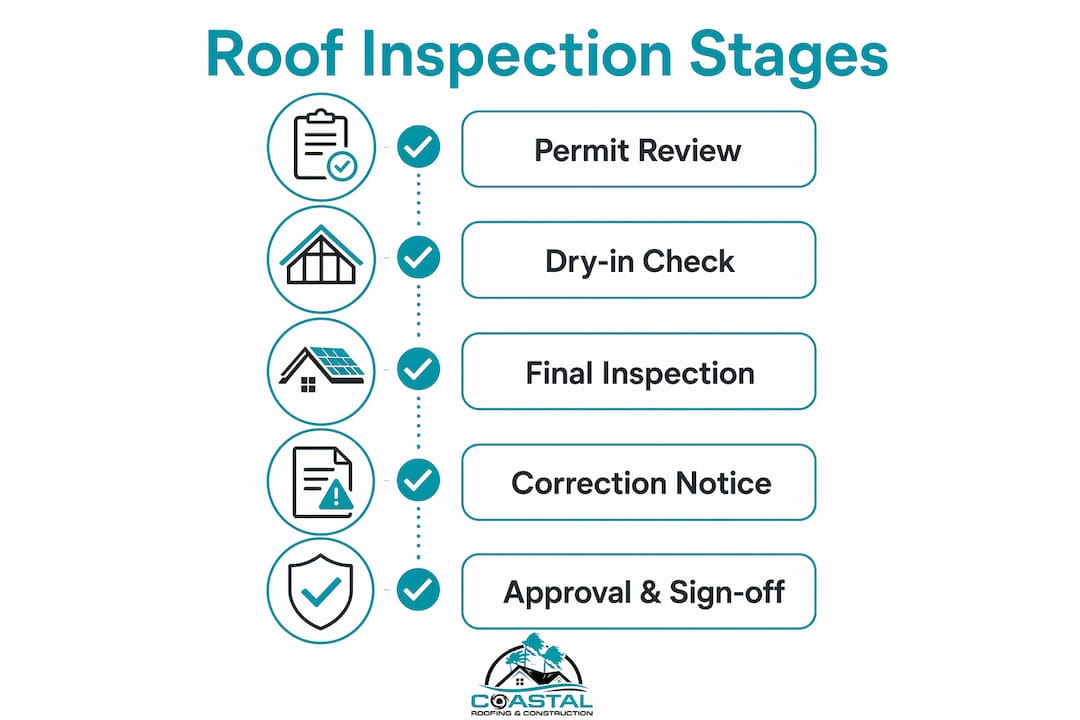
Roofing inspections happen in phases, not just at the end. Each phase targets components that will be covered and concealed by the next layer of work.
-
Permit review. Before work begins, the building department reviews the permit application. This document includes material specifications, fastening schedules, and installation methods. The inspector confirms the proposed work meets code before approving the permit.
-
Dry-in inspection. Once the old roofing is removed and the decking, underlayment, and flashing are installed, an inspector visits the site. This is the most critical stage. Covering structural elements before approval leads to failed inspections and expensive rework.
-
Mid-project inspection. In coastal wind zones like Pinellas County and Hillsborough County, inspectors often check nailing patterns and fastener placement before the final layer goes on. Florida’s wind uplift requirements are among the strictest in the country.
-
Final inspection. The inspector reviews the completed roof against IRC sections R905 and R903.1, manufacturer instructions, and the approved permit. Flashing at chimneys, valleys, skylights, and roof edges all receive close attention.
The concept contractors call the “point of no return” is real. Once the final roofing material covers the underlayment and decking, those components cannot be verified without tearing the roof apart. Scheduling inspections at the right stages protects you from that outcome.
Pro Tip: Ask your contractor to confirm the inspection schedule in writing before work begins. Knowing exactly when each inspection is booked prevents the costly mistake of covering components before an inspector has signed off.
How does the building inspector enforce roofing compliance?
Inspectors enforce compliance by checking roofing work against two parallel standards: the building code and the manufacturer’s installation instructions. Final inspections focus on IRC R905 for roof coverings and R903.1 for weather protection, ensuring the roof will perform as designed. These are not suggestions. They are legal minimums.
The typical roof assembly inspection checklist covers approved material use, proper flashing installation at chimneys, valleys, skylights, and roof edges, and compliance with wind uplift fastening patterns in coastal zones. Each item on that list corresponds to a real failure mode that has caused roof damage in Florida storms.
Common reasons roofs fail inspection include:
- Improper valley flashing. Missing or incorrectly installed valley flashing is one of the most frequent concealed defects. Improper valley flashing or missing accessories cause failures even when the roof looks finished and neat from the outside.
- Wrong fastener patterns. Coastal zones require specific nail spacing and penetration depth to meet wind uplift ratings. Inspectors measure and count fasteners, not just glance at them.
- Non-compliant materials. Shingles installed on a slope below the manufacturer’s minimum rating, or ridge caps that do not match the approved product, will trigger a rejection.
- Underlayment deficiencies. Torn, improperly lapped, or missing underlayment sections are caught at the dry-in stage. If they are not caught then, they become a hidden liability.
A roof that passes visual inspection but fails code compliance creates serious insurance and resale problems. Building inspectors protect public health and safety by catching these issues before they become your problem after the contractor has left.
What are the permit requirements for reroofing in Tampa Bay?
Permits are required for nearly all full roof replacements and many partial replacements. Permit thresholds vary by jurisdiction: some cities require a permit when replacement exceeds 25% of the roof area within 12 months, while others set the threshold at 50%. In Tampa Bay, the building departments in Pinellas County, Hillsborough County, and Pasco County each have their own specific requirements, so confirming with your local building department before work starts is non-negotiable.
| Scenario | Permit typically required? |
|---|---|
| Full roof replacement | Yes, in virtually all jurisdictions |
| Partial replacement over 25%–50% | Yes, depending on local rules |
| Like-for-like minor repair | Often not required |
| New construction roofing | Always required |
Your contractor should pull the permit and coordinate all inspections. Homeowners who pull their own permits assume full legal responsibility for technical documentation and inspection scheduling. That is a significant burden without construction expertise.
Pro Tip: Budget an extra 1–2 weeks beyond the physical installation timeline for permit processing and inspection scheduling. Rushing this step is the fastest way to end up with an unpermitted roof that creates problems at resale or after a storm claim.
Unpermitted roofing work carries real consequences. Insurance companies can deny storm damage claims on roofs installed without permits. Buyers’ attorneys flag unpermitted work during real estate transactions. And if a code violation causes injury, the homeowner bears liability.
What common issues do building inspectors find during roofing inspections?
Even neat, professional-looking roofs get flagged. Concealed installation defects are the most common cause of inspection failures, and they are invisible once the final layer is installed. Catching them early saves thousands of dollars in rework.
The issues inspectors find most often in Tampa Bay include:
- Flashing failures at penetrations. Chimneys, pipe boots, skylights, and HVAC curbs all require specific flashing methods. Shortcuts here are the leading cause of water intrusion after storms.
- Fastener non-compliance. Florida’s High Velocity Hurricane Zone and coastal wind exposure zones require specific nail lengths, gauges, and spacing. A single row of nails placed an inch off-pattern can void a wind uplift rating.
- Wrong ridge cap product. Using a standard shingle cut as a ridge cap instead of a manufacturer-approved hip and ridge product violates both code and warranty terms.
- Decking deterioration. Inspectors at the dry-in stage often find soft spots, rot, or delaminated sheathing that was hidden under the old roofing. Replacing damaged decking before the new roof goes on is a code requirement, not optional.
- Rushed or incomplete installation. Signs include skipped starter strips, missing drip edge at rakes, and underlayment that does not extend to the eave edge. These details protect the roof deck from wind-driven rain.
Catching these problems during a scheduled inspection is far less expensive than discovering them after a hurricane. For a closer look at what professionals find during inspections, the roofing problems identified during inspections resource from Coastal Roofing & Construction covers the most common issues in detail.
How can homeowners prepare for roofing inspections?
Homeowners who understand the inspection process get better outcomes. You do not need to manage the inspections yourself, but knowing what to expect keeps your contractor accountable.
-
Confirm your contractor handles permitting. A licensed contractor pulls the permit, submits the technical documentation, and schedules all required inspections. If a contractor asks you to pull the permit, that is a red flag.
-
Know the inspection timeline. Ask your contractor when each inspection is scheduled. The dry-in inspection must happen before the final layer is installed. Missing it means either tearing back the roof or failing the final inspection.
-
Stay in communication. You do not need to be on-site for every inspection, but you should receive updates after each one. Ask for copies of all inspection reports.
-
Review and act on correction notices promptly. If an inspector issues a correction notice, your contractor must address it before work continues. Delays compound costs.
-
Keep all documentation. Permit records, inspection reports, and manufacturer warranty documents belong in your home files. They protect you during insurance claims and real estate transactions.
Trusted contractors like Coastal Roofing & Construction manage the entire permitting and inspection process, including coordinating with local building departments across Pinellas, Hillsborough, and Pasco counties. For additional guidance on residential roof inspections in Tampa Bay, Coastal Roofing & Construction provides detailed information on what the process involves and what homeowners should expect.
Key Takeaways
Building inspectors are the legal enforcement layer between your roofing contractor’s work and the safety standards your home must meet, and skipping or rushing the inspection process creates financial and structural risks that outlast the roof itself.
| Point | Details |
|---|---|
| Inspectors enforce, not advise | Building inspectors have stop-work authority; home inspectors only provide advisory reports. |
| Inspection timing is critical | Covering decking and underlayment before the dry-in inspection causes failed inspections and costly rework. |
| Permits protect homeowners | Unpermitted roofing work risks insurance claim denials and legal liability at resale. |
| Hidden defects are the real risk | Improper flashing, wrong fastener patterns, and decking issues are invisible once the final layer is installed. |
| Contractors should handle permits | Licensed contractors manage permit applications and inspection scheduling; homeowners who do it themselves assume full legal responsibility. |
Why I take building inspections more seriously than most contractors do
Most homeowners think of a building inspection as a bureaucratic checkbox. After years of working on roofs across Tampa Bay, I see it differently. The inspection is the one moment in the entire project when an independent authority confirms that the work was done correctly. That matters more in Florida than almost anywhere else in the country.
I have seen roofs that looked perfect from the ground fail inspection because the nailing pattern was off by a fraction of an inch. I have also seen roofs pass a quick visual check and then fail catastrophically in the first major storm because the flashing details were wrong under the surface. The inspector catches what the eye misses.
The homeowners who have the smoothest experience are the ones who treat the inspection process as a feature, not a delay. They ask their contractor for the inspection schedule upfront. They request copies of every report. They understand that a passed final inspection is worth more than any verbal guarantee a contractor can give. If your contractor resists permits or tries to skip inspections, that tells you everything you need to know about the quality of the work underneath.
— Ryan
Coastal Roofing & Construction handles compliance from permit to final sign-off
Navigating Tampa Bay’s building codes, wind uplift requirements, and multi-stage inspection process is straightforward when your contractor knows the system. Coastal Roofing & Construction manages every step, from pulling permits with Pinellas, Hillsborough, and Pasco county building departments to scheduling dry-in and final inspections on your behalf.

Every project Coastal Roofing & Construction completes is fully permitted and inspected, with manufacturer-certified installation from a team trained by Owens Corning, GAF, and Tri County Metals. You can review completed roof replacement projects to see the quality and compliance standards applied to every job. For homeowners ready to replace an aging roof the right way, contact Coastal Roofing & Construction for a free inspection and estimate.
FAQ
What is the role of a building inspector in roofing?
A building inspector is a code official who verifies that roofing work meets the International Residential Code and local building department requirements. The inspector has legal authority to approve work or issue stop-work orders at any stage of the project.
When does a building inspector visit during a roof replacement?
Inspectors typically visit at three stages: before work begins to review the permit, during the dry-in phase to check decking, underlayment, and flashing, and at the end for a final inspection of the completed roof.
Do I need a permit for a roof replacement in Tampa Bay?
Permits are required for virtually all full roof replacements in Tampa Bay. Partial replacements exceeding 25%–50% of the roof area also typically require permits, depending on the specific county or municipality.
What happens if my roof fails a building inspection?
The inspector issues a correction notice listing the deficiencies. Your contractor must fix the identified problems and schedule a re-inspection before work can continue or the project can be closed out.
Can a roof look good but still fail inspection?
Yes. Even neat-looking roofs fail inspections due to improper fastening patterns, wrong ridge cap products, or concealed sheathing issues that are invisible once the final layer is installed.