
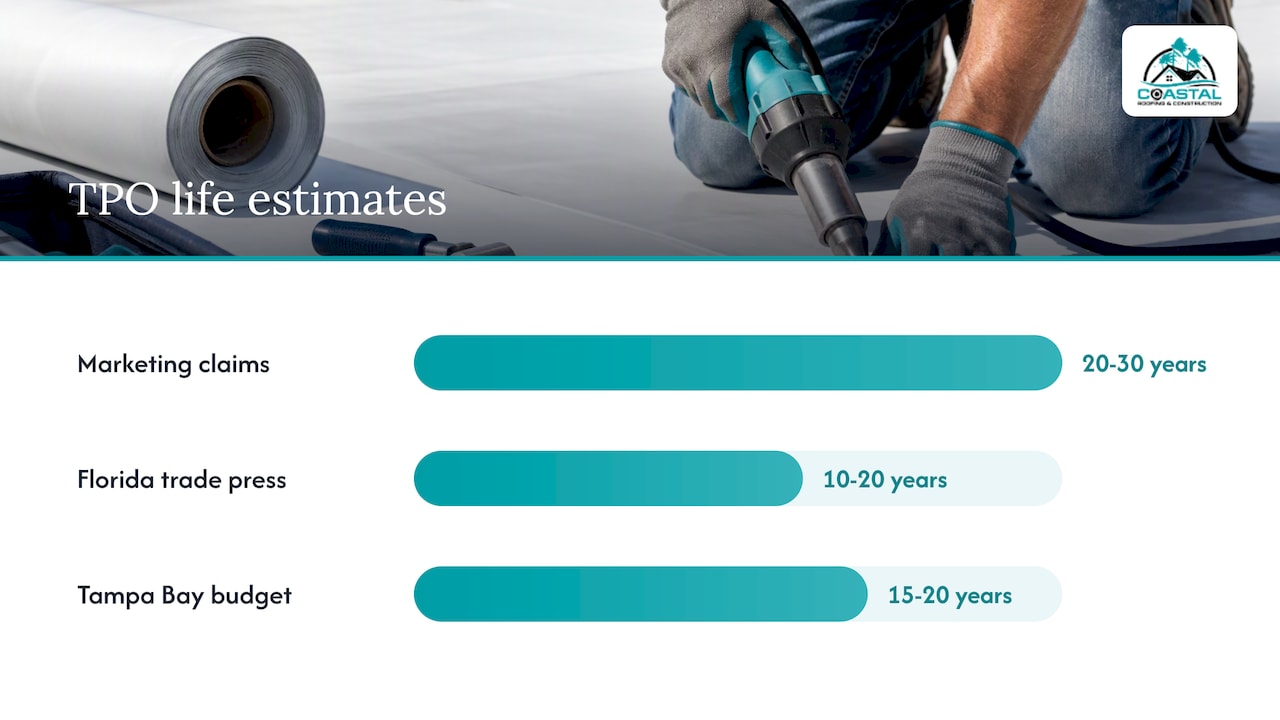
A TPO roof in Florida should be planned around 10 to 20 years of service, not the 20 to 30 years often quoted nationally. Industry reporting in Roofing Contractor puts thermoplastic polyolefin (TPO) membranes at 10 to 20 years in demanding climates, with high UV, heat and humidity pulling the number down. Some well-installed, well-maintained roofs go longer. Many reach the end of practical repairability well before they leak through.
This guide explains why Florida shortens the range, how to tell where your roof sits in it, and what to do in each stage. We are a Tampa Bay roofing contractor, so we focus on what we see on flat and low-slope roofs on the Gulf Coast.
TL;DR
- Plan for 10 to 20 years from a TPO roof in Florida. Brochure figures of 20 to 30 years assume milder conditions and ideal upkeep.
- The practical turning point is often 7 to 10 years, when the membrane surface weathers and becomes harder to heat-weld for repairs.
- Installation quality, membrane thickness, drainage and maintenance matter as much as the product name.
- Warranty length is not service life. Get inspections on the calendar before hurricane season and after any named storm.
- Ask your roofer to explain a replacement versus a repair in writing, with materials and scope listed.
Table of Contents
- How long does a TPO roof last in Florida?
- Why Florida is hard on TPO
- The 7 to 10 year mark: where repairs get harder
- Service life is not warranty length
- What decides whether your roof lands at 10 years or 20
- A maintenance rhythm that fits Tampa Bay
- Signs your TPO roof is nearing the end
- How TPO compares with other Florida roof options
- Repair, recoat or replace?
- Our perspective: plan the end before it plans you
- Hiring someone to inspect or replace your roof
- Have us look at your roof
- FAQ
- Sources
How long does a TPO roof last in Florida?
The honest answer is a range, and the range depends on who is talking. Search results for this topic show figures from 15 to 25 years up to 20 to 30 years, mostly from contractor marketing pages. The sources we trust more are the trade press and building-science bodies, and they are more cautious for hot, sunny, humid regions.
| Source type | Typical TPO figure | Notes |
|---|---|---|
| National marketing claims | 20 to 30 years | Assumes mild climate, good maintenance |
| Roofing Contractor, 2023 | 10 to 20 years | Intensive climates such as Florida |
| Older NRCA-based data, reported in Roofing Contractor, 2004 | Early TPO estimates were far lower | Early-generation membranes, so treat as history, not a forecast |
The 2004 figures describe membranes made two decades ago. Formulations and thicknesses have changed, and newer studies suggest TPO performance varies widely by membrane thickness and installation quality. We would not plan a budget around the old number, and we would not plan around the brochure number either.
Our working rule for Tampa Bay owners: budget for replacement somewhere between year 15 and year 20, and treat anything beyond that as a bonus you earned through maintenance.
Why Florida is hard on TPO
TPO is a single-ply white membrane, usually sold for flat and low-slope roofs. It is popular because it reflects heat, welds into a continuous surface and costs less up front than some alternatives. Florida tests each of those strengths.
Sun and heat
Year-round UV and heat work on the membrane surface every day. Over time the surface oxidizes, the material stiffens and the top layer loses some of the flexibility it had when new. A roof in a cooler, cloudier place sees fewer of these stress cycles.
Humidity and standing water
Florida roofs sit wet for long stretches: afternoon storms, morning dew, sea air on the barrier islands. Low-slope roofs that drain poorly hold water in the same low spots, and ponding speeds wear at seams and around penetrations. Good slope design and clear drains are cheap protection.
Wind
Wind drives a lot of Florida roof failures. In the IBHS investigation after Hurricane Michael, roof cover loss occurred in every wind speed band studied. Whether a membrane is fully adhered, mechanically attached and properly edge-secured decides how it behaves in a storm, and those details are installation choices, not product features.
The 7 to 10 year mark: where repairs get harder
This is the part many owners never hear. TPO seams are heat-welded, which is why a fresh membrane makes strong, watertight repairs. That weldability does not last forever. Forensic work covered in Roofing Contractor, including an article on TPO surface oxidation and long-term integrity, looks at what happens when a membrane that has weathered for a decade or more needs repair. Industry analysis puts the turning point at roughly 7 to 10 years of exposure in a climate like ours.
What that means in practice:
- A roof can look intact and still be hard to repair reliably.
- Patching old membrane to new material may not fuse the way it would on a young roof, so repairs may rely on coatings, mechanical fasteners or sealants that need watching.
- The most valuable roof assessment happens before the 10-year mark, not after the first leak.
That is why we tell owners of 8 to 12 year-old TPO roofs to schedule an inspection now. It is the cheapest moment to learn whether you are looking at maintenance, a targeted repair, or a replacement plan for the next few years.
Service life is not warranty length
A 20-year manufacturer warranty reads like a 20-year roof. It is not. Warranties cover defined defects under defined conditions, often with exclusions for storm damage, ponding or lack of maintenance. Industry sources note that owners commonly confuse the two, and that a proactive maintenance routine with annual inspections, cleaning and professional documentation of damage is often what lets a roof reach its upper range.
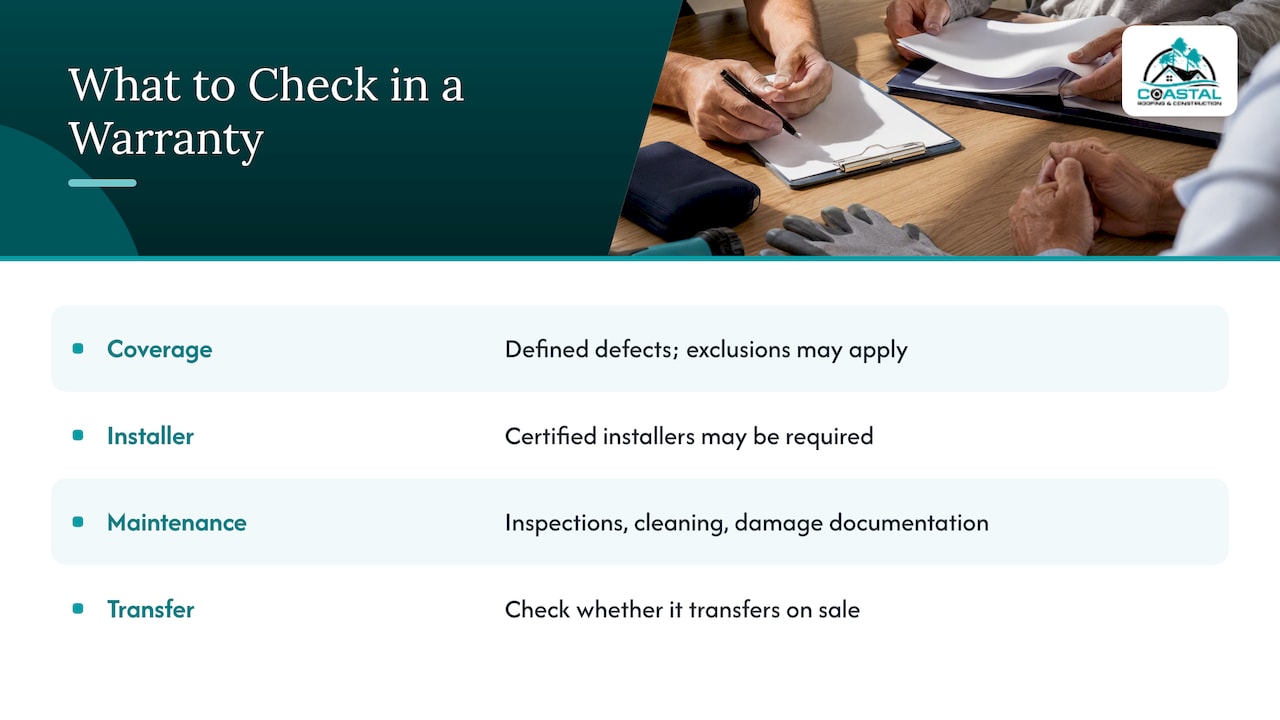
Read any warranty for four things: what it covers, who must do the installation (manufacturer-certified installers are often required), what maintenance it expects, and whether it transfers when you sell.
What decides whether your roof lands at 10 years or 20
- Installation quality. Seam welding, flashing details, attachment pattern and edge metal. Improper installation is a leading cause of premature roof failure in high-wind environments.
- Membrane thickness. Thicker membranes give more material to weather through. Ask what thickness is specified and have it written into the contract.
- Drainage. Clear scuppers, drains and gutters, and a slope that moves water off the roof within a day or so.
- Foot traffic and rooftop equipment. AC technicians, satellite installers and pool-service crews walking the roof add punctures and scuffs. Protective walkway pads help.
- Debris and cleaning. Leaves, palm fronds and salt film hold moisture and hide damage.
- Inspection rhythm. Small problems at flashings and seams cost little when caught early.
A maintenance rhythm that fits Tampa Bay
IBHS advises that a roof inspection be prioritized ahead of hurricane season so there is time for any needed repairs. For a TPO roof, a simple calendar works:
- Spring, before June 1: Full inspection of seams, flashings, penetrations, drains and edge metal. Photograph everything.
- After any named storm: Walk-through or professional check, even if nothing leaks. Document for your insurer.
- Late fall: Clear debris, check ponding spots, confirm drains are open.
- Every year after year 7: Ask specifically about membrane condition and weldability for repairs.
We lay out a fuller schedule in our 12-month Florida roof plan, and our piece on twice-yearly roof inspections explains why the cadence matters for insurance conversations. For storm-season specifics, see Tampa roof maintenance and storm season checks.
Signs your TPO roof is nearing the end
- Seams lifting, or a dull, chalky, cracked-looking surface
- Repeated leaks in different spots rather than one location
- Membrane that feels stiff or brittle, or shrinks away from flashings and edges
- Ponding that stays more than a day or so after rain
- Repairs that peel or do not hold
- Interior stains, or damp insulation found during an inspection
One of these does not mean replacement. A cluster of them on a roof older than 12 years usually does mean it is time to price one. Our guide on how to know when a roof needs full replacement walks through the decision.
How TPO compares with other Florida roof options
TPO is a flat or low-slope solution. Pitched roofs use different materials with different timelines, so the comparison is only useful when your roof shape allows more than one choice.
| Material | Where it fits | Florida notes |
|---|---|---|
| TPO | Flat and low-slope roofs | Reflective and welded, but surface weathers in strong UV |
| Modified bitumen | Flat and low-slope roofs | Multi-layer, a common alternative for flat roofs |
| Architectural shingle | Pitched roofs | IBHS research indicates performance on asphalt shingles in Florida declines noticeably after about 10 years |
| Standing seam metal | Pitched and some low-slope roofs | In the Hurricane Michael study, less than half of metal roofs were damaged, while all 3-tab shingle roofs investigated were |
| Concrete or clay tile | Pitched roofs | Heavy and durable, with underlayment that ages sooner than the tile |
We install all of these, so we have no reason to push one over what fits the building. We offer flat roofing systems in TPO and modified bitumen, as well as metal, shingle and tile. If you are weighing upgrades beyond like-for-like, our roof upgrade options guide and hurricane-resistant roofing options cover the trade-offs.
Repair, recoat or replace?
The right call depends on age, condition and how much of the roof is affected.
- Repair makes sense under about 7 to 10 years, when the membrane still welds well and damage is localized.
- Maintenance plus targeted repairs fits a roof in the 10 to 15 year window that has been inspected and is dry, with a clear watch list.
- Replacement planning starts when repairs fail to hold, when moisture is in the insulation, or when the roof is past 15 years and showing widespread weathering.
One Florida rule is worth knowing. The state’s 25% reroofing provision in the Florida Building Code Existing Building volume was clarified by SB 4-D in 2022. Roofs built or replaced under the 2007 code or later, and in which 25% or more is being repaired or replaced, generally only need the repaired part to meet current code. Rules depend on your roof’s history and local building department, so confirm with the permitting office in your county before assuming it applies.
Our perspective: plan the end before it plans you
Most flat-roof owners call us after the first leak. By then the choice has narrowed: emergency repair on an aging membrane, or a rushed replacement with whatever schedule the weather allows.
We would rather see you at year 8 or 9. At that point an inspection costs little, and it tells you whether you have three more easy years or a need to budget now. A replacement planned in the dry season, with materials chosen and a written scope, is nearly always a better project than one done in a panic after a storm.
We are family-owned, licensed and insured, and our crews are factory-trained and manufacturer-certified, including with Owens Corning, GAF and Tri County Metals. We say that because it matters to how a roof is built: attachment, seams and flashing details are where Florida roofs succeed or fail. We would rather tell you honestly that your roof has another few years than sell you a replacement you do not need.
— Ryan
Hiring someone to inspect or replace your roof
Roofing scams spike after storms. The FTC’s advice on avoiding home improvement scams is worth reading before you sign anything. A few points apply directly here:
- Get several written estimates that list the work, materials, completion date and price.
- Do not automatically choose the lowest bidder, and ask for an explanation when estimates differ widely.
- Confirm the contractor’s license and insurance, and check for complaints with your local building department.
- Ask who will be on the roof. Subcontracted crews should be named.
If you want a range of what a Tampa roof replacement runs in this market, our Tampa roof replacement cost breakdown covers permits and insurance considerations, and the Tampa Bay roof replacement guide explains the process from inspection to final walkthrough.
Have us look at your roof
If your TPO roof is past 8 years, or you are not sure how old it is, we can inspect it, document its condition and tell you plainly whether you are looking at maintenance, repair or replacement. We serve Pinellas, Hillsborough and Pasco counties, including St. Petersburg, Clearwater, Tampa, Largo and the beaches. Start with our roof replacement services or see recent projects to see our work.
FAQ
How long does a TPO roof last in Florida?
Plan on 10 to 20 years. Industry reporting cites that range for intensive climates, and Florida’s UV, heat and humidity put roofs toward the lower half unless installation and maintenance are strong. National claims of 20 to 30 years assume milder conditions.
Can a TPO roof be repaired when it gets old?
Yes, but it gets harder. After roughly 7 to 10 years of exposure, the weathered surface is harder to heat-weld, so repairs may rely on other methods. A professional assessment before the 10-year mark tells you which approach will hold.
Is TPO a good choice for a Florida home?
It can be, for flat or low-slope roofs, if it is installed by certified crews and inspected regularly. For pitched roofs, metal, tile or architectural shingles are usually the better fit. We can compare options for your roof shape.
Does a TPO warranty mean the roof will last that long?
No. A warranty covers defined defects and has conditions, often including maintenance and certified installation. Service life is how long the roof actually performs, which depends on climate, workmanship and upkeep.
When should I inspect my TPO roof?
At least once a year, ideally before hurricane season starts on June 1, and after any significant storm. Start earlier and more often once the roof passes 7 years.
Sources
- Choosing the Best Low-Slope Roofing System for Your Building, Roofing Contractor
- A Forensic Approach to TPO Surface Oxidation and Long-Term Integrity, Roofing Contractor
- Service Life Predictability, Roofing Contractor
- IBHS Hurricane Michael wind executive summary
- IBHS 2022 Year in Review
- IBHS Hurricane Ready guides
- Florida’s 25% Roofing Rule, J.S. Held
- How To Avoid a Home Improvement Scam, FTC