
Installed TPO roofing in Florida typically runs $7 to $14 per square foot, with most residential and commercial jobs landing between $8 and $12. That figure usually covers membrane, insulation, fasteners or adhesive, flashing, and labor. The biggest swing factor isn’t the material at all. It’s whether your roof needs a full tear-off, new insulation, or upgrades to meet Florida’s wind codes.
TL;DR:
- TPO roofing costs in Florida vary from $7 to $14 per square foot, depending on membrane thickness, attachment method, and whether a tear-off is needed.
- Upgrading from 45-mil to 80-mil membranes significantly impacts cost, puncture resistance, and warranty, with fully adhered systems offering better wind resistance.
- Full replacement for a 1,500-square-foot roof typically ranges from $6,000 to $13,500, with larger structures costing proportionally more due to tear-offs and added materials.
- Contractors should itemize costs for membrane, insulation, tear-off, and accessories to avoid underestimating total expenses, especially for older or complex roofs.
- Spending more on an 80-mil or fully adhered TPO system is justified for roofs with rooftop equipment, high foot traffic, or in high wind zones for better durability and fewer repairs.
Table of Contents
- How Much Does TPO Roofing Cost Per Square Foot in Florida?
- What Does a TPO Roof Cost for a 1,500, 2,000, or 5,000 Square Foot Roof?
- What Factors Affect the Cost of a TPO Roof in Florida?
- Is TPO Cheaper Than PVC or EPDM in Florida?
- How Long Does a TPO Roof Last in Florida’s Climate?
- What Should You Ask Before Signing a TPO Roofing Contract?
- Why Coastal Roofing & Construction’s Certifications Matter for TPO Installs
- When Is It Worth Spending More on a TPO Upgrade?
- Ready for a TPO Roof Estimate in Tampa Bay?
- Where These Florida TPO Cost Figures Come From
- Sources
How Much Does TPO Roofing Cost Per Square Foot in Florida?
The per-square-foot price depends almost entirely on two decisions: membrane thickness and how it’s attached to the deck. In Central Florida, installed TPO pricing runs $7 to $8.50 per square foot for 45-mil, $7.50 to $11.50 for 60-mil, and $10 to $14 for 80-mil. Palm Beach County contractors quote a similar spread, with installed TPO ranging from $8 to $16 per square foot, where fully adhered 60-mil systems sit at the top of that band because of the added wind-uplift resistance.
Here’s what typically drives you toward one end of the range or the other:
- 45-mil TPO ($7 to $8.50/sq ft): Lowest upfront cost, thinnest membrane, shortest warranty. Common on budget-conscious residential recover jobs with minimal roof traffic.
- 60-mil TPO ($7.50 to $11.50/sq ft): The standard most Florida contractors recommend for both homes and commercial buildings, balancing puncture resistance with cost.
- 80-mil TPO ($10 to $14/sq ft): Reserved for roofs with heavy foot traffic, rooftop equipment, or owners who want maximum service life.
- Mechanically fastened: Cheaper to install, generally sufficient for smaller residential sections.
- Fully adhered: Costs more upfront but performs better in Florida’s high-wind zones and on roofs with unusual shapes.
One thing to watch on quotes: many contractors price the membrane and labor but list insulation, tear-off, and edge metal as separate line items. Ask for one itemized number, not a per-square-foot rate that excludes half the job.
What Does a TPO Roof Cost for a 1,500, 2,000, or 5,000 Square Foot Roof?
Turning a per-square-foot rate into an actual budget requires knowing your assumptions. A recover job (installing over existing insulation) always costs less than a full tear-off, and larger commercial roofs benefit from economies of scale that smaller residential sections don’t get.
1,500 square feet (typical residential flat section): South Florida data puts most homeowners at $7,500 to $13,500 for a complete replacement, assuming 60-mil membrane and standard tear-off. A simple recover job without deck repairs can land closer to $6,000.
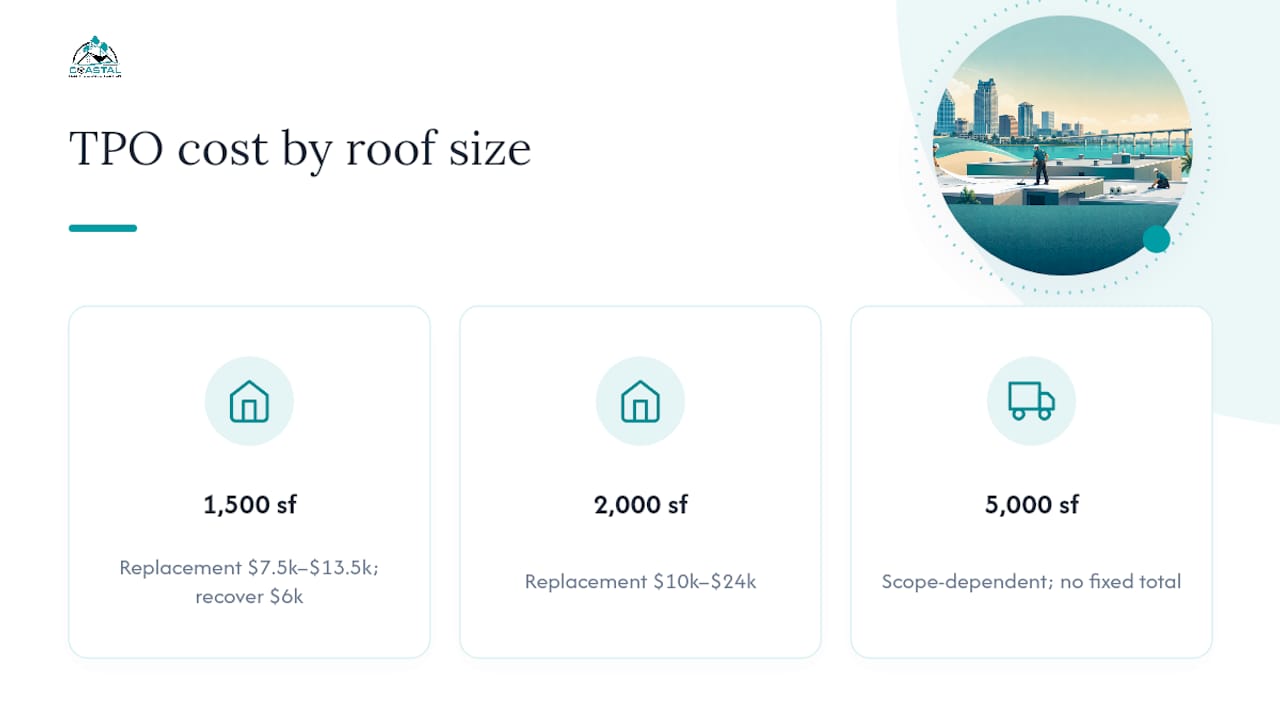
2,000 square feet (larger residential or small commercial): Tampa-area pricing shows full flat roof replacement costing $10,000 to $24,000, with the high end reflecting tear-off, deck repair, and upgraded insulation.
5,000 square feet (commercial building): Costs can be substantial for tear-off and fully adhered 60-mil systems with new polyiso insulation; additional equipment and penetrations increase the total.
Residential flat sections (a porch roof, a garage extension, a low-slope addition) rarely price the same as standalone commercial buildings, since commercial jobs carry more complex drainage, code requirements, and equipment curbs.
What Factors Affect the Cost of a TPO Roof in Florida?
Once you understand membrane thickness and attachment method, the rest of the price comes down to six variables contractors weigh on every estimate.
- Membrane thickness. Moving from 45-mil to 60-mil often adds only a modest per-square-foot premium, but it meaningfully improves puncture resistance and stretches the manufacturer warranty. It’s one of the few upgrades in roofing where the extra cost is genuinely worth considering on almost every job.
- Attachment method. Fully adhered systems cost more in labor and adhesive but resist wind uplift better, a real consideration anywhere near the Gulf Coast.
- Tear-off and disposal. Removing old roofing and hauling it away is frequently the line item homeowners underestimate most. Rotted decking discovered mid-tear-off adds cost that no estimate can predict in advance.
- Insulation type and R-value. Polyiso insulation is standard for Florida installations because it performs well in heat and helps meet energy code minimums, but higher R-values and tapered systems for drainage both add to material cost.
- Roof complexity. Drains, curbs, skylights, HVAC penetrations, and parapet walls all multiply flashing work and labor hours compared to a simple rectangular deck.
- Labor rates and timing. Labor alone runs $1.75 to $4.50 per square foot in the Tampa market, and rates tend to climb during peak storm-season demand when crews are booked out weeks in advance.
Pro Tip: Ask your contractor to quote insulation and edge metal as separate line items rather than folding them into a single “system price.” Membrane-only quotes that skip the full assembly consistently understate what you’ll actually pay once the job starts. This mirrors advice on budgeting for complete roofing systems, where flashing and drainage details, not just the membrane, determine long-term performance.
Is TPO Cheaper Than PVC or EPDM in Florida?
TPO generally sits in the middle of the flat-roofing cost spectrum. PVC membranes typically run somewhat higher per square foot because of stronger chemical resistance, which matters for restaurants or buildings near heavy grease exhaust. EPDM (rubber roofing) is often the cheapest upfront option but performs worse under Florida’s intense UV exposure unless it’s a white reflective variant, and its seams age faster than TPO’s heat-welded seams.
- Choose TPO for the best balance of cost, UV reflectivity, and seam strength on most residential and commercial low-slope roofs.
- Choose PVC if the roof faces heavy grease, chemical exposure, or rooftop kitchen exhaust.
- Choose EPDM for a lower initial budget on smaller sections, accepting a shorter realistic lifespan in full Florida sun.
- Choose modified bitumen for roofs with heavy foot traffic or where a torch-down, multi-ply system fits an existing assembly better than a single-ply membrane.
For a broader rundown of how these systems stack up on flat residential sections, our flat roof replacement options guide breaks down the material trade-offs in more depth.
How Long Does a TPO Roof Last in Florida’s Climate?
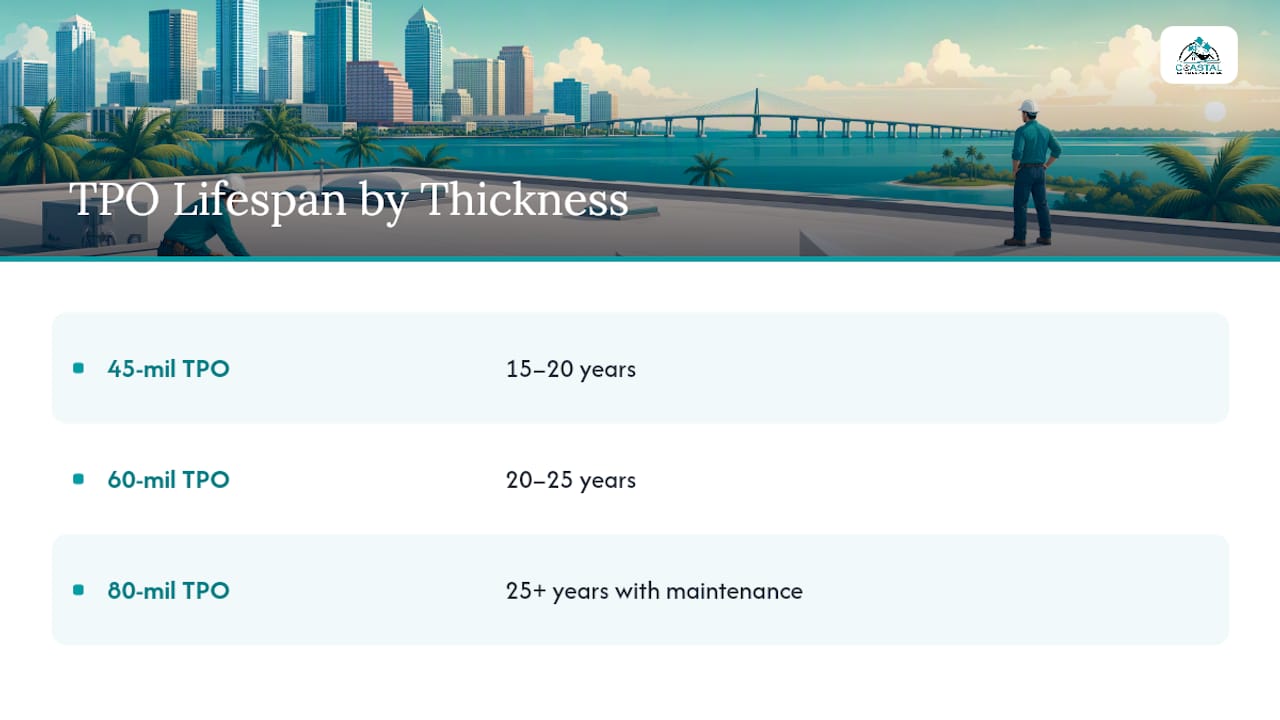
A well-installed 60-mil TPO roof typically lasts 20 to 25 years in Florida, while 45-mil systems often see 15 to 20 years and 80-mil installations can push past 25 with proper maintenance. TPO’s white reflective surface can meaningfully reduce rooftop surface temperatures compared to darker membranes, which translates into lower cooling loads during the hottest months, though the payback period depends heavily on your building’s existing insulation and HVAC efficiency.
Routine maintenance is inexpensive relative to the investment: a semiannual inspection checking seams, flashing, and drains typically costs a few hundred dollars per visit, as noted in roofing SEO strategies for roofing businesses. The failures that shorten TPO’s life in Florida almost always trace back to three causes: ponding water left unaddressed near clogged drains, foot traffic puncturing the membrane without protective walkway pads, and poor seam welding during installation. None of those are membrane defects. They’re installation and maintenance gaps, which is exactly why the contractor you hire matters as much as the mil thickness you choose.
What Should You Ask Before Signing a TPO Roofing Contract?
A trustworthy quote reads like a parts list, not a marketing brochure. Before you sign anything, walk through this checklist with every contractor bidding the job.
- Get it itemized in writing. The quote should separately list membrane mil and brand, attachment method, insulation type and R-value, tear-off and disposal, flashing and edge metal, and warranty terms. A single lump-sum number is a red flag.
- Verify licensing and insurance. Florida requires roofing contractors to carry a state license; ask for the license number and confirm active workers’ compensation and liability coverage.
- Confirm manufacturer certification. Membrane manufacturers certify installers for their No Dollar Limit (NDL) warranty programs, which cover material defects and, in stronger warranty tiers, labor for repairs. A certified installer is required for you to even qualify for these.
- Understand the two warranties. The manufacturer’s warranty covers the membrane; the contractor’s workmanship warranty covers the installation. Ask what voids each one, since improper foot traffic or unauthorized rooftop penetrations commonly do.
- Build in a contingency. Set aside 10% to 20% above the quoted price for deck repairs discovered during tear-off. On older roofs, this isn’t optional padding. It’s the realistic cost of not knowing what’s under the old membrane until it’s gone.
Pro Tip: If two quotes for the same roof come in more than $2 to $3 per square foot apart, ask both contractors to walk you through their insulation R-value and attachment method line by line. That gap almost always traces back to a spec difference, not a pricing gimmick.
Why Coastal Roofing & Construction’s Certifications Matter for TPO Installs
Coastal Roofing & Construction is a licensed, insured, family-owned contractor built around premium roof replacement across asphalt shingle, tile, metal, and flat roofing systems engineered for Florida’s climate. The team holds manufacturer certifications with Owens Corning, GAF, and Tri County Metals, credentials that matter directly for TPO warranty coverage, since manufacturer-backed NDL warranties require certified installation.
Flat roofing, including TPO and modified bitumen systems, is one of the company’s core service lines for both residential and commercial property owners throughout the Tampa Bay area. That combination of certification and hands-on flat-roof experience is what separates a warranty that actually holds up from one that gets voided on a technicality nobody explained upfront.
When Is It Worth Spending More on a TPO Upgrade?
Buildings with rooftop HVAC equipment, medical facilities, or any roof with regular foot traffic almost always justify the jump to 80-mil or fully adhered attachment. The added upfront cost buys real protection against punctures and wind uplift, and it shows up later as fewer emergency repair calls.
For a standard single-family home or a straightforward commercial box without heavy rooftop equipment, a 60-mil mechanically fastened system is a reasonable, well-tested baseline. It’s not cutting corners. It’s matching the spec to the actual risk profile of the building.
Whatever you choose, get it in writing, itemized, before a single fastener goes into the deck.
— Ryan
Ready for a TPO Roof Estimate in Tampa Bay?
Some roofing contractors provide Florida property owners with a written, itemized proposal that spells out mil thickness, attachment method, insulation, and warranty terms before signing. Serving Tampa, Clearwater, St. Petersburg, and surrounding Gulf Coast communities, some certified installers provide TPO installation qualifying for NDL warranty coverage that uncertified crews can’t offer.
Every estimate starts with an on-site inspection of your existing roof, deck condition, and drainage before any pricing gets discussed. If you’re comparing quotes or just want a straight number for a flat roof replacement or commercial roof installation, request an estimate through the residential roof replacement page and expect a full walkthrough of your options within a few business days.
Where These Florida TPO Cost Figures Come From
The pricing ranges in this guide come from published Central Florida installer data on mil-by-mil TPO pricing, Tampa-area cost data from Angi’s flat roof replacement guide, and regional contractor pricing from Palm Beach County and South Florida markets. Because pricing varies by county and even by neighborhood, treat these as planning ranges and confirm site-specific numbers with a local written estimate.
Sources
- How Much Does It Cost To Replace a Flat Roof in Tampa, FL? | Angi
- Flat Roof Replacement Cost in Palm Beach County
- TPO Roofing Cost In South Florida 2026