
A full roof replacement in Tampa typically runs between $9,002 and $21,604 in 2026, with a common median near $14,402 for a standard single-family home. Asphalt shingle jobs generally land around $7 to $9 per square foot installed, while metal and tile run higher. Insurance may cover part of the bill after storm damage, but age-related wear is usually an out-of-pocket expense. Pricing can shift quickly once roof pitch, decking condition, or permit requirements enter the picture.
TL;DR:
- Roof replacement costs in Tampa range from $9,002 to $21,604 in 2026, with the median around $14,402 for a typical single-family home.
- Higher costs result from complex rooflines, multiple old shingle layers, numerous penetrations, or access issues, which can significantly increase labor and material expenses.
- Insurance typically covers storm damage but rarely pays for wear and tear, making proactive replacement before failure financially advantageous.
- Florida permits usually cost about $195, and using certified contractors with proper licensing and insurance is crucial for warranty and protection.
- Asphalt shingles last 15 to 22 years, while metal and tile roofs can last 40 to over 50 years, with coastal salt air demanding higher-grade finishes for metal systems.
Table of Contents
- How Much Does Roof Replacement Cost in Tampa by Size and Material?
- What Drives the Price Difference Between Roofing Quotes?
- How Does Florida Insurance Affect Roof Replacement Costs?
- What Permits and Fees Should Tampa Homeowners Expect?
- How Do You Compare Roofing Contractor Quotes?
- How Long Do Different Roofing Materials Last in Tampa?
- Financing Options and the Best Time to Replace Your Roof
- Why Choose Coastal Roofing & Construction for Your Tampa Roof
- What’s the Smartest Time to Replace a Roof in Tampa?
- Get a Written Roof Replacement Quote in Tampa Bay
- Sources
How Much Does Roof Replacement Cost in Tampa by Size and Material?
The number that matters most to your budget isn’t the average, it’s the per-square-foot rate for your specific material, multiplied by your actual roof size. Tampa installed rates commonly fall between $5 and $12 per square foot depending on material choice, with asphalt shingles at the low end and standing-seam metal or tile pushing well past it.
Company job records show a typical 2,000 square foot single-story home with architectural shingles often lands around $16,500 to $20,500, a figure that climbs when a home needs a wind-compliant fastening schedule or extensive decking repair. Here’s how that breaks down by size and material for 2026:
These ranges assume a straightforward tear-off with no major structural surprises. A few things push a project toward the high end of any given band:
- Steep or complex rooflines. Multiple valleys, dormers, or a pitch above 6/12 slow down crews and increase material waste, adding labor hours you won’t see reflected in a flat per-square-foot number.
- Multiple layers of old roofing. Homes with two or three layers of shingles underneath cost more to tear off and dispose of than a single-layer strip.
- Penetration count. Every skylight, chimney, vent stack, and solar mount needs custom flashing, and each one adds material and labor time.
- Access constraints. Steep lots, gated communities, or homes tight against neighboring properties can slow equipment staging and material delivery.
Flat and TPO systems often price lower per square foot than pitched materials, but they carry different maintenance rhythms and shorter typical lifespans, something worth weighing against the sticker price alone.
What Drives the Price Difference Between Roofing Quotes?
Two contractors can look at the same roof and hand you numbers $4,000 apart, and the gap almost never comes from one contractor “padding” the bid. It usually comes from what’s actually included in the scope.
Tear-off and decking are the biggest wildcards. Pulling off one layer of shingles is routine. Finding rotted plywood underneath, which happens often in older Tampa Bay homes near the coast, means replacing sheets of decking at $75 to $150 per sheet, a cost that’s nearly impossible to quote accurately before the old roof comes off.
Underlayment matters more than most homeowners realize. A basic felt underlayment costs less than a self-adhering synthetic membrane, but the synthetic option holds up dramatically better against wind-driven rain, which Tampa gets plenty of during the summer storm season.
Line items that quietly separate a complete quote from an incomplete one:
- Ridge vent or ridge cap replacement
- Flashing around chimneys, skylights, and wall intersections
- Attic ventilation upgrades (soffit and ridge balance)
- Ice-and-water or high-wind membrane at eaves and valleys
- Disposal and dumpster fees for old material
- Permit acquisition and inspection scheduling
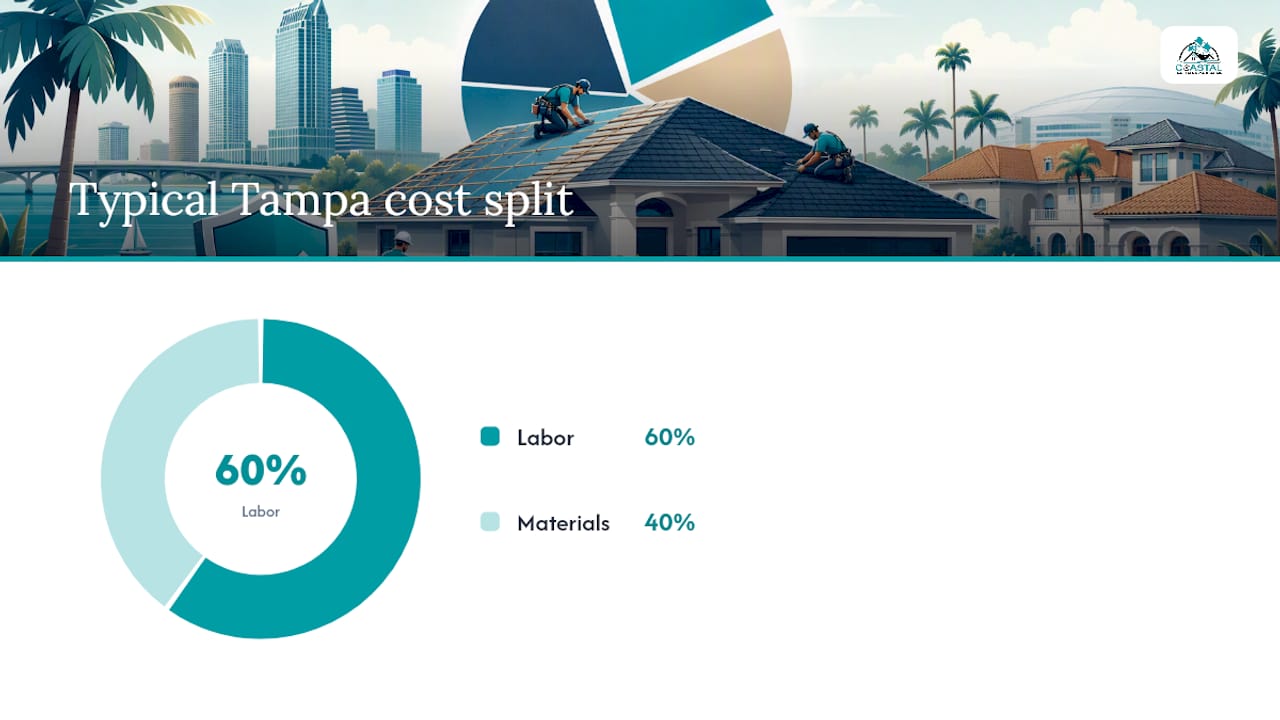
A useful benchmark for Tampa projects: labor typically runs about 60% of the total cost, materials about 40%. If a quote skews heavily toward materials with a suspiciously low labor line, that’s often a sign corners are getting cut on crew size or installation time, both of which affect how well the roof performs in a storm.
Pro Tip: Ask every contractor for a line-item PDF quote, not a one-page estimate with a single total. Lay two bids side by side and compare the same scope items, not just the bottom-line number. A $2,000 gap usually explains itself once you see what’s missing.
How Does Florida Insurance Affect Roof Replacement Costs?
Florida’s insurance rules create a specific fork in the road for Tampa homeowners: your roof’s condition and age can determine whether you pay for a replacement yourself or split the cost with your insurer.
Florida insurance rules generally require bringing damaged roofing up to current code when repairs cross a significant threshold, which in practice frequently pushes insurers and homeowners toward a full replacement rather than a partial patch. This rule most often appears after a hailstorm or wind event damages one slope of a roof but leaves the rest intact.
Insurers draw a sharp line between storm damage and wear-and-tear. Wind or hail damage tied to a documented storm event is typically the kind of claim that gets covered, with adjusters wanting dated photos, a storm report, and sometimes an engineer’s inspection. Age-related deterioration, granule loss, or a roof simply past its expected service life is treated differently. Insurers are increasingly limiting coverage for wear-and-tear claims, which is why proactive replacement before a roof fails outright often works out better financially than waiting for a claim that may get denied.
Wind mitigation upgrades can offset some of that risk. Common credits homeowners pursue include:
- Secondary water barrier installation
- Hip roof designs (versus gable)
- Impact-rated roof coverings
- Reinforced roof-to-wall connections (hurricane clips or straps)
Each of these can trigger a wind mitigation discount on your homeowners policy, and a fresh wind mitigation inspection after a roof replacement is one of the most overlooked ways Tampa homeowners leave savings on the table.
What Permits and Fees Should Tampa Homeowners Expect?
Roof replacement almost always requires a permit in Hillsborough County, and skipping one can complicate a future home sale or insurance claim. Local calculator data puts typical Hillsborough permit fees around $195 for a standard residential replacement, though fees vary by project scope and jurisdiction.
A few things worth confirming before work starts:
- Licensed contractors typically pull the permit themselves, not the homeowner, and this should be baked into your quote rather than billed as a surprise add-on.
- Verify any contractor’s license status directly through myfloridalicense.com before signing anything. An unlicensed installer can leave you without recourse if something goes wrong.
- Fees and inspection timelines differ slightly across Pinellas, Hillsborough, and Pasco counties, so a quote for a Clearwater home and a Brandon home may reflect different permit line items even with identical roof specs.
- Wind-rated fastening schedules required under Florida’s building code often extend inspection requirements slightly compared to non-coastal jurisdictions.
How Do You Compare Roofing Contractor Quotes?
A written quote should read like a contract, not a sales flyer. If it doesn’t specify materials by brand and model, it’s not a real quote yet.
Look for these elements in every bid before you compare pricing:
- Exact scope of work, including tear-off layers, decking repair terms, and disposal.
- Named materials and manufacturer, not generic descriptions like “30-year shingle.”
- Fastening schedule that meets Florida wind code for your zone.
- Permit and inspection responsibility, clearly assigned to the contractor.
- Start and completion dates, with language on weather delays.
- Payment schedule, tied to project milestones rather than large upfront deposits.
- Written warranty terms, separating manufacturer warranty from workmanship warranty.
Before signing, ask who will physically be on your roof, whether that crew carries their own liability coverage, and whether the installer holds manufacturer certification for the product being installed. Certified installers matter more than most homeowners assume: installation quality and proper system components, not just material choice, determine whether a manufacturer warranty actually holds up years down the road. A pre-replacement inspection can also flag issues professionals catch that homeowners typically miss, which helps you compare quotes against an accurate scope rather than guesswork.
Red flags worth walking away from: a contractor who won’t provide proof of insurance, a quote missing permit costs entirely, or pressure to sign same-day after a storm. If two bids differ by thousands of dollars, the cheaper one is often missing decking allowances, underlayment upgrades, or disposal fees that show up later as change orders.
How Long Do Different Roofing Materials Last in Tampa?
Upfront price only tells half the story. What a roof costs you per year of service life often flips the ranking entirely.
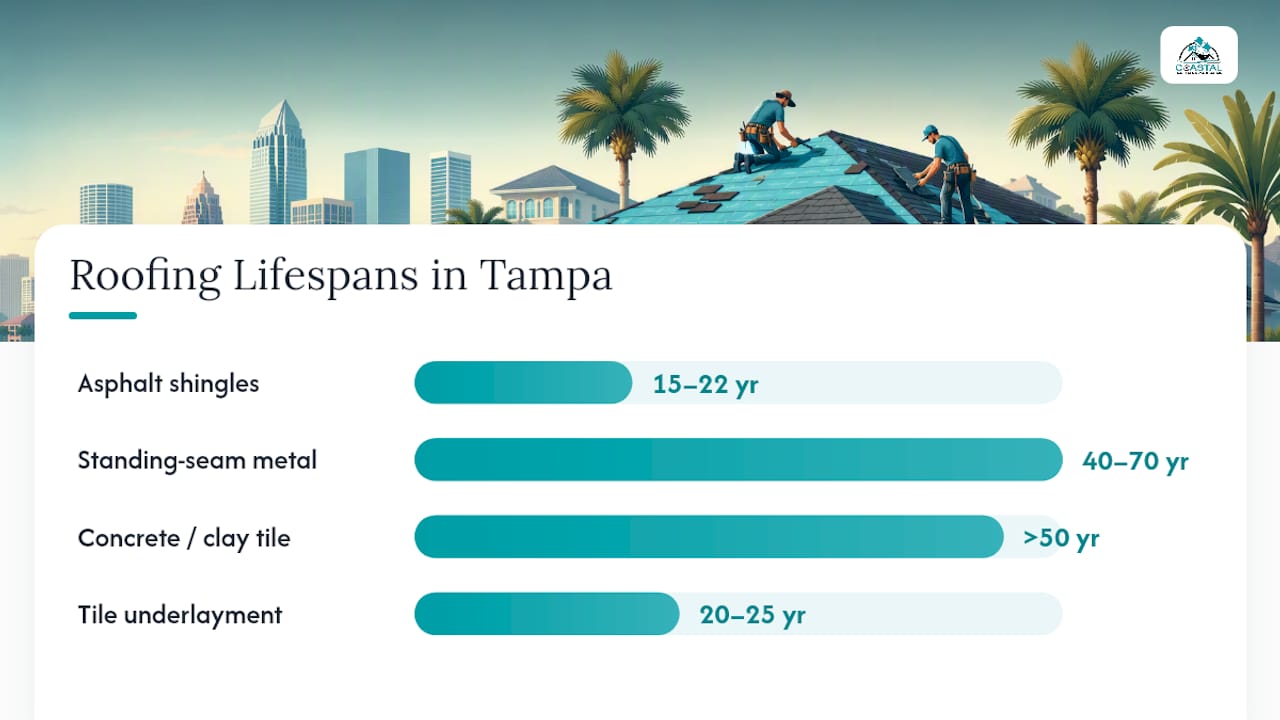
- Asphalt shingles typically last 15 to 22 years in Florida’s climate, shorter than in cooler states due to UV exposure and humidity.
- Standing-seam metal commonly lasts 40 to 70 years, with minimal maintenance beyond periodic fastener checks.
- Concrete and clay tile can exceed 50 years, though the underlayment beneath the tile usually needs replacement around the 20 to 25 year mark, a cost many homeowners don’t anticipate.
Coastal properties face an added wrinkle: salt air accelerates corrosion on unprotected metal fasteners and lower-grade coatings, so metal roofing near the Gulf needs premium finishes and stainless fasteners to hit its full expected lifespan, which raises installed cost but avoids early degradation.
Run a rough cost-per-year comparison: a $16,500 shingle roof lasting 18 years works out to about $917 per year. A $28,000 metal roof lasting 50 years works out to about $560 per year, before factoring in lower maintenance and potential insurance discounts. Reflective roofing materials can also trim cooling costs, a factor the Department of Energy highlights for hot, humid climates like Tampa’s.
Financing Options and the Best Time to Replace Your Roof
Most Tampa homeowners fund a roof replacement through one of three routes: a home equity line, a personal loan, or contractor-arranged financing. Home equity financing usually carries the lowest interest rate but takes longer to close. Contractor financing closes faster and sometimes offers promotional terms, though it pays to confirm the actual APR before committing.
Timing affects price more than most people expect. Demand spikes immediately after hurricane season storms compress contractor availability and push prices upward, while scheduling in late winter or early spring, before the June through November storm window, typically means better pricing and a shorter wait for a crew.
If you expect to coordinate a replacement with an insurance claim, a few habits pay off:
- Photograph roof damage immediately after any storm, before cleanup
- Keep a copy of your wind mitigation inspection on file
- Request a written estimate that separates storm-related repair from any upgrades you’re adding voluntarily
Why Choose Coastal Roofing & Construction for Your Tampa Roof
Some roofing contractors are licensed, insured, and family-owned, with training around Tampa Bay’s roofing conditions rather than generic pricing. Manufacturer certifications with Owens Corning, GAF, and Tri County Metals allow certified installers to access enhanced manufacturer warranties that uncertified crews cannot offer.
The process follows a consistent sequence: an initial inspection and written scope, permit acquisition, installation, and a final inspection before the job closes out. That structure exists to prevent the kind of scope gaps and change orders that inflate a project’s final cost beyond the original quote.
Homeowners across Seminole, Clearwater, St. Petersburg, Tampa, Brandon, and the surrounding Gulf Coast communities work with Coastal Roofing & Construction for everything from standard shingle replacements to high-end standing-seam metal systems on custom and coastal homes.
What’s the Smartest Time to Replace a Roof in Tampa?
Replace a roof before it fails, not after. That’s the single piece of advice worth repeating to every Tampa homeowner reading this: a roof showing granule loss, curling shingles, or soft decking in June is a roof you want handled in April, not during the scramble that follows a named storm.
Reactive replacements after storm damage come with compressed timelines, higher demand pricing, and insurance paperwork that can drag on for weeks while a tarp sits on your roof. Proactive homeowners who schedule during the slower season get better crew availability, more attention to detail, and fewer surprises on decking or underlayment once the old roof comes off.
— Ryan
Get a Written Roof Replacement Quote in Tampa Bay
Some Tampa Bay roofing contractors provide manufacturer-certified installation from crews specializing in the local climate, backed by certifications with Owens Corning, GAF, and Tri County Metals.

Before you commit to a number from this guide, see the work behind it. Browse recent completed projects across Tampa Bay to compare craftsmanship, or head straight to the residential roof replacement page to request a written, line-item estimate for your home. If you’re weighing a metal roof upgrade against a standard shingle replacement, the metal roofing page breaks down what that investment looks like on a Gulf Coast property. For homeowners still mapping out a broader home project, One Day Doors & Closets of Tampa is a useful local resource for related renovation planning.
Sources
Cost figures reference RemodelerIQ’s Tampa roofing data and Build-Folio’s Tampa permit calculator. Code and insurance guidance come from the Florida Building Commission and Progressive’s coverage guidance.
- 2026 Cost to Remodel a Roof Replacement in Tampa | RemodelerIQ
- How Much Does a Roof Replacement Cost in Tampa, FL? (2026 Real Data)
- Roof Replacement Cost in Tampa, FL (2026): $9,000–$24,000
- Florida Building Commission