
Most Tampa single-family asphalt-shingle roof replacements take 1 to 3 crew days to install, but the full project from estimate to permit closeout commonly runs 2 to 4 weeks under normal conditions. Permits, inspections, and Florida’s weather patterns are the usual reasons a job stretches longer. Knowing both clocks, the crew’s on-site work and the city’s permit timeline, helps you plan around your own schedule instead of guessing.
TL;DR:
- Permitting and inspection processes in Tampa typically add one to two weeks to the project’s overall timeline, with permit closeout often occurring within days once scheduled.
- Asphalt-shingle roof replacements usually take one to three days on-site, but delays are common if deck repairs or hidden damage are discovered during tear-off.
- Weather, especially thunderstorms and hurricane season, can cause unexpected delays, often adding several days to the schedule, particularly for complex or specialty roof materials.
- Clear communication about permit numbers, inspection sequences, and potential weather buffers with your contractor can help you plan a realistic project schedule.
- Storm events and roof complexity can extend the timeline, with complex tile or metal roofs requiring up to several weeks from permit approval through final inspection.
Table of Contents
- Timeline at a glance: what to expect by material and stage
- Before installation: inspections, permits, scheduling, and site prep
- Installation day: how crews spend each hour on your roof
- What commonly affects the timeline: weather, complexity, and demand
- Realistic sample schedules you can adapt to your own project
- How to plan and communicate with your contractor
- Local experience behind these timelines
- Scheduling around permits and weather, a practical note
- Ready to get a timeline for your own roof?
- FAQ
- Sources
Timeline at a glance: what to expect by material and stage
A roof replacement runs on two separate clocks: the crew’s on-site work, measured in days, and the permit and inspection process, measured in calendar weeks, as detailed in the comprehensive roof replacement process for homeowners. Keeping both in view prevents the common surprise of a finished roof that is not yet officially closed out.
Here is the general sequence most Tampa homeowners move through:
- Estimate and inspection: typically scheduled within a few days of your first call.
- Permit application and approval: submitted by your contractor before work begins.
- Material ordering and delivery: timing depends on the product you choose.
- Site staging: driveway and yard prep happen the morning of or day before install.
- Installation days: 1 to 3 days for asphalt shingle, longer for metal or tile.
- Final inspection and permit closeout: scheduled after installation wraps up.
Asphalt shingle jobs tend to move fastest. Metal and tile roofs take longer on-site because of the precision and labor involved, which we cover in detail below.
Before installation: inspections, permits, scheduling, and site prep
A thorough pre-replacement inspection covers deck condition, flashing, ventilation, and accurate square footage, since underestimating material needs is one of the quickest ways to delay a project once work starts.
In Tampa, roof-covering replacement permits go through the City of Tampa’s application, fee, and inspection process, and the city is clear that finishing installation is not the same as closing out the permit. Properties in unincorporated Hillsborough County follow a similar but separate process. A Hillsborough County permit record shows how this plays out in practice: one reroof project logged a start notification and a re-roof final inspection two days apart, giving a sense of how quickly closeout can happen once the city or county schedules its visit.
Steps you can expect your contractor to handle, roughly in order:
- Submit the permit application with your measurements and product documentation.
- Pay applicable permit fees.
- Schedule material delivery around the approved start date.
- Request the permit number and planned inspection sequence from your contractor.
- Schedule the final inspection once installation is complete.
On your end, clear the driveway, move vehicles, make arrangements for pets, and notify your HOA if one applies. Our Tampa Bay preparation guide walks through these steps in more detail.
Pro Tip: Ask for your permit number in writing before the crew arrives, then check it yourself against the city or county portal once work begins.
Installation day: how crews spend each hour on your roof
Tear-off and debris removal usually take up the first several hours of day one for an average-sized asphalt roof. Crews then inspect the deck for rot or soft spots, and common issues found during inspection, like water-damaged sheathing or failed flashing, can add anywhere from a few hours to a full extra day if boards need replacing.
Once the deck is sound, the crew installs underlayment, flashing, and ventilation components before laying the final roofing material. According to GAF, an asphalt-shingle roof on an average home can often be completed within one to two days of on-site work, though hidden deck damage is one of the most common factors that extends that window. IKO describes the same staged sequence, tear-off, deck repair, underlayment, then installation, and notes that homeowner prep affects how smoothly each stage moves.
Here is how the stages typically break down:
- Tear-off and debris handling: several hours to a full day.
- Deck inspection and any needed repairs: a few hours, longer if rot is widespread.
- Underlayment, flashing, and ventilation work: part of day one or into day two.
- Material installation: fastest for shingles, slower for metal and tile.
- Cleanup, quality check, and final walkthrough with you: typically the last hour or two.
Metal roofing demands more precise cutting and seaming, while tile is labor-intensive because each piece is set individually, which is why both systems typically take longer than shingle installations of a similar size.
What commonly affects the timeline: weather, complexity, and demand
Tampa’s afternoon thunderstorms, especially from June through September, are the single biggest wildcard in any roofing schedule. A sudden storm can halt work mid-day, and hurricane season adds the possibility of multi-day weather delays that no contractor can fully control.
Beyond weather, several other factors shape how long your project takes:
- Roof geometry: steep pitches require extra safety setup and slow down crew movement.
- Specialty materials: metal panels and certain tile profiles can carry longer lead times before they even arrive on-site.
- Post-storm demand: after a major weather event, contractor schedules fill quickly across the region.
- Deck condition: unexpected rot discovered during tear-off adds repair time before installation can continue.
Industry scheduling guidance recommends building in a buffer rather than assuming a best-case timeline will hold. A simple rule of thumb: add two business days of buffer for routine asphalt jobs, and a full week for specialty materials that depend on manufacturer shipping.
Pro Tip: Schedule your replacement outside of peak storm season when your roof’s condition allows, since availability tightens fast after regional weather events.
Realistic sample schedules you can adapt to your own project
Example A, average asphalt shingle home:
- Week 1: estimate, inspection, and permit submission.
- Week 2: permit approval, material delivery, and site staging.
- Week 3: installation (1 to 3 days) followed by cleanup and walkthrough.
- Week 3 to 4: final inspection and permit closeout.
Example B, complex tile or metal project:
- Weeks 1 to 2: estimate, inspection, and permit submission with product approval documentation.
- Weeks 3 to 5: permit approval and material procurement, since specialty products often ship on longer lead times.
- Weeks 6 to 7: installation, typically longer than shingle work given the precision involved.
- Week 7 to 8: final inspection and closeout.
Extra days most often appear around permit review and the final inspection scheduling, not during the installation itself.
How to plan and communicate with your contractor
A reliable timeline starts with the right questions before you sign a contract. Ask directly:
- What are the expected install dates and how many crew-days are planned?
- What is the permit number, and what is the inspection sequence?
- What is the process for authorizing repairs if deck damage is found?
- Will I receive a written timeline that includes a weather contingency?
Once permits are submitted, you can track progress yourself through the City of Tampa or Hillsborough County permit portal using the permit number your contractor provides. If a contractor is vague about permit numbers, inspection scheduling, or how change orders get approved, treat that as a warning sign rather than a minor detail.
Local experience behind these timelines
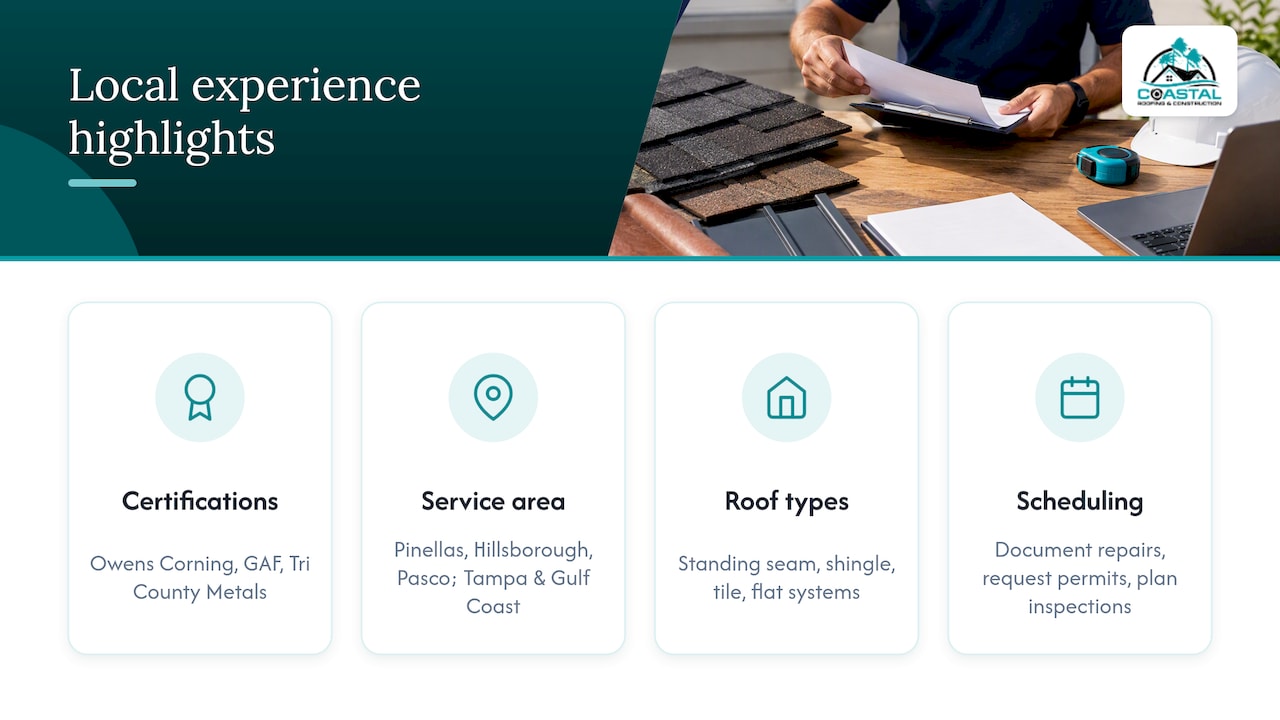
Our team at Coastal Roofing & Construction is manufacturer-certified through Owens Corning, GAF, and Tri County Metals, and we serve homeowners across Pinellas, Hillsborough, and Pasco counties, including Tampa, Clearwater, St. Petersburg, and surrounding Gulf Coast communities. We install standing seam metal, architectural shingle, tile, and flat roofing systems, which means our crews are used to the different time demands each material carries.
In practice, that experience shapes how we schedule: we document deck repairs with written change orders instead of verbal agreements, we request permit numbers up front, and we build inspection windows into the calendar rather than treating them as an afterthought.
Scheduling around permits and weather, a practical note
If there’s one thing years of Tampa roofing jobs have taught us, it’s that the permit clock and the weather clock matter as much as the installation itself. We track permit numbers from day one, document every repair approval in writing, and build weather buffers into every schedule we give a homeowner.
— Ryan
Ready to get a timeline for your own roof?
If you want a schedule you can actually plan around, our roof replacement service starts with a detailed, on-site estimate that covers material options, expected crew-days, and the permit steps specific to your property.

When you request your estimate, ask us directly for the planned permit number and inspection sequence so you know exactly where your project stands at each stage. We serve homeowners throughout the Tampa Bay area and we’re glad to walk you through what a realistic calendar looks like for your home.
FAQ
How long between replacing a roof?
Most asphalt-shingle roofs last decades before replacement is needed, though metal and tile systems typically last longer. The right timing depends more on inspection findings, like deck condition and flashing wear, than on age alone.
How much does it cost to replace a roof on a 2,200 square foot house?
Pricing depends on material, roof complexity, and local labor costs, so there is no single figure that applies everywhere. We provide project-specific pricing after an on-site inspection rather than a flat estimate.
What color roof increases home value?
There is no single roof color proven to raise resale value, since buyer preferences and HOA rules vary by neighborhood. Choosing a color that fits the home’s style and local building standards tends to matter more than the shade itself.
Is $30,000 too much for a roof?
Whether that figure is reasonable depends heavily on roof size, material, and complexity, since premium systems like standing seam metal or tile cost more than standard asphalt shingles. An accurate answer requires a specific quote based on your roof’s measurements and chosen material.
Sources
- Roof Covering Replacement Permits – Roof Coverings | City of Tampa
- Hillsborough County permit record (example)
- How long does it take to replace a roof? | GAF
- What to expect during roof replacement – IKO North America