
Sagging in the roofline, soft or spongy decking underfoot, persistent water stains or mold in the attic, and daylight visible through the roof boards are the clearest signs that decking needs replacement, not repair. If you spot any of these, schedule a professional inspection quickly: waiting risks structural damage and mold growth. Guidance from the U.S. Department of Energy and manufacturer resources like IKO back up what experienced field crews see on ladders regularly.
TL;DR:
- Sagging rooflines, soft spots, or visible daylight through roof boards indicate likely decking failure requiring replacement.
- Inside the attic, water stains, mold, active fungal growth, or light passing through damaged boards confirm ongoing moisture problems.
- When extensive sagging spans multiple rafters or rot affects several sections, full deck replacement is necessary instead of patching.
- Poor attic ventilation and faulty flashing are the root causes of deck rot, emphasizing the importance of addressing airflow issues and leak sources.
- Early detection relies on professional inspections that include detailed attic probing, moisture measurements, and photographic documentation to prevent structural damage.
Table of Contents
- Exterior signs you can spot from the ground or a ladder
- What to inspect inside the attic for deck damage
- Structural warning signs that mean replacement, not repair
- Why decks rot: ventilation, flashing, and material factors
- What a professional inspection and replacement involves
- What Ryan’s field checklist looks for during an inspection
- What homeowners consistently get wrong about deck damage
- Getting your roof deck professionally inspected
- Where to read more on ventilation and deck rot
- Sources
- FAQ
Exterior signs you can spot from the ground or a ladder
Curled or cupped shingles, patches of missing granules, and bald spots on the roof surface do not always mean the decking underneath has failed, but they tell you the underlayment has likely lost its protective seal, and any further exposure lets water reach the wood directly. A roof-system inspection from Owens Corning treats these shingle warning signs as a prompt to check the deck itself, not just the surface layer.
Look for localized dips or wavy patches across the roof plane. A flat, straight roofline is normal; a dip that follows a section between two rafters usually means the decking there has softened and is deflecting under its own weight. After any significant storm, check flashing around chimneys, skylights, and roof penetrations, since a lifted or corroded flashing seam is one of the most common entry points for water that eventually rots the deck below it.
Moss and algae are not purely cosmetic. Thick moss holds moisture against the shingle surface for days after rain stops, and that sustained dampness works its way down to the decking over time, especially in shaded, north-facing sections of a roof.
- Photograph any sagging, missing shingles, or moss patches with a date stamp for insurance and contractor records.
- Note which side of the roof faces prevailing wind and rain, since damage often clusters there.
- Avoid walking on a roof you suspect has soft spots; observe from a ladder or use binoculars instead.
Sagging rooflines and localized soft spots are among the most reliable visible signs of decking failure, and catching them early from the ground often points to underlying deck problems before they become full replacements. Coastal Roofing & Construction’s storm damage guidance covers what a post-storm exterior check should include.
What to inspect inside the attic for deck damage
The attic tells you more than the roof surface ever will, because you are looking at the underside of the same decking that shingles hide from view outside. A flashlight and thirty minutes on a dry day are usually enough for a first pass.
- Look for water stains or dark streaking on the rafters and the underside of the sheathing, especially near the eaves where wet, flattened insulation often collects.
- Check for visible mold, mildew, or fuzzy fungal growth on the wood itself; discoloration alone can be old and dry, but active growth signals ongoing moisture.
- Turn off the attic light during daylight hours and look for pinpricks or larger gaps of light coming through the roof boards, which means the decking has thinned or opened up enough to let light pass.
- If a board looks suspect, a professional will gently press the handle end of a screwdriver against it rather than the point, since a sound board resists while a rotted or delaminated one gives way; homeowners should generally leave this probing to a contractor to avoid puncturing wood that is only temporarily damp.
- Pay attention to any musty odor, which usually means moisture has been sitting in the wood or insulation for a while rather than a one-time leak.
IKO’s guidance on identifying rotted sheathing lists discoloration, sponginess, fungal growth, musty smells, and crumbling wood as the core indicators, and notes that wood that crumbles under light pressure has moved past the point where drying it out is an option.
Structural warning signs that mean replacement, not repair
Some decking damage is minor enough to patch. Delamination, though, changes the calculation: when the layers of plywood or the strands of OSB separate, the board can no longer transfer roof loads evenly to the rafters beneath it, and a patch over that spot does not restore its strength.
The line between a repair and a full decking replacement usually comes down to two questions: how much of the deck is affected, and whether the sagging shows up across multiple rafter bays rather than one isolated spot. IKO’s contractor process notes that not every wet board needs to come out, since professionals weigh exposure duration and the extent of rot before deciding, but once sagging spans several rafters, replacement is usually the only durable fix.
- Localized rot around a single vent boot or flashing seam often means a targeted patch is enough.
- Sagging that follows a line across three or more rafter bays usually means the decking has lost structural integrity over a wider area.
- Wet insulation, reduced attic airflow, and rising energy bills often trail behind chronic deck moisture problems.
- A soft spot near a ridge or valley carries more urgency than one on a flat section, since water concentrates there.
Pro Tip: If you find a soft spot before a contractor can get out, avoid foot traffic on that section and place a tarp over it if rain is expected, but skip any temporary patching that could trap moisture underneath.
Why decks rot: ventilation, flashing, and material factors
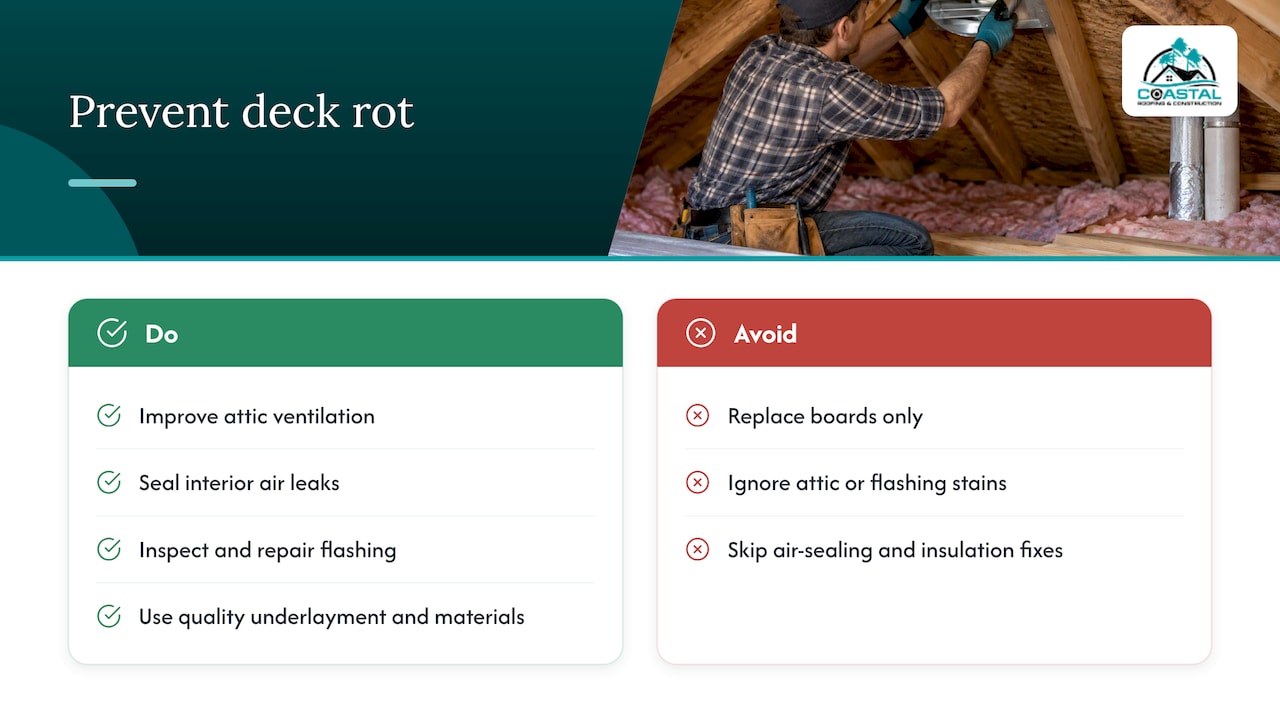
Decking rarely fails on its own. The DOE’s guide to durable attics identifies poor attic ventilation and unchecked interior air leakage as primary drivers of premature deck rot, since warm, moist household air that reaches the attic condenses against cool decking and keeps it damp far longer than rainfall alone would.
Flashing around chimneys, skylights, vent boots, and roof-mounted equipment accounts for a large share of the leaks that eventually show up as attic stains. Material choice matters too: OSB and plywood behave differently once wet, and the presence and quality of an ice and water barrier under the shingles often determines whether a small leak stays contained or spreads across a wide section of decking.
Improper ventilation and air sealing, not just weather exposure, are the primary long-term threats to a healthy roof deck.
When ventilation and insulation are the root cause, replacing the damaged boards without fixing the airflow problem behind them usually means the same repair comes up again within a few years.
What a professional inspection and replacement involves
A thorough inspection starts outside with a visual survey of shingles, flashing, and valleys, then moves into the attic to check rafters, insulation, and the underside of the deck. Where the exterior or attic findings raise questions, a contractor will pull back a section of shingles to probe the decking directly rather than guessing from stains alone.
- The contractor documents suspect areas with photos before and after removing any shingles or underlayment.
- Rotted or delaminated sections get cut back to the nearest solid rafter so the new board has full support on both ends, following the same process IKO outlines for sheathing replacement.
- Replacement panels are matched to the original thickness, whether that means plywood, OSB, or a mix of both, so the finished shingles lay flat.
- New underlayment and ice and water barrier go down before the shingles are reinstalled, since reusing stripped shingles is not recommended.
A single soft spot can often be repaired in a day, while a full deck replacement tied to a reroof runs closer to the same timeline as the roof replacement itself. Reputable crews protect landscaping with tarps and plywood paths, and homeowners should receive dated photos of any decking that was removed and replaced.
What Ryan’s field checklist looks for during an inspection
Years spent on Tampa Bay roofs after storms make one thing clear: the reports that catch decking problems early are specific, not vague.
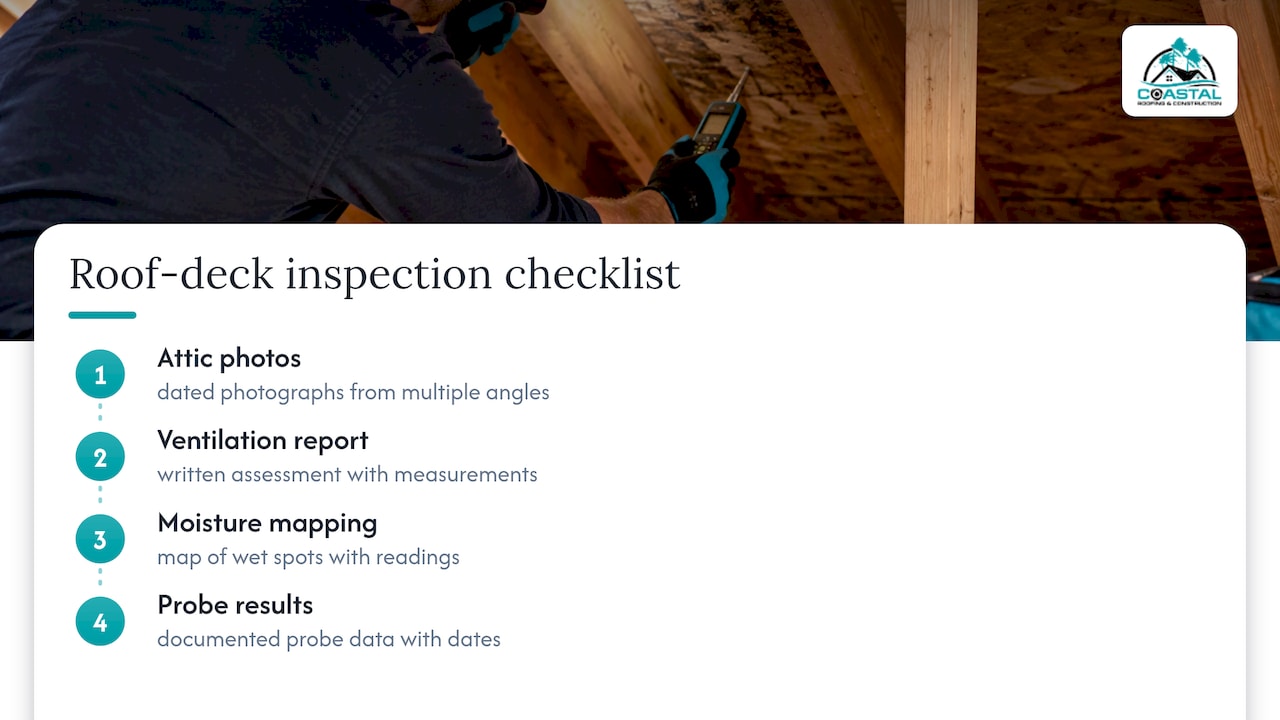
Ask any inspector for attic photographs, a written ventilation assessment, moisture mapping, and documented probe results rather than a verbal summary. A report that says only to “monitor” a stained area without dates, photos, or measurements is a report that leaves you guessing later.
What homeowners consistently get wrong about deck damage
The biggest misjudgment homeowners make is treating a stain as the problem instead of a symptom. A brown ring on the attic ceiling gets patched with paint or sealant, and the rot underneath keeps spreading unnoticed for another season or two.
Conventional advice tends to focus on shingle age as the trigger for concern, but decking failure often has more to do with attic ventilation and flashing quality than with how many years the shingles have been on the roof. A well-vented, well-flashed roof can protect its decking for decades past what shingle warranties suggest, while a poorly ventilated one can develop soft spots within a few years of installation.
If you take one thing from a self-check, prioritize the attic over the exterior. Surface signs like curling shingles are useful early warnings, but the attic is where you find out whether the decking underneath still has structural integrity, and that finding should drive whether you call a contractor this week or just keep an eye on things.
— Ryan
Getting your roof deck professionally inspected
Factory-trained crews check decking, ventilation, and flashing together during inspections, since treating one without the others tends to bring the same problem back. 
Before your inspection, gather a few things that speed up the visit:
- Photos of any attic stains or discoloration you have already noticed.
- Approximate dates of past leaks or storm events tied to the affected area.
- Clear attic access so the crew can check rafters and decking without delay.
Schedule a roof replacement inspection to find out whether your decking needs targeted repair or full replacement before small soft spots turn into structural ones.
Where to read more on ventilation and deck rot
For deeper reading, the DOE’s durable attics guide covers ventilation and moisture control, IKO’s sheathing guide walks through rot identification and replacement, and Owens Corning’s roofing guide explains roof-system warning signs. A water damage prevention checklist offers additional attic inspection pointers.
Sources
- Guide to Durable Attics — U.S. Department of Energy
- Rotted roof deck: how to replace roof sheathing — IKO
- Roof Smarter roofing 101 guide — Owens Corning
FAQ
What is the 25 rule in roofing?
The “certain portion rule” is a building code provision some jurisdictions use, stating that if more than a set portion of a roof needs repair or replacement in a given period, the entire roof system must be brought up to current code. It varies by location and is not a universal roofing standard, so check with your local building department for the specific threshold that applies to your area.
What are five signs that my roof needs to be replaced?
Common signs include a visibly sagging or wavy roofline, soft or spongy spots when walked on, water stains or dark streaking on the attic side of the decking, daylight visible through the roof boards, and shingles that are curled, cupped, or missing many granules. Any combination of these usually means it is time for a professional inspection rather than a simple patch.
How much does it cost to replace flashing on a roof?
Flashing replacement costs vary widely depending on the roof’s size, the type of flashing, and regional labor rates, so there is no single published figure that applies everywhere. A contractor can give you an accurate quote after inspecting the specific flashing sections involved, such as chimney, valley, or skylight flashing.
How to tell if roof decking needs to be replaced?
Decking typically needs replacement rather than repair when it feels soft or spongy underfoot, shows active mold or fungal growth, has separated into visibly delaminated layers, or lets daylight through from inside the attic. IKO’s guidance notes that wood crumbling under light pressure has moved past the point where it can be dried out and reused.