
In Florida, expect a standard architectural asphalt shingle roof to hold up for roughly 15 to 22 years, not the 30 years printed on the warranty paperwork. Coastal exposure pushes that number toward the lower end; inland properties tend to land toward the higher end. The gap between manufacturer warranty and actual Florida service life comes down to sun, heat, and salt air, and the ranges below break it down by shingle tier so you can plan accordingly.
TL;DR:
- Coastal exposure can reduce a shingle roof’s lifespan by up to six years within one mile of saltwater, even if the warranty suggests 30 years.
- Premium impact-rated shingles extend usable life by approximately 4 to 8 years compared to standard architectural shingles in Florida’s harsh climate.
- Regular maintenance, including inspections, gutter cleaning, and attic ventilation, can slow roof deterioration and add several years of service.
- Most roofs show early failure signs like granule loss and shingle brittleness between 12 and 15 years, necessitating professional assessment for accurate remaining life.
- Insurance policies often require formal condition reports at 12 to 15 years, making proactive inspections crucial to avoid premature roof replacement demands.
Table of Contents
- Shingle Roof Lifespan in Florida by Material and Coastal Distance
- Why Florida’s Climate Wears Out Shingles Faster Than Almost Anywhere Else
- Warning Signs Your Shingle Roof Is Reaching the End of Its Life
- How to Get More Years Out of Your Shingle Roof
- Insurance Realities: What Florida Insurers Expect From an Aging Shingle Roof
- What Coastal Roofing & Construction Sees During Tampa Bay Roof Inspections
- Why the Warranty Number Is the Wrong Number to Plan Around
- Get a Written Remaining-Life Estimate Before Your Insurer Does
- Sources
Shingle Roof Lifespan in Florida by Material and Coastal Distance
Shingle manufacturers test their products in controlled lab conditions, not on a Gulf Coast roof deck that hits 160 degrees in July. That gap explains why a 30-year architectural shingle rarely makes it past year 20 in most Florida neighborhoods. Here’s what realistic architectural shingles lifespan in Florida actually looks like by product tier:
- 3-tab shingles: typically span a shorter service life than architectural types due to their thinner, single-layer design, which accelerates granule loss and curling in Florida heat.
- Standard architectural shingles: generally provide a medium-range service life suitable for most new roofs, though exact duration varies by location and conditions.
- Premium-granule architectural shingles: feature denser mats and heavier granule coatings designed to resist UV breakdown, resulting in a longer lasting roof compared to standard types.
- Impact-rated (Class 4) shingles: 20 to 28 years, with the added benefit of better wind and hail resistance. Premium and impact-rated products commonly extend usable life by 4 to 8 years over standard architectural shingles.
Coastal proximity changes these numbers more than most homeowners expect. A rule of thumb worth remembering: within one mile of saltwater, subtract 4 to 6 years from any of the ranges above. Between one and five miles, subtract 2 to 4 years. Beyond five miles inland, the reduction is minor, often 0 to 2 years, depending on how exposed the property is to prevailing wind.
For context, metal and tile roofing systems in Florida commonly run 40 to 50 years or more, which is why we see so many premium coastal homes moving toward standing seam metal. Shingles remain the more budget-friendly option, but that cost advantage narrows once you factor in one or two extra replacement cycles over a 40-year ownership window.
Why Florida’s Climate Wears Out Shingles Faster Than Almost Anywhere Else
Florida throws more at a roof than nearly any other state, and it’s not just the hurricanes. Sustained UV exposure, heat cycling, humidity, and salt air combine to break down asphalt shingles years faster than in temperate climates. Each factor attacks the roof differently:
- UV radiation breaks down the asphalt binder and strips away protective granules, the small stone particles that shield the mat underneath from sun damage. A roof that’s lost significant granule coverage in the gutters has already lost a meaningful chunk of its UV shield.
- Heat cycling matters more than raw temperature. Florida attics regularly swing between scorching afternoon highs and cooler overnight lows, and that daily expansion and contraction stresses the seal strips that bond shingles together.
- Humidity and algae growth create dark streaking and hold moisture against the shingle surface longer than in drier climates, which accelerates granule loss over time.
- Salt air, especially within a mile or two of the coast, corrodes exposed fasteners and flashing faster than inland installations, weakening the roof’s overall grip during wind events.
- Wind and storm pressure cycles, even from routine summer storms rather than named hurricanes, repeatedly flex the sealant bonds between shingles. Every cycle is a small setback; a decade of them adds up to real wear.
None of these factors act alone. A roof battered by salt air and baked by UV for 15 summers is a different animal than the same product installed 20 miles inland.
Warning Signs Your Shingle Roof Is Reaching the End of Its Life
Most roof failures don’t happen overnight. They show up first in small, easy-to-miss signals, and catching them early is the difference between a repair bill and a full replacement.
- Granules piling up in gutters. A few granules are normal. Handfuls after every rain mean the protective coating is wearing thin.
- Curling, cupping, or bare patches on the shingle surface. These indicate the asphalt mat has dried out and lost flexibility.
- Brittle shingles that crack when walked on. This is a late-stage sign the roof has lost most of its remaining flexibility.
- Recurring leaks or visibly patched sections. A roof that needed the same repair twice in three years is telling you something.
- Failed flashing around chimneys, skylights, or roof valleys. Flashing failure is one of the most common issues a professional inspection turns up, often before homeowners notice any interior signs.
- Roofs approaching 12 to 15 years old. This is the point where a professional condition check, not a DIY glance from the ground, makes sense even without visible damage.
- Post-storm damage after any named tropical system or severe wind event. Photograph missing shingles, dented vents, and debris impact marks right away. Insurers want dated documentation, not a description from memory weeks later.
How to Get More Years Out of Your Shingle Roof
Two roofs installed the same year, on the same street, can age at completely different rates. The difference almost always comes down to product choice, installation quality, and what happens after the crew leaves.
- Upgrade to premium-granule or impact-rated shingles at replacement time. The extra 4 to 8 years of service life they typically deliver usually justifies the modest per-square-foot upcharge, especially on a coastal property where every other factor is already working against the roof.
- Insist on a proper nail pattern and starter strip during installation. Underdriven or misplaced nails are one of the top reasons shingles fail early, wind or no wind.
- Require peel-and-stick underlayment, particularly in valleys and around penetrations, for an added layer of protection against wind-driven rain.
- Fix attic ventilation. Balanced soffit intake and ridge exhaust can lower attic temperatures by 20 to 30 degrees, which directly slows the heat-driven breakdown of the asphalt binder. It’s the single most controllable factor a homeowner has.
- Schedule an annual inspection, soft-wash the roof to control algae, and clear gutters regularly. None of this is glamorous, but it’s the maintenance equivalent of an oil change: cheap now, expensive to skip.
Pro Tip: If you’re comparing asphalt shingle options for a coastal property, ask your contractor for the specific wind and impact rating on the product data sheet, not just the marketing name. “Architectural” alone tells you almost nothing about how it performs in salt air.
Insurance Realities: What Florida Insurers Expect From an Aging Shingle Roof
Florida’s insurance market treats roof age differently than almost any other state, and it’s worth understanding before your renewal notice shows up. Many carriers, along with statewide guidance on roof-related coverage, use 15 to 18 years as a practical threshold where they start requiring proof of condition or pushing toward non-renewal.
- Four-point inspections often get requested around the 12 to 15 year mark, well before the roof actually fails. Insurers use these to check the roof, electrical, plumbing, and HVAC systems together.
- A written remaining-life estimate from a licensed roofing contractor gives you leverage. Condition, not just age, drives many insurer decisions, and a documented assessment can sometimes delay a forced replacement.
- Off-season timing helps your budget. Scheduling replacement outside peak storm-season demand (typically late fall through early spring) often means shorter permit windows and more contractor availability.
- Keep dated photos, inspection reports, and receipts. This documentation matters for insurance claims now and for resale value later.
If your roof is closing in on that 12 to 15 year window, it’s worth getting ahead of the insurer’s timeline rather than reacting to a cancellation notice. Our Tampa Bay roof replacement guide walks through what that planning process looks like.
What Coastal Roofing & Construction Sees During Tampa Bay Roof Inspections
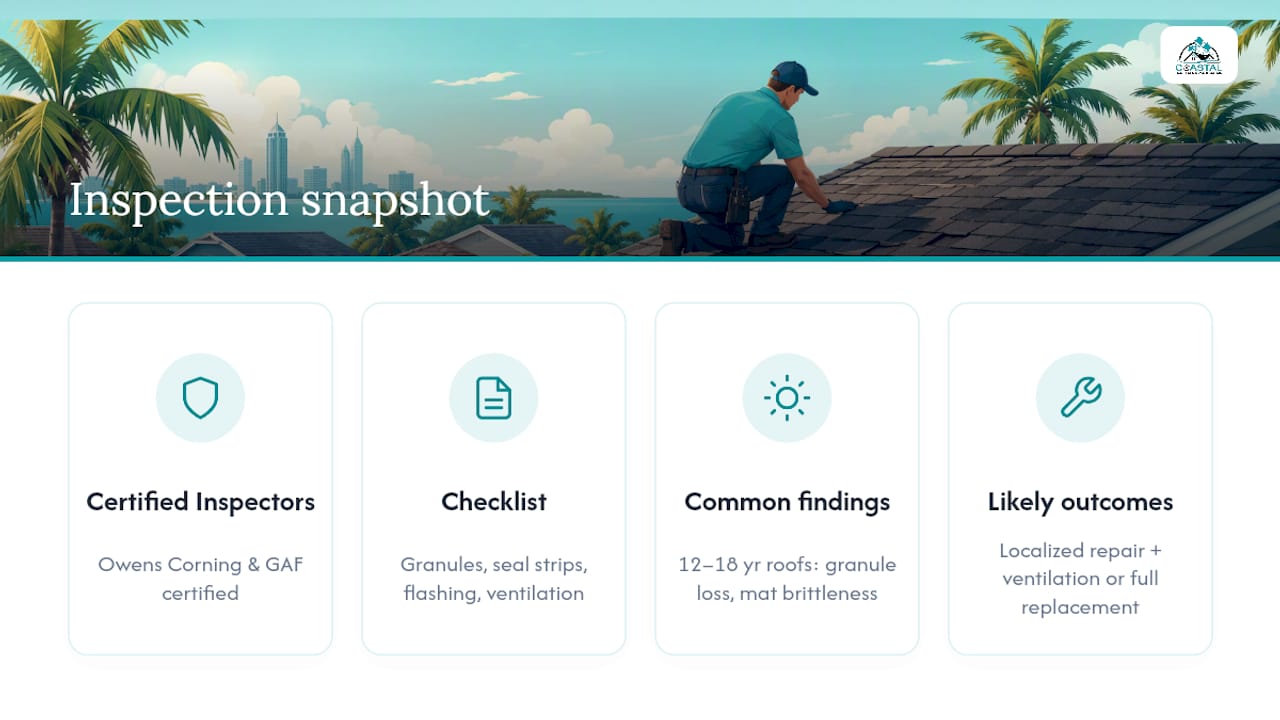
Our inspectors are manufacturer certified through Owens Corning and GAF, and we run a standard checklist on every visit: granule loss patterns, seal strip integrity, flashing condition, and attic ventilation balance. Most Tampa Bay shingle roofs we inspect between 12 and 18 years show measurable granule loss and early mat brittleness, particularly on west and south-facing slopes that take the heaviest sun exposure.
Not every aging roof needs full replacement. Sometimes a localized repair and a ventilation fix buy several more years. Our roof inspection process gives you a written condition assessment either way, so the decision is based on what your roof deck actually shows, not a guess.
Why the Warranty Number Is the Wrong Number to Plan Around
The biggest mistake homeowners make with shingle roof lifespan isn’t ignoring maintenance. It’s anchoring their expectations to a warranty figure that was never designed for Florida’s climate. A 30-year warranty describes a defect guarantee under laboratory test conditions, not a promise about how the shingle performs after two decades of Gulf Coast sun and salt air.
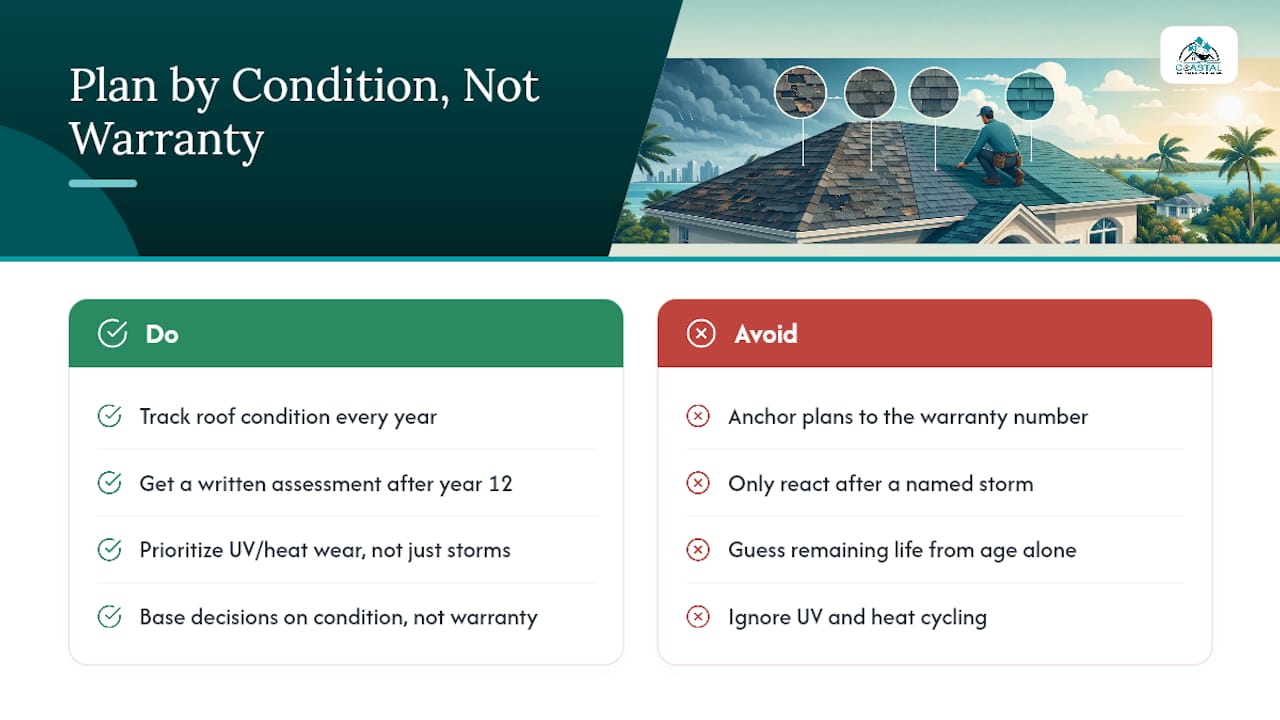
Conventional advice tends to focus heavily on storm damage and hurricane prep, which matters, but it undersells the slower, cumulative toll of UV and heat cycling that wears down a roof long before any named storm arrives. The homeowners who get the most out of their roof aren’t the ones who react fastest after a storm. They’re the ones who track age against condition every year and get an honest professional read before an insurer forces the issue.
If your roof is past year 12, prioritize getting a written condition assessment over guessing based on age alone. Two roofs of the same age can have very different remaining life, and that distinction is the one that actually saves money.
— Ryan
Get a Written Remaining-Life Estimate Before Your Insurer Does
Coastal Roofing & Construction gives Tampa Bay homeowners something most roof quotes skip: an honest, written remaining-life estimate instead of a sales pitch toward immediate replacement. That means photos, specific findings on granule loss and seal strip condition, and a clear repair-versus-replace recommendation you can actually use for insurance or resale conversations.

Our crews are manufacturer certified with Owens Corning, GAF, and Tri County Metals, and we install everything from standard architectural shingles to premium impact-rated products and standing seam metal, depending on what your budget and coastal exposure actually call for. You can browse completed projects on our project portfolio to see the range of work firsthand. If your roof is approaching the 12 to 15 year mark, or you’ve already had an insurer flag it, schedule a residential roof replacement consultation and get a clear answer on where your roof actually stands.
Sources
- How Long Do Shingles Last in Florida? | Real Lifespan Guide (2026)
- Florida roof lifespan by material (2026) — BuildPriced
- FloridaClimate Institute — Florida climate key messages
- NACHI — Florida life expectancy (roofing table and commentary)