
A concrete tile roof in Florida can visibly last 30 to 50 years, and clay tile often reaches 50 to 100 years or more. But here’s what most homeowners don’t find out until it’s expensive: the underlayment beneath those tiles usually fails decades earlier, often between years 18 and 25 in coastal markets. The tiles can look flawless while the waterproof membrane underneath has already turned brittle.
Understanding that the tile condition does not directly reflect the roof’s watertight integrity is crucial for tile roofing in Florida.
- Concrete tile: visible tile life of roughly 30 to 50 years, but system-level replacement is often needed sooner
- Clay tile: visible tile life of 50 to 100+ years, with the same underlayment ceiling underneath
- The trigger point: coastal Florida homes should commission an underlayment condition assessment around year 18 to 20
If your roof is approaching that window, or you just bought a home with tile that’s already 15 years into its life, the smart move is scheduling that assessment now, not waiting for a stain on the ceiling to make the decision for you.
Key Takeaways
Tile roof lifespan in Florida is governed less by the tile itself and more by how long the underlayment underneath it can hold up against heat, salt, and humidity.
| Point | Details |
|---|---|
| Tile outlasts underlayment | Concrete tile lasts 30 to 50 years and clay tile 50 to 100+ years, but underlayment often fails at 18 to 25 years. |
| Schedule inspection at year 18 to 20 | A limited tile-removal underlayment condition assessment reveals real membrane condition that ground inspections miss. |
| Coastal exposure accelerates failure | Homes near open water can see underlayment degrade 20 to 30% faster from salt air and heat. |
| Lift-and-relay preserves tile | Removing tiles, replacing underlayment, and reinstalling is usually faster and less wasteful than full replacement. |
| Coastal Roofing & Construction offers certified assessments | Manufacturer-certified crews perform tile-removal inspections and lift-and-relay work across Tampa Bay. |
Table of Contents
- Why Tile Roof Lifespan in Florida Really Comes Down to Underlayment
- How Long Do Concrete and Clay Tile Roofs Actually Last?
- What Coastal Conditions Do to Your Roof, and What Actually Slows It Down
- When Should You Schedule an Underlayment Inspection?
- Lift-and-Relay or Full Replacement: How to Decide
- What Should You Budget for Underlayment Work in Florida?
- How Florida Building Codes Shape Tile Roof Longevity
- Hurricanes and Severe Weather: The Real Test of Tile Roof Durability
- What Tile Roof Warranties in Florida Actually Cover
- Does Installation Method Change How Long a Tile Roof Lasts?
- How Coastal Roofing & Construction Handles Underlayment Assessments and Repairs
- Coastal Roofing & Construction: Your Next Step for Tile Roof Assessments
- Sources
Why Tile Roof Lifespan in Florida Really Comes Down to Underlayment
Underlayment is the waterproof layer installed directly on the roof deck, underneath the tile. The tile handles UV exposure, wind, and impact. The underlayment does the actual job of keeping water out of your house. Tile is essentially armor; underlayment is the skin doing the real work of waterproofing.
For decades, most Florida homes were built with asphalt-felt underlayment, and in coastal conditions that material tends to fail at roughly 18 to 25 years. That’s a stark contrast to a concrete tile rated for 30 to 50 years, or clay tile that can outlast the felt by 50 years or more. Attic heat accelerates this. A Tampa Bay attic can regularly hit 150°F in summer, and that thermal cycling, combined with UV bleed-through on older tile profiles and salt-laden air near the coast, dries out asphalt felt until it cracks and delaminates.
Modern synthetic and peel-and-stick underlayments handle these stresses far better. Specifying peel-and-stick self-adhering underlayment at replacement time can add 15 to 20 years to the system’s service life compared to legacy felt.
- Asphalt felt: roughly 18 to 25 years in coastal Florida conditions
- Synthetic/peel-and-stick: extends service life well beyond felt, often by 15 to 20 years
- Attic heat and salt air are the two biggest accelerants of felt breakdown
How Long Do Concrete and Clay Tile Roofs Actually Last?
Both tile types carry long manufacturer warranties, but Florida’s coastal climate creates a real split between what a warranty promises and what the roofing system delivers in practice.
Concrete tile typically shows a 30 to 50-year visible service life, and manufacturers often warranty the tile itself for 50 years. That warranty, though, covers the tile product, not the roof deck and underlayment beneath it. Clay tile performs even better as a material, commonly reaching 50 to 100+ years in field conditions, which explains why you’ll still see original clay tile roofs on 1920s-era homes in neighborhoods like Davis Islands in Tampa or the Bayboro Historic District in St. Petersburg. Those tiles have genuinely earned their keep. The underlayment beneath them, meanwhile, has typically been replaced two or three times.
That’s the distinction homeowners miss: a warranty on tile durability says nothing about how long the waterproofing underneath will hold up under Gulf Coast humidity and salt exposure. Florida-specific field data backs this up consistently: concrete tile in the 30 to 50-year range and clay tile in the 50 to 100+ year range, with underlayment replacement recommended every 20 to 25 years regardless of how the tile itself looks.
- Concrete tile: 30 to 50 years visible life, 50-year manufacturer warranty on the tile product
- Clay tile: 50 to 100+ years visible life, often outlasting several underlayment cycles
- System-level replacement (the underlayment) is typically needed well before the tile itself shows wear
What Coastal Conditions Do to Your Roof, and What Actually Slows It Down
Four environmental stressors do most of the damage to Florida tile roofs, and they compound each other in ways that inland homes never experience.
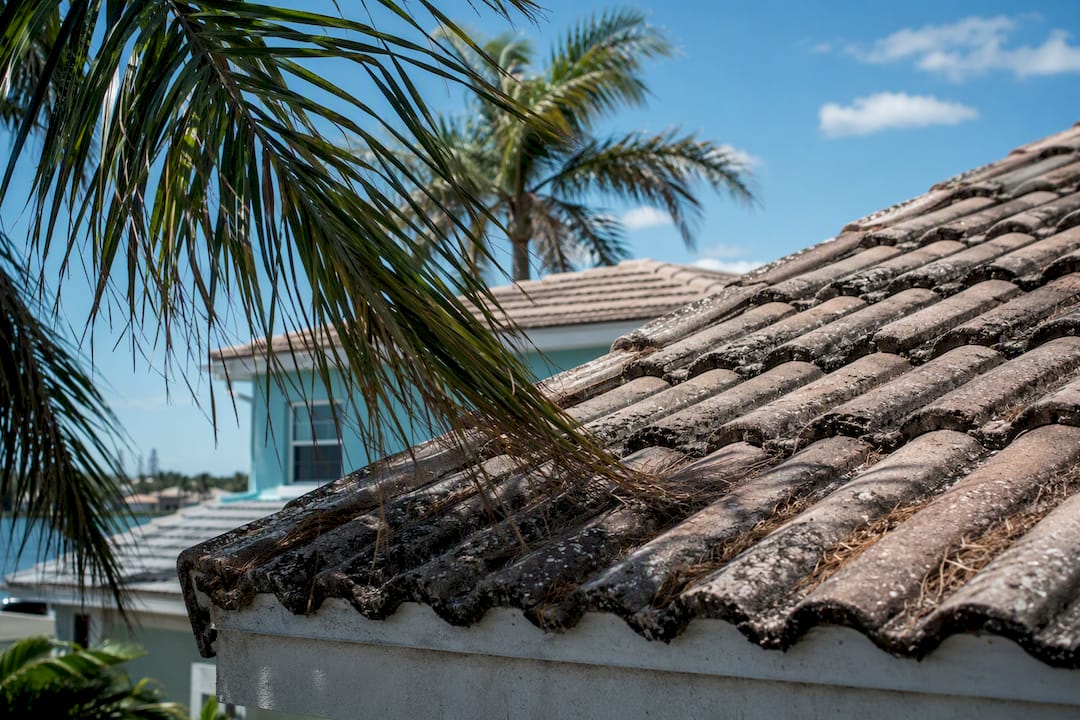
Ultraviolet exposure bakes the tile surface and, over years, contributes to the brittleness of any exposed underlayment at flashing points and roof penetrations. Humidity keeps moisture cycling through the roof assembly nearly year-round, which promotes the granular breakdown of older asphalt felt. Salt air is the accelerant coastal homeowners underestimate most: properties within roughly 1,500 feet of open water can see underlayment degrade 20 to 30% faster than the same system a few miles inland. Storms add physical stress through wind uplift and wind-driven rain that finds its way under compromised tiles.
Attic ventilation is the highest-impact variable you actually control. A poorly ventilated attic traps heat against the underlayment from below, on top of everything the sun does from above, cutting years off its life.
- Rinse algae and organic buildup off tile surfaces annually to prevent moisture retention
- Clear gutters and valleys every season so water doesn’t pool against tile edges
- Replace cracked or slipped tiles promptly. Even one gap lets water reach the underlayment directly
- Schedule a visual roof inspection after any named storm or major wind event
Pro Tip: If your home sits within a few blocks of the water, treat your maintenance schedule like it’s five years ahead of the calendar. What a felt underlayment does in year 20 inland, it may do in year 15 near the Gulf.
When Should You Schedule an Underlayment Inspection?
For coastal Florida homes, the window to act is around year 18 to 20. That’s when experts recommend a limited tile removal underlayment condition assessment rather than relying on a visual check from the ground.
Here’s what actually happens during that inspection:
- A licensed contractor removes tiles from several representative zones across the roof, not just one spot
- The exposed underlayment gets examined directly for embrittlement, cracking, delamination, and water staining on the deck
- Findings get mapped to a recommendation: leave it alone, repair isolated areas, replace the underlayment (lift-and-relay), or move to full replacement
A visual inspection from the ground can’t tell you what’s happening under the tile. A limited tile removal inspection takes only a few hours but delivers evidence that exterior observation simply cannot replicate.
The Residential Roof Inspection process should feel routine, not alarming. Most homes in the 18 to 20-year range have underlayment that’s aging normally. Some need attention now. The only way to know which category yours falls into is to look.
Lift-and-Relay or Full Replacement: How to Decide
Lift-and-relay means a crew carefully removes and tags your existing tiles, replaces the failed underlayment, then reinstalls those same tiles to factory-standard alignment. It’s the mainstream fix in Florida when the tile is still serviceable but the membrane underneath isn’t, and it’s typically far less wasteful than tearing everything off and starting over.
- Choose lift-and-relay when: the deck is sound, most tiles are undamaged, and the underlayment assessment shows failure without deck rot
- Pros: preserves the existing tile aesthetic, generates less debris, usually finishes faster than a full tear-off
- Full replacement becomes necessary when: the deck has rotted sections, a large percentage of tiles are cracked or broken, or code updates require structural changes
- Insurance renewal requirements or updated wind-mitigation standards can also tip the decision toward full replacement even when the tile itself is salvageable
What Should You Budget for Underlayment Work in Florida?
A typical single-family lift-and-relay project runs into real money, and the range depends heavily on roof complexity, tile type, and how much hand labor is required to carefully remove and reset each tile without breakage.
Cost drivers worth knowing before you get quotes:
- Roof complexity: steep pitches, multiple valleys, and dormers all add labor hours
- Tile handling: clay tile is more fragile than concrete and breaks at a higher rate during removal, which adds replacement tile costs
- Disposal needs: old felt underlayment and any broken tiles require proper haul-away
- Underlayment choice: synthetic and peel-and-stick materials cost more upfront than felt but extend the next replacement cycle by 15 to 20 years
Insurance carriers in Florida increasingly request roof age and condition documentation at renewal, and a proactive assessment can put you ahead of that request instead of scrambling after a nonrenewal notice. The smartest approach is treating underlayment replacement as a planned line item in a 20 to 30-year roof lifecycle budget, the same way you’d plan for an HVAC replacement, rather than an emergency expense triggered by a leak.
How Florida Building Codes Shape Tile Roof Longevity
Florida’s building codes, tightened significantly after Hurricane Andrew and revised repeatedly since, directly affect how long a tile roof system holds up. The Florida Building Code sets minimum standards for tile attachment methods, underlayment specifications, and wind resistance ratings that vary by wind zone, with coastal High Velocity Hurricane Zone areas in South Florida facing stricter requirements than parts of the Tampa Bay region.
These codes matter for longevity in a very practical way: a roof installed to current code with mechanically fastened or foam-adhered tile and code-compliant underlayment will generally outperform an older installation that predates these standards. When you do a lift-and-relay or full replacement, the new work has to meet current code, which often means upgrading underlayment specifications even if you’re keeping the original tile. That’s actually good news for lifespan. Code-mandated upgrades at the time of underlayment replacement tend to push homeowners toward the synthetic and peel-and-stick materials that outperform old felt.
Permitting also creates a paper trail that matters at resale and for insurance. A tile roof with permitted lift-and-relay work on file demonstrates the underlayment has been addressed within code, which carries weight with both future buyers and insurance underwriters evaluating roof age.
Hurricanes and Severe Weather: The Real Test of Tile Roof Durability
Wind uplift is the primary threat hurricanes pose to tile roofs, not the rain itself. Individual tiles can lift, shift, or dislodge under sustained high winds, and once even one tile moves, wind-driven rain gets a direct path to the underlayment below. That’s why a roof that survives a storm with its tiles intact can still develop leaks weeks later if the underlayment took on water during the event.
Older, degraded underlayment is far more vulnerable during storms than fresh synthetic material. Brittle felt that’s already cracking from UV and heat exposure has little flexibility left to handle the flexing and water intrusion a tropical system brings. This is part of why coastal Florida homes with aging underlayment often see storm damage claims cluster around the same age range as the underlayment failure window: 18 to 25 years.
Post-storm inspections matter regardless of whether tiles look displaced from the ground. A thorough post-storm checklist should include attic checks for water staining, since intrusion often shows up inside before it’s visible outside. Homeowners who get an underlayment assessment done before hurricane season, rather than after storm damage forces the issue, generally get better outcomes and avoid the compressed timelines and contractor backlogs that follow a major storm.
What Tile Roof Warranties in Florida Actually Cover
Manufacturer warranties on concrete and clay tile commonly run 50 years or longer, and that number gets quoted often in sales conversations. Read the fine print, though, and a different picture emerges: that warranty covers the tile product itself, meaning cracking, fading, or manufacturing defects in the tile. It says nothing about the underlayment, flashing, or waterproofing system underneath.
Underlayment products carry their own, much shorter warranties, and those vary significantly by material. Asphalt felt warranties are typically shorter than the material’s real-world coastal lifespan of 18 to 25 years, while synthetic and peel-and-stick products often carry longer manufacturer warranties that better match their actual field performance.
Workmanship warranties from your installer are the third piece, separate from any manufacturer coverage, and cover installation errors rather than material failure. When you’re evaluating a quote, ask specifically what’s covered on the tile, what’s covered on the underlayment, and what the installer covers on labor. A homeowner who assumes a “50-year roof warranty” covers the whole system is often surprised, and not pleasantly, when an underlayment leak at year 20 turns out to fall outside that coverage entirely.
Does Installation Method Change How Long a Tile Roof Lasts?
Yes, and this is an underappreciated variable. Florida allows several tile attachment methods, mechanical fastening, mortar-set, and foam adhesive systems, and each interacts differently with the underlayment beneath it during the roof’s life.
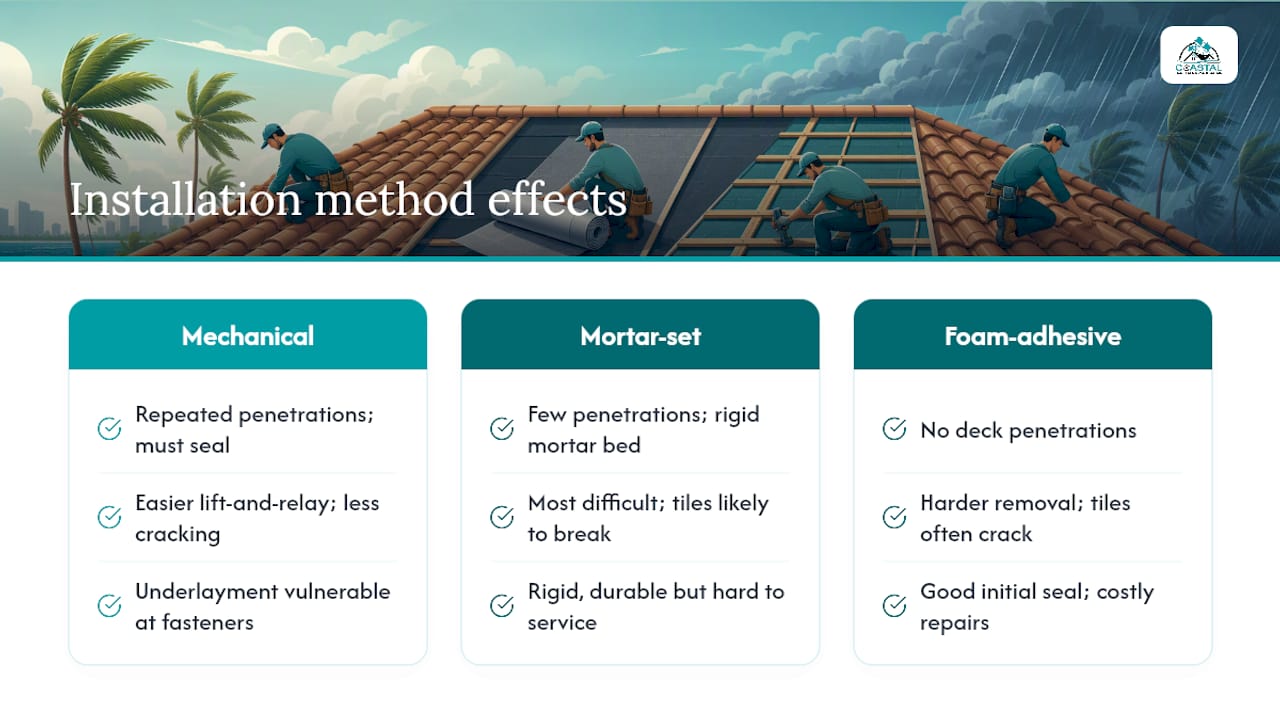
Mechanically fastened systems use screws or nails through the tile into the deck, which means the underlayment sees repeated penetration points that installers must seal carefully. Foam-adhesive systems bond tile directly to the underlayment surface without penetrating it, which can reduce puncture points but makes future tile removal for lift-and-relay work more labor-intensive, since tiles bonded with foam adhesive are more likely to crack during removal than fastened ones. Mortar-set systems, common on older clay tile installations, tend to be the most rigid and the most difficult to service without breakage.
The installation method chosen at your last roof replacement affects both how well your current system is sealed against coastal moisture and how easy (or costly) a future lift-and-relay will be. This is worth asking about directly if you don’t already know how your tiles were installed, because it shapes what your next underlayment project will actually involve.
A Note From Ryan on Planning Ahead Instead of Reacting
The homeowners who regret their roof decisions almost always share one thing: they waited for a ceiling stain to force the issue instead of scheduling an assessment while they still had options. Get your underlayment checked before hurricane season ramps up, not during it, and try to align that inspection with your annual maintenance visit so you’re not adding another appointment to your calendar. If your tile roof is closing in on 18 years, the smartest thing you can do this year is put that inspection on the schedule now, while you can still choose lift-and-relay instead of being forced into an emergency full replacement.
— Ryan
How Coastal Roofing & Construction Handles Underlayment Assessments and Repairs
Coastal Roofing & Construction is a licensed, insured, family-owned contractor serving Tampa Bay, and the team is manufacturer-certified through Owens Corning, GAF, and Tri County Metals. That certification matters directly for tile roof longevity: factory-trained installers understand how to specify the right underlayment for coastal exposure and how to execute a lift-and-relay without damaging serviceable tile.
Services relevant to what this article covers include:
- Limited tile-removal underlayment condition assessments
- Lift-and-relay projects that preserve existing tile while replacing the failed membrane
- Full roof replacement when deck condition or code requirements call for it
- Storm damage restoration and preventative maintenance programs
- Schedule an inspection through the Tampa Bay Roof Replacement Guide to understand what condition your roof is actually in
- Get a straight answer on repair versus lift-and-relay versus full replacement, based on what the assessment finds, not a sales script
- Move forward with a manufacturer-certified crew if underlayment work is needed
Working with a certified, factory-trained installer isn’t paperwork for its own sake. It’s the difference between an underlayment specified correctly for salt air and heat, and one that fails again in 15 years.
Pro Tip: Ask any contractor quoting underlayment work which specific product they’re proposing, felt or synthetic, and why. The answer tells you a lot about whether they’re solving your 20-year problem or just your this-week problem.
If you’re within that 18 to 20-year window, or you’ve inherited a tile roof with no maintenance history, a residential roof inspection is the logical next step before storm season narrows your options.
Coastal Roofing & Construction: Your Next Step for Tile Roof Assessments
If you’ve read this far, you already know the tile isn’t the question. The underlayment is. Coastal Roofing & Construction built its tile roofing practice around that exact distinction, running limited tile-removal assessments that tell you precisely where your roof stands instead of guessing from a ladder.

What sets this apart from a generic repair call is the manufacturer certification behind it. Coastal Roofing & Construction’s crews are factory-trained through Owens Corning and GAF, which means a recommended lift-and-relay or replacement gets specified with underlayment that’s actually built for Gulf Coast salt air and attic heat, not whatever’s cheapest to stock. The team serves Pinellas, Hillsborough, and Pasco counties, including Clearwater, St. Petersburg, Tampa, Palm Harbor, and the surrounding Gulf Coast communities, and works directly with homeowners on everything from a single underlayment assessment to a full residential roof replacement.
If your tile roof is approaching that 18 to 20-year mark, or you simply don’t know what’s happening under the tiles, schedule an inspection now while you still have the option to choose lift-and-relay over an emergency full replacement. You can also browse completed roof replacement projects to see the craftsmanship behind the certifications before you book.
Sources
- Florida Roof Lifespan by Material (2026 Guide) | BuildPriced
- 2026 Roofing Material Lifespan Report (Field Data) | TRB
- How Long Do Roofs Last in Florida? Lifespan by Material (2026) — NEXGEN Roofing
- How Long Does a Tile Roof Last in South Florida? | Tequesta Roofing