
Yes, coating a TPO roof is often a smart, cost-effective move if the membrane is still structurally sound. Two approaches work reliably: a water-based acrylic system over a compatible primer for general reflectivity and budget, or a high-solids silicone system where ponding water collects. Before you commit to either, run an adhesion test and confirm the product is on your membrane manufacturer’s approved list.
TL;DR:
- Proper adhesion testing and manufacturer approval are essential to prevent coating failure and warranty voidance on a TPO roof.
- Acrylic coatings work best for roofs without ponding water and typically last seven to fifteen years, while silicone is more durable for water collection areas.
- Primers specific to TPO are almost always required to ensure the coating bonds correctly, especially on the thermoplastic surface.
- Surface repairs such as seam sealing, patching punctures, and removing moisture are crucial steps before application to maximize coating longevity.
- A full system build-up with the correct dry-mil thickness and reinforcement layers ensures adequate protection and extends the roof’s service life.
Table of Contents
- What Is TPO Roof Coating and Why Consider One?
- Which Coating Chemistries Actually Bond to TPO?
- Do You Need a Primer Before Coating TPO?
- What Should You Check Before Coating a TPO Roof?
- How Should the Coating System Be Applied?
- How Long Do TPO Coatings Last and What Do They Cost?
- Coastal Roofing’s Decision Workflow for TPO Coating
- Get a Professional TPO Roof Assessment
- Sources
- FAQ
What Is TPO Roof Coating and Why Consider One?
A TPO roof coating is a liquid-applied membrane, not paint. Paint sits on the surface and cracks with the substrate; a coating cures into a flexible, seamless layer that moves with the roof and restores UV protection the original TPO has lost to years of sun exposure. Coatings can restore reflectivity, reinforce vulnerable seams, and extend the roof’s service life when the membrane underneath is still structurally sound, according to guidance from the Roof Coating Authority.
Coating makes financial sense when the roof shows aging, chalking, or minor seam issues but no widespread deck damage. Replacement is the better investment once you’re dealing with saturated insulation, extensive membrane punctures, or a roof that’s already past its structural prime.
Property owners typically choose coating for:
- Restoring solar reflectivity on a roof that’s lost its factory sheen
- Reinforcing seams before they become active leaks
- Buying five to ten additional years of service life on an otherwise sound membrane
- Lowering cooling costs on commercial buildings with a CRRC-rated reflective topcoat
Which Coating Chemistries Actually Bond to TPO?
Not every coating chemistry is a fit for TPO’s slick, thermoplastic surface. Four categories dominate the market, and each solves a different problem.
- Acrylic elastomeric. The most common and most affordable choice. It’s highly reflective and easy to apply, but it softens understanding water, so it’s a poor fit for roofs with persistent ponding. Expect a service life in the seven to fifteen year range depending on climate exposure.
- Silicone. The go-to for ponding water and long-term durability. Silicone resists UV degradation and won’t break down when submerged, though it costs more upfront and almost always needs a roof-specific primer first. Dicor’s Signature Extended Life Silicone Coating, for instance, is rated for use on TPO only when a compatible primer goes down beforehand.
- Polyurethane/urethane. Prized for abrasion resistance, which makes it a strong choice for roofs with foot traffic, rooftop equipment, or maintenance walkways.
- Proprietary membrane topcoats. Systems designed and sold by the TPO manufacturer itself. These often carry the best odds of preserving your original membrane warranty because they’re explicitly listed as approved.
Do You Need a Primer Before Coating TPO?
Almost always, yes. TPO’s thermoplastic surface chemistry actively resists adhesion. Most acrylic and silicone topcoats need a primer or tie coat to bond correctly, and skipping this step is the single most common reason a coating job fails within a year or two.
Solvent-based primers formulated specifically for TPO outperform generic all-purpose primers because they’re engineered to interact with the membrane’s chemistry rather than just sit on top of it. USSC’s TPO Thermo Plastic Olefin primer is one example built for exactly this purpose, and it comes with solvent-handling precautions applicators need to follow, including ventilation and proper PPE.
Adhesion pulls under ASTM D903 should be run in multiple zones of the roof, not just one spot near the access hatch.
Pro Tip: Test the perimeter, the field center, and any detail work around penetrations separately. A membrane can pass in the center and fail at a flashing detail, and that failure zone will delaminate first if you don’t catch it before application.
- Primers are mandatory when the product data sheet specifies one for TPO substrates
- A failed adhesion pull in any zone means that zone gets repaired and retested, not coated over
- Solvent-based primers require adequate ventilation and standard skin/eye protection during application
What Should You Check Before Coating a TPO Roof?
Surface prep determines whether a coating lasts three years or fifteen. Work through this sequence before any product goes down:
- Repair seam separation and open fasteners. Any lifted seam or exposed fastener head needs mechanical repair first; coating over a moving seam just hides the problem temporarily.
- Patch membrane punctures. Small punctures get patched with compatible membrane material, not just filled with coating.
- Check for wet insulation. A moisture scan (infrared or core-cut) catches saturated insulation that coating cannot fix. Wet insulation under a coated roof is a warranty and structural problem waiting to surface.
- Clean the surface. Low-pressure washing with an approved detergent removes chalking and grime; avoid broad sanding unless the product’s technical data sheet specifically calls for it.
- Confirm permit requirements. Some jurisdictions treat a full recoat as a re-roofing activity that triggers permitting, especially on commercial buildings.
Pro Tip: If your roof requires fall protection anyway for the inspection, budget for it in the coating quote too. OSHA’s fall-protection rules apply the same way during a coating job as during a full tear-off.
How Should the Coating System Be Applied?
A typical warranty-oriented build-up follows three layers: primer, base coat, top coat. Some restoration systems specify an exact dry-mil target for the whole assembly, and the number matters more than most homeowners expect. One widely used urethane restoration system, EVER-THANE’s 10-year quick spec, calls for about 32 dry mils across the full system to qualify for extended warranty coverage and ponding-water resistance.
Applicators typically use an airless sprayer for large open field areas and a roller or brush for detail work around penetrations, curbs, and flashings. Wet film thickness gauges during application confirm you’re hitting the dry-mil target before the coat cures, since it’s nearly impossible to add material back accurately once it’s dry.
Watch for these common mistakes:
- Applying coating too thin to hit the specified dry-mil target, which shortens lifespan dramatically
- Skipping fabric or fleece reinforcement at seams and detail work, where most failures start
- Coating directly over an active leak or wet insulation, which traps moisture instead of solving the problem
- Ignoring recoat window timing between primer, base, and top coats, which can compromise inter-coat bonding
How Long Do TPO Coatings Last and What Do They Cost?
Lifespan depends heavily on chemistry and exposure. Acrylic systems typically run seven to fifteen years, with the shorter end showing up on roofs with heavy ponding or intense UV exposure, according to comparative durability data. Silicone and high-grade urethane systems tend to outlast acrylic, particularly where standing water is a recurring issue.
- Acrylic systems: roughly $1.50 to $3.50 per square foot installed
- Silicone and urethane systems: notably higher, driven by material cost and primer requirements
- Repair scope, roof access, and reinforcement needs all push the final number up
The biggest lifespan killer isn’t the coating chemistry, it’s skipping the adhesion testing and manufacturer approval step up front. Coating with an unapproved product, or without documented adhesion testing, is the fastest way to void a membrane warranty that was otherwise still active.
Coastal Roofing’s Decision Workflow for TPO Coating
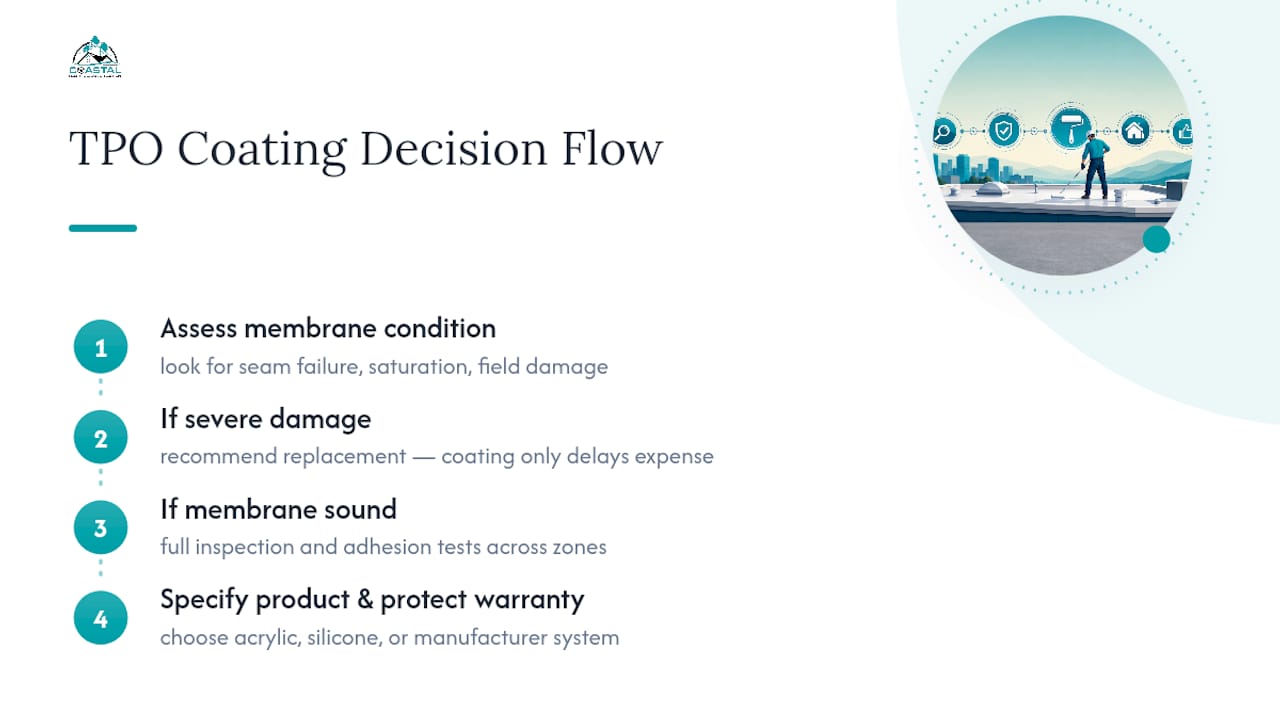
We don’t recommend coating on every roof that asks for it. If a TPO membrane shows widespread seam failure, saturated insulation, or damage across more than a small percentage of the field, we’re upfront that replacement is the better long-term investment; patching a failing system with a coating just delays an expense that’s coming anyway.
When the membrane is sound, our process starts with a full inspection and adhesion testing across multiple roof zones before we ever specify a product. That step tells us whether acrylic, silicone, or a manufacturer-specific system is the right call, and it protects any existing warranty coverage still in force. We’d rather spend an extra hour on testing than have a client discover a coating failure two years in.
— Ryan
Get a Professional TPO Roof Assessment
Professional roofers provide property owners expert installers who know exactly when a coating protects your investment and when it’s just delaying a bigger repair bill. These expert installers are often factory-trained through manufacturer partnerships, and that same attention to manufacturer specifications carries over into how flat roofing systems are evaluated.

If your TPO roof is showing its age, we’ll start with a full inspection that includes adhesion testing, a scope-of-repair estimate, and an honest recommendation on coating versus full replacement. We handle both, so there’s no incentive to push one option over the other. Explore our flat roofing services or reach out to schedule an inspection for your property in Pinellas, Hillsborough, or Pasco County.
Sources
FAQ
What Is TPO Roof Coating?
A TPO roof coating is a liquid-applied, elastomeric layer, typically acrylic, silicone, or urethane, that bonds to a TPO membrane after a compatible primer step. It restores reflectivity and adds a protective layer without the cost of a full replacement.
What Is the Best Coating for a TPO Roof?
There’s no single best coating; it depends on the roof. Acrylic is the most economical and reflective option for roofs without ponding, while silicone systems like Dicor’s Signature Extended Life Silicone Coating hold up better where water collects and sits.
What Are the Common Problems With TPO Roofing?
The most frequent issues are seam separation, membrane punctures, and reduced reflectivity as the surface ages and chalks. Left unaddressed, seam problems typically turn into active leaks before any other part of the membrane fails.
How Many Years Does a TPO Roof Last?
An uncoated TPO membrane typically lasts fifteen to twenty years depending on climate and maintenance. A coating applied at the right time, following a system like EVER-THANE’s 32-dry-mil build-up, can add another seven to fifteen years of service life to an otherwise sound roof.