A roof inspection report is a detailed, photo-documented evaluation of a roof’s condition, organized by system and severity, to guide maintenance, repair, and replacement decisions. Most homeowners receive one after buying a home, filing an insurance claim, or scheduling routine maintenance. Yet few know how to read it. Understanding what the report says, and what it means for your budget and timeline, is the difference between a proactive homeowner and one caught off guard by a $15,000 emergency replacement. This guide breaks down every section of a standard roof inspection report so you can act on it with confidence.
What does a roof inspection report include?
A roof inspection report is the industry term for what inspectors formally call a roof condition assessment. It covers the entire roofing system, not just the shingles you can see from the street. High-quality inspections cover 30 points across six systems: shingles, flashing, ventilation, drainage, structure, and attic interior. That breadth matters because a roof can look fine from the curb while hiding serious ventilation failures or rotting decking underneath.
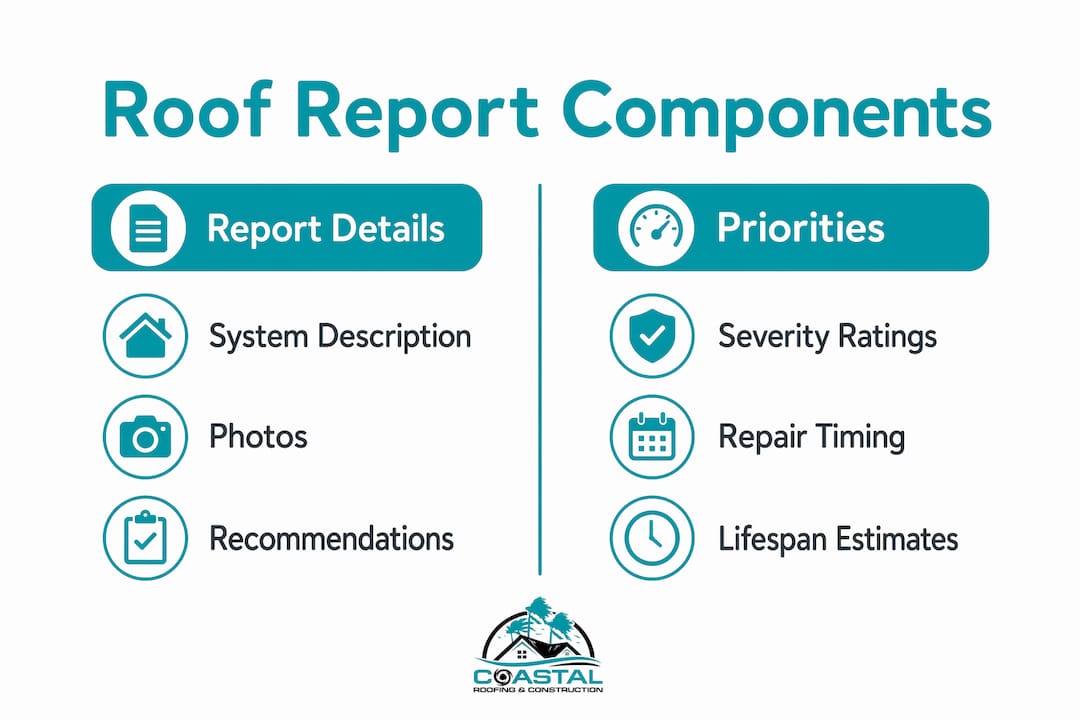
The report opens with a roof system description. This section lists the roofing material (asphalt shingle, tile, metal, TPO), the estimated age, the slope, and the total square footage. It gives the inspector and the homeowner a shared baseline before any findings are discussed.
After the system description, the report moves into itemized findings. Each finding is tied to one of the six systems listed above and assigned a severity rating. A standard report includes 20–60 captioned photos that correspond directly to each finding. That photo count is not arbitrary. It means every claim in the report has visual proof attached, which protects you when negotiating with contractors or insurance adjusters.
The three severity categories used in most professional reports are:
- Safety: Active risks requiring immediate attention, such as structural failure, exposed decking, or compromised flashing at penetrations.
- Performance: Issues that reduce the roof’s ability to protect the home, including poor ventilation, granule loss, or failing sealants. These affect energy efficiency and long-term durability.
- Maintenance: Lower-priority items that, if left unaddressed, will escalate into performance or safety concerns over time.
The report closes with repair recommendations, suggested timelines for each item, and remaining lifespan estimates for major components like the field membrane, flashing, and ridge cap.
Pro Tip: Ask your inspector to walk you through the severity ratings before they leave. A five-minute verbal summary saves hours of confusion when you read the report later.
| Report Section | What it tells you |
|---|---|
| System description | Material type, age, slope, and square footage |
| Itemized findings | Issues organized by roofing system with severity ratings |
| Photo documentation | Visual proof of each finding, 20–60 captioned images |
| Repair recommendations | Suggested fixes and timelines for each issue |
| Lifespan estimates | Remaining useful life for key components |
How do you interpret and prioritize report findings?
Severity ratings decode timing and priority. They tell you which problems need a contractor this week and which ones belong in next year’s maintenance budget. Safety findings require immediate attention to prevent damage from the next rain event or wind storm. In Florida, where hurricane season runs june through november, that urgency is not theoretical.
The most common Safety-rated issues include active leaks, missing or lifted flashing, and structural sagging. These items should be addressed within days, not weeks. Homeowners benefit most by scheduling Safety repairs within days and budgeting for Performance issues within 60–90 days.
Performance findings are the category most homeowners underestimate. Performance issues affect energy efficiency and long-term roof health and are frequently overlooked because they do not cause visible leaks right away. Improper attic ventilation is a classic example. It accelerates shingle aging, voids manufacturer warranties, and drives up cooling costs, yet it rarely shows up as a drip on your ceiling until the damage is severe.
Maintenance findings are the easiest to defer, but deferring them has a cost. Clogged gutters, minor sealant cracks, and small granule loss patches all have a compounding effect. Each deferred item increases the likelihood that a future inspection will reclassify it as a Performance or Safety issue.
A common misreading of inspection reports is treating every finding as a sales pitch. Quality reports act as objective assessments with photographic proof, not as justification for a full replacement. If a report lists 12 findings but only two are Safety-rated, you do not need a new roof today. You need a plan.
Pro Tip: Use the report as a negotiating tool. Real estate investors routinely use Performance and Safety findings to request seller credits or price reductions before closing.
What is the difference between a roof inspection report and a roof certification?
These two documents serve completely different purposes, and confusing them is a costly mistake. Inspection reports differ from roof certifications in both scope and legal weight. An inspection report is a diagnostic document. It describes the current condition of the roof without making any guarantees about future performance.
A roof certification, by contrast, is a formal guarantee. Roof certifications provide guarantees about the roof’s condition for a defined period, typically two to five years, and are required in many real estate transactions and insurance applications. The contractor or inspector who issues a certification is stating that the roof will perform adequately for that period. That is a legal commitment, not just an opinion.
Understanding the difference helps homeowners and investors avoid costly mistakes and obtain the right document for the right situation. If your lender or insurer asks for a “roof cert,” an inspection report will not satisfy that requirement. If you are planning maintenance, a certification without a detailed inspection report tells you almost nothing useful.
| Document | Purpose | Guarantees anything? | When you need it |
|---|---|---|---|
| Inspection report | Diagnose current condition | No | Maintenance, budgeting, pre-purchase review |
| Roof certification | Formal condition guarantee | Yes, for a defined period | Real estate transactions, insurance applications |
The role of building inspectors in this process is worth understanding. Licensed roofing contractors and certified inspectors can issue both documents, but the standards and liability attached to each are different. Always confirm which document you need before scheduling the appointment.
What should you expect during a professional roof inspection?
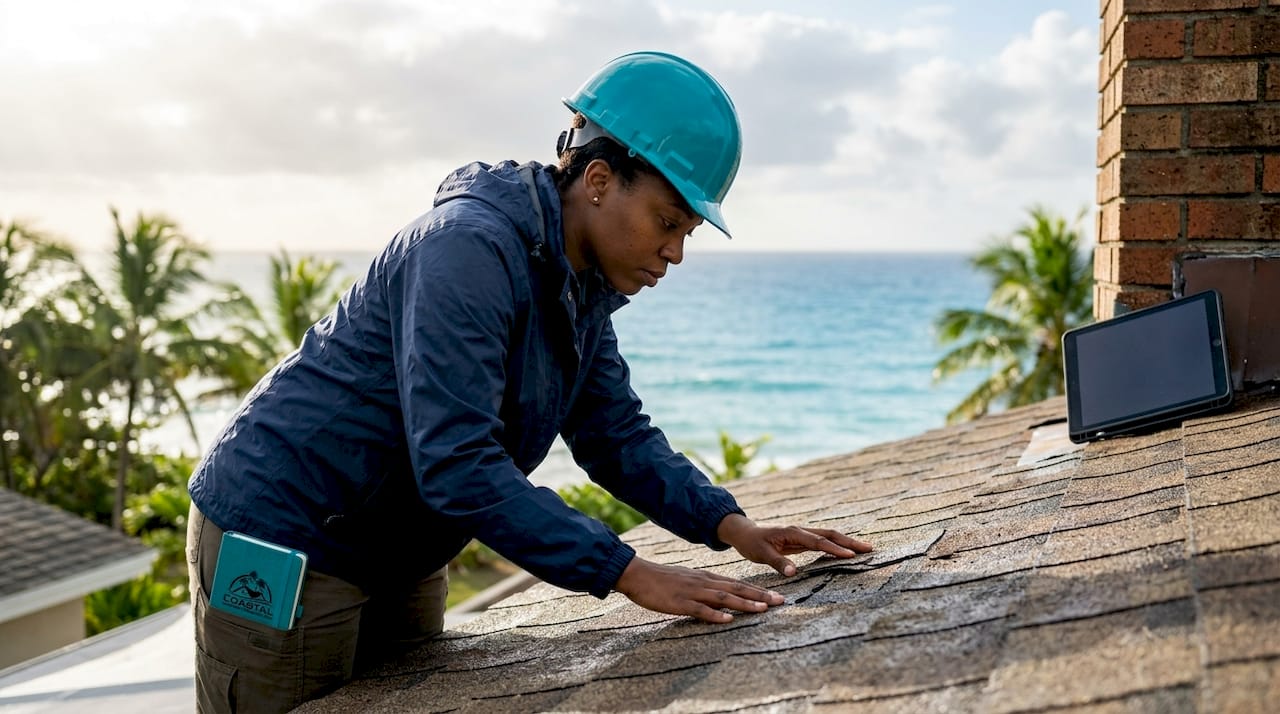
A professional roof inspection follows a structured process. Typical residential inspections combine drone imagery, a roof walk, and an attic check for a complete assessment. Each method catches different failure points. Drones identify surface damage and missing material. The roof walk reveals flashing conditions, nail pops, and ridge integrity. The attic check exposes ventilation problems, moisture staining, and decking deterioration.
Here is what the process looks like from start to finish:
- Pre-inspection review. The inspector reviews the home’s age, roofing material, and any known issues before climbing onto the roof.
- Exterior roof walk. The inspector walks the field, ridges, valleys, and perimeter, checking shingles, flashing, gutters, and drip edges.
- Drone or aerial documentation. Steep or complex roofs are documented with drone photography to capture areas that are unsafe to walk.
- Attic inspection. The inspector checks for moisture, proper ventilation, insulation condition, and signs of structural stress from inside.
- Report compilation. Findings are organized by system and severity, photos are captioned, and repair recommendations are written.
A standard inspection takes 30–60 minutes for most homes, up to 90 minutes for complex or large roofs. Professional inspections cost $150–$650, with some contractors offering free inspections bundled with an estimate. Reports are typically delivered within 48–72 hours and include itemized findings, photos, and repair recommendations.
Watch for red flags. Inspections that rely only on a visual walk-around without photos are often sales calls in disguise. A legitimate inspection report documents every finding with a photo and assigns a severity rating. If the inspector hands you a one-page summary with no images and a quote for a full replacement, ask for the detailed report before signing anything.
For seasonal homeowners and investors managing multiple properties, a digital inspection report with timestamped photos creates a reliable maintenance record that travels with the property.
Key Takeaways
A detailed roof inspection report, organized by severity and supported by photos, is the most reliable tool for planning repairs, budgeting maintenance, and protecting your investment.
| Point | Details |
|---|---|
| Reports cover six systems | Shingles, flashing, ventilation, drainage, structure, and attic are all assessed. |
| Severity ratings set your timeline | Address Safety findings within days; budget Performance fixes within 60–90 days. |
| Photos are non-negotiable | Legitimate reports include 20–60 captioned images as proof of every finding. |
| Reports and certifications differ | An inspection diagnoses; a certification guarantees. Know which one you need. |
| Superficial inspections are a red flag | No photos and an immediate replacement quote signals a sales call, not an inspection. |
What I’ve learned after years of reading roof reports
Most homeowners read a roof inspection report the wrong way. They scan for the total number of findings and panic, or they see “Maintenance” items and assume nothing is urgent. Both reactions miss the point.
The severity rating system exists for a reason. A report with 20 Maintenance findings and zero Safety items is a healthy roof. A report with three findings, two of which are Safety-rated, needs immediate action. The number of line items is almost irrelevant. The category is everything.
The second mistake I see constantly is homeowners treating the report as the end of the conversation. It is the beginning. A good report gives you leverage. If you are buying a property and the inspection reveals $8,000 in Performance-rated repairs, that number belongs in your negotiation. If you are a current homeowner, that same report becomes your maintenance roadmap for the next three years.
The third thing most articles will not tell you: vague reports protect the inspector, not you. If a report says “shingles show wear” without a photo, a severity rating, or a repair recommendation, it is not a useful document. Push back. Ask for specifics. A professional roof inspection should give you enough detail to get three competitive repair quotes without the contractor needing to re-inspect the roof.
Seek out inspectors who are manufacturer-certified or who carry credentials from recognized industry bodies. Their reports tend to be more thorough, more defensible, and more useful when dealing with insurance carriers.
— Ryan
Coastal Roofing & Construction delivers reports you can actually use
Coastal Roofing & Construction provides professional roof inspections throughout Tampa Bay, including Clearwater, St. Petersburg, Palm Harbor, and surrounding communities. Every inspection covers all six roofing systems, includes captioned photo documentation, and delivers a clear severity-rated report within 48–72 hours.
The team at Coastal Roofing & Construction is manufacturer-certified with Owens Corning, GAF, and Tri County Metals, which means their inspections are grounded in the same standards used to install and warrant the systems they evaluate. There is no pressure to replace. If repairs are the right call, that is what the report will say. Browse recent replacement projects to see the quality standard behind every recommendation, or contact Coastal Roofing & Construction directly for a no-pressure consultation and free estimate.
FAQ
How long does a roof inspection take?
Most residential inspections take 30–60 minutes, with complex or larger roofs taking up to 90 minutes. The attic check and drone documentation add time but significantly improve accuracy.
What does a roof inspection report cost?
Professional inspections range from $150 to $650, depending on scope and region. Some contractors bundle a free inspection with a written estimate.
How many photos should a roof inspection report include?
A quality report includes 20–60 captioned photos, one for each documented finding. Fewer than that is a warning sign that the inspection was not thorough.
Is a roof inspection report the same as a roof certification?
No. An inspection report diagnoses the current condition without making guarantees. A roof certification is a formal guarantee of performance for a defined period, required in most real estate and insurance transactions.
When should I act on a Safety-rated finding?
Safety findings should be addressed within days. They represent active risks that can cause significant interior damage during the next rain or wind event, particularly in Florida’s storm-prone climate.