A shingle is Miami-Dade approved only when an active Notice of Acceptance covers that exact product and the exact way it will be installed. The NOA has to be on file with your permit application and on site the day the crew starts nailing. Skip either step and you don’t have an approved roof. You have a liability.
TL;DR:
- Verifying a Miami-Dade approved shingle requires matching the NOA approval number, scope, and installation details with the actual product and assembly on site.
- Proper installation according to the NOA is critical, including fastening patterns, underlayment, and accessory placement, as deviations invalidate approval and risk inspection failure.
- Inspections focus on verifying that labeled packaging, the exact assembly, and installation follow the documented standards rather than just checking paperwork.
- Approval standards for HVHZ zone shingles involve wind uplift, impact resistance, and specific installation methods, with approved products rated for winds above 110 mph.
- Post-installation maintenance, repairs, and documentation are vital to maintaining ongoing compliance and ensuring the roof performs during a storm.
Table of Contents
- How to Verify a Shingle Is Miami-Dade Approved
- What an NOA Actually Controls on Your Roof
- Permits, Inspections, and Where NOA Jobs Go Wrong
- Reading a Real NOA: What the Fine Print Actually Says
- How Coastal Roofing & Construction Documents NOA Compliance
- Why Miami-Dade’s Hurricane Zone Demands Stricter Materials
- Which Shingle Types Actually Carry Miami-Dade Approval
- Installing Miami-Dade Shingles the Way the NOA Requires
- The Wind and Durability Standards Behind Every Approval
- Keeping an Approved Roof Compliant Over Time
- Why NOA Compliance Isn’t a Paperwork Formality
- Get an NOA-Compliant Roof Installed Right the First Time
- Where to Verify Miami-Dade Shingle Approvals Yourself
- Sources
How to Verify a Shingle Is Miami-Dade Approved
Don’t take a salesperson’s word for it. Verify it yourself in five steps.
- Search the product yourself. Miami-Dade’s Product Control database lets you look up any roofing product by manufacturer name, product name, or NOA number.
- Pull the NOA front page. Check the approval number, the expiration date, the scope of coverage, the deck type it applies to, and any required attachments listed at the bottom.
- Check the packaging. Approved shingle bundles carry a permanent label with the manufacturer’s name and the phrase “Miami-Dade County Product Control Approved,” or the official seal.
- Match the assembly, not just the shingle. The NOA’s fastening pattern, underlayment requirement, and flashing details need to line up with what’s actually going on your roof deck.
- Make the contractor include the paperwork. NOA pages belong in the permit submission itself, not in a filing cabinet at the contractor’s office.
Pro Tip: An NOA approves a specific product for a specific assembly, not the brand name in general. The same shingle line can carry different fastening requirements depending on deck type, so always confirm your exact configuration is covered before signing off.
What an NOA Actually Controls on Your Roof
An NOA reads more like an engineering spec than a marketing brochure, and that’s the point. It locks down exactly how a product can be installed in Florida’s High Velocity Hurricane Zone.
Most shingle NOAs spell out:
- The deck type allowed (wood or concrete), and sometimes a minimum slope range
- The exact nail pattern and fastener count per shingle
- Underlayment type and how it must be layered beneath the shingle
- References to Roofing Application Standards like RAS 115, which governs asphalt shingle installation methods in HVHZ
- Test standards behind the approval, commonly TAS 110 for sealed shingle performance and TAS 107 for wind uplift resistance
Many installation disputes on approved shingles trace back to fastening or underlayment mismatches rather than product defects. The shingle was fine. The installer didn’t follow the NOA’s exact instructions, and that gap is exactly what an inspector is trained to catch.
Manufacturer application instructions are frequently written directly into the NOA as a mandatory reference, which means “install per manufacturer guidelines” isn’t a suggestion. It’s a condition of the approval itself. Swap in a different nail, skip a required accessory, or use the wrong underlayment weight, and the installed roof no longer matches the document that made it legal to install in the first place.
Permits, Inspections, and Where NOA Jobs Go Wrong
Miami-Dade’s roofing permit application has a dedicated shingle roof system section, and it expects specific paperwork attached, not a general description of the job.
- Submit the NOA front page for every product going on the roof, shingles included.
- Attach system detail drawings showing how the assembly matches the NOA’s specifications.
- Include manufacturer installation instructions referenced by the NOA.
- Expect inspectors to physically compare the fastening pattern and labeled materials on the roof to what the NOA describes, not just glance at paperwork.
The most common failure isn’t a bad shingle. It’s using a general Florida Product Approval (an FL number) instead of a Miami-Dade NOA. Florida’s statewide approval system does not automatically satisfy HVHZ requirements, and Miami-Dade inspectors know the difference immediately. Expired NOAs and missing approvals for accessories like starter strips or hip and ridge caps cause the rest of the failures. At project close, ask your contractor for copies of every NOA used, plus the final inspection signoff. That packet matters at resale and at insurance renewal.
Reading a Real NOA: What the Fine Print Actually Says
NOA documents look intimidating until you know which three things to scan for.
- Labeling clause: every unit must carry a permanent label with the manufacturer’s name and the required Miami-Dade wording or seal.
- Scope line: lists exactly which shingle models the approval covers and which deck types they’re rated for.
- Installation excerpt: spells out nail counts and often points directly to RAS 115 for method.
One approval covering TAMKO’s shingle line requires the Miami-Dade approval wording printed on packaging and ties installation directly to RAS standards. A separate NOA for Owens Corning’s Oakridge family lists specific deck types and manufacturing locations alongside the same labeling mandate. GAF’s Timberline series appears in its own approval requiring the exact phrase “Miami-Dade County Product Control Approved” on the product.
Treat these as illustrations, not shortcuts. Always download the current, active NOA for the specific product you’re buying, since revisions and expirations happen.
How Coastal Roofing & Construction Documents NOA Compliance
Verification isn’t a one-time lookup. It’s a workflow that runs before, during, and after the job.
- Before the job starts, we pull and archive the NOA PDF for every shingle and accessory we’ve specified, confirming the scope actually matches what’s going on your roof.
- On site, NOA front pages and labeled product boxes stay available for the inspector, and installation follows the manufacturer’s drawings exactly, not a shortcut version.
- After the final inspection, you get a compliance packet: the NOAs used, installation photos, and signed inspection records, all in one file.
Our team’s manufacturer certifications with Owens Corning and GAF matter here because those certifications require training on the exact fastening and application standards each NOA references.
Pro Tip: Ask any roofing contractor bidding your job to hand over the NOA PDFs before you sign a contract, not after. If they hesitate, that’s your answer about how carefully they usually check.
Why Miami-Dade’s Hurricane Zone Demands Stricter Materials
Miami-Dade and Broward counties sit inside Florida’s High Velocity Hurricane Zone, a designation created after Hurricane Andrew exposed how badly standard roofing performed under sustained extreme wind. HVHZ isn’t a marketing term. It’s a distinct regulatory zone with its own testing and approval track that runs separately from the rest of the state’s building code.
That separation is exactly why a standard Florida Product Approval doesn’t cut it here. HVHZ materials undergo wind uplift testing, impact resistance testing, and water intrusion testing calibrated to conditions this specific coastline actually experiences. A shingle approved for use in Orlando can be entirely unapproved for a roof in Miami, even if it’s the identical product from the identical manufacturer, because the testing thresholds differ by zone.
For homeowners and builders working outside Miami-Dade but still along Florida’s coast, the underlying logic still applies: coastal wind exposure calls for hurricane resistant roofing options engineered for sustained wind and wind-driven rain, not just standard code minimums. The zone boundary is a legal line, but the wind doesn’t respect it, and materials chosen for genuine performance tend to hold up better everywhere along the Gulf Coast, not just inside HVHZ borders.
Which Shingle Types Actually Carry Miami-Dade Approval
Not every asphalt shingle on a shelf has NOA coverage, and the ones that do vary meaningfully in performance.
Laminated architectural shingles dominate the Miami-Dade approved list, largely because their layered construction and heavier weight give them better wind uplift resistance than older three-tab designs. Owens Corning’s Oakridge and TruDefinition Duration lines, GAF’s Timberline HD series, and TAMKO’s Heritage line all carry active NOAs, though the exact model and deck type covered varies by document.
Performance characteristics worth comparing before you choose:
- Wind rating: approved shingles are tested well beyond the code minimum for standard zones, with sealed-strip technology to resist blow-off.
- Granule adhesion: matters more in a coastal environment where wind-driven rain and salt air accelerate granule loss on lower-quality products.
- Impact resistance: some NOA-covered lines carry additional impact-rated classifications useful where hail or wind-borne debris is a factor.
The differences between approved lines aren’t cosmetic. A homeowner comparing asphalt shingle options should weigh wind rating and warranty terms alongside price, since the cheapest NOA-compliant shingle and the best-performing one can carry the same approval number for entirely different reasons.
Installing Miami-Dade Shingles the Way the NOA Requires
An approved shingle installed the wrong way is not an approved roof. That distinction trips up more jobs than any product defect.
Manufacturer instructions referenced inside the NOA typically dictate starter strip placement, exact nail count and location per shingle, minimum overlap at seams, and specific underlayment requirements for the deck type in use. A detailed installation guide covering fastening sequence and seam overlap illustrates why these steps aren’t interchangeable between products, even when two shingles look nearly identical on the shelf.
Hip and ridge caps, starter strips, and drip edge flashing usually need their own NOA coverage, separate from the field shingle. Installers who swap in a generic ridge cap because it’s cheaper or more available can invalidate the entire assembly’s approval, even though the main shingle field is perfectly compliant. Nail placement is the detail crews get wrong most often: an NOA might require six nails per shingle in a specific pattern for high-wind exposure, while a crew used to standard-zone work defaults to four nails out of habit. That’s not a minor shortcut. It’s the difference between a roof engineered to hold and one that isn’t.
The Wind and Durability Standards Behind Every Approval
Every Miami-Dade approved shingle has passed testing calibrated specifically for hurricane-force wind, not general weather resistance.
TAS 107 measures wind uplift resistance, simulating the pressure a shingle experiences at sustained high wind speeds. TAS 110 tests the seal strip’s ability to stay bonded under repeated wind cycling, which matters because a shingle that unseals even slightly becomes vulnerable to progressive blow-off during a sustained storm event. RAS 115 then governs the installation method that makes those lab results apply in the field: nail count, placement, and pattern.
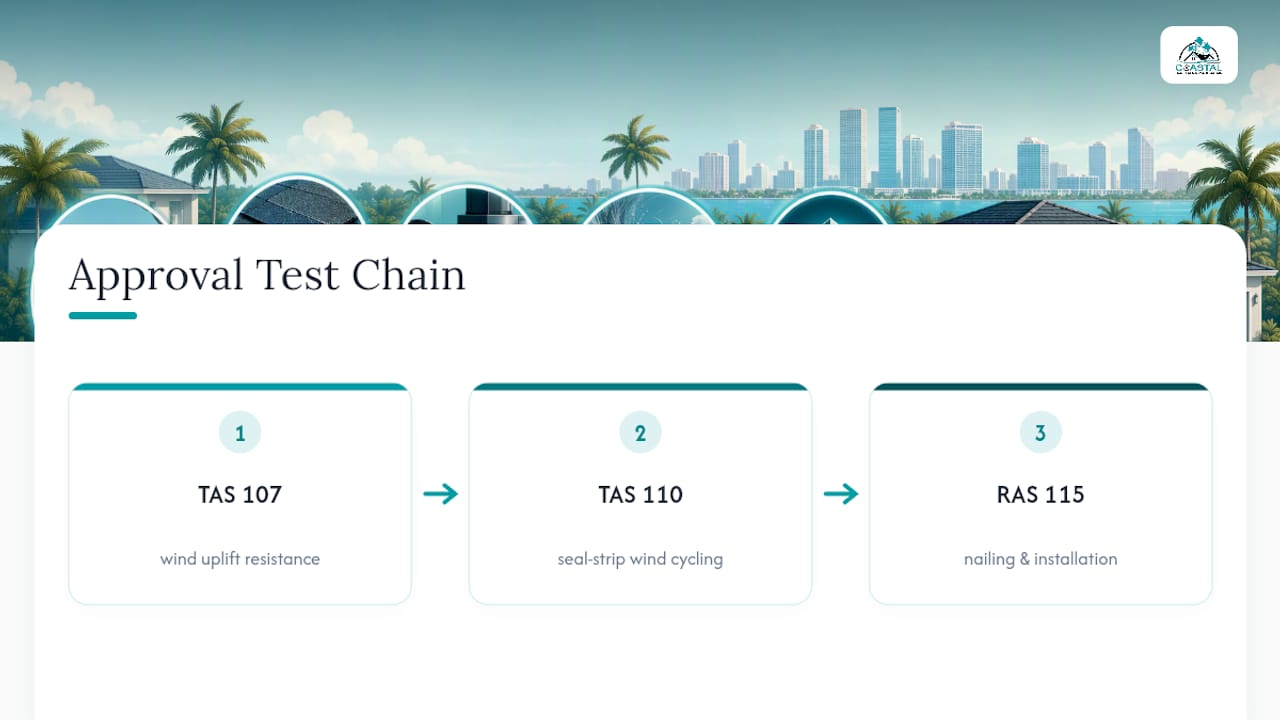
These three standards work together, not separately. A shingle can pass TAS 107 and TAS 110 in a lab and still fail in the field if RAS 115’s installation method isn’t followed exactly, which is the entire reason NOAs bundle product testing with mandatory installation specifications rather than approving materials on performance alone.
Wind rating on approved products commonly reaches well above the 110 mph baseline required in standard wind zones, with premium architectural lines rated for sustained higher speeds. That margin matters during a storm that arrives stronger than forecast, which happens more often than anyone would like along this coastline.
Keeping an Approved Roof Compliant Over Time
Approval at installation doesn’t guarantee performance for the life of the roof. Maintenance decisions made years later can quietly undo what the NOA certified on day one.
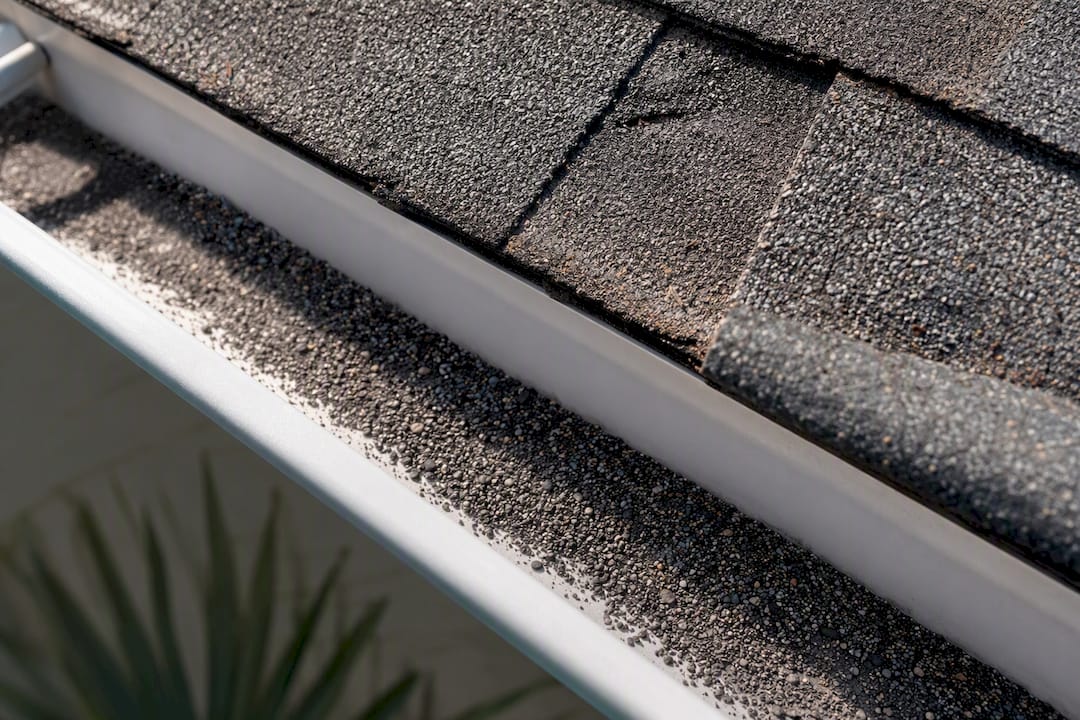
Granule loss is the earliest visible sign of wear on architectural shingles, and it accelerates faster in coastal salt air than in inland climates. A roof inspection every one to two years catches lifted shingle edges, cracked sealant strips, and flashing separation before a storm turns a small defect into a major leak. Replacing a damaged shingle with a non-matching or non-NOA’d product during a repair, even a small patch job, can technically break the compliance chain for that section of roof, which matters if you ever need to prove compliance for an insurance claim.
Most Miami-Dade approved architectural shingles carry manufacturer warranties lasting multiple decades, but those warranties assume installation followed the NOA exactly and that repairs used compatible, equally approved materials. Keep your original NOA documents and any repair invoices together. When you sell the home or file a wind damage claim, that paper trail is often the fastest way to prove the roof was done right the first time.
Why NOA Compliance Isn’t a Paperwork Formality
Skipping proper NOA verification doesn’t just risk a failed inspection. It risks a rejected insurance claim after the storm that actually tests the roof, and a rework bill that dwarfs whatever the “value” contractor saved you upfront. I’ve seen the pattern often enough to trust it: the roofs that fail aren’t the ones with bad shingles, they’re the ones where nobody checked the paperwork against the nail gun.
Ask for the NOA before you sign. Hire installers with manufacturer certification, not just a license number. Keep every document from the job, because five years from now, that folder is worth more than the invoice.
— Ryan
Get an NOA-Compliant Roof Installed Right the First Time
Verifying an NOA is only half the job. Getting a crew that actually installs to its exact fastening pattern, underlayment spec, and flashing detail is the half that protects your investment. Coastal Roofing & Construction pulls the NOA for every product before we bid the job, builds the permit packet around it, and hands you a full compliance file when the last shingle goes on. That’s the difference between a roof that’s technically legal and one you can actually rely on in a real storm.
Our teams are factory-trained and certified with Owens Corning and GAF, which means the installation crew on your roof has been trained on the exact specs those manufacturers’ NOAs require, not a general approximation of them. We’ve built that process working on custom coastal homes and commercial properties throughout Pinellas, Hillsborough, and Pasco counties, where sloppy NOA paperwork causes more permit delays than any material shortage ever does.
If your roof is due for replacement, request an estimate and compliance review from Coastal Roofing & Construction. We’ll walk you through exactly which NOAs apply to your project before a single shingle gets ordered.
Where to Verify Miami-Dade Shingle Approvals Yourself
Check any product directly through the Product Control search tool. Sample NOAs referenced above cover TAMKO shingles, Owens Corning Oakridge, and GAF Timberline products.