
The main flat roof systems are built-up roofing (BUR), modified bitumen, EPDM, TPO, PVC, standing seam metal, concrete, green/vegetative roofs, and liquid-applied membranes. Before you pick a membrane, settle three things first: how water actually leaves your roof, what your local climate demands, and whether your installer is manufacturer-certified. The membrane comes last.
Here’s a quick orientation before diving into each system:
- Drainage first: NRCA/ICC guidance requires a minimum slope of 1/4 inch per foot toward drains or scuppers. No membrane survives chronic ponding.
- Climate match: TPO and PVC perform well in Florida’s high-UV, coastal environment; EPDM and SBS-modified bitumen are the go-to choices in cold climates.
- Lifespan ranges: TPO, EPDM, and PVC average 20–30 years; modified bitumen runs 15–20 years; standing seam metal reaches 40–70 years.
- Installer quality: Seams, flashings, and drain details determine long-term performance more than any brand name on the membrane roll.
- Local expertise: Coastal Roofing & Construction installs TPO and modified bitumen systems throughout the Tampa Bay area, with manufacturer certifications and documented flood-test protocols.
Table of Contents
- What “flat roof” really means, and why drainage decides everything
- The main flat roof systems, one by one
- How do installed costs and lifespans compare across systems?
- How a durable flat roof is actually built
- Common flat roof problems and a practical maintenance checklist
- How to choose the right flat roof system for your building
- What the research actually says about installation quality and system selection
- Key Takeaways
- What a contractor actually looks for on inspection day
- Coastal Roofing & Construction’s approach to flat roof systems in Tampa Bay
- Useful sources and authority references
What “flat roof” really means, and why drainage decides everything
A flat roof is not actually flat. The term describes any low-slope roof with a gentle pitch that appears flat from the ground. The slight incline is intentional and non-negotiable.
Statistic callout: ICC building codes and NRCA guidance specify a minimum slope toward drains or scuppers to ensure proper drainage. Without that slope, water pools, membranes degrade faster, and most manufacturer warranties are voided.
Because the slope is subtle, water does not run off on its own the way it does on a steep shingle roof. The drainage system has to be engineered deliberately. Three strategies are common:
- Internal drains sit at low points on the deck and connect to the building’s plumbing. They handle large volumes efficiently but require regular cleaning and proper flashing collars.
- Scuppers are openings cut through parapet walls that channel water to downspouts. They are simpler to maintain but can overflow during heavy rain if undersized.
- Perimeter gutters work on smaller roofs or where parapets are absent. They are the most familiar to homeowners but the least common on larger commercial flat roofs.
Before you choose a membrane, walk your roof after a rain. Look for low spots where water sits, check whether drains are clear, and note where scuppers are positioned. A roof that drains poorly will fail regardless of which membrane covers it.
The main flat roof systems, one by one
1. Built-up roofing (BUR)
BUR is the original flat roof system, built from alternating layers of bitumen and reinforcing fabric, topped with gravel or a mineral cap sheet. It is heavy, durable, and genuinely redundant: if one layer is compromised, the layers below still protect the building. The gravel surface resists UV degradation and foot traffic.
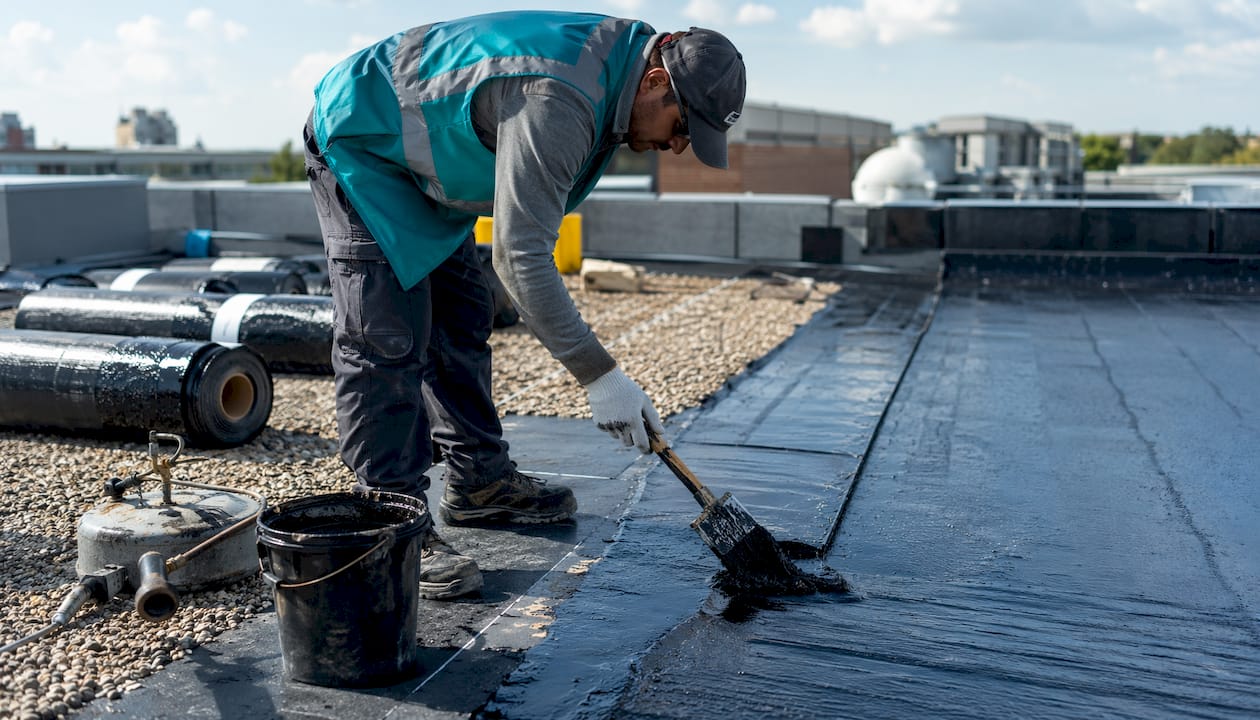
The downsides are real. Installation is labor-intensive and produces strong odors from hot-applied bitumen. The weight can stress older structural decks. For most residential projects today, modified bitumen or single-ply membranes have largely replaced BUR, though it still appears on large commercial buildings where its multi-layer redundancy justifies the cost.
Lifespan: 15–25 years. Best for: Large commercial roofs with heavy foot traffic or equipment loads.
2. Modified bitumen
Modified bitumen is asphalt reinforced with either APP (atactic polypropylene) or SBS (styrene-butadiene-styrene) polymers. It comes in rolls applied by torch, cold adhesive, or peel-and-stick backing. Two or three layers go down, creating a thick surface with built-in redundancy similar to BUR but with better flexibility.
SBS-modified bitumen stays pliable in cold temperatures, which is why it is frequently recommended for cold climates. In Florida’s heat, APP torch-applied systems perform well. The material handles complex geometry with lots of penetrations better than large single-ply sheets, making it a practical choice for residential additions, garage roofs, and porch overhangs.
Lifespan: 15–20 years. Best for: Residential flat sections, complex geometry, areas with frequent foot traffic.
3. EPDM (ethylene propylene diene monomer)
EPDM is synthetic rubber that has been in use since the 1960s. There are documented 40-year-old EPDM roofs still functioning, a track record no other single-ply membrane can claim. The material stays flexible in subzero temperatures, resists UV degradation, and handles extreme thermal cycling without cracking.
The primary weakness is the seam. EPDM seams are glued or taped rather than heat-welded, and adhesive bonds degrade faster than welded ones, especially on roofs with significant temperature swings. Standard EPDM is black, which absorbs heat and raises cooling costs in warm climates. White EPDM exists but costs more and shows staining. For Florida buildings, the heat-absorption issue is a real consideration.
Lifespan: 20–30 years. Best for: Cold climates, large commercial roofs where material cost matters, shaded installations.
4. TPO (thermoplastic polyolefin)
TPO is currently the most-installed flat roofing membrane in North America. Its white or light-gray surface reflects solar heat effectively, which directly reduces cooling costs in warm climates. Seams are heat-welded with a hot-air gun, creating a bond stronger than any adhesive. The material resists UV, ozone, and punctures reasonably well at the right thickness.
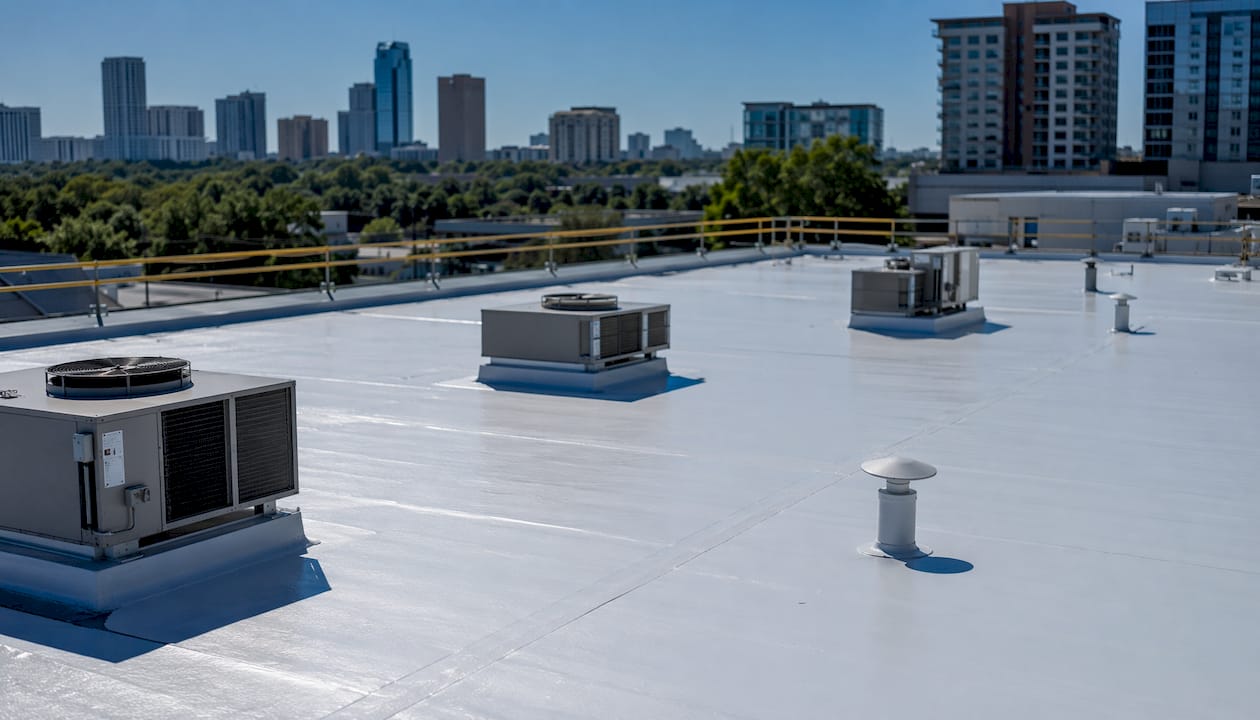
Quality variation is the catch. TPO formulations differ significantly between manufacturers. Early products from the mid-2000s had widespread seam failures; modern formulations from established manufacturers have stabilized considerably. Specify 60-mil thickness from a major manufacturer. At 45 mil, the margin for error shrinks considerably, and the cost difference on a typical roof is minimal.
For Tampa Bay homeowners and commercial owners, TPO’s reflective surface and heat-welded seams make it one of the strongest choices. PVC and TPO are generally favored for UV and salt exposure when detailed correctly, which matters in a coastal Florida environment.
Lifespan: 20–30 years. Best for: Energy-efficient commercial buildings, warm and sunny climates, general residential flat sections.
5. PVC (polyvinyl chloride)
PVC is the premium single-ply option. Like TPO, it uses heat-welded seams, but PVC has a longer documented performance history and superior chemical resistance. Grease, oils, and most industrial chemicals do not degrade it, which makes PVC the default choice for restaurants, manufacturing facilities, and any building with rooftop HVAC equipment that might leak refrigerant or oil.
PVC also carries superior fire resistance ratings and holds up well as a walkable rooftop surface when paired with walkway pads. The price premium over TPO is real, and on a straightforward warehouse or residential addition with no chemical exposure, it is often unnecessary. But if your roof will see foot traffic, rooftop dining, or chemical exhaust, PVC earns every cent of that premium.
Lifespan: 20–30 years. Best for: Restaurants, rooftop decks, chemical-exposure environments, premium residential.
6. Standing seam metal
Standing seam metal is the longest-lasting flat or low-slope roofing option available. Panels interlock at raised seams, keeping fasteners concealed and eliminating the penetration points that cause most membrane leaks. The system handles Florida’s wind loads exceptionally well when properly engineered.
Metal roofs are not maintenance-free, but their failure modes are different from membrane systems. Seam separation, fastener corrosion, and flashing failures are the things to watch. For coastal salt-air exposure, corrosion-resistant termination details and appropriate panel coatings are non-negotiable.
Lifespan: 40–70 years. Best for: Long-term investment properties, coastal and hurricane-prone areas, luxury residential.
7. Concrete flat roofs
Concrete roofs are common in commercial construction and in certain residential markets where structural mass is an advantage. A properly waterproofed concrete deck is extremely durable and fire-resistant. The challenge is waterproofing the surface and all penetrations, since concrete itself cracks over time with thermal movement. Liquid-applied membranes or torch-applied modified bitumen are typically used over concrete decks.
Weight is the primary constraint. Concrete roofs require robust structural support and are rarely added to existing residential buildings without an engineering assessment.
Lifespan: Varies widely based on waterproofing system. Best for: Commercial construction, new builds with adequate structural capacity.
8. Green and vegetative roofs
A green roof places a growing medium and vegetation over a waterproofing membrane, typically a root-resistant PVC or TPO system with a drainage layer beneath the soil. The benefits are real: reduced stormwater runoff, improved thermal performance, and extended membrane life because the vegetation shields the membrane from UV and thermal cycling.
The cost and structural requirements are significant. A saturated growing medium is heavy, the waterproofing specification must be flawless, and maintenance involves both roofing and landscaping expertise. Green roofs are most practical on new commercial construction where the structural load is engineered in from the start.
Lifespan: Membrane beneath typically 30–50 years when protected. Best for: Commercial new construction, urban buildings with stormwater management requirements.
9. Liquid-applied membranes
Liquid-applied systems are coatings that cure into a seamless, fully adhered membrane. They are applied by roller, brush, or spray and conform to any shape, making them ideal for complex roofs with many penetrations, skylights, or unusual geometry where sheet membranes are difficult to detail. Common formulations include polyurethane, acrylic, and silicone-based products.
The seamless nature eliminates the most common failure point of sheet membranes. However, application quality is highly dependent on surface preparation and coating thickness. Thin spots or inadequate primer adhesion create weak points that are invisible until they leak. These systems are best used by experienced applicators and are often chosen for restoration over existing roofs rather than new construction.
Lifespan: 10–25 years depending on formulation and maintenance. Best for: Complex geometry, roof restoration, penetration-heavy roofs.
How do installed costs and lifespans compare across systems?
Cost and lifespan are the two numbers every owner wants upfront. The table below uses sourced installed cost ranges alongside industry-average lifespans.
| System | Typical installed cost (USD/sq ft) | Expected lifespan | Warranty types |
|---|---|---|---|
| TPO | — | 20–30 years | Material + labor (certified installer) |
| EPDM | — | 20–30 years | Material; labor varies |
| PVC | — | 20–30 years | Material + labor (certified installer) |
| Modified bitumen | — | 15–20 years | Material; installer warranty varies |
| BUR | — | 15–25 years | Material; labor varies |
| Standing seam metal | — | 40–70 years | Material + labor (manufacturer-certified) |
| Liquid-applied | — | 10–25 years | Material; applicator warranty varies |
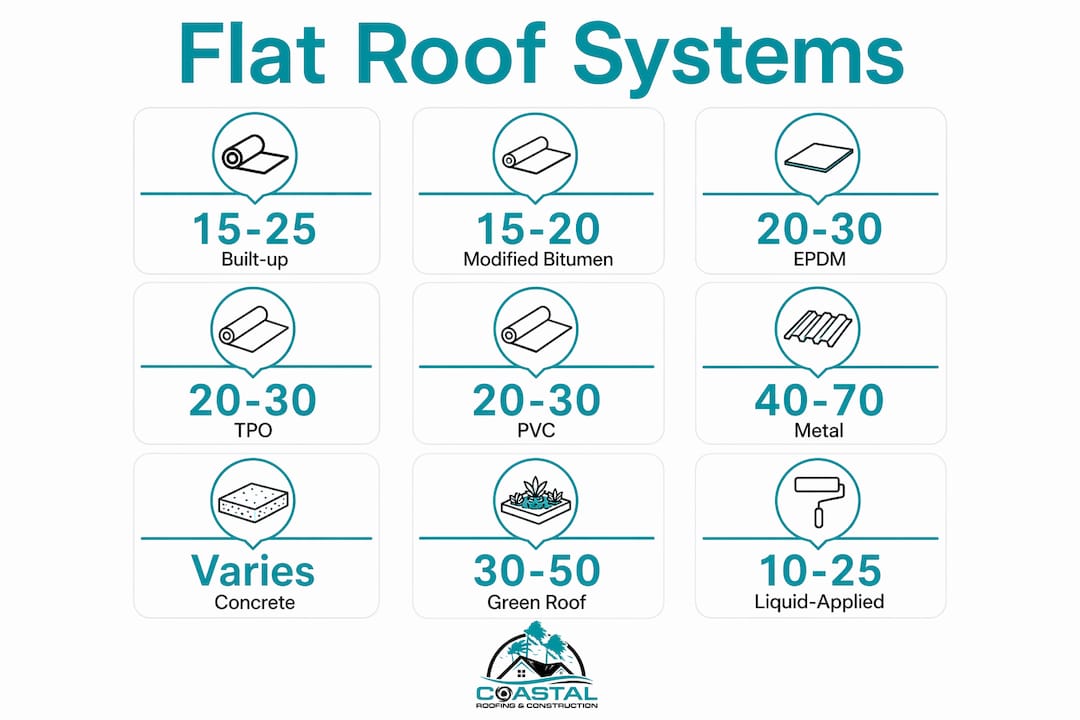
Major cost drivers beyond the membrane itself include deck repair or replacement, insulation upgrade or tapered system installation, drain and edge metal upgrades, and flashing work at penetrations. A quote that covers only the membrane and skips insulation or drain work is not a complete quote.
Pro Tip: Insist on a manufacturer-certified installer warranty, not just a material warranty. A material-only warranty covers the membrane roll; a full-system warranty covers the assembly. Ask specifically: “Does this warranty cover labor and the full assembly, or just the membrane material?” The answer tells you a great deal about the contractor.
How a durable flat roof is actually built
The membrane is the most visible part of a flat roof, but it is not the most important decision you make. A flat roof is a 10–12 layer assembly, and skipping or compromising any core layer causes failures that are invisible on the surface until water is already inside the building.
The essential layers, from bottom to top:
- Structural deck: Typically 5/8-inch plywood or OSB. Must be solid, level, and free of rot before anything goes on top.
- Vapor retarder: Prevents interior moisture from migrating up into the insulation, where it condenses and causes rot from below.
- Insulation: Rigid boards (polyisocyanurate, XPS, or EPS) installed above the deck. Above-deck placement keeps the structural deck warm, prevents condensation, and improves R-value.
- Tapered insulation system: When the deck itself lacks built-in slope, tapered insulation boards create the required 1/4 inch per foot drainage pitch.
- Cover board: A layer between insulation and membrane that protects insulation from foot traffic and improves membrane adhesion.
- Membrane: The waterproofing layer. TPO, PVC, EPDM, modified bitumen, or another system depending on climate and use.
- Flashings: Seal every transition: parapet walls, penetrations, drains, and edges. Flashings are where most leaks originate.
- Edge metal and termination bars: Secure the membrane perimeter and prevent wind uplift and peeling.
- Drainage components: Drains, scuppers, or gutters with proper flashing collars.
Two installation details separate good work from mediocre work. First, insulation boards should be laid in a staggered, brick-lay pattern to prevent linear thermal bridging and reduce seam stress. Second, sheet membranes (EPDM, TPO, PVC) should be allowed to relax for approximately 30 minutes before final adhesion. Skipping that step causes shrinkage and wrinkles that stress seams over time.
Pro Tip: If a roof shows soft spots underfoot, request a core cut or an infrared moisture scan before any new membrane goes down. Wet insulation trapped beneath a membrane shortens the entire system’s life and will not dry out on its own. Replacing wet insulation at installation time costs far less than tearing off a new membrane two years later.
Common flat roof problems and a practical maintenance checklist
Most flat roof failures are preventable. The most common root cause is poor drainage and compromised underlying layers, not the membrane itself. Knowing what to look for twice a year keeps small problems from becoming expensive ones.
Common problems to watch for:
- Ponding water: Standing water more than 48 hours after rain voids most warranties and accelerates membrane degradation.
- Seam failure: Heat-welded seams (TPO, PVC) can separate if improperly welded; adhesive seams (EPDM, modified bitumen) degrade faster with thermal cycling.
- Failed flashings: Parapet walls, pipe penetrations, and HVAC curbs are the most common leak entry points.
- Clogged drains and scuppers: Debris accumulation causes instant ponding. A blocked 4-inch drain can back up water across an entire roof deck.
- Membrane punctures: Dropped tools, falling branches, or HVAC technician foot traffic create pinhole leaks that are hard to find.
- UV and thermal degradation: Alligatoring (surface cracking from thermal cycling) is a sign a membrane is approaching end of life.
- Trapped moisture in insulation: Soft spots underfoot indicate wet insulation, which compresses and loses R-value permanently.
Seasonal inspection checklist (at minimum twice yearly and after major storms):
- Clear all drains, scuppers, and gutters of debris
- Inspect seams and flashings for separation, lifting, or cracking
- Walk the roof and note any soft spots or areas that feel spongy
- Check all penetrations (pipes, HVAC curbs, skylights) for sealant failure
- Look for blistering or alligatoring on the membrane surface
- Confirm water is not pooling in any area more than 24 hours after rain
When to call a professional:
- Ponding water persists more than 48 hours
- A leak recurs after a previous repair
- Visible seam separation or membrane lifting at edges
- Large soft spots covering more than a few square feet
- Any storm damage involving wind uplift or debris impact
Pro Tip: Ask your contractor to perform a flood test after a new installation. The contractor fills low areas with water and inspects for leaks 24 hours later. This catches residual low spots and confirms positive drainage before you accept the job.
How to choose the right flat roof system for your building
The right approach is to choose the membrane last. Two quotes with the same membrane name can represent very different assemblies depending on what is done with drainage, insulation, and flashings.
Decision checklist:
- Drainage performance first. Identify where water currently exits the roof. Are there low spots? Are drains clear and properly located? Will the new system include tapered insulation or drain resets to fix existing ponding areas?
- Substrate and insulation condition. Is the existing deck solid? Does the insulation need replacement? Wet or compressed insulation must come out before a new membrane goes down.
- Exposure and climate. High UV and salt air (Florida coast) favor TPO or PVC with corrosion-resistant edge details. Cold climates favor EPDM or SBS-modified bitumen. Chemical exhaust from restaurant equipment points directly to PVC.
- Intended roof use. Will the roof carry HVAC equipment, solar panels, or foot traffic? Each use affects membrane choice and walkway pad requirements.
- Budget and warranty. Compare lifecycle cost, not just upfront cost. A metal roof at $15/sq ft that lasts 50 years often beats a $6/sq ft membrane replaced twice in the same period.
Questions to ask every contractor:
- How will you address existing low spots or drainage problems?
- What insulation scope is included, and will you replace wet or damaged boards?
- Are you manufacturer-certified for this specific system?
- What does the warranty cover: material only, or full system including labor?
- Can you show me examples of similar projects in this climate?
Red flags in quotes and estimates:
- Membrane-only quotes with no mention of insulation, drain work, or edge metal
- Vague flashing language (“flashings as needed”) without specifying penetration count
- Unclear warranty holder (manufacturer vs. installer vs. both)
- Contractors who refuse core cuts or moisture scans on an existing roof
- Seasonal installation risks: adhesive-based EPDM systems perform poorly in cold temperatures; ask how the contractor handles temperature constraints for your chosen system.
What the research actually says about installation quality and system selection
The evidence on flat roof performance points in one consistent direction: installation quality matters more than membrane brand.
Statistic callout: NRCA and ICC guidance sets the minimum slope at 1/4 inch per foot. Ponding water that persists beyond 48 hours voids most manufacturer warranties and accelerates membrane deterioration regardless of which system is installed.
Lifespan ranges from the industry bear this out. TPO, EPDM, and PVC all average 20–30 years when properly installed. The systems that fail in 5–8 years are not failing because of the membrane formulation. They are failing because of inadequate drainage slope, improperly welded seams, missing vapor retarders, or flashings that were rushed.
For coastal and high-UV environments like Tampa Bay, the practitioner consensus is clear: TPO and PVC with heat-welded seams and corrosion-resistant edge details outperform adhesive-based systems over time. The reflective surface of both membranes also reduces cooling loads, which matters in a Florida summer.
Pro Tip: Make manufacturer-certified installer status a contract requirement, not a preference. Manufacturer certifications (Carlisle, GAF, Owens Corning) exist because those companies know their warranties are only as good as the installation. A certified installer has documented training on seam welding, flashing details, and drainage requirements for that specific system. Require a documented flood or drainage test as a condition of final payment.
Key Takeaways
The single most important decision in any flat roof project is drainage: fix the slope and water flow before choosing a membrane, and the membrane will perform as advertised.
| Point | Details |
|---|---|
| Drainage before membrane | NRCA/ICC requires 1/4 inch per foot minimum slope; ponding water voids most warranties. |
| Lifespan by system | TPO, EPDM, and PVC average 20–30 years; modified bitumen runs 15–20 years; standing seam metal reaches 40–70 years. |
| Installation quality wins | Seam work, flashings, and drain details determine performance more than membrane brand. |
| Climate match matters | TPO and PVC suit Florida’s high-UV, coastal environment; EPDM and SBS-modified bitumen excel in cold climates. |
| Coastal Roofing & Construction | Installs TPO and modified bitumen systems in Tampa Bay with manufacturer certifications and flood-test protocols. |
What a contractor actually looks for on inspection day
When I walk a flat roof for the first time, the membrane is almost the last thing I look at. The first thing is water. Where does it go? I walk the perimeter, check every drain and scupper, and look for the telltale tide marks that show where water has been sitting. Those marks tell you more about a roof’s history than any inspection report.
After drainage, I sound the deck. Walking slowly and listening for hollow spots or soft areas underfoot reveals wet insulation that no visual inspection catches. A roof can look fine from 10 feet away and have saturated insulation boards across half its surface. That wet insulation is the real problem, and it will not dry out once it is trapped under a membrane.
Then I look at flashings. Parapet walls, pipe boots, HVAC curbs, and edge terminations are where the vast majority of leaks originate. A membrane in the field of the roof can last decades. The flashing at a poorly detailed pipe penetration can fail in two years.
The membrane condition comes last. By the time I get there, I already know whether the roof needs a full tear-off and assembly rebuild or whether a targeted repair and re-coat will hold for another decade.
Ask your inspector to walk you through the low spots and explain whether tapered insulation or drain resets are included in the quote. If they cannot answer that question clearly, keep looking.
Coastal Roofing & Construction’s approach to flat roof systems in Tampa Bay
Flat roofing in Florida is not the same job as flat roofing in Ohio. Salt air accelerates edge corrosion. Summer UV intensity degrades adhesive-based systems faster than manufacturers’ lab tests suggest. Hurricane-season wind uplift demands fastening details that exceed minimum code. Coastal Roofing & Construction builds flat roof assemblies with all of that in mind.
The team installs TPO and modified bitumen systems with a system-first approach: drainage and insulation are assessed before a membrane is specified, and every installation includes a documented flood test before project closeout. Coastal Roofing & Construction holds manufacturer certifications with Owens Corning, GAF, and Tri County Metals, which means the warranties they offer cover the full assembly, not just the membrane roll. The company is licensed, insured, and family-owned, serving Pinellas County, Hillsborough County, Pasco County, and surrounding Gulf Coast communities.
For Tampa Bay homeowners and commercial property owners ready to move forward, the flat roof installation page covers the full scope of what Coastal Roofing & Construction includes in a flat roof proposal. To see completed projects, the project portfolio shows recent residential and commercial work. Request an inspection and get a quote that covers the complete assembly, not just the membrane.
Useful sources and authority references
These are the most reliable resources for flat roof specifications, code guidance, and product details:
- ICC Codes Online: Primary source for the 1/4 inch per foot minimum slope requirement and low-slope roofing code provisions. Use this for code/spec guidance and permit conversations with local building departments.
- Carlisle SynTec technical resources: Manufacturer installation guidance for TPO, EPDM, and PVC systems, including staggered insulation joint requirements and membrane relaxation protocols. Best for product-specific installation details.
- American Roofing Guide: Flat Roofing: Industry-average lifespan ranges and system comparison overview. Useful for homeowners comparing systems and setting lifecycle-cost expectations.
- This Old House: Building a Flat Roof Right: Practical step-by-step installation overview with contractor commentary. Good for homeowners who want to understand what a professional installation involves.
- Roof-Installation.com: Flat Roof Installation Guide: Detailed cost ranges, membrane comparison table, and common installation mistakes. Useful for cost benchmarking and contractor question preparation.
- Coastal Roofing & Construction: Flat Roof Replacement Options for Florida Homes: Local guide comparing TPO, EPDM, PVC, and modified bitumen specifically for Florida climate conditions and coastal exposure.