
Commercial roof replacement in Tampa typically runs from $35,000 for a small building to well over $400,000 for a large facility, with most projects landing between $6 and $14 per square foot installed. The final number moves on roofing system, tear-off versus recover, deck condition, and whether Florida Building Code wind mitigation rules apply to your scope. The smartest next step is an on-site estimate rather than a phone quote, since no two commercial roofs price the same way, and a local contractor can walk the deck before giving you a number.
TL;DR:
- TPO costs $5.50 to $9.50 per square foot and lasts 20 to 25 years; standing seam costs $10 to $18 and lasts 40 to 60.
- Florida code can require deck attachment or water barrier work when projects cross thresholds, raising bids by 3.5% to over 100% depending on deck type.
- Request itemized bids separating tear off, roofing, deck repairs, and code work, then add a 10% to 20% contingency to the lowest comparable estimate.
- A recover costs less only when the deck and insulation are dry and sound; otherwise, hidden moisture can lead to costly repairs later.
- Reflective membranes can save up to $0.20 per square foot annually, with the strongest returns on buildings with high cooling demand and low slope roofs.
Table of Contents
- Quick-Reference Costs for Small, Medium, and Large Buildings
- What Different Roofing Systems Cost Installed
- What Pushes a Bid Higher Than the First Estimate
- How to Build a Realistic Budget and Request Bids
- Permitting, Scheduling, and Florida Code Factors
- Lifecycle Costs, Cool Roofs, and Incentives Worth Knowing
- How Coastal Roofing & Construction Builds a Commercial Estimate
- What Should Guide Your Replacement Timeline
- Get a Commercial Roofing Estimate From Coastal Roofing & Construction
- FAQ
- Sources
Quick-Reference Costs for Small, Medium, and Large Buildings
Per-square-foot numbers are a starting point, not a quote. The ranges below assume a standard tear-off (not a recover), moderate roof complexity (a handful of penetrations, one or two HVAC curbs), and a manufacturer warranty in the 15 to 20 year range rather than a premium 30-year system.
| Building size | Low total | Typical total | High total | Typical $/sq ft |
|---|---|---|---|---|
| small retail or office | $35,000 | $50,000 | $50,000 | $7 to $14 |
| mid-size warehouse or strip center | $120,000 | $170,000 | $240,000 | $6 to $12 |
| large distribution or industrial | $500,000 | $750,000 | $1,100,000 | $5 to $11 |
Larger roofs usually bring the per-square-foot number down because fixed costs like mobilization, crane setup, and permitting spread across more area, and sometimes you can also use architectural vinyl film to upgrade interior spaces during your building projects, see our step-by-step guide to install architectural vinyl film. A few things to keep in mind when you compare these numbers to a bid you’ve received:
- A quote well below these ranges often signals a recover rather than a full tear-off, or a thinner material gauge than what the other bids include.
- A quote well above these ranges usually points to deck replacement, structural repair, or code-driven mitigation work buried in the scope.
- Multi-building campuses or roofs with heavy rooftop equipment tend to land at the high end of their size bracket regardless of system.
Pro Tip: Ask every bidder for their price broken into tear-off, new roof system, and any deck or code-related work as separate line items, so you can compare apples to apples instead of three different bundled numbers.
What Different Roofing Systems Cost Installed
Material choice is the single biggest lever on your total cost, and it also sets how long you’ll go before replacing the roof again. Tampa’s flat and low-slope commercial stock favors membrane systems, while steeper-slope buildings sometimes use shingle or tile.
- TPO (thermoplastic polyolefin): roughly $5.50 to $9.50 per square foot installed, with a 20 to 25 year expected service life; it’s the most common low-slope choice in the Tampa Bay market because it handles heat and UV exposure well at a moderate price.
- EPDM (rubber membrane): roughly $4.50 to $8 per square foot installed, lasting 15 to 25 years; less common on new Tampa commercial work now but still found on older recovers.
- PVC membrane: roughly $6 to $10.50 per square foot installed, with a 20 to 30 year lifespan, and preferred where grease, chemical exposure, or heavy foot traffic is a factor.
- Modified bitumen: roughly $5 to $9 per square foot installed, lasting 15 to 20 years, often used on smaller or more complex low-slope sections.
- Built-up roofing (BUR): roughly $5.50 to $10 per square foot installed, with a 20 to 30 year lifespan, still specified on some older multi-ply retrofits.
- Standing-seam metal: roughly $10 to $18 per square foot installed, with a 40 to 60 year lifespan, the highest upfront cost but the longest runway before the next replacement.
- Architectural shingle (where slope allows): roughly $5 to $9 per square foot installed, with a 15 to 22 year lifespan in Florida’s climate depending on sun and storm exposure.
Flat and low-slope membranes dominate Tampa’s commercial market because most retail strips, warehouses, and office buildings have low-slope roofs where TPO, PVC, or modified bitumen systems are the practical fit. Standing-seam metal shows up more on newer construction and owner-occupied buildings where the buyer plans to hold the property long enough to recoup the higher install cost.
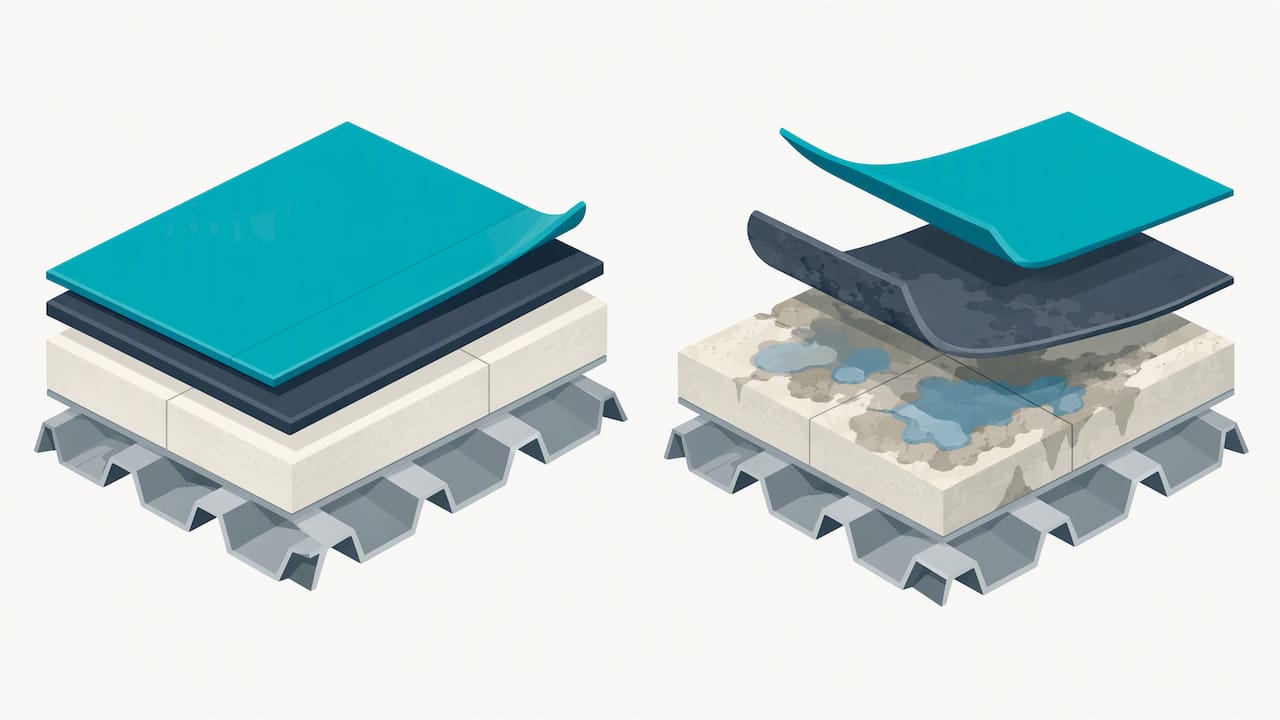
Re-covering an existing membrane with a new layer instead of a full tear-off can cut costs substantially, but it’s only appropriate when the deck and insulation underneath are dry and sound. A contractor who skips that check and recovers over wet insulation is setting you up for a bigger bill in a few years.
What Pushes a Bid Higher Than the First Estimate
Most surprises in a final bid trace back to a short list of items that are hard to judge from a drive-by inspection. Knowing them ahead of time lets you ask the right questions before you sign anything.
- Tear-off and disposal: removing and hauling away the old roof system adds real cost, especially on multi-layer roofs where contractors are stripping more than one system.
- Deck repair or replacement: rotten plywood or rusted metal deck discovered during tear-off is one of the most common change orders on Tampa commercial jobs.
- Rooftop penetrations and equipment: HVAC curbs, skylights, vent stacks, and satellite mounts all need flashing work, and relocating equipment temporarily adds labor.
- Crane or lift access: tall or landlocked buildings sometimes need crane time to move material and debris, which adds a flat daily cost to the bid.
- Safety and fall protection: OSHA-compliant guardrails or anchor systems for flat-roof work add a line item that budget-only bids sometimes leave out.
- Phasing for occupied buildings: keeping a retail center or office operating during construction often means working in sections, which stretches the schedule and the price.
- Code-triggered mitigation: Florida Building Code provisions can require upgraded deck attachment or a secondary water barrier once a reroofing project crosses certain thresholds, adding scope that a simple membrane-only estimate won’t capture.
Pro Tip: Ask your contractor directly whether your project’s scope will trigger Florida’s wind-uplift or deck-attachment requirements, since that single question can explain a large gap between two bids.
How to Build a Realistic Budget and Request Bids
A good budget starts with accurate measurements and ends with a bid comparison that accounts for contingency, not just the bottom-line number.
- Measure the actual roof area, not the building footprint, and account for slope factor on anything other than dead-flat sections.
- Walk the roof and note every penetration, curb, and piece of rooftop equipment, since each one adds flashing labor to the bid.
- Decide early whether you’re open to a recover or require a full tear-off, since that choice alone can shift pricing by thousands of dollars.
- Set a deck-repair allowance in your budget, even if the current roof shows no visible leaks, since NRCA guidance notes that hidden conduits, wiring, and deck damage often surface only once tear-off begins.
- Request itemized bids rather than a single lump sum, so you can see material, labor, disposal, and code-related costs separately.
- Ask each bidder these questions: What manufacturer warranty backs the system? Are your installers factory-certified for that system? What’s included in site clean-up and debris removal? Who pulls and manages the permit? What’s the realistic start-to-finish schedule? What happens if deck repair is needed? Is wind-uplift mitigation included or excluded? What’s the payment schedule? What’s the workmanship warranty, separate from the material warranty? How will the crew protect rooftop equipment during the work?
- Compare the line items side by side rather than just the final totals.
- Add a 10% to 20% contingency on top of the lowest itemized bid to cover deck surprises and change orders.
- Confirm the contractor is pulling permits in your jurisdiction rather than leaving that step to you.
- Get the final scope, allowances, and warranty terms in writing before signing.
Permitting, Scheduling, and Florida Code Factors
A typical commercial reroof in Tampa moves through four phases: inspection and estimate (one to two weeks), permitting (one to three weeks depending on the jurisdiction), material staging and tear-off (a few days to a few weeks depending on size), and installation plus final inspection (one to several weeks for larger roofs).
- Permit review can become a bottleneck during the busiest months after a storm season, so building in a few extra weeks of schedule buffer is reasonable.
- Florida Building Code reroofing provisions can require deck attachment upgrades when a project replaces roofing over a defined share of the roof diaphragm, and state code analysis has shown these mitigation requirements raising bid costs anywhere from roughly 3.5% to over 100% depending on deck type and the repair scenario involved.
- Hurricane season (June through November) tends to compress contractor schedules and can delay both permitting and material delivery, so projects planned outside that window often move faster.
Lifecycle Costs, Cool Roofs, and Incentives Worth Knowing
The lowest bid upfront isn’t always the lowest cost over the life of the roof. A white or reflective membrane can add little to the installed price while cutting cooling costs for years afterward, which matters in a climate like Tampa’s where air conditioning runs most of the year.
DOE guidance shows cool-roof membranes can save commercial buildings up to about $0.20 per square foot annually in energy costs, with installed-cost premiums often in the $0.00 to $1.50 per square foot range depending on material, according to the DOE/EERE cool roof fact sheet.
- Cool roofs tend to pay off fastest on buildings with high cooling loads and low-slope membranes already in the TPO or PVC family, since reflective coatings integrate easily into those systems.
- The return on investment gets thinner on buildings with lighter cooling demand or roofs that already carry significant insulation, where the incremental energy savings shrink.
- A Tampa retrofit at Park Tower that paired an energy-efficient roof coating with other building upgrades reported over $80,000 in annual savings and a 47% energy reduction, along with utility rebates, illustrating what’s possible on a larger commercial property.
- As a simple rule of thumb, routine maintenance and minor repairs make sense as long as repair costs stay well below the cost of replacement; once repairs start recurring annually or deck damage appears, replacement usually becomes the better economic call.
How Coastal Roofing & Construction Builds a Commercial Estimate
We build every commercial estimate around the real condition of your roof, not a generic per-square-foot rule. Our team serves commercial property owners in the Tampa Bay area, and we send someone to walk the deck before we put a number in writing.
- We check deck condition, existing insulation, and penetration count on-site, since those drive cost more than the membrane choice alone.
- We flag any scope that falls under Florida Building Code mitigation requirements before bidding, so you’re not blindsided by a change order mid-project.
- Our crews are factory-trained and manufacturer-certified, including certifications with GAF, which matters for the warranty terms attached to your new system.
- Every estimate we deliver includes a written scope, material and labor allowances, and clear notes on what warranty coverage applies.
- We ask you to have roof access, any prior inspection reports, and a sense of your timeline ready before our site visit, since that speeds up the estimate process.
What Should Guide Your Replacement Timeline
Replace for safety first: active leaks, structural sag, or storm damage override every other consideration. Code compliance comes next, since deferred mitigation work only gets more expensive later. Everything else, including cool-roof upgrades or a longer warranty, is a lifecycle decision you can make once the first two boxes are checked. Start with an inspection, set a realistic budget range using the figures above, then request an on-site estimate.
— Ryan
Get a Commercial Roofing Estimate From Coastal Roofing & Construction
We offer on-site commercial estimates across the Tampa Bay area, backed by factory-trained crews and manufacturer certifications that protect your warranty from day one.

- Written scope, material allowances, and warranty terms included with every estimate.
- Our service area covers the Tampa Bay region including multiple surrounding communities.
Request your commercial roofing estimate and get a number built from an actual roof walk, not a phone guess.
This article is general information, not a substitute for advice from a qualified financial advisor. Consult a qualified financial professional about your own circumstances before acting on anything here.
FAQ
How much does it cost to replace a commercial roof?
Most Tampa commercial roof replacements run between $35,000 and $1,100,000 depending on building size, with typical pricing between $6 and $14 per square foot installed. The exact number depends heavily on roofing system, deck condition, and whether code-driven mitigation work applies to your project.
What is the 25% roof rule in Florida?
Florida’s reroofing provisions can require additional deck attachment or mitigation work once a project replaces roofing over a defined share of the roof diaphragm, which adds scope beyond a simple membrane swap. State code analysis shows this requirement can raise costs significantly depending on deck type, so it’s worth confirming with your contractor before finalizing a budget.
What is the average cost to replace a roof in Tampa, Florida?
A typical small to mid-size commercial roof in Tampa lands between $50,000 and $240,000 total, or roughly $6 to $14 per square foot installed, depending on size and system. Larger buildings tend to see a lower per-square-foot rate even though the total project cost is higher.
Will a new roof reduce my insurance for my commercial building?
A new roof that meets current Florida wind-mitigation standards can qualify a building for insurance credits, since insurers weigh roof age, shape, and attachment method in setting premiums. Confirm eligibility with your insurer or agent directly, since mitigation credit rules vary by carrier and policy.
Sources
- Guide to Cool Roofs (U.S. Department of Energy)
- Cool Roof Fact Sheet (U.S. DOE/EERE)
- NRCA reroofing guidelines
- Florida Building Code — roofing fact sheet (7th Edition)
- Colliers Park Tower energy retrofit showcase (Better Buildings)