
Metal roof insulation does three jobs at once: it slows heat transfer through the panels, controls the condensation that forms when warm indoor air meets a cold metal deck, and dampens the noise of rain and hail. Which assembly matters most depends on your climate and your roof’s exposure. If condensation is your bigger risk, closed-cell spray foam or a sealed continuous insulation layer is the safer bet. If summer heat is the main problem, a reflective radiant barrier paired with a ventilated air gap does more for your cooling bill. Both approaches can work together, and the right combination usually comes down to your local climate, your roof’s construction, and your budget.
Here’s how to use the rest of this guide:
- Want to know which material fits your roof? Skip to the comparison of insulation types below.
- Fighting condensation drips or rust? Go straight to the moisture-control section.
- Budgeting for a project? Jump to the costs and savings breakdown.
Key Takeaways
Metal roof insulation succeeds when the material, placement, and vapor sequencing are matched to your climate rather than chosen by price alone.
| Point | Details |
|---|---|
| Match material to climate | Hot climates favor reflective barriers with an air gap; humid climates favor closed-cell spray foam for sealing. |
| Condensation control comes first | Sequence vapor retarders correctly and consider above-deck continuous insulation to keep the deck above the dew point. |
| Purlins undercut R-value | Thermal bridging through purlins can bypass insulation performance unless the assembly design accounts for it. |
| Underlayment rating matters | Standard asphalt membranes degrade under hot metal; specify high-temp-rated underlayment for retrofits. |
| Coastal Roofing & Construction installs to factory spec | Manufacturer-certified training with Owens Corning, GAF, and Tri County Metals reduces the vapor-sequencing errors that void warranties. |
Where to Learn More About Metal Roof Insulation Standards
- ASHRAE 90.1 summary for metal buildings: code compliance and continuous insulation provisions.
- Attic Radiant Barriers resource guide: radiant barrier test data and air-gap specifications.
- Metal Roof Insulation: Options, Installation, and Cost Compared: material comparisons and installed cost ranges.
- Spray polyurethane foam on metal panels: application methods and condensation-control practices.
Table of Contents
- The Role of Metal Roof Insulation in Managing Heat and Sound
- Which Insulation Type Works Best on a Metal Roof?
- How Do You Stop Condensation on a Metal Roof?
- Above-Deck, Under-Deck, or Retrofit: Where Should Insulation Go?
- What’s the Right Insulation Strategy for Your Climate?
- What Should You Budget for Metal Roof Insulation?
- How Do You Spot a Bad Metal Roof Insulation Job?
- Why Contractor Certifications Matter for Insulated Metal Roofs
- What Homeowners Get Wrong About Metal Roof Insulation
- Get a Metal Roof Insulation Assessment From Coastal Roofing & Construction
- Sources
The Role of Metal Roof Insulation in Managing Heat and Sound
Metal conducts heat far faster than shingles or tile, which is exactly why insulation plays such an outsized role in how a metal roof performs. Three physical processes are at work, and each calls for a different fix.
- Conduction. Heat moves directly through the metal panel and into the structure below. Purlins, the horizontal supports that panels attach to, often bridge straight through insulation layers, creating a thermal short circuit that lets heat bypass the insulation entirely unless the assembly accounts for it.
- Radiation. A sun-baked metal roof can radiate heat downward into the attic or living space even after the air temperature has cooled. Reflective foil layers work here specifically because they block radiant energy rather than just slowing conduction.
- Sound transmission. Rain and hail hitting bare metal create a distinct drumming noise. Insulation, particularly denser materials like mineral wool or closed-cell foam, absorbs vibration and cuts that noise substantially, which is often the deciding factor for homeowners converting from shingles.
Ignore purlin bridging and you can install a high R-value product and still lose a meaningful chunk of its performance to the metal framing running straight through it.
Which Insulation Type Works Best on a Metal Roof?
No single material wins on every metric. The right pick depends on where it sits in the assembly and what problem you’re solving.
- Fiberglass batts: roughly R-3 to R-4 per inch, inexpensive, but they lose most of their R-value if compressed or exposed to moisture. Best suited to under-deck cavities with a clear vapor strategy.
- Mineral (stone) wool: similar R-value to fiberglass, better fire resistance, and denser, so it handles sound dampening better and tolerates incidental moisture without collapsing.
- Rigid foam boards (polyiso, XPS, EPS): polyiso provides a relatively high R-value per inch, offers continuous coverage over purlins, and pairs well with low-perm facers that resist moisture intrusion, a property documented in Thermax metal building board datasheets. XPS handles wet conditions better than EPS but costs more.
- Closed-cell spray foam: around R-6 to R-7 per inch, and it air-seals as it insulates, which makes it the strongest single option for humid climates where sealing the deck against moisture intrusion matters as much as R-value.
- Radiant/reflective barriers: near-zero R-value on their own, but when installed with an air gap they reflect most radiant heat, making them a specialist tool for radiant load rather than a substitute for mass insulation.
The most common installation mistake is compressing batts to fit a tight cavity, which crushes the air pockets that create R-value in the first place. The second most common: installing a vapor barrier on the wrong side of the assembly, trapping moisture instead of blocking it.
Pro Tip: If your contractor can’t tell you which side of the assembly the vapor retarder faces and why, get a second opinion before signing anything.
How Do You Stop Condensation on a Metal Roof?
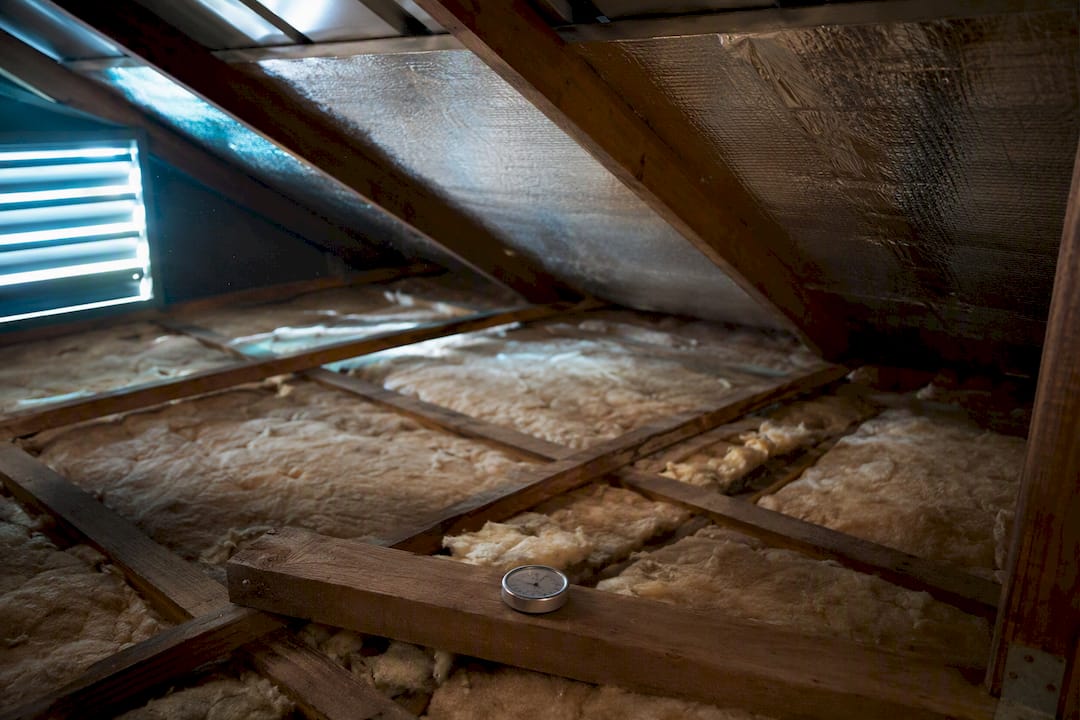
Condensation forms when warm, moist air contacts a surface at or below the dew point, and a metal roof deck cools faster than almost any other roofing surface. That’s why “roof sweat,” the dripping condensation that stains ceilings and rusts fasteners, shows up on metal roofs more than shingle roofs, especially in humid climates or conditioned buildings with poor air sealing.
Three assemblies reliably manage this:
- Vented gap assemblies: a ventilated air space, typically at least 3/4 inch, lets moisture escape before it accumulates, and it doubles as the space a radiant barrier needs to function.
- Closed-cell spray foam: applied directly to the deck, it air-seals and insulates in one step, which installer field reports describe as the most dependable fix in warm, humid regions.
- Continuous above-deck insulation: rigid board laid over the deck keeps the structural surface warmer than the dew point, so condensation never forms on it in the first place.
Sequencing matters as much as material choice. Vapor-permeable layers belong on the warm side of the assembly, low-perm barriers on the cold side, and getting that backward defeats the whole strategy. ASHRAE 90.1 lays out continuous insulation and cool-roof provisions for metal building roofs that push designers toward exactly these whole-assembly solutions rather than relying on per-inch R-value alone.
Above-Deck, Under-Deck, or Retrofit: Where Should Insulation Go?
Placement changes both performance and price, and understanding the trade-offs helps you evaluate a contractor’s bid instead of just comparing bottom-line numbers.
- Above-deck rigid insulation: installed over the structural deck before panels go on, this delivers continuous R-value with no purlin bridging and strong condensation control, since the deck stays warm. It requires taller fasteners and engineered clips to reach through the extra thickness, which adds labor cost.
- Under-deck or between-purlin insulation: batts or foam fill the cavity between structural members. It’s cheaper but needs a clear ventilation path and careful attention to the thermal bridging that purlins create.
- Over-roof retrofit: for an existing metal roof, a new insulated panel system goes directly over the old one. This avoids tearing off the original roof but demands high-temperature-rated underlayment, since standard asphalt membranes can degrade under a hot metal panel, plus careful fastener engineering to handle the added weight and wind load.
Pro Tip: Ask any contractor bidding an over-roof retrofit for the underlayment’s temperature rating in writing. Anything below 240°F is a red flag on a metal assembly.
What’s the Right Insulation Strategy for Your Climate?
Climate should drive the decision more than brand preference or what a contractor happens to stock.
- Hot and humid: prioritize a radiant barrier with a ventilated gap to knock down radiant heat gain, or closed-cell spray foam where sealing against humidity matters more than reflectivity. This region is where condensation risk and cooling load hit hardest at the same time.
- Hot and dry: reflective barriers do most of the work here since humidity-driven condensation is less of a concern; mass insulation matters less than blocking radiant load.
- Cold climates: focus on warm-side air sealing and continuous insulation to keep the structural deck above the dew point, and place vapor retarders carefully since a mistake here causes moisture to accumulate inside the wall or roof assembly instead of outside it.
- Mixed climates: a hybrid approach, reflective foil under the panel with an air gap plus a mass insulation layer of batts or rigid board, addresses radiation, conduction, and moisture control simultaneously, and it’s often where local energy code R-value minimums end up dictating the final specification anyway.
Roof color plays into this too. A reflective roof surface reduces the radiant load insulation has to manage in the first place, and research on roof color and energy use backs up how much that upstream choice affects the insulation strategy underneath it.
What Should You Budget for Metal Roof Insulation?
Costs scale with material and labor complexity, not just square footage.
- Fiberglass batts: the least expensive option, but labor to fit them properly around purlins and framing often costs more than the material itself.
- Rigid foam board: moderate material cost, moderate labor, since it goes in faster than batts but slower than spray foam.
- Closed-cell spray foam: the highest material and equipment cost of the group, though labor efficiency partly offsets it since it seals and insulates in one pass. As a rule of thumb across all three, installed labor often roughly doubles the material cost alone.
On the savings side, DOE-cited field data shows radiant barriers cutting cooling costs modestly in hot climates, with some tests recording significant reductions in ceiling heat flux specifically. Above-deck retrofits with continuous insulation tend to produce larger whole-building savings, though the gain depends heavily on your existing insulation baseline. Lifecycle costs matter too: spray foam depends on unbroken seal integrity, and a future re-roof over foam requires more planning than pulling off batts.
How Do You Spot a Bad Metal Roof Insulation Job?
Some warning signs show up fast, others take a season or two to surface.
- Watch for: condensation drips after the first cold snap, rust forming around fasteners, insulation sagging visibly between purlins, or a roof that got noticeably louder in rain after “insulation work” was supposedly completed.
- Ask before hiring: What’s the vapor retarder’s perm rating, and which side does it face? What underlayment temperature rating are you specifying? What’s the fastening pattern and screw length for this panel gauge? Is there an actual ventilation plan, or just insulation stuffed into the cavity?
- Know when to escalate: a full re-roof makes sense when the deck itself shows rot or widespread rust; a selective retrofit is enough when the structure is sound and only the insulation layer has failed.
Why Contractor Certifications Matter for Insulated Metal Roofs
Getting a metal roof assembly right depends less on the insulation product itself and more on whether the installer understands how that product interacts with fasteners, underlayment, and ventilation. Coastal Roofing & Construction’s crews are factory trained through manufacturer certifications with Owens Corning, GAF, and Tri County Metals, training that covers exactly the details this guide walks through: correct vapor retarder orientation, high-temp underlayment specification, and fastener patterns matched to panel gauge.
That training reduces warranty risk in a very specific way: most manufacturer warranties on insulated metal roofing systems are void if the installation deviates from factory specification, and condensation damage from a botched vapor sequence is one of the most common reasons a claim gets denied.
An on-site inspection typically documents:
- Current insulation type, condition, and placement
- Existing ventilation path, if any
- Deck condition and any signs of past moisture damage
- A recommended assembly matched to your climate zone and roof use
What Homeowners Get Wrong About Metal Roof Insulation
Most guidance on this topic treats R-value as the finish line. It isn’t. A roof can hit its code-required R-value and still fail if the vapor sequencing is backward or the purlins bridge straight through the insulation layer, and that’s the gap conventional advice tends to skip over.
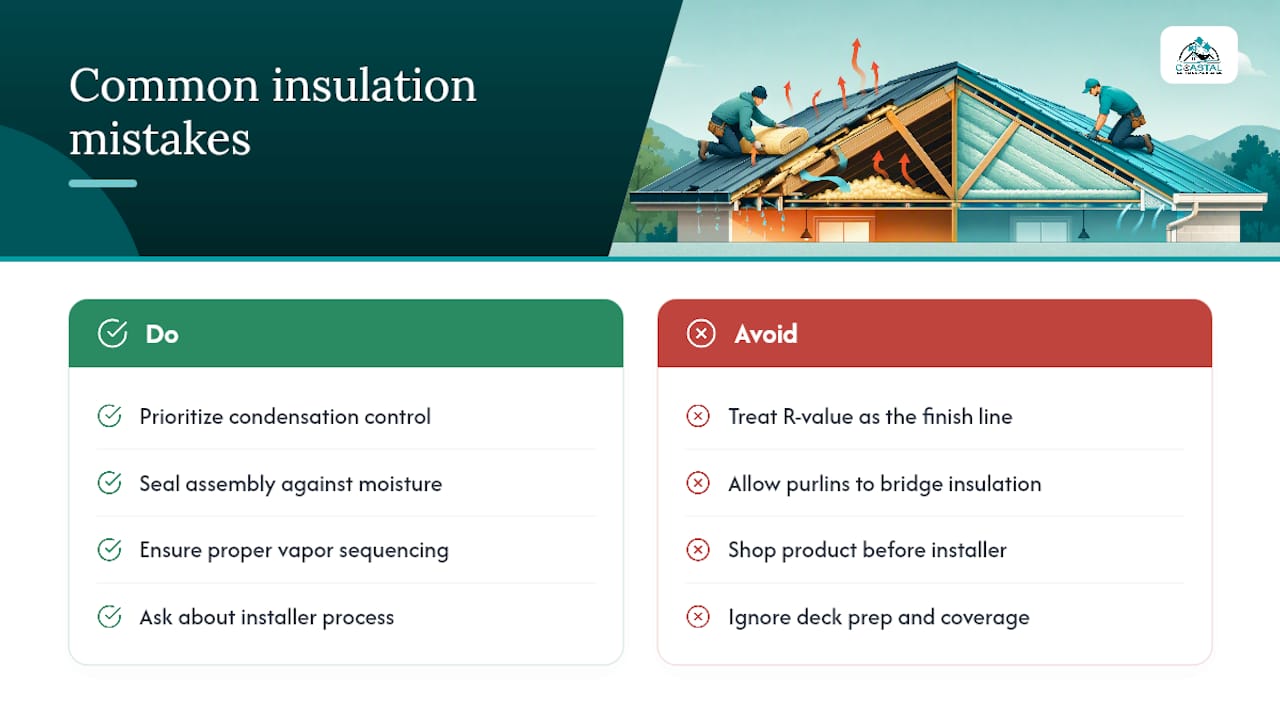
Condensation control deserves top billing, not thermal performance. A roof that runs slightly warm in August is an inconvenience. A roof that drips condensation onto ceiling drywall every winter is a repair bill, and often a mold problem. If you only have budget for one upgrade, sealing the assembly against moisture movement, whether through closed-cell foam or a properly sequenced vapor retarder, outperforms chasing another R-point of insulation.
The other blind spot: homeowners shop for insulation products when they should be shopping for installation discipline. Two identical spray foam jobs can perform completely differently depending on deck prep, coverage thickness, and whether the installer understands how metal panels expand and contract with temperature swings. Ask about the installer’s process before you ask about the product’s R-value.
— Ryan
Get a Metal Roof Insulation Assessment From Coastal Roofing & Construction
If you’ve read this far, you already know insulation decisions on a metal roof aren’t one-size-fits-all, and getting them wrong costs more to fix later than to plan correctly up front. Coastal Roofing & Construction specializes in exactly this kind of assembly-level thinking for Tampa Bay area homes, backed by factory training with Owens Corning, GAF, and Tri County Metals that translates directly into fewer condensation callbacks and cleaner warranty coverage.

Whether you’re planning a new standing seam metal roof or evaluating whether your current assembly needs an insulation retrofit, our team documents deck condition, existing insulation, and ventilation before recommending a fix, not after. If you’re weighing a full roof replacement against a targeted insulation upgrade, request an on-site inspection and we’ll walk you through both options with real numbers for your roof, not generic ranges.
Sources
- Attic Radiant Barriers resource guide (BASC / PNNL)
- ASHRAE 90.1 summary for metal buildings (Insulation Institute extract)
- Spray polyurethane foam on interior surfaces of metal panels (Metal Construction Association)