
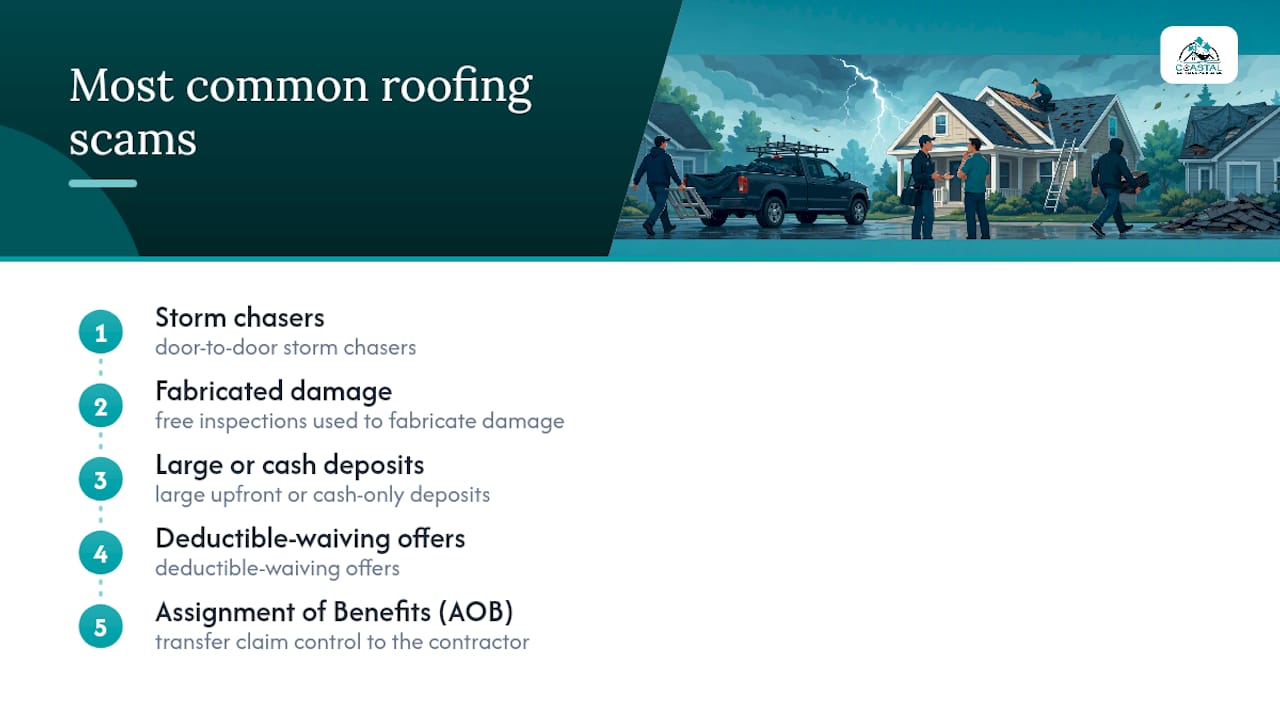
The most common post-storm roofing scams are door-to-door “storm chasers,” free inspections that manufacture damage, demands for large upfront deposits, offers to waive your insurance deductible, and Assignment of Benefits (AOB) contracts that sign away control of your claim. The single best first move: document the damage with photos and video, then call your insurer before you call anyone else.
Do these three things in the first hour:
- Photograph and video every damaged area, inside and out, with timestamps using a post-storm roof inspection checklist for South Florida homes.
- Call your insurance company to open a claim and request an adjuster visit.
- Refuse to sign anything a contractor hands you on your doorstep.
Storm-chasing operators cost homeowners hundreds of millions of dollars every year, and they typically work an affected region for 6 to 18 months before packing up and moving to the next disaster zone. A quick check of your county’s permit history and a call to your state’s Department of Insurance can tell you in minutes whether the person on your porch has ever done legitimate work in your area.
Key Takeaways
Homeowners avoid post-storm roofing fraud by documenting damage, calling their insurer first, and verifying a contractor’s permit history and license before signing anything.
| Point | Details |
|---|---|
| Insurer comes first | Open your claim before talking to any contractor who shows up unannounced. |
| Watch the deposit size | A 10 to 20 percent deposit is normal; 50 percent or more is a warning sign. |
| Never sign an AOB blind | Assignment of Benefits hands over control of your claim; get legal advice first. |
| Verify before they climb | Check permits, license, insurance, and manufacturer certification before any roof access. |
| Choose a documented local contractor | Coastal Roofing & Construction provides licensed, certified inspections and written estimates for Tampa Bay homeowners. |
Where to Verify Claims and Report Roofing Fraud
- Check licensing and deposit rules through your state Department of Insurance.
- File a complaint with your state Attorney General’s consumer protection office.
- Search your county’s building permit office to confirm prior contractor filings.
Table of Contents
- The Common Roofing Scams After Storms You’re Most Likely to See
- How the Storm Chaser Playbook Actually Unfolds
- What to Do in the First 24 to 72 Hours After Damage
- How to Vet a Roofer Before You Sign Anything
- The Contract Traps That Cost Homeowners the Most
- When You’re Ready for a Real Inspection, Not a Sales Pitch
- Frequently Asked Questions
- Sources
The Common Roofing Scams After Storms You’re Most Likely to See
Storm damage brings out two kinds of contractors: the ones who’ve worked in your county for years, and the ones who showed up three days after the wind died down. Here’s how the second group operates.
Storm chasers knock on doors before you’ve even filed a claim. They usually drive vehicles with out-of-state plates, can’t name a single local reference, and have zero permit history in your county. The pitch sounds urgent and generous, “we’re already in the neighborhood, we can start today,” but the outcome is almost always the same: rushed, low-quality work with no warranty, and a company that’s unreachable by the time shingles start lifting again.
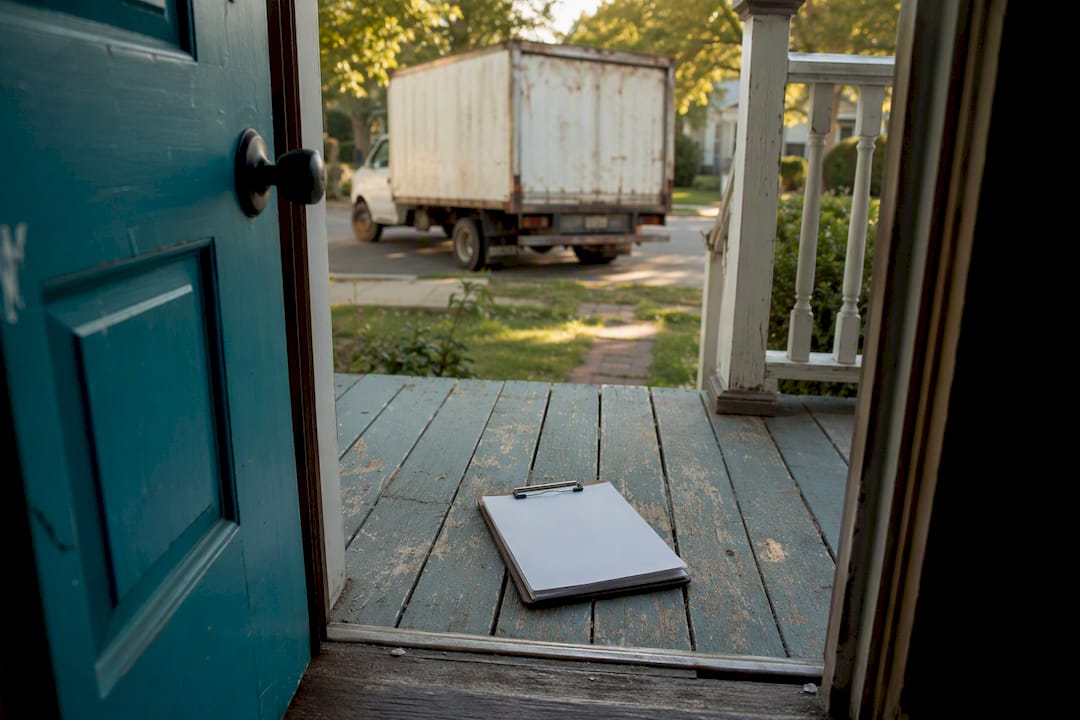
The “free inspection” is the bait for a bigger con. An inspector climbs your roof, comes down with photos of dramatic damage, and pressures you to sign a contract on the spot. Industry specialists warn that free inspections are often the pretext for creating or exaggerating damage, and once someone unvetted has been on your roof, you have no way to prove what damage was already there.
Then come the money red flags:
- Large upfront deposits. A normal deposit runs 10 to 20 percent; anything at 50 percent or more, especially if it’s cash-only, is a signal to walk away.
- Deductible waivers. A contractor who offers to “cover” your deductible is typically inflating the invoice to hide it, which counts as insurance fraud in most states.
- Assignment of Benefits contracts. Signing an AOB hands your claim, and your say in how it’s handled, directly to the contractor.
- Fabricated or exaggerated damage. Some operators pad claims to justify a full replacement when a repair would do, then vanish before the work is finished.
Pro Tip: Never let anyone onto your roof until you’ve confirmed their license and local address. A ladder in your yard is not consent to inspect, quote, or diagnose.
Free inspections are often the pretext for creating or exaggerating damage, and homeowners should avoid letting an unvetted contractor on the roof until credentials are confirmed.
How the Storm Chaser Playbook Actually Unfolds
The sequence rarely changes: an unsolicited knock, a “free” climb onto your roof, a phone full of dramatic damage photos (some of which the inspector may have just created), then pressure to sign an AOB or contract before the adjuster even calls you back.
Urgency is the engine that makes it work. Offers like “special pricing today only” or “we have leftover materials from the job next door” exist to short-circuit the normal instinct to slow down and check credentials. Legitimate roofers rarely need you to decide in the next ten minutes.
- Knock happens within days of the storm, often before your insurer contacts you.
- “Free inspection” produces photos used to justify a contract, not just an estimate.
- Pressure to sign an AOB or full contract follows almost immediately.
- Upfront payment is requested before any permit is pulled.
Pro Tip: Search your county’s online permit portal for the contractor’s business name. If they’ve never filed a permit there before this week, that’s a five-second scam detector.
What to Do in the First 24 to 72 Hours After Damage
- Document everything first. Photograph and video every damaged surface, inside and out, with date and time stamps, before letting anyone touch the roof, if it’s safe to do so.
- Handle interior leaks with temporary measures only. Buckets, moved furniture, and towels are fine. Skip permanent repairs until your insurer has seen the damage.
- Call your insurer before any contractor. Insurers contact you when they need an inspector, they don’t send unsolicited “partners” to your door, so anyone claiming that affiliation should raise suspicion.
- If you need a tarp, hire a documented, licensed provider and keep the receipt. Emergency tarping is usually covered by homeowners insurance as mitigation, and large-area tarping commonly runs $400 to $700, but it’s a temporary fix, not a repair.
- Expect a wait, not instant service. After a major storm, legitimate local roofers are backlogged for weeks. A crew that can start “today” with a full crew and materials in hand is often the red flag, not the relief.
Pro Tip: Keep every receipt tied to temporary mitigation. Reimbursement for tarping and emergency repairs almost always requires proof of payment.
How to Vet a Roofer Before You Sign Anything
Verifying a contractor takes longer than a handshake, but it takes less time than fixing a botched roof. Start with permit history: search your county’s building department to see whether this company has filed permits in your area before this storm, not just after it. A contractor with years of local permits behind them is a fundamentally different bet than one that appeared last Tuesday.
From there, work through a short list:
- Confirm the contractor’s license number and insurance directly with your state licensing board, and request proof of general liability and workers’ compensation.
- Ask for manufacturer certifications, like Owens Corning or GAF credentials, and a written warranty you can verify through the manufacturer.
- Collect two to three written estimates that spell out material specs, a timeline, and a payment schedule.
| Vetting Step | What to Check |
|---|---|
| Permit history | Search county records for prior permits filed under the contractor’s business name |
| License and insurance | Verify directly with the state licensing board, request certificates of insurance |
| Manufacturer certification | Confirm certification status through the manufacturer’s official lookup tool |
| Written estimate | Should include material specs, scope of work, timeline, and payment schedule |
Demand the removal of any contract with blanks, a vague scope of work, a 50 percent or higher upfront demand, cash-only terms, or a breezy “we’ll handle everything with your insurance” promise that skips the details. If a contractor won’t put specifics in writing, that omission tells you what a sales pitch never will.

The Contract Traps That Cost Homeowners the Most
An Assignment of Benefits contract lets a roofer bill your insurer directly and negotiate the claim on your behalf. It sounds convenient. In practice, it means you lose control of your own claim, and if the contractor inflates the invoice or fights the insurer, you’re the one left holding the dispute, sometimes even the legal exposure.
A contractor offering to waive or “cover” your deductible is telling you they plan to pad the bill elsewhere to make the math work, which typically counts as insurance fraud. And never sign a contract with blank fields or vague line items; a real scope of work names materials, quantities, and a payment schedule tied to completed milestones, not a lump sum up front.
- Let your insurer coordinate directly with the adjuster rather than handing that role to a contractor.
- Insist payment follows milestones the contractor has actually completed.
- Talk to a lawyer before signing any AOB. It’s a binding legal document, not a formality.
Assignment of Benefits transfers control of your insurance claim to the contractor, which can lead to inflated claims and legal disputes that the homeowner still has to face.
A Five-Minute Check That Beats Most Scams
- Search your county’s permit portal for the contractor’s business name and prior filing dates.
- Call the state licensing board to confirm the license and insurance certificates.
- Photograph the damage and save every receipt in one folder.
Pro Tip: A permit-history lookup takes less time than the sales pitch you’ll sit through if you skip it.
What Fifteen Years of Watching This Pattern Taught Me
Every storm season, the same operators resurface with the same script. The homeowners who avoid getting burned aren’t the suspicious ones, they’re the ones who ask for permit history and a written scope before anyone touches a shingle.
When You’re Ready for a Real Inspection, Not a Sales Pitch
Coastal Roofing & Construction is licensed, insured, and manufacturer-certified through Owens Corning, GAF, and Tri County Metals, which means our estimates come with documentation a storm chaser can’t produce: permit history, factory-backed warranties, and a written scope you can actually hold us to.

We handle everything from emergency tarping and repair to full storm damage restoration and insurance claim coordination for homeowners across the Tampa Bay area. If your roof took a hit, request a documented inspection and written estimate before you sign anything with anyone else.
Frequently Asked Questions
What are the most common roofing scams after storms?
The top patterns are door-to-door storm chasers, free inspections used to fabricate damage, large upfront or cash-only deposits, deductible-waiving offers, and Assignment of Benefits contracts that transfer claim control to the contractor.
Should I let a contractor inspect my roof before calling my insurance company?
No. Call your insurer first to open the claim, since insurers initiate adjuster visits themselves and never send unsolicited representatives to your door.
How much should a roofing deposit cost?
A customary deposit runs 10 to 20 percent of the total job cost. Demands for half the price upfront, especially in cash, are a strong sign of a fly-by-night operator.
What is an Assignment of Benefits, and why is it risky?
An AOB lets a contractor bill your insurer directly and negotiate your claim. It sounds convenient but leaves you with little control if the contractor inflates the invoice or disputes arise.
How do I check if a roofing contractor is legitimate?
Search your county’s permit records for prior filings under the company’s name, verify their license and insurance with the state board, ask for manufacturer certifications, and get two to three written estimates before deciding.
This article is general information, not a substitute for advice from a qualified financial advisor. Consult a qualified financial professional about your own circumstances before acting on anything here.
Sources
- Avoiding predatory roofing scams | NC Department of Insurance
- Home repair fraud: roofing scams | Texas Attorney General
- Emergency roof tarp guide | RoofVista