
For long-term roof performance, hire a craftsmanship-first contractor over a high-volume operator whenever the job allows it. Craftsmanship-first firms use trained, consistent crews and accept slower growth in exchange for fewer callbacks and stronger reputations. Before signing anything, confirm three things:
- The installer is manufacturer-certified and verifiable through the manufacturer’s own locator tool
- The contract names the actual installing crew and includes that crew’s certificate of insurance
- The workmanship warranty terms are spelled out, not just referenced
The tradeoff is straightforward: craftsmanship-first bids often run higher and crews book further out, but you’re buying installation durability instead of installation speed.
Key Takeaways
Craftsmanship-first roofing contractors deliver more consistent long-term performance because their crews are trained, paid for quality, and accountable by name, not by commission.
| Point | Details |
|---|---|
| Verify certification directly | Check manufacturer locators for GAF, Owens Corning, or similar certification before signing anything. |
| Name the crew in writing | Require the installing crew or subcontractor and their certificate of insurance in the contract. |
| Score, don’t just compare price | Get three quotes, discard the extremes, and score the middle ones on scope, crew, and warranty. |
| Match model to job complexity | Use craftsmanship-first crews for complex, metal, or commercial jobs; volume operators can work for simple, urgent jobs with protections in place. |
| Choose Coastal Roofing & Construction for oversight | Coastal Roofing & Construction pairs manufacturer-certified crews with documented onsite quality-control inspections across the Tampa Bay area. |
Table of Contents
- Roofing Craftsmanship vs Volume Explained: What Drives the Difference
- How Craftsmanship-First and High-Volume Roofers Are Structured and Incentivized
- What These Differences Mean for Your Roof
- Exact Line Items and Contract Clauses to Demand
- What to Ask Before You Hire, and the Red Flags to Watch For
- A Fast Way to Compare Three Competing Roof Quotes
- When a High-Volume Roofer Actually Makes Sense
- Why This Distinction Is Worth Taking Seriously
- Get a Craftsmanship-First Estimate Built Around This Checklist
- Sources
Roofing Craftsmanship vs Volume Explained: What Drives the Difference
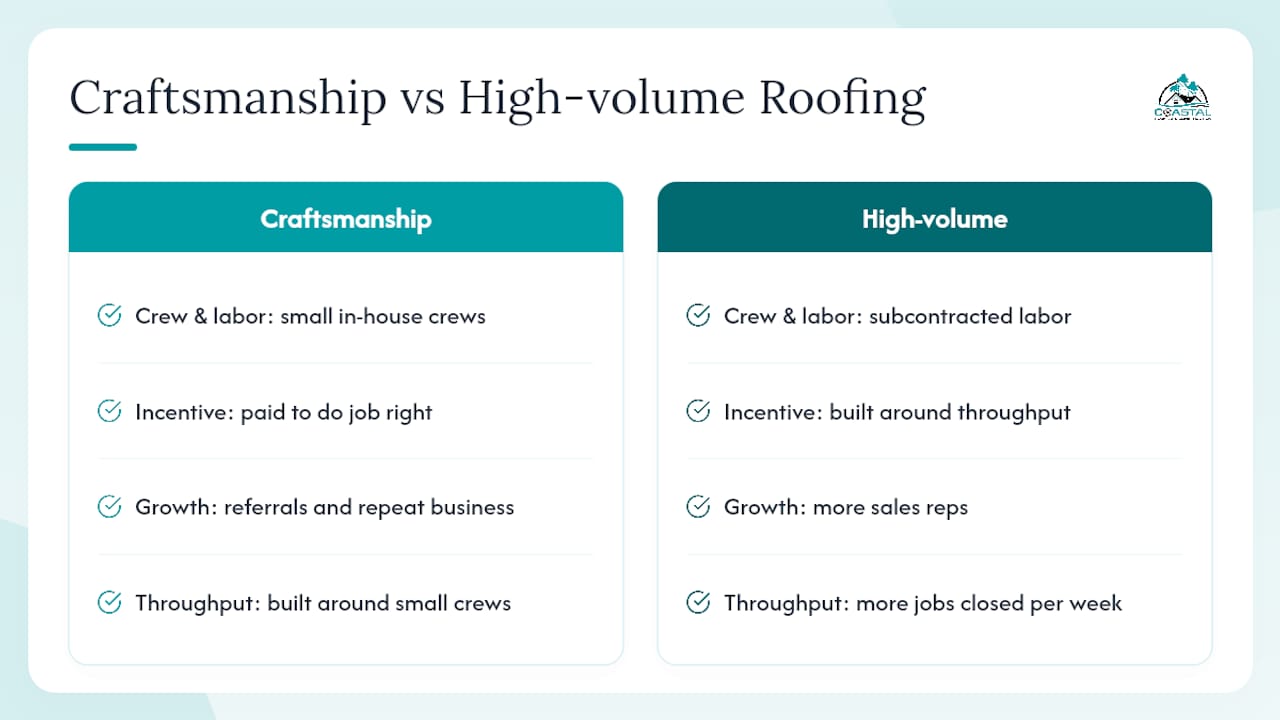
The phrase “roofing craftsmanship vs volume explained” describes two competing business models, not two tiers of the same company. Craftsmanship-first contractors build around a small number of highly trained, often in-house crews who get paid to do the job right, then rely on referrals and repeat business to grow. High-volume contractors build around throughput: more sales reps, more subcontracted labor, more jobs closed per week.
Neither model is inherently dishonest. Industry analysts note that the roofing industry’s labor shortage pushes companies toward one of these two survival strategies, and the strategy a company picks shapes almost everything else about how it treats your roof. Understanding roofing craftsmanship in this context means recognizing it as a deliberate operating choice, not a marketing slogan.
How Craftsmanship-First and High-Volume Roofers Are Structured and Incentivized
A craftsmanship-first roofing company typically pays its crews hourly or on salary, keeps installers in-house, and leans on manufacturer certifications from brands like GAF or Owens Corning as proof of standards. Because the same crews return year after year, quality stays consistent from one job to the next. The company’s growth engine is word of mouth, not a call center.
A high-volume company usually looks different from the inside. Sales reps work on commission and are financially motivated to close deals fast, sometimes before the homeowner fully understands the scope. Installation crews are frequently subcontracted and paid per square rather than by the hour, which means:
- Faster installs earn subcontractors more money per day, regardless of finish quality
- The sales rep who sold the job often never touches a hammer or supervises the install
- Marketing spend, not craftsmanship, drives most of the company’s growth
Hourly-paid crews are more likely to prioritize precision and follow manufacturer specifications, while crews paid per square are financially incentivized to maximize speed and may cut corners on flashing, underlayment placement, and nail patterns.
Large companies also commonly separate sales from installation and subcontract labor, which is exactly why the crew that shows up on installation day can be a stranger to the office that sold you the job. Reviewing which roofing certifications actually matter for homeowners is one of the fastest ways to see through that gap before you sign.
What These Differences Mean for Your Roof
Quality variance is the biggest risk with volume operators. Your outcome depends entirely on which crew shows up, and craftsmanship-first firms sidestep that risk by keeping the same trained installers on every job.
Practical consequences follow from there:
- Warranty risk: manufacturer system warranties usually require the contractor to be certified and to register the job, so an uncertified crew can quietly void coverage you thought you had
- Hidden shortcuts: layover installs, where new shingles go over old ones, save a subcontractor time but hide rot and often void the manufacturer warranty entirely
- Long-term maintenance: inconsistent flashing and nailing work shows up years later as leaks, not on move-out day
Job type should guide your decision. A single-story asphalt shingle replacement on a straightforward roof is lower risk territory where a well-vetted volume operator can perform fine. Complex geometry, steep pitches, standing seam metal, or commercial buildings carry more failure points, and that’s where craftsmanship-first crews earn their higher bid.
Timelines vary accordingly. A single-story asphalt shingle tear-off typically takes 1 to 2 days, while metal roofing and complex tear-offs run considerably longer. If a quote promises a complex metal job in a single day, that’s a scheduling red flag, not a selling point.
Exact Line Items and Contract Clauses to Demand
Your contract is where craftsmanship gets enforced. Vague scope language is how corners get cut without you noticing until the next storm. Require every line item spelled out, not summarized.
| Scope Item | What to Require in Writing |
|---|---|
| Tear-off | Number of existing layers being removed, down to the deck |
| Underlayment | Specific brand and model, not just “synthetic underlayment” |
| Ice-and-water shield | Exact placement (valleys, eaves, penetrations) |
| Drip edge | Material and gauge specified |
| Flashing | Step and chimney flashing details, plus new pipe boots |
| Shingles | Manufacturer and product line named |
| Nailing | Method and pattern per manufacturer spec |
| Ventilation | Any improvements included in scope |
| Cleanup | Magnetic sweep for nails and debris |
| Contract Clause | Why It Matters |
|---|---|
| Named installing crew or subcontractor | Prevents an unfamiliar crew from showing up on install day |
| Crew-level certificate of insurance | Protects you if a subcontracted worker is hurt on your property |
| Workmanship warranty terms | Should state duration and whether it transfers to a new owner |
| Permit and inspection responsibility | Confirms who pulls permits and schedules inspections |
| Manufacturer system warranty registration | Contractor commits, in writing, to registering the job |
Roofing contracts explained for homeowners breaks down how these clauses typically read, and it’s worth comparing that language against anything you’re handed before signing. Manufacturer system warranties only hold up when registration happens correctly, so get proof of that step before final payment, not after.
Pro Tip: Ask directly, “Would you ever do a layover instead of a full tear-off?” A contractor who hesitates or says “it depends on the customer” just told you they’ll cut that corner if you let them.
What to Ask Before You Hire, and the Red Flags to Watch For
Screen every bid with the same short list of questions:
- Who is physically installing my roof, and are they W-2 employees or subcontractors?
- How is the install crew paid, hourly or per square?
- Will this be a full tear-off, or could a layover be an option?
- Are you manufacturer-certified, and can I verify that on the manufacturer’s locator?
- Can I get the crew’s certificate of insurance and installer license numbers in writing?
Walk away fast if you hit any of these:
- A commissioned sales rep refuses to name the actual installing crew
- The quote leaves the door open for a layover instead of a tear-off
- Warranty language is vague (“industry-standard warranty” with no specifics)
- The company won’t itemize scope beyond “roof replacement, materials included”
Check BBB complaint counts and resolution rates as a final filter. Reviewing questions to ask roofing contractors before you hire alongside this list adds a few more angles worth covering on that first call.
A Fast Way to Compare Three Competing Roof Quotes
Get three quotes minimum, then throw out the cheapest and the most expensive. Industry checklists recommend choosing from the middle after scoring what’s left against real scope, not sticker price.
- Convert each remaining quote into the line-item checklist above
- Score each on four categories: scope transparency (40%), crew credentials (25%), warranty coverage (20%), cleanup and extras (15%)
- Disqualify any quote missing underlayment specs, flashing details, or crew information, even if the price looks great
If two quotes list identical shingles but one skips underlayment model and flashing details, treat the vague one as materially inferior regardless of price. Reading through how to evaluate roofing contractor bids can help you build this scorecard before quotes even come in. The middle quote usually costs more than the cheapest, but it typically buys years of additional roof life and far less risk of a mid-warranty leak.
When a High-Volume Roofer Actually Makes Sense
Volume operators earn their place in specific situations: very large commercial reroofing contracts, emergency storm response where you need a documented, qualified crew fast, and jobs where in-house financing speeds up an insurance claim.
If you go this route, protect yourself the same way regardless of urgency:
- Insist the subcontractor be named in the signed contract
- Require that subcontractor’s certificate of insurance before work starts
- Demand a post-install quality-control inspection, documented in writing
- Hold back final payment until a punch list of fixes is fully closed
Even with those protections in place, lean toward craftsmanship-first when the roof has complex geometry, uses premium materials like standing seam metal, or when long-term performance matters more than shaving a few days off the schedule.
Why This Distinction Is Worth Taking Seriously
Homeowners tend to assume a bigger roofing company means more accountability. In practice, size often means more layers between you and the person actually nailing shingles to your deck. The most durable roofs I’ve seen described in this industry come from crews who get paid for the job, not the pace, and who work for a company whose name is on the line every time a manufacturer certification gets checked. Coastal Roofing & Construction operates that way in the Tampa Bay area, with manufacturer-certified crews and documented onsite oversight on every project. That’s not a small detail. It’s the entire difference between a roof that lasts and one that leaks in three years.
Get a Craftsmanship-First Estimate Built Around This Checklist
Coastal Roofing & Construction is built around the exact standards this guide just walked through: manufacturer-certified crews, a named-installer policy, and documented quality-control inspections on every job, from standing seam metal to architectural shingles. That’s the practical difference between a contractor who treats your contract as a formality and one who treats it as a commitment.

Instead of guessing which bid actually protects your roof long-term, browse Coastal Roofing & Construction’s completed projects to see the workmanship firsthand, then request a residential roof replacement estimate built line-by-line against the checklist above. Bring your other quotes. Coastal Roofing & Construction will walk through the scope differences with you before you commit to anyone.
Sources
- The roofing industry faces a labor crisis in the U.S.: what’s behind the shortage and what’s at stake
- How to Choose a Roofing Contractor: The No-BS Guide (2026) | SiftPros
- How to Choose a Roofing Contractor: 15-Point Checklist | The Roofing Brief
- Hourly vs. Per-Square Roofing Crews: Why Pay Structure Directly Impacts Quality