
If water is still sitting on your flat roof 48 hours after the last rain, that’s ponding, and it needs attention. A thin film that drains within a day is usually normal lag. Water that lingers past the 48-hour mark, however, is the industry-standard threshold for a drainage problem that warrants evaluation, not just observation.
Your immediate triage steps:
- Walk the perimeter and check every drain, scupper, and strainer for leaves, debris, or mud. A blocked drain is the most common cause, and clearing it costs nothing.
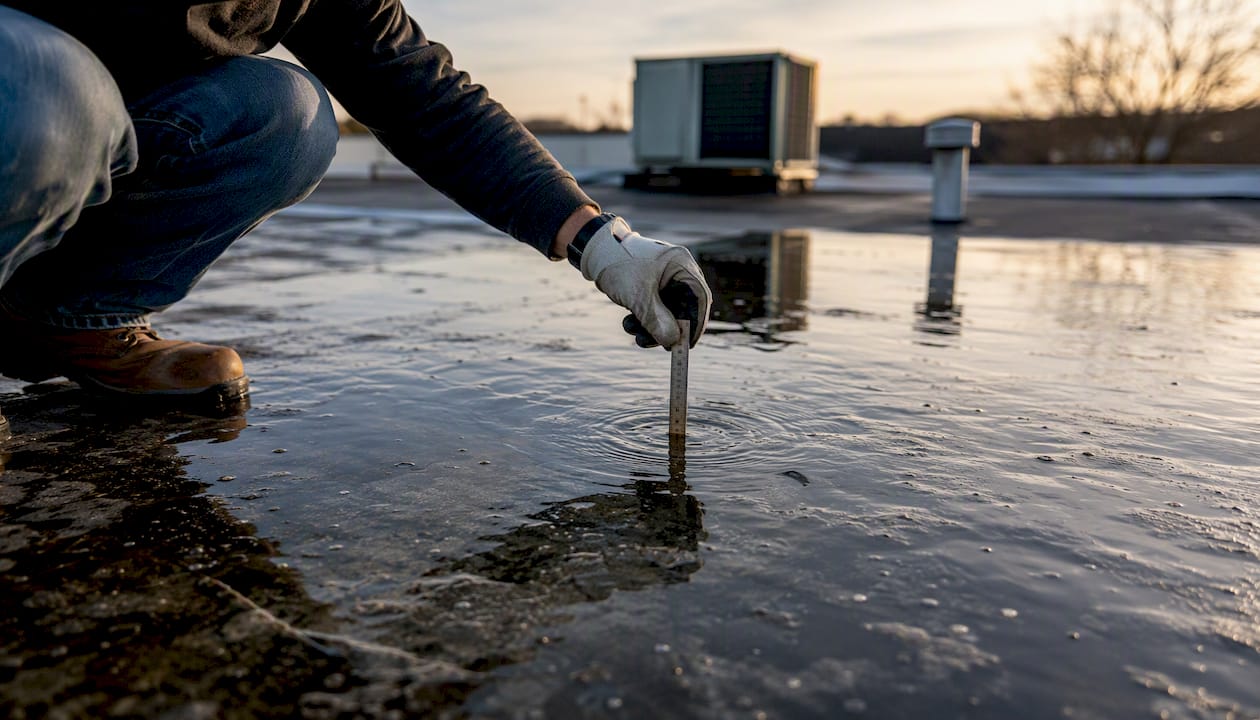
- Photograph the pooled area from multiple angles. Note the approximate depth (a ruler works fine), the size of the pool, and the timestamp of the last rainfall.
- Mark the pool’s edge with chalk or tape so you can tell whether it’s growing or shrinking over the next 24 hours.
- Stay off any area that feels soft or spongy underfoot. A deck that flexes is a structural warning sign, not a roofing one.
- Do not apply sealant or coating over standing water, and do not cut into the membrane without a professional assessment.
Key Takeaways
Flat roof ponding water that remains past the 48-hour mark is a documented drainage or structural problem that requires professional evaluation, not just monitoring.
| Point | Details |
|---|---|
| 48-hour benchmark | Water still present 48 hours after rain ends meets the industry definition of ponding and needs evaluation. |
| Slope baseline | U.S. codes require a minimum ¼ inch per foot slope; dead-flat roofs are not permitted for new construction. |
| Structural load risk | Standing water adds roughly 5.2 lb/ft² per inch of depth, accelerating deck deflection over time. |
| Three urgent red flags | Soft deck underfoot, interior staining, or a pool that grows after each storm means call a pro immediately. |
| Best prevention habit | Clearing drains and scuppers twice yearly prevents most ponding problems before they become repair jobs. |
Table of Contents
- What counts as flat roof ponding water
- Why water pools on flat roofs
- What standing water does to your roof over time
- How to inspect, document, and decide what to do next
- Permanent repairs a professional can perform
- Safe temporary measures you can do right now
- Typical costs and timelines for common repairs
- What Coastal Roofing & Construction checks on every flat-roof inspection
- What our roofers see homeowners get wrong
- Coastal Roofing & Construction can assess and fix your flat roof
- Sources
What counts as flat roof ponding water
The industry definition is clear: water that remains on a low-slope roof more than 48 hours after rainfall ends is ponding. The National Roofing Contractors Association (NRCA) and most major manufacturers use this same benchmark. It exists because some drainage lag is normal, especially after a heavy storm, but water that won’t move after two full days signals a slope, drainage, or structural problem.
The 48-hour rule is your baseline. If the roof is dry by hour 47, you’re probably fine. If it’s still wet at hour 49, you have a documented ponding condition.
The Asphalt Roofing Manufacturers Association sets the code baseline at a minimum slope of ¼ inch per foot for positive drainage. Dead-flat roofs are not permitted for new construction under current U.S. building codes precisely because water has nowhere to go. Older buildings often have slopes that have degraded over time, which is why ponding tends to get worse as a roof ages.
To apply the 48-hour check practically: note the exact time rain stops, then inspect the roof at the same time two days later. If water remains, photograph and measure it before calling a contractor.
Why water pools on flat roofs
Ponding traces back to a short list of causes, and identifying the right one determines which fix actually works:
- Clogged drains, scuppers, or strainers. Leaves, dirt, and debris accumulate fast, especially after Florida’s afternoon storms. Even a partially blocked drain can back up enough to leave standing water across a large area.
- Insufficient slope. Roofs built with inadequate pitch, or designed with too few drains for the square footage, will pond even when drains are clear.
- Insulation compression. Over years of foot traffic, stored equipment, and simple age, rigid insulation boards compress and create low spots that weren’t there at installation.
- Structural deck deflection. Wood or steel decks can sag progressively under load, especially around heavy HVAC units or in spans that weren’t sized for long-term deflection.
- Dips near penetrations and equipment. Pipe boots, curbs, and HVAC pads are common low-spot generators. Water migrates toward them and sits.
- Poor transitions between roof sections. Where two roof areas meet at different elevations, water can trap in the valley if flashing and slope aren’t designed to redirect it.
Pro Tip: Before calling a roofer, photograph every drain and scupper on the roof. If you can see debris sitting in or around the drain, clearing it first costs nothing and may solve the problem entirely.
What standing water does to your roof over time
Ponding is not a cosmetic issue. Water weighs approximately 5.2 pounds per square foot per inch of depth. A 1,000-square-foot pond sitting two inches deep adds roughly 10,400 pounds of dead load to the deck. That load accelerates the very deflection that caused the low spot, which holds more water, which adds more load. It’s a self-reinforcing cycle.
Beyond structural load, prolonged water exposure degrades roofing membranes faster than almost anything else. Seams soften, adhesives weaken, and UV-degraded membranes lose their elasticity at the waterline. Vegetation, particularly algae and moss, takes root in persistent pools and physically breaks down membrane surfaces. In climates with freeze-thaw cycles, trapped water expands and contracts inside seams and cracks, widening them with each cycle.
Interior damage follows. Once water finds a seam or penetration, it tracks horizontally inside the assembly before appearing as a ceiling stain, which means the leak source is rarely directly above where you see the water inside. Saturated insulation loses its R-value and, if left long enough, begins to support mold growth in the assembly.
The cost escalation is real: a drain-clearing job that costs a few hundred dollars today can become a full tear-off and re-roof if saturated insulation and a deflected deck are left unaddressed for a season or two.
How to inspect, document, and decide what to do next
A good inspection takes about 20 minutes and gives you the information a contractor needs to give you an accurate estimate. Use this checklist before you call anyone:
- Confirm the time rain stopped and note it in writing.
- Photograph all pooled areas from ground level and, if safe, from the roof perimeter.
- Measure pool depth with a ruler or marked stick at the deepest point.
- Estimate pool area in square feet (length × width is close enough).
- Note each pool’s distance from the nearest drain or scupper.
- Check whether seams or membrane edges are submerged.
- Press the deck surface gently with your foot at the pool’s edge. Note any flex or softness.
- Record whether this pool appeared after previous storms (recurrence matters).
Our storm damage inspection checklist covers additional post-storm documentation steps worth reviewing before a contractor visit.
Decision rubric:
| Condition | Action |
|---|---|
| Thin film, drains within 24–48 hours, not near seams | Monitor; clear drains and recheck after next storm |
| Water present after 48 hours, depth under 1 inch, isolated | Schedule a professional evaluation within 2–4 weeks |
| Water after 48 hours, depth over 1 inch, or near seams/penetrations | Call a licensed roofer promptly; don’t wait for the next storm |
| Deck feels soft, interior staining, or pool area is growing | Call a licensed roofer and possibly a structural engineer immediately |
When the pool is large, deep, and growing after each storm, the problem is often structural. A structural engineer’s evaluation is warranted when deck deflection is suspected, because a roofer can fix the membrane but cannot fix a sagging deck.
Permanent repairs a professional can perform
Matching the fix to the cause is what separates a lasting repair from one that fails in the next rainy season. Here’s how the main options compare:
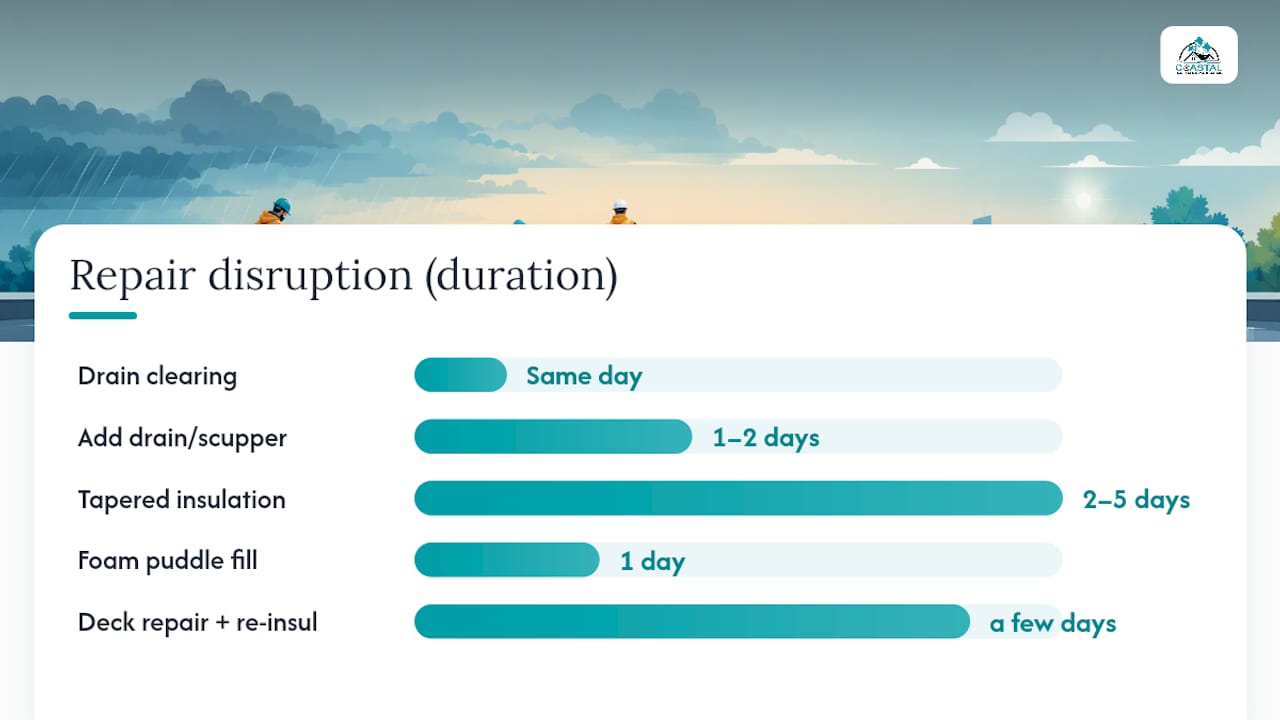
| Repair type | Best for | Permanence | Relative cost | Disruption |
|---|---|---|---|---|
| Drain/scupper clearing | Clogged drainage as sole cause | Temporary without maintenance | Low | Same day |
| Add drain or scupper | Undersized drainage layout | Permanent | Moderate | 1–2 days |
| Tapered insulation / cricket | Isolated low spot, slope deficiency | Permanent | Moderate to high | 2–5 days |
| Localized foam fill / puddle filler | Very small, shallow low spot | Short-term (about 3 years) | Low to moderate | 1 day |
| Deck repair + re-insulation | Waterlogged insulation, deck damage | Permanent | High | a few days |
| Full tear-off and re-roof | Systemic slope failure, saturated assembly | Permanent | Highest | 5–10 days |
Tapered insulation systems and crickets are the industry-standard solution for slope deficiency. Pre-cut tapered boards are installed over the existing deck to create positive drainage toward drains or scuppers, often during a re-roof. They work as both slope correction and new insulation, which makes them cost-effective when a membrane replacement is already planned.
Adding drains or scuppers solves the problem when the drainage layout was simply undersized for the roof area. On commercial roofs, siphonic drainage systems can dramatically increase discharge rates compared with gravity-only drains, which is worth discussing with a contractor on larger buildings.
Where ponding cannot be fully engineered out, silicone-based coatings tolerate continuous water exposure better than acrylic coatings. That said, coatings only perform on dry, sound assemblies. Applying any coating over saturated insulation traps moisture and accelerates failure.
- For flat roof replacement options specific to Florida homes, TPO and modified bitumen systems are the most common choices in the Tampa Bay market.
- TPO membranes with heat-welded seams hold up well in Florida’s UV environment and tolerate occasional standing water better than older EPDM systems.
- Modified bitumen offers excellent puncture resistance and is a solid choice for roofs with heavy foot traffic from HVAC maintenance.
Pro Tip: Ask any contractor quoting a tapered insulation job to show you the slope layout drawing before work starts. A well-designed tapered system directs water to specific drain locations; a poorly designed one just shifts the low spot.
Safe temporary measures you can do right now
Clearing drains is the single highest-value action a homeowner can take. Routine maintenance, especially keeping drains and scuppers clear, prevents many ponding cases before they become repair jobs. Use a long-handled grab tool or gloved hand to pull debris from the drain bowl and strainer. Never lean over a parapet on a wet roof without secure footing.
If a large shallow pool has formed and the roof surface is sound and accessible, a submersible pump or wet-dry vacuum can remove the water safely. Get the water off before it adds more load or finds a seam. Dry the area afterward and inspect the membrane surface for cracks, blisters, or open seams.
Temporary patching with peel-and-stick membrane tape or roofing sealant can slow an active leak at a seam or around a penetration, but only on a dry surface. These are short-term measures, not repairs.
What not to do:
- Do not walk on any area that feels soft or bouncy. A deflected deck can fail under foot traffic.
- Do not apply a coating or sealant over wet or saturated insulation. You’ll trap moisture and accelerate rot.
- Do not cut into the membrane to “let water out” without a professional on-site.
- Do not install a permanent coating over an active leak. It will fail within months.
Pro Tip: After clearing a drain, run a garden hose into it for 60 seconds. If water backs up or drains slowly, the blockage is further down the line and needs a professional to snake or camera the drain pipe.
Typical costs and timelines for common repairs
Cost ranges below reflect general U.S. market conditions. Florida labor and material costs, access difficulty, roof height, and whether insulation replacement is needed all push numbers up or down.
- Get at least two written estimates for any repair over $1,000. Scope descriptions should match line by line.
- Ask whether insulation replacement is included. Wet insulation left in place under new membrane is the most common cause of premature re-roof failure.
- Check seasonality. In Tampa Bay, hurricane season runs June through November. Scheduling repairs before June avoids both storm-season delays and the premium pricing that follows a major storm event.
- Emergency response costs more. If you call after a storm with active interior leaking, expect a 20–40% premium over standard scheduling.
What Coastal Roofing & Construction checks on every flat-roof inspection
Our crews start at the drains, every time. A blocked or slow drain explains the majority of ponding calls we receive, and confirming it takes two minutes. From there, we work outward: seam condition, membrane surface for blistering or cracking, flashing at all penetrations and walls, and the feel of the deck underfoot across the pooled area.
Field tests we perform on-site include a probe test on the insulation (a dry insulation board is firm; a saturated one compresses and stays compressed), a visual check of the membrane at the waterline for UV crazing and seam separation, and a water-flow test on each drain to confirm it’s draining at full capacity.
Our manufacturer certifications with GAF and Owens Corning mean we can install warranted systems that carry both workmanship and material coverage. That matters most when you’re choosing between a localized repair and a full re-roof: a warranted system gives you documented protection, not just a contractor’s word.
For a broader look at what a professional inspection uncovers, our guide on roofing problems professionals identify covers the most common findings across all roof types.
What our roofers see homeowners get wrong
The most expensive mistake is waiting. A small recurring pool near a seam that gets ignored for two rainy seasons almost always becomes a saturated insulation replacement job. The second most expensive is storing heavy equipment or materials on a flat roof. Every extra pound accelerates the deck deflection that creates low spots.
The habits that save the most money are also the simplest:
- Clear drains and scuppers twice a year, minimum, and after every major storm.
- Walk the roof perimeter after heavy rain and photograph any standing water.
- Keep the roof surface clear of debris, branches, and stored items.
- Schedule a professional inspection every two years even when nothing looks wrong.
If you’re unsure whether what you’re seeing is normal drainage lag or a genuine ponding condition, the safest call is to have someone on-site who can measure, probe, and document it properly.
Coastal Roofing & Construction can assess and fix your flat roof
Flat-roof ponding in Tampa Bay gets worse fast. Florida’s intense rain events drop large volumes of water in short windows, and a drainage system that was marginal in dry season can fail completely by July.

Coastal Roofing & Construction’s flat-roof inspection covers photo documentation of all pooled areas, depth and area measurements, drain-flow testing, insulation probe checks, and a written summary of findings with repair options ranked by urgency and cost. We serve homeowners and commercial property owners across Pinellas, Hillsborough, and Pasco counties, and we price small targeted repairs separately from full re-roof projects so you’re not pushed toward a replacement when a repair is the right answer.
If the inspection finds that a full replacement is the better long-term value, our residential roof replacement services and commercial flat-roof installation teams handle both. Schedule your inspection today by contacting us directly through the website.
Sources
- Ponding water basics | Asphalt Roofing Manufacturers Association
- Ponding Water on Flat Roofs | Flat Roof Report
- Understanding Ponding Water: Common Causes and Solutions for Flat Roofs | Polyglass
- Mitigating water on roofs | GAF building science
- Some commonsense rules for maintaining a flat roof | This Old House