
A manufacturer warranty covers defects in the roofing product itself; a workmanship warranty covers errors made during installation. When something goes wrong with your roof, your first move is to photograph the damage, pull out your installation records, and confirm whether the product was registered with the manufacturer. Those three steps determine who you call and who pays.
If shingles are cracking or blistering without any storm event, that points to a product defect and the manufacturer’s technical team gets involved. If water is coming in around the flashing or at a valley, that is almost always an installation error and your contractor is the first responder. In many cases, both parties end up at the table, which is why documentation from day one matters so much.
Table of Contents
- What manufacturer and workmanship warranties actually cover
- Who backs each warranty, and what happens if they disappear
- How long warranties last, whether they transfer, and why registration deadlines matter
- Common exclusions that catch homeowners off guard
- How to file a warranty claim, step by step
- When both warranties could apply: how responsibility gets sorted out
- What to ask a contractor before you sign anything
- Why manufacturer-certified installers protect your coverage
- Key Takeaways
- The warranty conversation most homeowners have too late
- Coastal Roofing & Construction: Warranty-safe roofing for Tampa Bay homeowners
- Useful sources and official warranty resources
What manufacturer and workmanship warranties actually cover
The distinction sounds simple, but the coverage boundaries get blurry fast once a real leak appears.
Manufacturer warranties (sometimes called product warranties) protect you against defects that originated in the factory. Manufacturer warranties cover defects in the product materials such as shingles cracking, blistering, or delaminating due to a production error, underlayment seams failing because of a bonding flaw, or metal panels developing premature corrosion from a coating defect. The remedy is typically replacement of the defective material, sometimes with a prorated credit after a certain number of years. The manufacturer arranges the fix, usually through a certified installer in your area.
Workmanship warranties (also called contractor warranties or installation guarantees) cover what your roofer did, not what the factory made. Workmanship warranties cover installation-related issues such as:
- Leaks caused by improperly installed or missing flashing around chimneys, skylights, or walls
- Water intrusion from incorrect nailing patterns that allow shingles to lift
- Sealing failures at pipe boots, ridge caps, or eave edges
- Improper underlayment overlap that lets wind-driven rain penetrate
The contractor is responsible for returning to repair the installation error at no charge during the warranty period. Some contractors also carry a surety bond that can fund repairs if they are unavailable.
Who backs each warranty, and what happens if they disappear
A manufacturer warranty is backed by the company that made the product. Owens Corning, GAF, and Tri County Metals are established manufacturers with long track records, and their warranties travel with the product regardless of which contractor installed it. Registration ties the coverage to your address and your name, not to the installer’s business.
A workmanship warranty is only as strong as the contractor behind it. A workmanship warranty is ultimately a contractor’s promise, and its value depends heavily on the contractor’s reputation and business stability. If your roofer closes up shop two years after your installation, that written workmanship warranty may be unenforceable. If a contractor goes out of business, the contractor-backed workmanship warranty may become unenforceable while manufacturer warranties typically remain tied to the product.
What protects you when a contractor disappears? Several options exist. First, check whether the contractor enrolled your project in a manufacturer’s certified installer program, such as Owens Corning’s Platinum Preferred or GAF’s Master Elite program. These programs often include a workmanship component backed by the manufacturer, not just the contractor. Second, many U.S. states recognize an implied warranty of workmanship. An implied warranty of workmanship exists in many U.S. states and can offer legal protection even if a contractor’s written warranty is vague or absent. That implied standard requires work to meet professional norms and can be enforced in court even without a written document.
Checking a contractor’s license, insurance, and business history before signing is the simplest risk-reduction step available to you.
How long warranties last, whether they transfer, and why registration deadlines matter
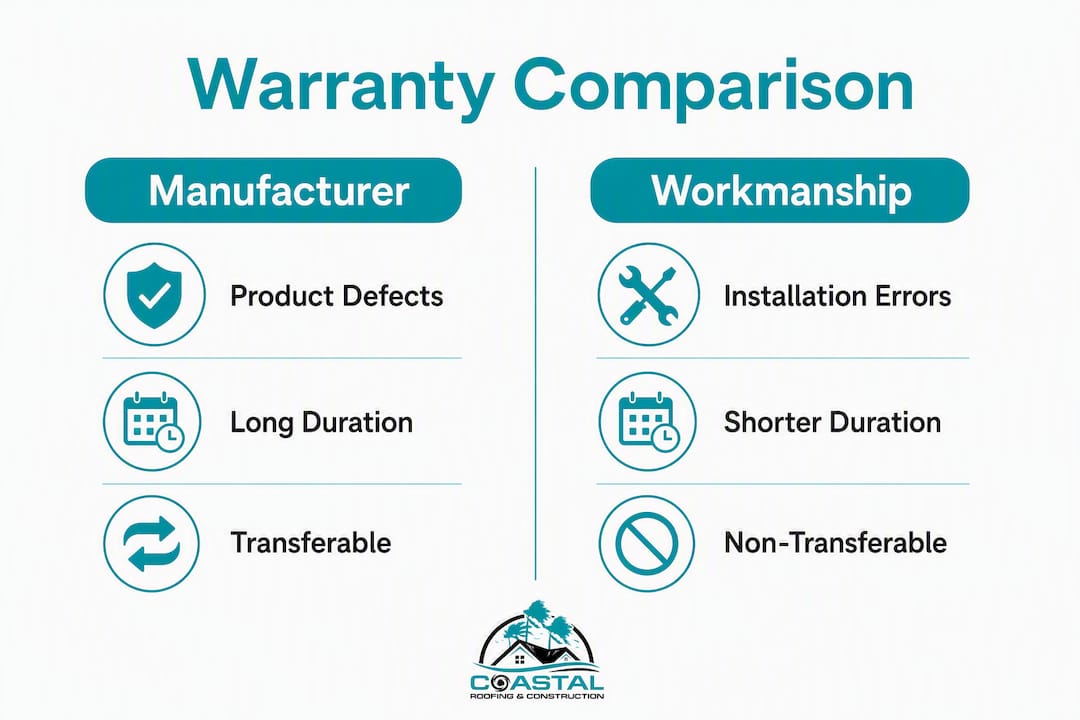
Typical residential roofing workmanship warranties most often last a few years, while manufacturer material warranties for asphalt shingles vary widely depending on product class. Metal roofing systems often carry manufacturer warranties with longer durations. The gap between workmanship and manufacturer warranty durations can be significant: your contractor’s obligation may expire well before the product warranty does.

| Warranty Type | Approximate Duration | Transferable? | Registration Required? |
|---|---|---|---|
| Workmanship (contractor) | Several years | Rarely | Typically no |
| Manufacturer standard | Varies by product | Often yes, with notice | Commonly yes |
| Manufacturer extended (certified installer) | Longer durations available | Yes, often with fee or notice | Often mandatory |
Transferability matters if you sell your home. Most manufacturer warranties allow transfer to a new owner, but the process usually requires written notice to the manufacturer within a set window (commonly 30–60 days after closing) and sometimes a transfer fee. Missing that window can void the coverage for the new owner entirely. Workmanship warranties rarely transfer because they are tied to the original contractor-client relationship.
Registration is the step homeowners most often skip. Without it, many manufacturers default to a shorter, non-registered coverage period. Owens Corning and GAF both require registration to unlock their longest coverage tiers. Your contractor should handle registration at project completion, but confirm it in writing. Ask for the registration confirmation number before you make your final payment.
Common exclusions that catch homeowners off guard
Both warranty types carry exclusions that can leave you holding the repair bill if you are not careful.
Manufacturer exclusions to know:
- Damage caused by a contractor who did not follow the manufacturer’s installation specifications. Manufacturers often void material warranties if their strict installation specifications are not followed. This is the most common denial reason.
- Normal UV degradation and color fade over time
- Storm damage, hail, and wind events above a specified threshold (these typically fall under homeowner’s insurance, not the product warranty)
- Unauthorized modifications, added penetrations, or repairs made by an uncertified contractor after the original installation
- Failure to maintain the roof per the manufacturer’s care guidelines
Workmanship exclusions to know:
- Storm damage, fallen debris, or any event outside the contractor’s control
- Normal wear and tear after the warranty period
- Damage caused by the homeowner walking on the roof, adding equipment, or making alterations
- Failure to maintain gutters, trim overhanging branches, or address known issues promptly
Here is where it gets complicated: a single leak can be excluded under both warranties simultaneously. Say a shingle lifts in a windstorm and water gets in. The manufacturer may say the wind event caused it (excluded). The contractor may say the shingle was defective (manufacturer’s problem). If you also skipped a maintenance inspection the previous year, both parties have grounds to reduce or deny the claim. Keeping annual inspection records is your defense against that scenario.
How to file a warranty claim, step by step
Acting quickly and methodically is what separates a paid claim from a denied one.
- Document immediately. Take date-stamped photos of the damage from multiple angles. Note the weather conditions in the days before you noticed the problem. Write down when you first observed the issue.
- Pull your records. Locate your installation contract, the written warranty documents for both the product and the workmanship, and any registration confirmation. If you do not have these, request them from your contractor.
- Contact your contractor first. Most warranty processes require you to notify the contractor before the manufacturer. Send a written notice (email is fine) describing the problem and requesting an inspection. Keep a copy.
- Contact the manufacturer if the problem appears product-related. Use the manufacturer’s warranty claim line or online portal. Have your registration number, installation date, and product model ready. Owens Corning, GAF, and Tri County Metals each have dedicated warranty support channels.
- Allow the inspection. When a defect occurs, identifying the root cause early with documented evidence, including photos, installation records, and the manufacturer’s installation guidelines, is critical to assigning responsibility. Do not attempt repairs before the inspection, as unauthorized repairs can void both warranties.
- Request a written finding. After any inspection, ask for the inspector’s written conclusion about root cause. This document is your leverage if a dispute arises.
- Escalate if needed. If the contractor and manufacturer disagree on responsibility, request a joint inspection. If the claim is still denied, your state’s implied warranty protections and small claims court are available options.
Pro Tip: Keep a dedicated folder, physical or digital, for every roofing document: the signed contract, installation photos, product data sheets, registration confirmation, and any inspection reports. Homeowners who can produce this file resolve warranty disputes significantly faster than those who cannot.
When both warranties could apply: how responsibility gets sorted out
Mixed-cause failures, where both a product defect and an installation error contributed to the damage, require a joint inspection by both the manufacturer’s representative and the contractor and are the most time-consuming disputes. A shingle that was slightly under-nailed (workmanship) and also had a factory adhesive strip that did not fully bond (product) is a classic example. Both parties contributed to the failure, and neither wants to own the full repair cost.
The typical sequence works like this: the contractor inspects first and forms an opinion on root cause. If they believe the product is defective, they notify the manufacturer. The manufacturer sends a technical representative. If the findings conflict, a joint inspection is scheduled. From there, liability is apportioned based on documented evidence.
| Scenario | Likely Responsible Party | Your Next Action |
|---|---|---|
| Shingles cracking with no storm event | Manufacturer | File manufacturer claim with registration number |
| Leak at chimney flashing | Contractor | Contact contractor in writing, request inspection |
| Shingle blow-off in high wind | Homeowner’s insurance (possibly both) | File insurance claim; check wind-speed threshold in warranty |
| Leak with no clear cause | Both (joint inspection needed) | Contact contractor first, then manufacturer |
| Premature granule loss | Manufacturer | Request manufacturer technical inspection |
| Water at pipe boot | Contractor | Contact contractor; document with photos |
Documented installation photos and following the manufacturer’s installation guide are decisive evidence that helps assign liability quickly during warranty disputes. Without that paper trail, both parties have plausible deniability and disputes drag on.
What to ask a contractor before you sign anything
The warranty conversation should happen before you hire, not after something goes wrong. Here is what to ask and what to watch for.
Questions to ask every contractor:
- How long is your workmanship warranty, and what does it cover in writing?
- Will you provide a sample warranty document before I sign the contract?
- Are you a manufacturer-certified installer for the products you are proposing? (Ask specifically about Owens Corning, GAF, or Tri County Metals certifications.)
- Who handles product registration, and will you provide written confirmation?
- Is your workmanship warranty transferable if I sell the home?
- What is your claims process if I have a problem after installation?
Red flags that should give you pause:
- A verbal warranty with nothing in writing
- Vague exclusion language like “normal conditions” with no definition
- Refusal to provide a sample warranty document before signing
- No manufacturer certification for the products being installed
- Pressure to skip registration or handle it “later”
- No proof of license and insurance
Trust signals that actually matter:
- Manufacturer-certified installer status from Owens Corning, GAF, or Tri County Metals. Certified installers follow strict installation specs, which keeps the manufacturer warranty intact and often unlocks extended coverage tiers.
- Written warranty terms with clearly defined exclusions, durations, and transfer procedures
- Proof of registration provided at project completion
- Installation photos delivered to the homeowner as part of the project close-out
You can review how to evaluate roofing contractor bids for a broader checklist that covers pricing, scope, and documentation alongside warranty terms.
Why manufacturer-certified installers protect your coverage
Certification is not a marketing badge. It is the mechanism that keeps your manufacturer warranty valid.
Manufacturers will often deny a materials claim if a contractor did not follow the exact installation specifications; hiring a factory-trained, manufacturer-certified installer substantially reduces this risk. Certified installers are trained on the specific fastening patterns, overlap dimensions, flashing details, and ventilation requirements each product demands. When those specs are followed precisely, the manufacturer has no grounds to deny a legitimate materials claim.
The practical homeowner benefit: Certified installer programs from Owens Corning, GAF, and Tri County Metals often unlock extended warranty tiers that are not available through non-certified contractors. Extended manufacturer warranties offered through certified contractor programs can increase material coverage and sometimes add stronger workmanship assurance. A standard Owens Corning shingle warranty might run 25 years; a Platinum Preferred contractor can register the same product for a 50-year SureNail warranty with a workmanship component backed by Owens Corning, not just the installer. That is a meaningful difference in long-term protection.
Coastal Roofing & Construction holds manufacturer certifications with Owens Corning, GAF, and Tri County Metals. Each certification requires ongoing training and adherence to installation standards, which means the installation documentation Coastal produces is the kind that holds up during a manufacturer inspection. For homeowners, that translates to faster claim resolution and a lower risk of coverage denial. You can read more about what roofing certifications mean for warranty protection and how they affect your coverage options.
Key Takeaways
Understanding the manufacturer warranty vs workmanship warranty distinction is the single most important step toward protecting your roofing investment: manufacturer warranties cover product defects, workmanship warranties cover installation errors, and a certified installer is the link that keeps both valid.
| Point | Details |
|---|---|
| Two separate warranties, two separate parties | Manufacturer covers product defects; your contractor covers installation errors. |
| Registration unlocks full coverage | Missing the registration deadline can reduce a 50-year warranty to a shorter non-registered term. |
| Certified installers protect both warranties | Factory-trained installers follow specs that prevent manufacturer denial and often unlock extended coverage tiers. |
| Document everything from day one | Photos, installation records, and registration confirmation are decisive evidence in any warranty dispute. |
| Coastal Roofing & Construction | Holds Owens Corning, GAF, and Tri County Metals certifications and handles product registration as part of every project. |
The warranty conversation most homeowners have too late
Most homeowners do not think about roofing warranties until something leaks. By then, they are scrambling to find paperwork they never organized, calling a contractor who may or may not still be in business, and learning for the first time that the manufacturer’s warranty was never registered.
The honest reality is that a 50-year manufacturer warranty is only as good as the installation behind it. A product can be flawless and still fail if the flashing is wrong, the nailing pattern is off, or the ventilation does not meet spec. And a contractor’s workmanship warranty is only as good as the contractor’s continued existence. Neither warranty stands alone.
What actually protects homeowners is the combination: a manufacturer-certified installer who follows specs precisely, registers the product immediately, and provides installation documentation at close-out. That combination keeps the manufacturer warranty intact, gives the workmanship warranty real teeth, and creates the paper trail that resolves disputes quickly.
The contractors who resist showing you sample warranty documents before you sign, or who cannot name their manufacturer certifications, are telling you something. A contractor confident in their work has no reason to hide the terms.
Coastal Roofing & Construction: Warranty-safe roofing for Tampa Bay homeowners
Knowing your warranties only helps if the installation behind them is done right. Coastal Roofing & Construction is a manufacturer-certified, factory-trained roofing contractor serving homeowners across Pinellas County, Hillsborough County, and Pasco County. The team holds active certifications with Owens Corning, GAF, and Tri County Metals, which means every eligible installation qualifies for extended warranty programs that non-certified contractors simply cannot offer.

Every project includes product registration handled by Coastal’s team, installation documentation delivered to the homeowner, and clear written workmanship warranty terms before any contract is signed. If a warranty issue comes up later, Coastal assists with the inspection and documentation process rather than leaving homeowners to navigate it alone. For homeowners who want to see the quality of work before committing, the completed project portfolio shows recent roof replacements across the Tampa Bay area. When you are ready to move forward, request a roof replacement estimate and ask specifically about the warranty programs available for your chosen roofing system.
Useful sources and official warranty resources
These sources are worth bookmarking before you file a claim or review a warranty document.
- Federal Trade Commission: Businessperson’s Guide to Federal Warranty Law covers what written warranties must include under the Magnuson-Moss Warranty Act, including the prohibition on eliminating implied warranties.
- FTC Consumer Advice: Warranties explains your rights as a buyer and what manufacturers must disclose before sale, including the requirement that warranty terms be available before purchase.
- LegalClarity: Workmanship Warranty Coverage Periods and Limits provides a practical breakdown of what workmanship warranties typically include and exclude, useful when reviewing a contractor’s written terms.
- LegalClarity: Implied Warranty of Workmanship explains the legal protections available in many U.S. states even when a written warranty is vague or absent.
- National Trades Authority: Trades Warranty and Workmanship Guarantees covers the claims process, documentation requirements, and how mixed-cause failures are handled.
- Investopedia: Warranty Definition and Types offers a clear overview of warranty types, including extended programs offered through certified installer channels.
- Coastal Roofing & Construction: Roofing Warranty Types Contractors Offer explains the specific warranty structures Tampa Bay homeowners will encounter when hiring a local roofing contractor.