
Standing seam metal roofing is the top choice for coastal climates, followed closely by clay and concrete tile, and premium synthetic composites. These materials share three properties that coastal homes demand above all else: resistance to salt corrosion, the ability to hold up against hurricane-force winds, and long-term durability under relentless UV exposure. If you’re replacing a roof on a waterfront or near-shore home, the material decision you make now will determine whether you’re replacing it again in 12 years or 50.
The leading options for coastal homes at a glance:
- Standing seam metal (aluminum or Galvalume): Wind resistance up to 180 mph, concealed fasteners, and a lifespan that can exceed 50 years with proper installation
- Clay and concrete tile: Excellent UV and moisture resistance, strong aesthetic appeal, but requires reinforced structural support due to weight
- Stone coated metal tile: Marine-grade Galvalume core with a stone granule barrier rated for 40–70 years in coastal environments
- Synthetic and composite roofing: Mimics natural materials, resists salt absorption, and requires minimal upkeep
- Asphalt shingles (impact-rated): Viable for lower-exposure zones but not recommended within close proximity to the shoreline
Table of Contents
- What makes coastal roofing so much harder than standard roofing?
- Why traditional roofing materials often fail near the water
- Comprehensive guide to roofing materials for coastal climates
- How to choose the right roofing material for your coastal home
- Why installation quality matters as much as material choice
- Coastal Roofing & Construction serves Tampa Bay homeowners who need this done right
- Key Takeaways
What makes coastal roofing so much harder than standard roofing?
Coastal environments attack roofs through multiple mechanisms simultaneously, and no single weather event is the whole story. The combination of stressors is what separates a coastal roof from an inland one.
- Salt air corrosion: Airborne salt particles settle on roofing surfaces and fasteners, accelerating oxidation. Salt air corrosion is measurably elevated up to 10 miles from the coastline, with marine-grade specifications strongly recommended within 3 miles.
- Hurricane-force winds: Coastal homes in Florida and along the Gulf Coast must contend with sustained winds exceeding 140 mph during major storms. Wind uplift is the leading cause of catastrophic roof failure.
- Moisture and driving rain: Frequent heavy rain, combined with high ambient humidity, creates persistent moisture exposure that accelerates rot, mold, and material degradation.
- UV radiation: Florida’s high UV index year-round bleaches pigments, degrades asphalt oils, and breaks down polymer coatings faster than in northern climates.
- Thermal cycling: Daily temperature swings cause roofing materials to expand and contract, stressing seams, fasteners, and adhesives over time.
Understanding these stressors together is what drives every material recommendation below. A roof that handles wind but fails at corrosion is still a liability.
Why traditional roofing materials often fail near the water
Most standard roofing products were not engineered with marine environments in mind. The results show up within a few years of installation.
- Asphalt shingles: Granule loss and accelerated oxidation reduce their lifespan to 12–20 years in coastal zones, compared to 25–30 years inland. Wind uplift is a constant threat, especially at roof edges and ridges.
- Wood shakes and shingles: Salt absorption causes fibers to swell and shrink repeatedly, leading to splitting, mold growth, and rot. In direct marine zones, wood shakes can fail in as few as 5–12 years.
- Standard galvanized steel: Zinc depletion from salt exposure causes base steel to rust through rapidly. Without a marine-grade coating, bare galvanized steel is inadequate within several miles of the coast.
- Non-marine-grade fasteners: Zinc-plated screws and standard galvanized nails corrode within 5–10 years in marine environments, compromising the entire roofing system even when the panels themselves are intact.
The failure pattern is consistent: materials specified for average conditions degrade quickly when exposed to the chemistry of coastal air. Choosing the right product from the start avoids that cycle.
Comprehensive guide to roofing materials for coastal climates
1. Standing seam metal roofing
Standing seam is the gold standard for coastal homes, and the physics explain why. The concealed-fastener design eliminates exposed screw penetrations, which are the single biggest corrosion vulnerability on any metal roof. Every exposed screw hole is a point where salt air can reach the steel core beneath the coating. Standing seam removes that vulnerability entirely.
Aluminum panels within 1,500 feet of saltwater outperform all other metal substrates because aluminum naturally forms a self-healing oxide layer. When scratched or cut, the oxide layer re-passivates within hours. No steel coating can replicate that behavior in concentrated salt environments. Farther from the shore, Galvalume steel with a PVDF paint system performs well and costs less than aluminum.
- Wind resistance: Very high wind resistance suitable for coastal hurricane conditions
- Lifespan: 30–50 years (aluminum); longer with PVDF coatings
- Energy efficiency: Reflective surface reduces cooling costs 25–40%
- Maintenance: Low; no granules to lose, no cracking or curling
- Best for: Waterfront homes, luxury coastal residences, new construction
Pro Tip: For homes within 1,500 feet of the water, specify aluminum panels rather than Galvalume. The self-healing oxide layer is a genuine performance advantage that no coating can fully replicate at that proximity.
2. Stone coated metal tile roofing
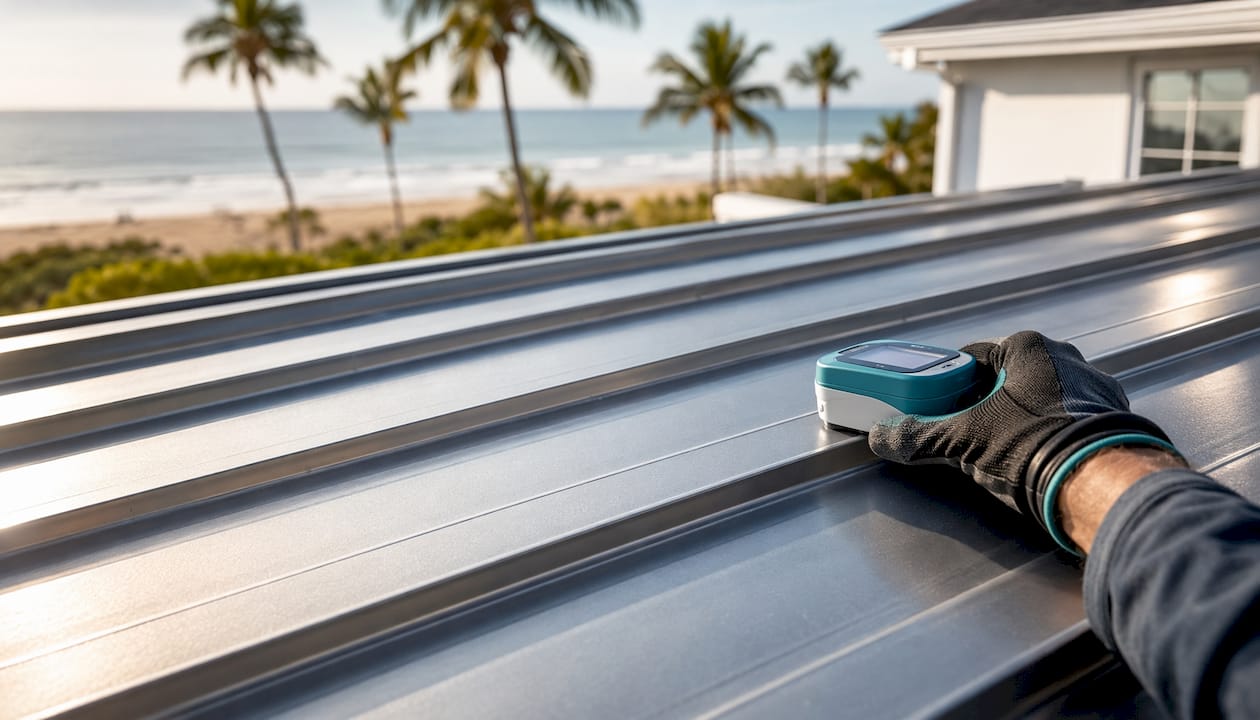
Stone coated metal combines a Galvalume steel core with a layer of natural basalt or ceramic granules sealed under a UV-stable acrylic topcoat. The stone layer physically isolates the steel from salt air contact, while the Galvalume core handles structural loads. When specified correctly with AZ150 Galvalume coating minimum (AZ180 for homes within half a mile of the shore), this system can last 40–70 years in coastal environments.
The aesthetic advantage over standing seam is real. Stone coated tiles mimic clay tile, wood shake, or slate profiles, which matters for homeowners in neighborhoods with architectural guidelines. The tradeoff is that the stone granule layer requires inspection after major storms to confirm adhesion integrity.
- Wind resistance: Rated for Category 4–5 hurricane wind loads when properly installed
- Lifespan: 40–70 years with AZ150+ coating and Type 316 stainless fasteners
- Corrosion resistance: Excellent when AZ150 minimum is specified
- Maintenance: Low; periodic inspection of granule adhesion recommended
3. Clay tile roofing
Clay tile has been the dominant roofing material in Florida for over a century, and the reason is straightforward: fired clay does not rot, rust, or absorb salt the way organic materials do. UV resistance is exceptional, and the thermal mass of clay tile helps moderate attic temperatures.
The limitation is weight. Clay tiles absorb moisture over time, becoming heavier and more prone to cracking under freeze-thaw cycles or impact. In Florida’s climate, freeze-thaw is rarely a concern, but the structural load requirement is real. Homes must have adequate framing to support clay tile, which adds cost to new construction and can complicate retrofits on older structures.
- Wind resistance: Good when properly fastened; individual tiles can dislodge in extreme winds
- Lifespan: 50+ years in Florida’s climate
- Corrosion resistance: Excellent; clay is inert to salt air
- Maintenance: Moderate; cracked tiles need prompt replacement to prevent water intrusion
4. Concrete tile roofing
Concrete tile offers most of clay tile’s benefits at a lower price point. It handles UV exposure well, resists salt air, and carries a long lifespan in Florida conditions. The weight profile is similar to clay, so the same structural support requirements apply.
Color retention is the main difference between clay and concrete. Concrete tile is pigmented through the mix and at the surface, and surface pigment can fade over time in high-UV environments. Sealed concrete tiles hold color longer. For homeowners prioritizing long-term appearance with lower upfront cost than clay, concrete tile is a practical choice.
- Lifespan: 40–50 years in coastal Florida
- Corrosion resistance: Excellent
- Weight: Heavy; requires structural assessment before installation
- Cost: Lower than clay tile; higher than asphalt shingles
5. Synthetic and composite roofing
Synthetic roofing products, typically made from polymer blends, recycled rubber, or fiber-reinforced composites, have improved considerably. The best products mimic the look of slate, wood shake, or clay tile while avoiding those materials’ coastal vulnerabilities. Salt absorption in micro-pores is minimal compared to natural materials, and most quality synthetics carry impact ratings that matter in hail-prone coastal areas.
Lifespan varies by product and manufacturer, generally ranging from 20–35 years in coastal environments. The key is verifying that the product carries a salt spray test certification and a meaningful wind rating. Not all synthetic products are equal, and the category spans a wide quality range.
- Wind resistance: Varies by product; look for products rated to 110 mph or higher
- Corrosion resistance: Good; no metal components to corrode
- Maintenance: Very low
- Best for: Homeowners who want a traditional aesthetic without the maintenance of natural materials
6. Impact-rated architectural shingles
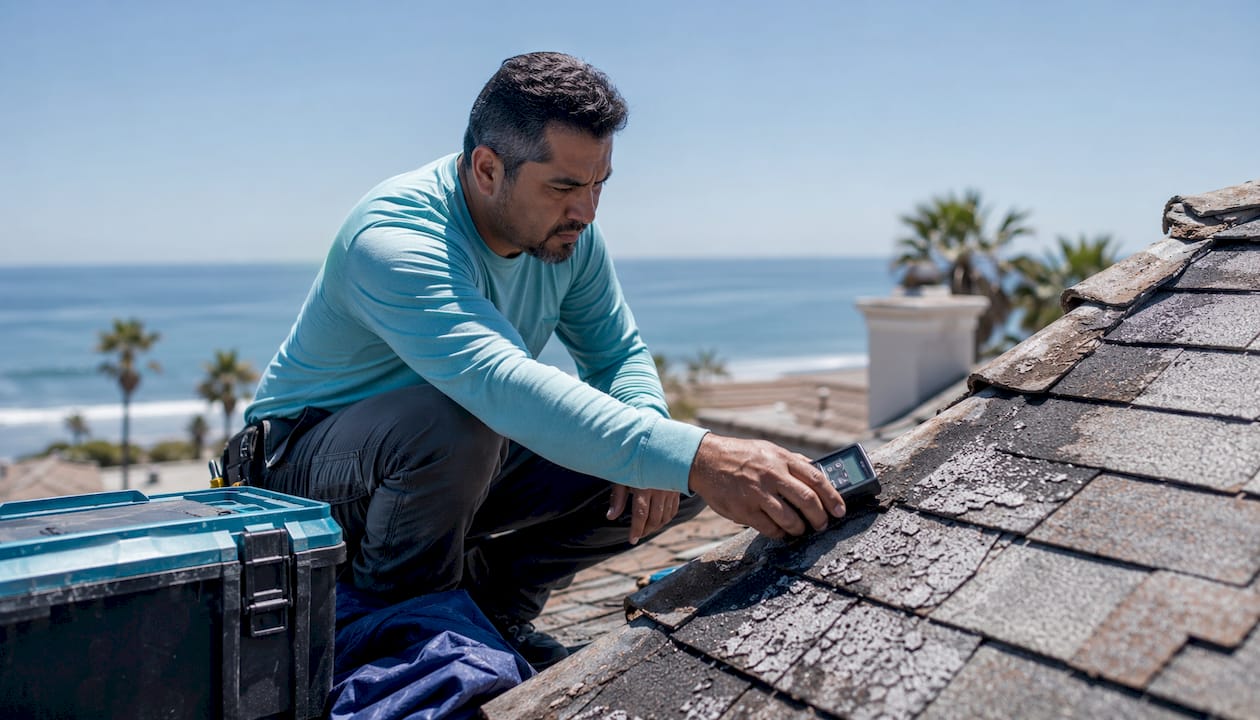
Architectural shingles rated Class 4 for impact resistance are the entry point for coastal roofing. They are not the best option for homes close to the water, but they are a reasonable choice for properties in lower-exposure zones, farther from the shoreline, where salt air concentration is reduced. Owens Corning and GAF both produce architectural shingles with enhanced wind ratings and algae-resistant granules suited to humid coastal climates.
The honest limitation: asphalt shingles in coastal zones have a lifespan of 12–20 years, roughly half what the same product delivers inland. Budget accordingly, and factor in the replacement cycle when comparing upfront costs to metal or tile alternatives.
| Material | Wind resistance | Corrosion resistance | Lifespan (coastal) | Maintenance | Aesthetic suitability |
|---|---|---|---|---|---|
| Standing seam metal | Up to 180 mph | Excellent (aluminum) | 30–50 years | Low | Modern, contemporary |
| Stone coated metal tile | Cat. 4–5 rated | Excellent (AZ150+) | 40–70 years | Low | Tile, shake, slate profiles |
| Clay tile | Good | Excellent | 50+ years | Moderate | Mediterranean, Spanish |
| Concrete tile | Good | Excellent | 40–50 years | Moderate | Versatile |
| Synthetic composite | 110+ mph (varies) | Good | 20–35 years | Very low | Slate, shake, tile |
| Architectural shingles | 110–130 mph | Fair | 12–20 years | Moderate | Traditional |
How to choose the right roofing material for your coastal home
The right material depends on where your home sits relative to the water, not just that it’s “near the coast.” Coastal exposure is not uniform, and material specification must be matched to your property’s ASCE 7-22 Exposure Category and salt gradient rather than a generic coastal standard.
- Distance from the shoreline: Within 1,500 feet, aluminum standing seam or AZ180+ stone coated metal is the appropriate specification. Between 1,500 feet and 1 mile, Galvalume with PVDF coating performs well. Beyond 3 miles, standard coastal specs apply.
- Wind load requirements: Florida’s building code requires roofing systems to meet specific wind uplift ratings based on location. Verify that your chosen product carries a tested wind rating, not just a marketing claim.
- Corrosion resistance: Prioritize products with documented salt spray test certifications. For stone coated metal, AZ150 is the minimum; AZ180 for high-exposure zones.
- Energy efficiency: Reflective roofing materials reduce cooling loads, which matters in Florida where air conditioning runs most of the year. Light-colored metal and tile roofs perform best on this metric. For more on this, reflective roofing options are worth reviewing before you finalize a color.
- Budget and lifespan: A standing seam metal roof costs more upfront than architectural shingles but avoids two or three replacement cycles over the same period. Total cost of ownership over 40 years often favors metal significantly.
- Maintenance capacity: If you want a roof you can largely ignore between inspections, metal or synthetic composite is the right direction. Clay tile requires prompt attention when individual tiles crack or dislodge.
Pro Tip: Ask your contractor for the product’s ASTM B117 salt spray test result before committing. A minimum of 1,000 hours is the baseline for coastal use; 2,000 hours is preferred for homes within a mile of the water.
Why installation quality matters as much as material choice
The best roofing material on the market will fail prematurely if it’s installed without coastal-specific expertise. Quality installation with marine-grade sealants and proper flashing doubles roof lifespan versus poor installation in coastal areas. That is not a small margin.
- Fasteners: Type 316 stainless steel fasteners are the standard for coastal metal roofs. Standard zinc-plated screws corrode within 5–10 years, compromising the entire system from the fastener outward.
- Flashing: Properly installed and sealed flashing at penetrations, valleys, and edges is where most coastal roof leaks originate. Marine-grade flashing at minimum 0.70mm thickness is the correct specification.
- Sealants: Polyurethane or silicone sealants with documented UV and salt spray resistance ratings outlast standard construction sealants by years in coastal conditions.
- Ventilation: Balanced ridge and soffit ventilation prevents condensation buildup in the attic, which is a primary driver of wood rot and mold in humid coastal climates. This is a detail that gets skipped on budget installations and shows up as structural damage years later.
- Contractor credentials: Manufacturer certifications from Owens Corning, GAF, or Tri County Metals indicate factory training and accountability. A certified contractor can offer manufacturer-backed warranties that uncertified installers cannot.
The FORTIFIED Home standard provides a useful benchmark: roofs built to FORTIFIED specifications include enhanced attachment, sealed roof decks, and impact-resistant materials tested under hurricane conditions, resulting in fewer insurance claims and better storm outcomes. It’s a credible third-party signal that a contractor knows what coastal installation actually requires.
Choosing the right material and then cutting corners on installation is the most expensive mistake a coastal homeowner can make. For hurricane-resistant roofing in Florida, the installation details are where the real protection lives.
Coastal Roofing & Construction serves Tampa Bay homeowners who need this done right
Waterfront and near-shore homeowners in Tampa Bay face a specific combination of Gulf salt air, high UV exposure, and hurricane-season wind loads that demands more than a standard roofing contractor. Coastal Roofing & Construction is a licensed, insured, family-owned contractor built specifically for this environment, with manufacturer certifications from Owens Corning, GAF, and Tri County Metals that allow the team to install and warranty the industry’s highest-performing roofing systems.
Standing seam metal, architectural shingles, clay and concrete tile, and flat roofing systems are all in the portfolio, covering every material discussed in this guide. The team serves Pinellas County, Hillsborough County, Pasco County, and surrounding Gulf Coast communities including Clearwater, St. Petersburg, Madeira Beach, Treasure Island, Indian Rocks Beach, and Tampa. Whether you’re replacing an aging roof on a waterfront property or specifying materials for a new custom build, Coastal Roofing & Construction brings the coastal-specific expertise that makes the difference between a roof that lasts and one that doesn’t. View the recent roofing projects to see the work firsthand, or get started with a metal roofing consultation tailored to your home’s exposure zone.
Key Takeaways
Standing seam metal roofing and marine-grade stone coated metal tile are the most durable roofing materials for coastal climates, with lifespans of 30–70 years when installed with Type 316 stainless fasteners and proper sealants.
| Point | Details |
|---|---|
| Top material for coastal homes | Standing seam metal (aluminum within 1,500 ft of water) resists wind up to 180 mph and lasts 30–50 years. |
| Stone coated metal durability | AZ150+ Galvalume with Type 316 fasteners delivers 40–70 years of coastal service life. |
| Asphalt shingle limitation | Coastal zones reduce asphalt shingle lifespan to 12–20 years due to granule loss and wind uplift. |
| Installation doubles lifespan | Marine-grade sealants, proper flashing, and Type 316 fasteners double roof lifespan versus standard installation. |
| Coastal Roofing & Construction | Manufacturer-certified contractor serving Tampa Bay with standing seam metal, tile, and shingle systems for coastal homes. |