For most homeowners, a reputable local roofing contractor beats a national chain on the things that matter after the crew leaves: accountability, warranty follow-through, and knowing exactly who to call when something goes wrong. National chains earn their place when you need massive post-storm crew capacity, in-house financing, or a brand name for a large commercial portfolio spread across states. The right call depends on what you’re actually optimizing for.
- Choose local when warranty service, direct owner access, and long-term relationship matter more than speed.
- Choose national when you need financing options or extremely fast scheduling after a regional disaster.
- Either way, verify licensing, insurance, and manufacturer certification before signing anything.
Coastal Roofing & Construction, a family-owned, GAF and Owens Corning certified contractor in the Tampa Bay area, is a working example of what the “local” side of this comparison looks like in practice.
Key Takeaways
A local, certified contractor typically delivers more reliable warranty service and accountability than a national chain, while chains offer speed and financing at the cost of direct supervision.
| Point | Details |
|---|---|
| Accountability favors local | Reputation-driven local firms have stronger incentive to resolve warranty issues fast and directly. |
| Know who’s on your roof | Ask whether crews are in-house employees or subcontractors before signing anything. |
| Two warranties, two rules | Material warranties come from the manufacturer; workmanship warranties depend entirely on the installer’s follow-through. |
| Compare identical scopes | Match tear-off count, underlayment, flashing, and disposal fees before judging any bid as “cheaper.” |
| Coastal Roofing & Construction fits the checklist | Licensed, insured, family-owned, and GAF and Owens Corning certified across the Tampa Bay area. |
Table of Contents
- Local Roofer vs National Chain: Accountability and Reputation
- Who Actually Shows Up: In-House Crews vs Subcontractors
- Warranty Coverage: Who Answers the Phone When It Leaks?
- Comparing Quotes Without Getting Fooled by the Lowest Number
- Scheduling and Storm Response: Speed vs Supervision
- How to Choose a Roofer: Your Estimate-Day Checklist
- Sources
Local Roofer vs National Chain: Accountability and Reputation
A local company’s entire business depends on its reputation in one community. If a crew botches a flashing detail on your neighbor’s roof, word travels fast, and that pressure shapes how carefully the job gets done. National chains, especially those backed by private equity rollups, often optimize for growth and standardized processes across dozens of markets rather than the reputation of any single branch. Ownership structure changes priorities: family-owned firms tend to protect relationships and referrals, while PE-owned operations chase volume and consistency at scale.
That doesn’t make every national chain careless, but it does change the incentive structure behind every callback request. A branch manager juggling regional quotas has less personal stake in your specific roof than an owner whose name is on the truck and the invoice.
- Look for a physical local office you can visit, not just a call center address.
- Ask how long the company has operated under its current name in your county.
- Request three references from jobs completed in the last two years, ideally in your own neighborhood.
Pro Tip: Search the contractor’s name plus “complaint” or “lawsuit” alongside your county’s Better Business Bureau listing. A company with five years of local jobs and a clean record tells you more than any five-star ad campaign.
Local roofing companies generally offer more personalized service, flexible policies, and competitive pricing, and they often bring deeper specialty experience with nonstandard roof types like standing seam metal or clay tile.
Who Actually Shows Up: In-House Crews vs Subcontractors
Homeowner guidance across the industry converges on one question that matters more than any other: who will actually be on your roof? National chains frequently dispatch subcontracted crews hired per job, sometimes different companies from one week to the next. Local contractors more often run in-house crews they’ve trained and supervised for years, though plenty of smaller shops sub out specialty work too. Neither model is inherently bad, but you need to know which one you’re getting.
Ask every estimator these questions directly:
- Are the installers your direct employees or subcontracted crews?
- How long has this specific crew worked together, and how many similar roofs have they installed this year?
- What insurance coverage applies to the crew on my roof specifically, not just the company’s general policy?
- Can I see photos of a similar completed installation from this same crew?
- Who is my point of contact if something goes wrong during or after installation?
A contractor who hesitates on question five is telling you something important. Request crew bios or at least a supervisor’s name attached to your project, and cross check any references against actual completed addresses when possible.
Warranty Coverage: Who Answers the Phone When It Leaks?
Two separate warranties cover your roof, and confusing them costs homeowners real money. The manufacturer’s material warranty covers defective shingles, metal panels, or underlayment. The workmanship warranty, issued by whoever installed the roof, covers installation errors, and it’s only as good as the company standing behind it years later.

A workmanship warranty is only as good as the company that issued it, and local presence combined with longevity makes warranty follow-up meaningfully more reliable than a national logo alone. National chains often route warranty requests through centralized call centers, which can mean weeks of hold times and multiple transfers before anyone schedules a visit. Local family-owned companies frequently offer what the industry calls a “driveable” warranty, meaning the owner or a known supervisor can be at your house within a day or two, not routed through a ticketing queue.
Before signing, get these details in writing:
- The exact name and direct phone number of your warranty contact, not just a general customer service line.
- A stated timeline for warranty response, ideally 48 to 72 hours for an initial callback.
- Documentation requirements: photos, dated inspection reports, and a copy of the original scope of work.
Comparing Quotes Without Getting Fooled by the Lowest Number
The lowest bid on your roof rarely reflects the lowest total cost, and quote comparison only works when you’re comparing identical line items. The national average to replace a 2,500 square foot roof runs roughly $11,875 to $25,000, with many homeowners landing around $17,500 for quality architectural shingles. A bid that comes in far below that range has usually cut something you’ll notice later.
Before comparing any two quotes side by side, confirm each one includes the same scope:
- Full tear-off count (single layer versus multiple layers of old shingles).
- Underlayment type and brand, since synthetic and felt underlayment differ significantly in cost and durability.
- Flashing replacement around chimneys, vents, and valleys, not just patching existing flashing.
- Dump fees and disposal method, plus who pulls the permit and pays for it.
National chains often lean on in-house financing to make a higher bid look more affordable month to month, but financed interest adds real cost over the loan term. Local firms often provide more personalized pricing and flexible policies that can be negotiated directly with a decision maker, not a regional sales script. Ask every bidder to itemize labor, materials, and disposal separately so you’re comparing scope, not just a bottom line number.
Scheduling and Storm Response: Speed vs Supervision
After a major hurricane, national chains can often mobilize crews from other regions faster than a single local shop can absorb hundreds of new roofs overnight. That speed comes with a trade-off: crews flown in for storm work may have less local supervision and less accountability once the immediate rush passes. Local companies typically run tighter, more predictable schedules, with the owner or a lead supervisor checking in on jobs directly, but that also means longer wait times during peak season.
Whichever route you take, put these safeguards in writing before signing:
- A written start window (not “sometime next month”), with a specific week or date range.
- A named escalation contact if the crew doesn’t show or the timeline slips.
- A deposit capped at a reasonable percentage, never the full contract paid upfront.
How to Choose a Roofer: Your Estimate-Day Checklist
Run through this before you sign anything, whether you’re talking to a local contractor or a national sales rep.
- Verify licensing and insurance. Ask for a certificate of insurance (COI) naming you as certificate holder, and confirm the license number against your state’s contractor licensing database.
- Confirm manufacturer certification. Certifications like GAF Master Elite or Owens Corning Preferred Contractor mean factory-trained installers and often unlock enhanced material warranties that uncertified crews can’t offer.
- Ask for three local references completed within the last two years, and actually call them.
- Find out who’s on the roof. In-house crew or subcontractor, and how long they’ve worked together.
- Identify the warranty contact by name. Not a department, an actual person with a direct line.
- Get the payment schedule and change order process in writing before the first shingle comes off.
Watch for these red flags, because any one of them should end the conversation:
- Demands for cash payment only, with no invoice or contract.
- Upfront deposits above 30% of the total project cost.
- A vague, one-paragraph scope of work with no material specifications.
- Refusal to provide a COI or proof of licensing when asked directly.
Pro Tip: Take a photo of the crew’s vehicle and license plate on day one of the job. If a dispute ever arises, having a timestamped record of who was actually on your property is worth more than any verbal assurance.
A Local Contractor’s View on What Separates Real Accountability From a Sales Pitch
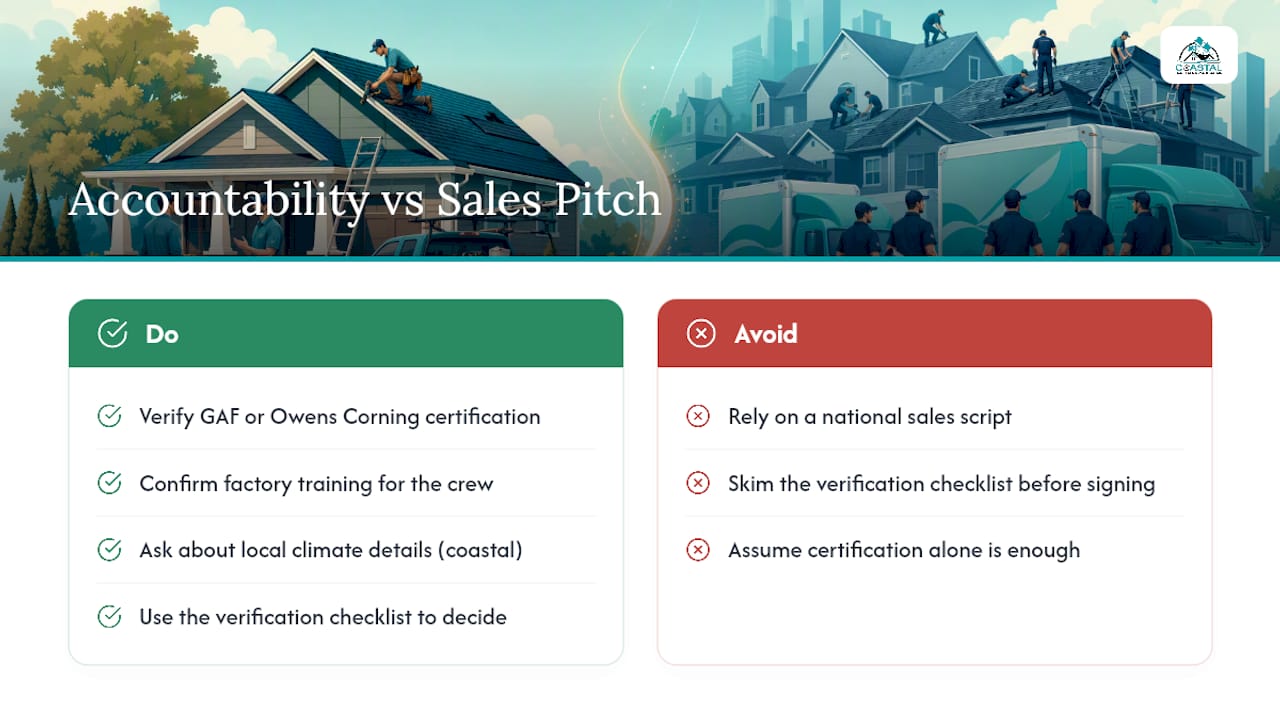
Certifications like GAF and Owens Corning aren’t decoration. They mean a crew passed factory training and understands how a roof needs to perform against Gulf Coast humidity, wind uplift, and afternoon storms that show up nearly every summer day. Local climate knowledge shows up in details a national script can’t teach, like flashing choices around a waterfront chimney or fastener patterns rated for coastal wind zones.
If you take one thing from this entire comparison, let it be this: treat the verification checklist as the actual decision, not a formality you skim before signing.
— Ryan
Why Coastal Roofing & Construction Checks Every Box on This List
You don’t have to choose between “local and accountable” and “certified and capable.” Coastal Roofing & Construction is licensed, insured, family-owned, and factory-certified with GAF, Owens Corning, and Tri County Metals, serving Pinellas, Hillsborough, and Pasco Counties from Clearwater to Tampa.
That combination maps directly onto the checklist above. Manufacturer certification means enhanced material warranty eligibility. Family ownership means a driveable workmanship warranty with a real person answering the phone, not a call center queue. Every estimate comes as a written scope of work, not a verbal promise, and every crew’s licensing and insurance can be verified before a single shingle moves. You can browse completed roof replacement projects across the Tampa Bay area, or start with a residential roof replacement estimate to see how the process works for your home specifically.
Sources
For deeper context on cost benchmarks, see Fixr’s roof replacement cost breakdown. For a homeowner-focused view on local hiring advantages, read Kevin Francis Design’s take on hiring local roofers.
- Local roofers vs. national roofing companies: Exploring the pros and cons
- Local vs. National Roofing Company | Global Roofing
- Family-Owned vs. Private Equity-Owned Roofing Companies
- Fixr
- Select Home Warranty — local vs national home warranty providers