
The minimum effective program is biannual professional inspections in spring and fall, plus monthly or quarterly drain and debris checks depending on your climate exposure. Budget $0.15 to $0.25 per square foot annually for full-service coverage, or $0.05 to $0.10 for inspection-only visits. Skip it, and you risk voiding your manufacturer warranty right when you need it most.
TL;DR:
- Conduct professional inspections twice a year in spring and fall, with quarterly visits for buildings in high-risk weather zones to prevent major damage.
- Focus on draining systems, flashings, membrane seams, and edge metal during inspections, especially after storms and when leaks are reported.
- Implement a maintenance plan costing between $0.05 and $0.10 per square foot annually for inspections only, up to $5,000 for full-service coverage for a 20,000-square-foot roof.
- Keep detailed, timestamped records of all inspections, repairs, and warranty documents to preserve manufacturer warranties and facilitate insurance claims.
- Inspect within 48 hours after storms and rooftop work, containing leaks immediately and documenting damage thoroughly to support claims and avoid further deterioration.
Table of Contents
- What Is the Right Commercial Roof Maintenance Schedule?
- Which Roof Failures Cause the Most Damage?
- How Much Does a Commercial Roof Maintenance Plan Cost?
- Roof Inspection Checklist for Every Professional Visit
- What Records Preserve Your Roof Warranty?
- What to Do After a Storm or Rooftop Work
- When Should You Repair, Restore, or Replace?
- What Most Maintenance Programs Get Wrong
- Get a Baseline Inspection Started
- Sources
What Is the Right Commercial Roof Maintenance Schedule?
The National Roofing Contractors Association sets two professional inspections per year as the floor, timed for spring and fall. That cadence catches winter freeze-thaw damage before summer heat makes it worse, and it flags summer UV degradation before cold weather turns small cracks into leaks. Buildings in hurricane, hail, or heavy snow zones often need quarterly visits instead.
Between those scheduled visits, your facilities team should still be walking the roof. A realistic annual rhythm looks like this:
- February or March: Professional spring inspection, focused on winter damage and clogged drains from fallen debris.
- Monthly (April through September): In-house visual check of drains and visible membrane, especially after heavy rain.
- September or October: Professional fall inspection, checking for UV wear and pre-winterizing drainage.
- As triggered: Inspection within 48 hours of any major storm, and within 48 to 72 hours after any rooftop trades work (HVAC service, satellite installs, electrical conduit runs).
Tenant leak reports should trigger an immediate visit too, not a wait-and-see approach.
Which Roof Failures Cause the Most Damage?
A handful of trouble spots account for most interior water damage claims, and they are the same spots inspectors should check every single visit.
- Blocked drains and ponding water: Water sitting more than 48 hours after rainfall signals a structural or drainage problem, not just debris; check our ponding water guide for warning signs.
- Flashings and penetrations: HVAC curbs, pipe boots, and wall flashings are where most leaks originate, since they’re where the membrane is cut and sealed rather than continuous.
- Membrane seams and laps: On TPO and modified bitumen systems, seam separation shows up as bubbling or a slight lift you can feel underfoot.
- Metal roof fasteners and seams: Standing seam systems need a check of clip spacing and fastener backout, which loosens with thermal cycling.
- Edge metal and coping: Wind uplift starts at the perimeter, so loose or rusted edge metal is an early warning sign worth flagging immediately.
How Much Does a Commercial Roof Maintenance Plan Cost?
Most programs fall into three tiers, and the difference between them is what happens when an inspector actually finds a problem.
- Inspection-only: Two visits a year, a written report, no repair work included. Runs $0.05 to $0.10 per square foot annually, or roughly $200 to $800 per visit for a mid-size roof.
- Standard maintenance: Adds drain clearing, minor repairs (small allowance included), and photo documentation with each visit.
- Full-service: Includes a defined repair allowance, an emergency response SLA for tarping and stabilization, and detailed reporting with photos and location references.
Quick math: A 20,000 square foot flat roof runs roughly $1,000 to $2,000 a year for inspection-only coverage, or $3,000 to $5,000 for full-service. Compare that to a premature membrane replacement running well into six figures, and the math justifies itself.
Before signing anything, check three contract mechanics: whether the repair allowance carries over unused, what the emergency response window actually guarantees, and whether reports arrive with photos tagged to specific roof locations rather than a generic summary.
Roof Inspection Checklist for Every Professional Visit
Every visit, professional or in-house, should follow the same sequence so nothing gets missed and every report is comparable to the last one.
- Walk the full perimeter, checking edge metal, coping, and gutter attachment points.
- Clear and photograph all drains, scuppers, and gutter outlets.
- Check every penetration (HVAC curbs, pipe boots, conduit) for sealant cracking or gaps.
- Inspect seams and laps on membrane systems for lifting, blistering, or separation.
- Note any standing water and measure how long it’s been sitting if possible.
- Photograph every issue with a location reference (roof zone, nearest equipment, or grid coordinate).
- Log the inspector’s name and the date on the report itself, not just the file name.
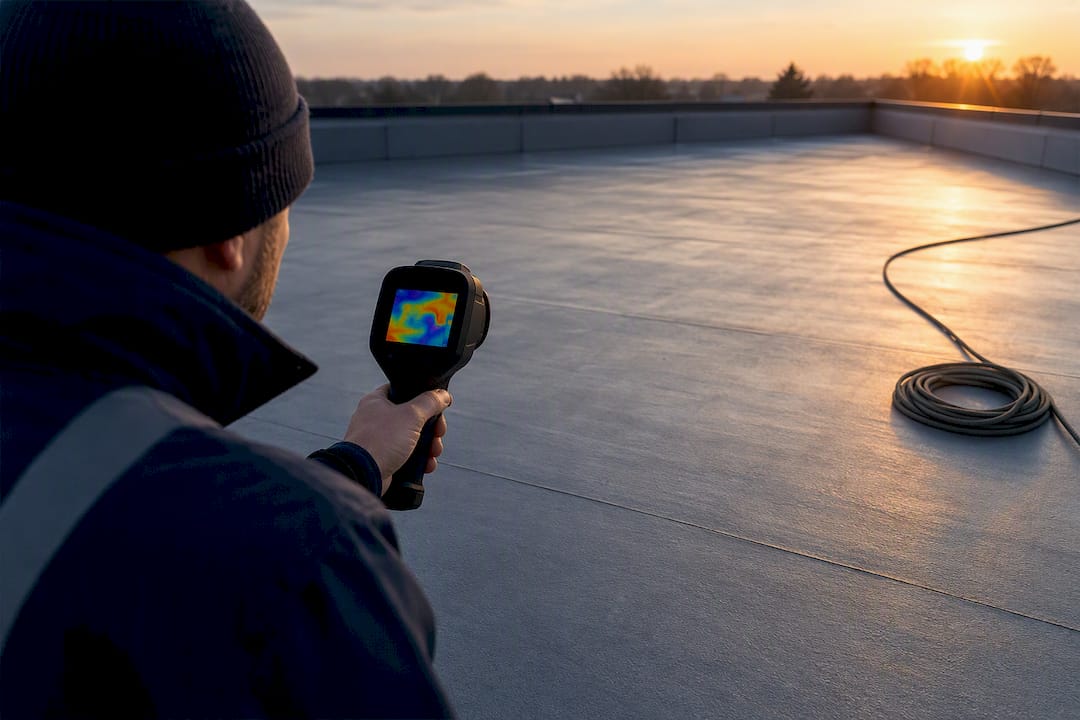
Call for an infrared moisture survey when interior stains appear with no obvious source, or before any coating project. IR surveys run $0.05 to $0.15 per square foot with a typical $500 to $1,500 minimum, and they find wet insulation that a visual walk simply cannot.
Pro Tip: Never coat over a roof without an IR survey first. Trapped moisture under a new coating accelerates deck corrosion, and you won’t know it’s there until the deck fails.
What Records Preserve Your Roof Warranty?
Manufacturer no-dollar-limit (NDL) warranties are conditional, not automatic. Miss the documentation requirements, and the warranty is effectively worthless when you need to file a claim.
Keep a dedicated, timestamped file for each roof containing:
- Every inspection report, with photos and inspector name
- Repair invoices, matched to the inspection that flagged the issue
- Original product specifications and installation documentation
- The manufacturer warranty document itself, including any transfer paperwork
- Photo documentation from every visit, organized by date
This file does triple duty. It’s what preserves your NDL warranty coverage, it’s the evidence an insurance adjuster wants after a claim, and it’s what a buyer’s due diligence team asks for if you ever sell the building.
What to Do After a Storm or Rooftop Work
Speed matters here. Water that sits for days does more damage than water that gets found and contained in hours.
- Inspect within 48 hours of any qualifying storm, and within 48 to 72 hours after any rooftop trades work.
- Contain active leaks immediately: tarp, redirect, and protect anything valuable underneath before worrying about the roof itself.
- Photograph damage before any temporary repair, then photograph the repair itself.
- File your insurance claim with dated photos and the maintenance log showing the roof’s condition before the event.
- Schedule the permanent repair once containment holds, and add the incident to your maintenance file.
Our post-storm response guide walks through the same triage sequence with more detail on evidence collection for claims.
When Should You Repair, Restore, or Replace?
Three numbers tell you which path makes sense. If ongoing maintenance and repair costs exceed roughly $0.30 per square foot per year, you’re likely past the point where patching makes financial sense. Cross-reference that against age: a roof past 15 to 20 years in service with a thin inspection history is a replacement candidate, while a well-documented roof of the same age might be a restoration candidate.
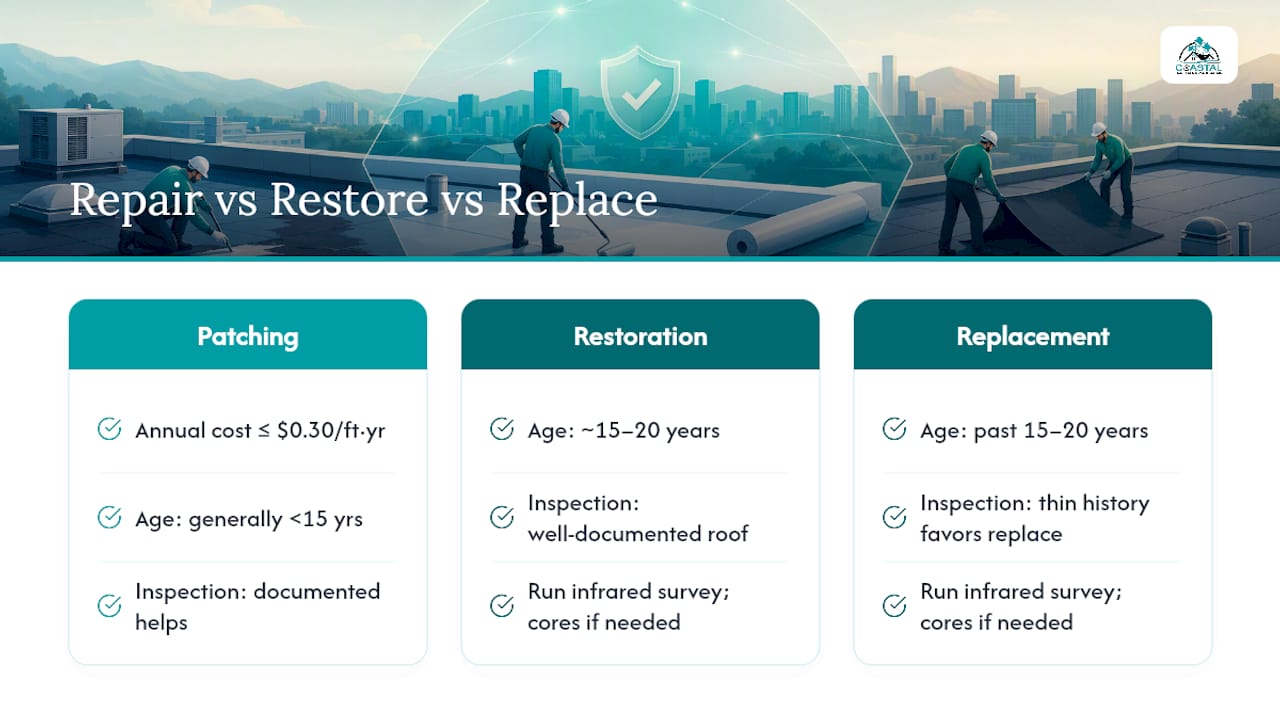
Run an infrared survey and, where questions remain, core samples before committing to either coating or replacement. Our Tampa Bay replacement guide covers the decision matrix in more depth.
What Most Maintenance Programs Get Wrong
The maintenance log is the actual asset here, more than any single inspection. A roof with five years of photo-documented, dated reports is worth more in a warranty claim, an insurance dispute, or a sale than a roof that’s been “maintained” with nothing to show for it.
The most common failure I’ve seen isn’t skipped inspections. It’s continuity loss: the facilities manager who owned the program leaves, and the log goes with them, mentally if not literally. Nobody hands off the file, the next person starts from zero, and eighteen months later there’s a warranty claim with no paper trail behind it. That’s exactly why a contractor-run program, where the records live outside any one employee’s inbox, often outperforms an in-house effort at similarly sized properties.
— Ryan
Get a Baseline Inspection Started
Some experienced commercial roof maintenance providers run programs with biannual inspections, drain clearing, documented reporting with photos tied to specific roof locations, and repair work handled by the same team that inspected the roof in the first place, not a subcontractor working from someone else’s notes.

If your building doesn’t have a maintenance file yet, or the one you have is a folder of scattered invoices, a baseline inspection is the place to start. We’ll document current condition, flag anything that needs attention now, and give you a clear picture of what a full-service program would look like for your specific roof. Browse our completed commercial and residential projects across Pinellas, Hillsborough, and Pasco counties, then reach out to schedule that first inspection and get your maintenance file started properly.
Sources
- Commercial Roof Maintenance Guide (2026) | Commercial Roof Guide
- Commercial Roof Maintenance & Inspection Program: Complete 2026 Guide