A standing seam metal roof typically costs $10 to $18 per square foot installed, according to current metal roofing market data, putting a standard 2,000-square-foot roof between $20,000 and $36,000. Premium substrates like zinc and copper push well past that range. Roof pitch, panel profile, coastal exposure, and tear-off complexity all move the final number.
TL;DR:
- The typical cost for a standing seam metal roof ranges from $10 to $18 per square foot, influenced by materials, complexity, and coastal exposure.
- Copper and zinc panels can exceed $25 per square foot, significantly raising overall project costs compared to steel or Galvalume options.
- Installation labor accounts for up to 60% of total costs and varies based on roofing complexity, pitch, local wages, and tear-off requirements.
- A standard 2,000-square-foot roof costs between $20,000 and $36,000, but high-end materials or coastal wind upgrades can push this well higher.
- Proper specification of materials, gauge, and warranty details is essential for accurate quotes and long-term value, especially in hurricane-prone coastal zones.
Table of Contents
- How Much Does a Standing Seam Roof Cost Per Square Foot?
- What Does Each Metal Type Cost, and How Do Finishes Change the Price?
- What Drives Labor and Installation Costs Up or Down?
- Is a Standing Seam Roof Worth It Over 50 Years?
- How Much More Does Coastal Exposure Add to the Price?
- How Long Does Installation Take, and How Do You Pay for It?
- How Do You Get an Accurate Standing Seam Roof Quote?
- What Makes Coastal Roofing & Construction Qualified for This Work?
- What Do Snow Guards, Gutters, and Skylights Add to the Cost?
- Which Warranty Terms Actually Affect Long-Term Value?
- Do Installation Methods Change What You Pay in Labor?
- Are There Tax Credits or Environmental Benefits Worth Factoring In?
- Where to Verify These Cost Figures
- The Real Math Behind This Decision
- Ready to Get an Exact Number for Your Roof?
- Sources
How Much Does a Standing Seam Roof Cost Per Square Foot?
Most homeowners budget between $10 and $18 per square foot for a standing seam metal roof, with steel and Galvalume panels landing on the lower end and specialty metals pushing toward $30 or more. That range covers materials, labor, underlayment, flashing, and standard trim work, based on Modernize’s standing seam cost data. A basic steel installation on a simple gable roof might come in at $10 per square foot, while a complex hip roof with copper panels and custom detailing can more than triple that.
Here’s what those per-square-foot ranges translate to for common roof sizes:
- 1,500 sq ft roof: $15,000 to $27,000 installed
- 2,000 sq ft roof: $20,000 to $36,000 installed
- 2,500 sq ft roof: $25,000 to $45,000 installed
- 3,000 sq ft roof: $30,000 to $54,000 installed
Pro Tip: Always ask contractors to quote by the “square” (100 square feet), not just per square foot. Roofing bids traditionally use squares, and mixing units is a common way homeowners misread an estimate by a factor of 100.
These figures assume a standard steel or Galvalume system with a mid-range finish. Swap in aluminum, zinc, or copper, and the total climbs fast. A 2,500-square-foot coastal home that would cost $32,000 inland might run closer to $40,000 to $45,000 once you factor in the substrate and clip upgrades required for high-velocity hurricane zones.
The width of these ranges isn’t padding. It reflects real variation in roof complexity, local labor markets, and material choice, three variables that swing a final bid by tens of thousands of dollars on the same size roof. A simple ranch home and a steeply pitched Craftsman of identical square footage can land $8,000 to $10,000 apart purely because of pitch and cut complexity.
What Does Each Metal Type Cost, and How Do Finishes Change the Price?
Material choice is the single biggest lever homeowners control when setting a standing seam roof budget. Steel and Galvalume sit at the affordable end, aluminum and zinc occupy the middle, and copper commands a serious premium for its appearance and 100-plus-year lifespan.
- Steel (24 to 26 gauge): $3 to $6 per square foot in material, $10 to $14 installed
- Galvalume steel: $3.50 to $7 per square foot in material, $10 to $15 installed
- Aluminum: $5 to $9 per square foot in material, $12 to $18 installed
- Zinc: $9 to $14 per square foot in material, $18 to $25 installed
- Copper: $14 to $25+ per square foot in material, $25 to $40+ installed
Gauge thickness matters as much as the metal itself. Coastal jobs often justify the upgrade, since thicker panels hold up better against wind-driven debris and salt spray.
Coating is the other major cost variable. A basic painted finish costs less upfront but fades and chalks faster in Florida’s UV exposure. Specialty finishes like weathered zinc patinas or copper’s natural oxidation process add cost differently. You pay for the raw material rather than a coating, and the finish develops over years rather than arriving factory-applied.
For coastal Florida homes, we generally steer clients toward Galvalume or aluminum with a PVDF coating unless budget allows for zinc. Bare steel, even galvanized, corrodes faster in salt air without that additional coating layer.
What Drives Labor and Installation Costs Up or Down?
Labor typically accounts for 40% to 60% of your total installed cost, and it’s the line item with the most variability from one bid to the next. Several factors determine where you land:
- Local wage rates. Roofing labor costs vary significantly by metro area, and Bureau of Labor Statistics wage data confirms installers in high-cost coastal markets earn meaningfully more than the national median, which shows up directly in your quote.
- Tear-off versus overlay. Removing an existing roof down to the deck adds $1 to $3 per square foot for labor and disposal, but standing seam systems rarely get installed over old shingles, so budget for full tear-off in nearly every case.
- Roof complexity. Dormers, valleys, skylights, and multiple penetrations multiply the cuts, seams, and flashing details a crew must fabricate on site, adding labor hours that flat, simple roofs don’t require.
- Pitch and access. Steep-slope roofs require additional safety equipment and slow down crews, typically adding 10% to 20% to labor costs above a moderate 4:12 to 6:12 pitch.
- Permits and engineering. Most municipalities require a permit for full roof replacement, and homes needing structural reinforcement for heavier gauge panels may need an engineer’s review before work begins.
Pro Tip: Ask your contractor for a labor-hours estimate, not just a dollar figure. A crew quoting 40 hours for a straightforward 2,000-square-foot gable roof is priced very differently than one quoting 70 hours for the same footprint, and that gap usually signals a complexity issue worth discussing before you sign.
Is a Standing Seam Roof Worth It Over 50 Years?
A standing seam roof typically lasts 40 to 70 years with minimal maintenance, while asphalt shingles need full replacement every 15 to 25 years, according to design and durability guidance from HUD’s research on roofing systems. That gap is where the real financial case for metal roofing lives.
Run the math over a 50-year ownership window on a 2,000-square-foot roof. A homeowner installing asphalt shingles at roughly $6 to $9 per square foot will replace that roof two to three times, plus periodic repairs, landing total lifecycle spend somewhere between $36,000 and $60,000 once you include labor inflation over decades. A homeowner installing standing seam at $20,000 to $36,000 upfront may never replace it again in their lifetime, paying only for occasional inspections and minor fastener or sealant touch-ups.
Harvard’s Joint Center for Housing Studies data on homeowner capital expenditures supports treating a roof as a long-horizon investment rather than a recurring maintenance line item. Metal roofing also reflects solar heat more effectively than asphalt, and many homeowners report noticeably lower summer cooling costs, though actual savings depend heavily on attic ventilation and insulation. Maintenance costs run low: an annual visual inspection and occasional resealing of penetrations, often under $300 to $500 a year, compared to shingle roofs that frequently need storm-related repairs.
How Much More Does Coastal Exposure Add to the Price?
Homes within a few miles of saltwater face accelerated corrosion risk that inland properties simply don’t deal with, and that risk changes both product specification and price. Salt-laden air attacks fasteners, cut edges, and lower-grade coatings years faster than it would in a dry inland climate.
- Aluminum and Galvalume generally outperform bare galvanized steel in direct salt exposure and are the baseline recommendation for most Gulf Coast homes.
- High-velocity hurricane zones require products with specific Miami-Dade or Florida Building Code product approvals, and compliant panels and fastening systems cost more than standard residential-grade options.
- Upgraded concealed clip systems designed for higher uplift ratings add cost but are often required, not optional, in coastal wind zones.
- Stainless steel fasteners, rather than standard coated screws, prevent the rust streaking that plagues coastal metal roofs within a few years of installation.
- Thicker gauge panels (22 gauge instead of 26) resist wind-driven debris damage better during storm events.
That premium buys wind ratings, corrosion resistance, and coating warranties that actually hold up in a marine environment, which matters more once you’re relying on the roof to perform during an actual named storm rather than just look good on a sunny day.
How Long Does Installation Take, and How Do You Pay for It?
Most residential standing seam projects run two to five days on site once installation begins, though lead time for material fabrication often adds two to six weeks before a crew ever shows up, longer for custom colors or specialty metals like zinc and copper that get ordered per project.
Payment structures vary by contractor, but a typical schedule looks like this:
- Deposit at signing: Often 10% to 30% of the total contract, covering material orders and scheduling.
- Progress payment at material delivery or mid-installation: Common on larger jobs where panels are custom-fabricated.
- Final payment at completion: Due after final inspection and cleanup, once you’ve confirmed the work matches the contract specs.
Financing options have expanded meaningfully for roofing projects. Many contractors partner with third-party lenders offering fixed-rate installment loans, and some homeowners tap home equity lines for larger metal roofing investments given the long payback horizon. Local utility rebates occasionally apply to reflective or cool-roof rated metal finishes, though availability varies by jurisdiction, so check with your municipality directly. Permit fees typically run a few hundred dollars but vary widely by county and project scope, and they’re worth confirming during the estimate phase rather than treating as an afterthought.
How Do You Get an Accurate Standing Seam Roof Quote?
A written estimate that doesn’t specify gauge, finish system, underlayment type, and clip system isn’t a real bid. It’s a placeholder that leaves room for the price to move once work starts.
Require every quote to spell out:
- Metal type and gauge (for example, “24 gauge Galvalume,” not just “metal roof”)
- Finish or coating system, including whether it’s PVDF/Kynar or a standard polyester paint
- Underlayment type, since EPA guidance on moisture control confirms proper underlayment and detailing directly reduce long-term moisture damage and maintenance costs
- Clip system (fixed versus floating) and fastener material
- Manufacturer warranty terms and workmanship warranty length separately
Pro Tip: Line up three bids side by side using these exact specs before comparing dollar figures. A quote that’s $4,000 cheaper but specs 26 gauge steel with basic paint against two competitors quoting 24 gauge with PVDF coating isn’t actually the better deal, it’s a different product entirely.
Ask directly about manufacturer certification and crew training, general liability insurance and workers’ compensation coverage, and whether the installer follows factory-specified installation procedures required to keep material warranties valid. A bid that’s dramatically lower than the others, or vague about specs, is the clearest red flag in the entire process.
What Makes Coastal Roofing & Construction Qualified for This Work?
Coastal Roofing & Construction is a licensed, insured, family-owned contractor serving the Tampa Bay area, and our team holds manufacturer certifications with Owens Corning, GAF, and Tri County Metals. That Tri County Metals certification matters specifically for standing seam work, since it means our crews are factory-trained on the panel systems we install rather than learning on a customer’s roof.
Every cost factor covered above, gauge selection, coating type, clip systems, coastal wind ratings, shows up in how we scope a project from the initial inspection forward. We’ve built a portfolio of premium standing seam installations across waterfront and coastal properties throughout Pinellas, Hillsborough, and Pasco counties, working directly with custom home builders and architects who need roofing systems engineered for Florida’s specific coastal exposure. You can review completed standing seam and metal roofing projects from communities including Clearwater, St. Petersburg, and Palm Harbor.
Our estimates spell out the exact specs discussed in this guide: substrate, gauge, coating, and clip system, so you’re comparing an apples-to-apples number against any other bid you collect.
What Do Snow Guards, Gutters, and Skylights Add to the Cost?
Standing seam roofs pair well with several add-on features, and pricing them separately from the base roof budget helps avoid surprises at contract time.
Snow guards aren’t a major factor for Florida installations, but for reference, systems designed to prevent sudden snow slides off metal panels run $8 to $15 per linear foot installed in colder climates. Gulf Coast homeowners can generally skip this line item entirely.
Gutters compatible with standing seam systems typically use concealed hangers that clip directly to the panel seams rather than traditional fascia-mounted brackets. Expect $8 to $20 per linear foot for aluminum or steel gutters designed to integrate cleanly with a metal roofline, with seamless aluminum systems on the higher end of that range.
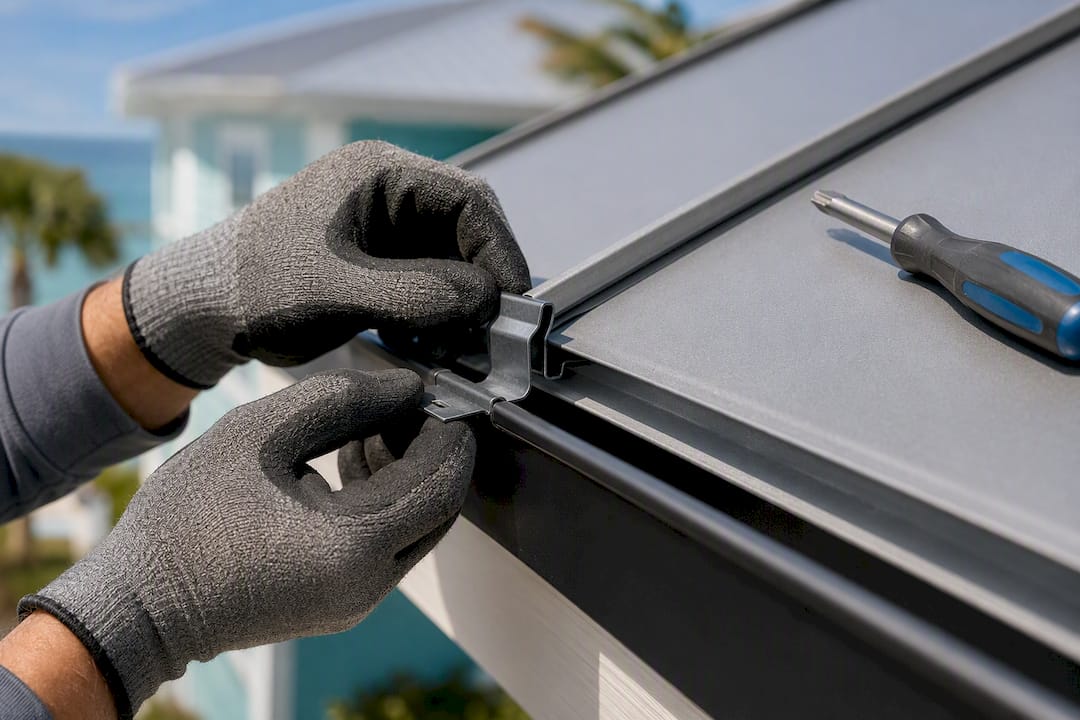
Skylights designed for standing seam installation require curb-mounted units with metal-specific flashing kits, since standard shingle-roof skylight flashing won’t seal properly against a raised seam profile. Budget $1,500 to $3,500 per skylight installed, including the specialized flashing work, roughly $300 to $600 more than a comparable shingle-roof installation due to the custom metalwork involved.
Bundling these additions into your original roofing contract, rather than hiring a separate contractor afterward, typically saves money and avoids warranty conflicts between installers.
Which Warranty Terms Actually Affect Long-Term Value?
Standing seam warranties come in three separate layers, and conflating them is one of the most common homeowner mistakes when comparing bids.
Material warranties from the panel manufacturer typically cover substrate defects for 30 to 50 years. Finish warranties covering paint fade, chalking, and color retention run shorter, often 20 to 30 years for PVDF coatings, and significantly less for basic paint systems. Workmanship warranties from your installer cover leaks and installation errors, and these vary enormously, anywhere from 2 years to a lifetime guarantee depending on the contractor.
A longer workmanship warranty generally costs more upfront because it reflects a contractor’s confidence in their own installation quality and their willingness to stand behind it years later. That’s not padding. It’s the installer pricing in their own risk. When comparing two bids with similar material specs, the one offering a 10-year workmanship warranty against one offering 2 years often justifies a modest price difference, since roof leaks from installation error typically show up within the first few years of service.
Always get warranty terms in writing, including what voids coverage, since improper maintenance or unauthorized modifications can void manufacturer warranties even when the original installation was flawless.
Do Installation Methods Change What You Pay in Labor?
Standing seam panels get installed two primary ways, and the method affects both labor hours and long-term performance. Field-locked systems, where panels are seamed together on site using specialized mechanical seaming equipment, generally cost more in labor because they require skilled operators and slower, more precise work. Snap-lock systems, where panels click together without mechanical seaming, install faster and reduce labor hours, but typically carry lower wind-uplift ratings than mechanically seamed alternatives.
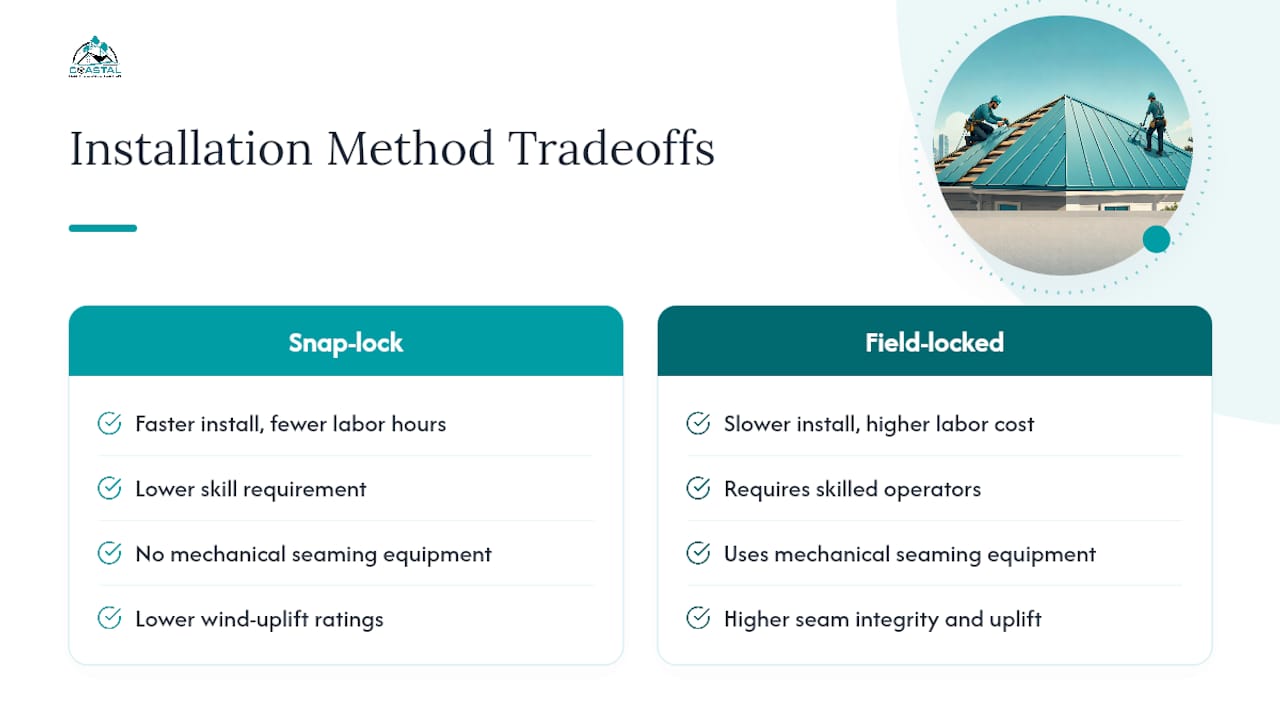
For most inland residential jobs, snap-lock systems offer a reasonable balance of cost and performance. For coastal Florida homes facing hurricane-force wind exposure, mechanically seamed panels are often the better long-term investment despite the added labor cost, since the seam integrity holds up better under sustained wind uplift during storm events.
Crew experience matters as much as method here. A crew unfamiliar with mechanical seaming equipment will take considerably longer and risk inconsistent seams, which is exactly why manufacturer certification and documented training matter when vetting a contractor for this specific installation type.
Are There Tax Credits or Environmental Benefits Worth Factoring In?
Standing seam metal roofs offer genuine environmental advantages that occasionally translate into direct financial incentives. Most residential metal roofing panels contain a meaningful percentage of recycled content, and the panels themselves are fully recyclable at the end of their multi-decade service life, unlike asphalt shingles, which largely end up in landfills after each replacement cycle.
Reflective or “cool roof” rated finishes, typically light-colored or specially coated panels, can qualify for certain manufacturer rebates or utility incentive programs, though availability depends heavily on your specific utility provider and local jurisdiction. Federal tax credit availability for roofing materials has shifted over recent years, so confirm current eligibility directly with a tax professional or the IRS rather than relying on outdated blog guidance, since these programs change year to year.
Longevity itself is an environmental benefit worth weighing. A roof that lasts 40 to 70 years without replacement generates far less manufacturing waste and disposal burden over a home’s lifetime than a shingle roof replaced two or three times across the same span. That’s a genuine consideration for homeowners weighing upfront cost against total resource use, even before any tax incentive enters the picture.
Where to Verify These Cost Figures
For readers who want to dig into the source data behind these numbers: HUD’s roofing systems research covers durability and design considerations, EPA’s moisture control guidance addresses maintenance-reducing detailing, BLS wage data explains regional labor cost swings, and Modernize’s cost guide anchors the per-square-foot ranges used throughout. Always confirm permit fees with your county’s building department, since those vary by jurisdiction and change more frequently than material pricing.
The Real Math Behind This Decision
The conventional advice on standing seam roofing treats it as a binary choice: pay more now or save money with shingles. That framing misses the actual decision homeowners are making, which is about time horizon, not just dollars. If you’re planning to sell within five years, the ROI math in this guide barely applies to you. If you’re building a forever home or a custom coastal property, the 50-year comparison is the only math that matters.
Where I think most homeowners get it wrong is treating material choice as the primary cost lever while ignoring installation quality. A mediocre installer using premium zinc panels will cost you more in leak repairs and warranty disputes than a certified crew using well-specified Galvalume. The gauge and finish matter, but who’s on your roof with a seamer in hand matters just as much, and it’s the variable most bidding processes never properly compare.
Get the specs in writing, verify certifications before price, and treat the cheapest bid with real skepticism rather than relief.
— Ryan
Ready to Get an Exact Number for Your Roof?
Every range in this guide gets narrower once someone measures your actual roof, checks your pitch and complexity, and specs the right substrate for your exposure. Coastal Roofing & Construction has built its standing seam practice specifically around Tampa Bay’s coastal conditions, with Tri County Metals factory training that means our crews aren’t guessing at panel systems or seaming techniques on your project.
If you’re weighing a standing seam upgrade against a shingle replacement, or you already know metal is the direction you want, request a detailed residential roof replacement estimate that spells out gauge, finish, clip system, and warranty terms in writing, the same specs this guide told you to demand from any contractor. We serve homeowners across Pinellas, Hillsborough, and Pasco counties, and we’ll walk your roof in person before quoting a number, not estimate it from a satellite photo.
Sources
- HUDuser — Roofs and roofing systems
- EPA — Moisture control guidance for building design, construction and maintenance
- BLS — Occupational Employment and Wage Statistics
- Harvard JCHS — Homeowner expenditures by project type
- Modernize — Standing seam metal roof guide