
The most effective way to quiet a metal roof is an assembly-first approach: combine panel damping or an acoustic underlayment with high-density insulation and a continuous interior mass barrier like a gypsum ceiling. Single-layer fixes rarely move the needle enough on their own. According to roof noise control research, entangled-filament underlayments paired with insulation and a gypsum ceiling can cut interior rainfall noise by up to approximately 21.5 dB — roughly the difference between a conversation and a quiet library.
Here are the four treatments ranked by impact:
- Panel damping or acoustic underlayment (varies based on product and coverage)
- High-density insulation with a sealed deck (adds additional noise reduction)
- Interior mass and decoupling — double drywall, resilient channels, or acoustic ceiling panels (provides interior-only improvement)
- Assembly changes for flat or ballasted roofs (ballast can help reduce noise)
Combined systems consistently outperform any single fix. A layered approach using these categories can achieve substantial total reduction. ISO 10140 and ISO 717 are the lab standards used to measure these results, so when you see dB figures on a product sheet, those are the test protocols behind them. Coastal Roofing & Construction installs complete metal roofing assemblies in the Tampa Bay area with all of these treatments built in from the start.
Table of Contents
- What are the main metal roof noise reduction options?
- Which underlayments actually reduce metal roof noise?
- What insulation works best under a metal roof for noise?
- How do panel damping treatments reduce roof resonance?
- How do interior ceiling treatments quiet a metal roof?
- DIY vs. hiring a pro: costs, timelines, and when to call
- What do the lab tests actually show about dB reductions?
- Key Takeaways
- The case for treating the assembly, not just the symptom
- Coastal Roofing & Construction handles the full acoustic assembly
What are the main metal roof noise reduction options?
The four practical paths to a quieter metal roof map to where noise enters the building: at the panel surface, through the deck, through the air cavity, and through the ceiling. Treating only one of those paths leaves the others wide open.
| Treatment category | Typical noise reduction | Approx. cost (USD) | DIY-friendly? | Disruption | Best for |
|---|---|---|---|---|---|
| Acoustic underlayment / entangled-filament | reduces impact noise measurably; combined systems further reduce noise | varies | Moderate (new installs); pro for retrofit | Requires roof removal for retrofit | Standing seam, corrugated |
| Attic / deck insulation upgrade | adds noticeable noise reduction | varies | Yes (batts/blown-in) | Low; attic access only | All roof types |
| Panel damping (sheets or liquid) | significant noise reduction depending on coverage | varies | Yes (sheets); pro for spray | Low to moderate | Corrugated, exposed-fastener |
| Interior mass and decoupling | effective for interior noise control | varies | Moderate (drywall); pro for full rework | Moderate; interior work | All roof types |
| Ballast / sandwich assembly (flat roofs) | reduces noise depending on assembly | varies; structural review required | No | High; structural | Low-slope / flat |
Quick fixes and their limits. Roof coatings applied to the topside and temporary attic insulation top-ups do reduce noise at the margins, but practitioner experience consistently shows that single-component fixes are inadequate for meaningful noise reduction. They are worth doing if you are waiting on a full assembly upgrade, not as a permanent solution.
Metal roofs are not inherently noisy. The noise you hear during a rainstorm is almost always a function of the assembly — how the panel is attached, whether there is solid sheathing underneath, and what sits between the panel and your ceiling. Fix the assembly and the noise follows.
Which underlayments actually reduce metal roof noise?
Underlayment is the first acoustic layer between the metal panel and the roof deck, and the type you choose makes a measurable difference. The underlayment selection guide from Smartech and third-party underlayment comparisons both confirm that synthetic and entangled-filament products outperform standard felt on acoustic performance.
Entangled-filament underlayments (sometimes called drainage mats or Enkamat-style products) are the acoustic standout. Their three-dimensional fiber matrix creates an air gap that breaks the vibration path between the metal panel and the deck. Lab data puts their impact noise reduction at 9.5–13.5 dB on their own, rising to approximately 21.5 dB when combined with insulation and a gypsum ceiling.
Synthetic underlayments are lighter, easier to install, and more moisture-resistant than felt, but their acoustic benefit is modest compared to entangled-filament products. They are a solid baseline choice for new installs where budget limits specialty options.
Self-adhering and rubberized asphalt underlayments add mass and damping at the deck surface. They bond directly to the sheathing, which eliminates the air gap that entangled-filament products rely on, but their added density does contribute some damping. They are more common on low-slope and flat applications.
Installation checklist for best acoustic results
- Use continuous sheathing (OSB or plywood) under the underlayment — gaps in the deck are one of the biggest noise leakage paths.
- Seal all seams with compatible tape; unsealed laps allow sound to bypass the underlayment layer entirely.
- Cover 100% of the deck surface with no skipped areas around penetrations or valleys.
- Follow the manufacturer’s fastening pattern to avoid creating vibration bridges at fastener points.
- Maintain attic ventilation clearances — compressing the underlayment against insulation can reduce both acoustic and thermal performance.
- For standing seam profiles, confirm the underlayment is rated for the clip attachment system so it does not compress under the seam.
Pro vs. DIY: Replacing underlayment on an existing metal roof means removing and reinstalling the panels. That is a contractor job. On a new installation or a full replacement, a skilled DIYer can install entangled-filament underlayment on a simple gable roof, but complex hip roofs, valleys, and penetration detailing are better left to a licensed roofer.
Pro Tip: Seal every pipe boot, ridge vent, and valley flashing with acoustically compatible sealant. A 1-inch gap around a penetration can undermine the noise reduction of an otherwise perfect underlayment installation.
What insulation works best under a metal roof for noise?
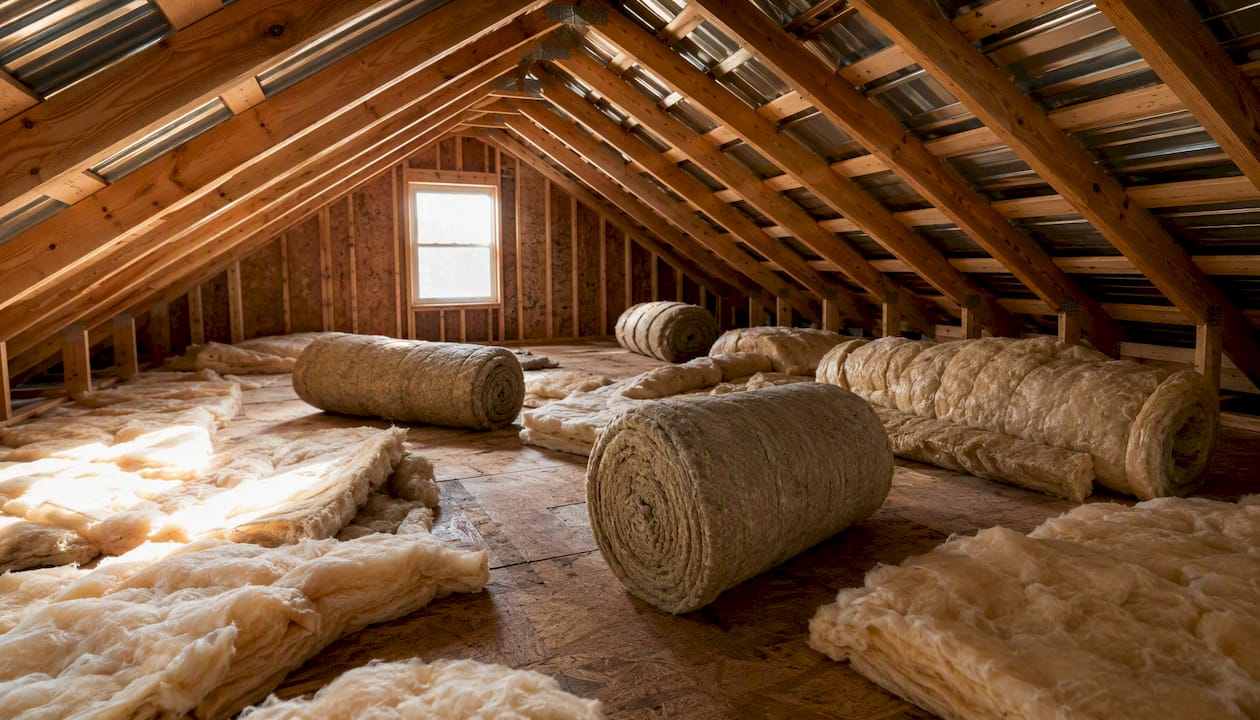
Insulation does two acoustic jobs: it absorbs mid-to-high frequency sound energy (above roughly 315 Hz, where rainfall noise is most intense), and it adds mass that resists low-frequency vibration when combined with a dense ceiling. Research on insulation and comfort confirms that the thermal and acoustic benefits of attic insulation are closely linked.
| Material | Acoustic benefit | R-value range | Moisture risk | DIY-friendly | Notes |
|---|---|---|---|---|---|
| Mineral wool (rockwool) | High — dense, absorbs mid/high freq. | — | Low | Yes | Best acoustic performer per inch; fire-resistant |
| Fiberglass batts | Moderate | — | Low to moderate | Yes | Widely available; less dense than mineral wool |
| Loose-fill cellulose | Moderate to high | R-3.2 per inch | Moderate | Blower required | Good for attic top-ups; settles over time |
| Spray polyurethane foam (closed-cell) | Moderate acoustic; excellent air seal | R-6 per inch | Very low | No — pro only | Adds structural rigidity; limits future access |
| Spray polyurethane foam (open-cell) | High acoustic absorption | R-3.5 per inch | Moderate | No — pro only | Softer; better sound absorption than closed-cell |
Mineral wool is the strongest acoustic performer in this group. Its density (typically 2.5–8 lb/ft³) absorbs rainfall-frequency sound more effectively than lower-density fiberglass, and multilayer test data validates that glass wool and mineral wool filling between roof layers produces measurable improvements in controlled assemblies.
One important caveat: insulation alone handles mid-to-high frequencies well, but low-frequency rumble (below ~250 Hz) requires added mass and decoupling at the ceiling level. If your metal roof produces a deep, resonant boom during heavy rain rather than a high-pitched patter, insulation upgrades alone will not fully solve it.
Moisture and code notes. In Florida’s humid climate, vapor control placement matters. Closed-cell spray foam applied directly to the underside of the roof deck creates a sealed assembly that eliminates attic ventilation requirements — but it must be installed by a licensed contractor and inspected for fire-code compliance. Fiberglass and mineral wool batts in vented attics need a vapor retarder on the warm-in-winter side (the ceiling side in Florida).
How do panel damping treatments reduce roof resonance?
Damping works at the source. When rain strikes a metal panel, the panel vibrates and radiates sound downward. A damping treatment increases the panel’s internal energy dissipation, so less of that vibration converts to audible noise. Research on underside-applied damping compounds confirms that treating the panel at its source breaks the vibration path before it amplifies through the assembly — and that underside application is generally more effective than topside coatings.
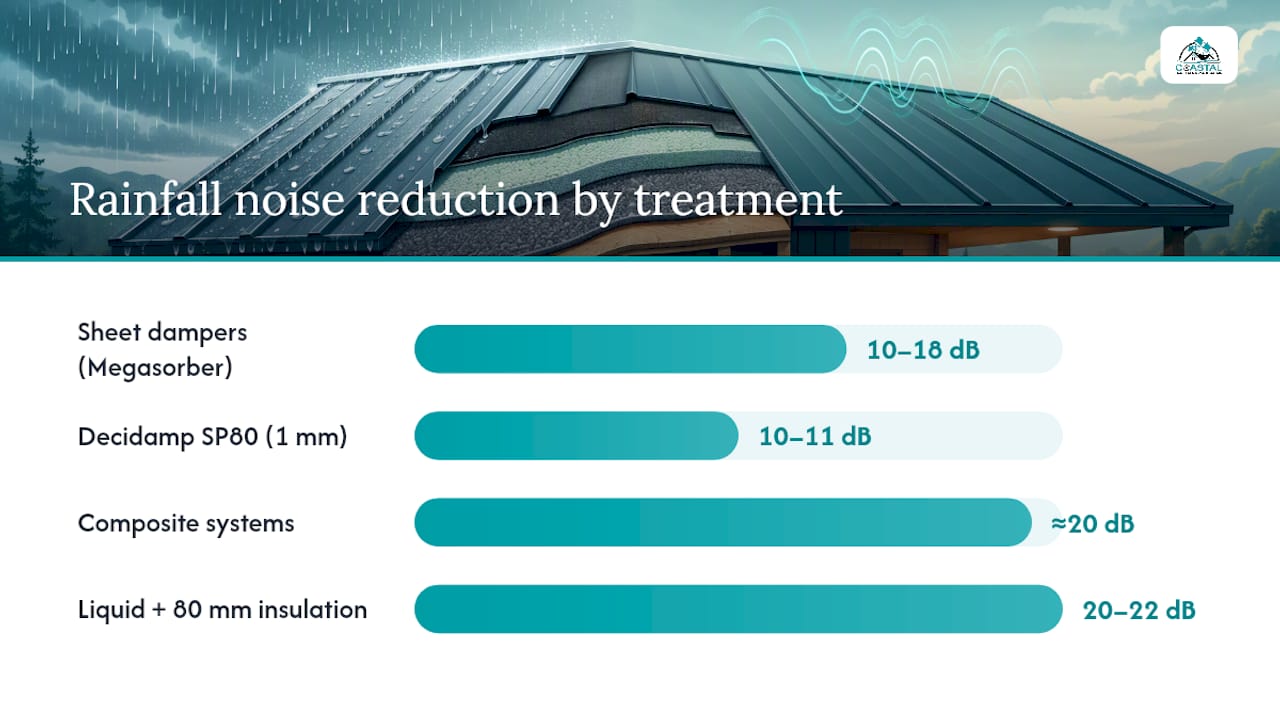
Sheet-based dampers are peel-and-stick strips (constrained-layer damping) applied to the underside of the panel. They add surface density and a viscoelastic layer that converts vibration to heat. Megasorber’s sheet and liquid damping products typically reduce impact noise by 10–18 dB depending on panel profile and coverage percentage, with composite systems approaching 20 dB.
Liquid deadeners are spray or trowel-applied coatings. Decidamp SP80 at 1 mm dry film thickness reduced rainfall sound intensity by 10–11 dB and improved the weighted sound reduction index (Rw) by 5–6 points on corrugated metal panels. When combined with 80 mm foil-faced insulation, the total system improvement reached approximately 20–22 dB.
Application guidance:
- Apply sheet dampers to 50–80% of the panel surface; full coverage is ideal but diminishing returns set in above 80% for most profiles.
- Liquid deadeners perform best at 100% coverage; any skipped area becomes a vibration hot spot.
- Surface prep is non-negotiable: clean, dry, and free of oil or mill scale before applying either product.
- Wear appropriate PPE (respirator, gloves, eye protection) when spraying liquid deadeners in enclosed spaces.
- For corrugated profiles, apply damping to the flat pan sections first, then the ribs — the flat areas radiate the most energy.
Pro Tip: Treat the fastener run lines and seam areas with extra damping material. These are the stiffest parts of the panel and act as vibration bridges directly into the structure. Covering them interrupts the primary transmission path.
How do interior ceiling treatments quiet a metal roof?
The interior ceiling is your last line of defense, and it is often the most cost-effective retrofit option because it does not require touching the roof at all. The principle is straightforward: mass resists airborne sound transmission, and decoupling prevents structure-borne vibration from traveling through the framing into the ceiling surface.
A standard single-layer drywall ceiling attached directly to joists transmits both airborne and structure-borne noise. Adding a resilient channel or hat channel between the joist and the drywall breaks the rigid connection. Double drywall (two layers of 5/8-inch gypsum) adds mass. Together, they can deliver 5–12 dB of interior-only improvement without any work on the roof itself.
Installation sequence for a decoupled ceiling
- Add insulation between the roof deck and the ceiling plane if not already present (mineral wool batts are ideal here).
- Install resilient channels or hat channels perpendicular to the joists at 16-inch centers, following manufacturer spacing requirements.
- Hang the first layer of 5/8-inch Type X gypsum board, screwing into the channel only — never into the joist directly, which defeats the decoupling.
- Apply acoustic sealant (Green Glue or equivalent) between the first and second drywall layers.
- Install the second drywall layer with joints staggered from the first.
- Seal the perimeter with acoustic caulk before finishing — gaps at the wall-ceiling junction are a common noise bypass.
Before and after expectations. Interior-only ceiling work typically yields 5–12 dB depending on the existing assembly. Combined with panel damping and insulation already in place, the cumulative system can exceed 20 dB total. Interior-only work will not address structure-borne vibration traveling through the wall framing, so it is most effective in rooms directly below the roof with no intermediate floor.
When to hire a contractor: Any ceiling work that requires moving electrical boxes, rerouting ductwork, or modifying structural members needs a licensed contractor. Full ceiling rework in a finished room is also a significant project — budget for drywall disposal, texture matching, and repainting.
DIY vs. hiring a pro: costs, timelines, and when to call
Most homeowners can handle a few of these treatments without professional help. Others require a licensed roofer or insulation contractor — not because the work is technically impossible, but because mistakes are expensive and some tasks require permits.
What a skilled DIYer can reasonably do:
- Apply peel-and-stick sheet dampers to accessible underside panels (garage ceilings, exposed rafters)
- Add mineral wool or fiberglass batts in an accessible attic
- Install resilient channels and a second drywall layer in a finished room (with basic carpentry skills)
- Blow in loose-fill cellulose with a rented blower machine
What requires a licensed contractor:
- Removing and reinstalling metal panels to replace underlayment
- Applying spray liquid deadeners (ventilation, PPE, and equipment requirements)
- Adding ballast or concrete toppings to a flat roof (structural and permit implications)
- Any ceiling work affecting electrical, HVAC, or structural members
- Full roof replacement with an upgraded acoustic assembly
Warning signs that you should call a pro before doing anything:
- Active roof leaks or water staining on the ceiling (fix the leak first)
- Soft spots or bounce in the deck sheathing when walking the roof
- Visible rust or corrosion on panel fasteners
- Any work that requires a building permit in your municipality
- Uncertainty about the roof’s structural capacity for added weight
For Tampa Bay homeowners considering a full metal roof installation or a complete acoustic assembly upgrade, Coastal Roofing & Construction offers inspections and estimates across Pinellas, Hillsborough, and Pasco Counties. When a retrofit is impractical, a roof replacement with a properly specified acoustic assembly is often the more cost-effective long-term path.
What do the lab tests actually show about dB reductions?
The published numbers are worth knowing before you spend money on any treatment.
- Entangled-filament underlayment alone: 9.5–13.5 dB impact noise reduction vs. a thin weather barrier; combined with insulation and gypsum ceiling, up to ~21.5 dB in lab conditions.
- Decidamp SP80 liquid deadener at 1 mm dry film: 10–11 dB rainfall noise reduction alone; ~20–22 dB combined with foil-faced insulation.
- Sheet and liquid damping products (Megasorber range): 10–18 dB depending on coverage and profile; composite systems approach 20 dB.
- Sandwich flat roof vs. coverboard: 4–8 dB quieter; lightweight concrete topping 16–20 dB quieter than underboard.
- Ballasted flat roof: ~10 dB quieter than non-ballasted in rainfall testing.
- Glass wool and damping compound combined: Multilayer test data validates measurable LIA improvements, supporting combined acoustic strategies.
Test conditions matter. ISO 10140 uses a standardized rainfall rate and measures at a fixed distance inside the test chamber. Real-world results vary based on rainfall intensity, roof pitch, panel profile, and the quality of installation. The dB figures above are lab results — field performance is typically within a few dB of lab results when installation is done correctly, but gaps, unsealed seams, and skipped coverage areas can erode gains significantly.
Where improvements are largest and smallest. Rainfall noise sits primarily in the 500 Hz–4 kHz range, where damping and insulation are most effective. Low-frequency rumble below 250 Hz is harder to treat — it requires added mass and structural decoupling rather than absorption alone. If your primary complaint is a deep, low boom, prioritize mass (double drywall, ballast, concrete topping) over absorption-only treatments.
Key Takeaways
The most effective metal roof noise reduction combines panel damping or acoustic underlayment with high-density insulation and a continuous interior mass barrier, with combined systems reaching 20+ dB of reduction.
| Point | Details |
|---|---|
| Assembly-first approach wins | Combining damping, insulation, and a gypsum ceiling reaches 20+ dB; single fixes typically yield 5–13 dB. |
| Underlayment type matters | Entangled-filament underlayments reduce impact noise 9.5–13.5 dB alone; combined with insulation and gypsum, up to ~21.5 dB. |
| Panel damping at the source | Liquid deadeners like Decidamp SP80 at 1 mm dry film cut rainfall noise 10–11 dB; combined with insulation, ~20–22 dB. |
| Flat roofs need different fixes | Ballasted assemblies are ~10 dB quieter; lightweight concrete toppings can be 16–20 dB quieter than underboard systems. |
| Coastal Roofing & Construction | Licensed Tampa Bay installer offering complete acoustic metal roof assemblies, inspections, and estimates across Pinellas, Hillsborough, and Pasco Counties. |
The case for treating the assembly, not just the symptom
Most homeowners who contact a roofer about noise have already tried the easy stuff: a coat of elastomeric paint, some batts stuffed into the attic, maybe a rug on the floor above. Those fixes are not wrong, but they treat the symptom rather than the source. The noise is not coming from the ceiling — it is generated at the panel and transmitted through every rigid connection between the panel and the room below.
What the evidence consistently shows is that the order of operations matters as much as the materials. Damping at the panel surface first, then insulation to absorb what gets through, then a decoupled mass barrier at the ceiling. Skip the middle step and the ceiling vibrates. Skip the first step and the insulation is absorbing energy that never needed to enter the assembly in the first place.
There is also a durability argument for doing this right once. Peel-and-stick damping sheets last 20+ years when applied to a clean, dry surface. A properly installed entangled-filament underlayment lasts the life of the roof. A double-drywall decoupled ceiling does not need maintenance. Quick fixes — temporary coatings, loosely placed batts — degrade, shift, and need repeating. The assembly approach costs more upfront and pays for itself in the absence of callbacks.
One thing worth flagging for Florida homeowners specifically: the combination of high humidity, intense afternoon storms, and hurricane-season rainfall means your roof’s acoustic assembly is under more stress than in most US climates. Fastener corrosion, compressed underlayment from wind uplift, and moisture-degraded insulation all erode acoustic performance over time. Annual roof inspections that check fastener integrity and underlayment condition are not optional maintenance — they are what keeps the assembly performing the way it was designed to.
Coastal Roofing & Construction handles the full acoustic assembly
If you have read this far and realized the fix you need goes beyond a DIY attic top-up, Coastal Roofing & Construction installs complete acoustic metal roofing systems across the Tampa Bay area — from standing seam profiles with factory-specified underlayment and damping systems to full interior ceiling upgrades coordinated with the roofing work.
The team is manufacturer-certified with Tri County Metals and factory-trained on the standing seam systems that deliver the quietest profiles available. Every installation includes the underlayment, deck sealing, and fastening details that make the acoustic numbers in this article achievable in the field, not just in a lab. Licensed, insured, and serving Pinellas, Hillsborough, and Pasco Counties, Coastal Roofing & Construction offers free inspections and estimates for homeowners who want a professional assessment before committing to any treatment path. Browse recent metal roofing projects or go straight to the metal roofing service page to request an estimate.