
What roofing warranty types do contractors offer?
Every new roof comes with up to three separate warranty documents, each written by a different party and covering a different type of failure. The roofing warranty types contractors offer fall into three categories: manufacturer material warranties, contractor workmanship warranties, and enhanced system warranties. Knowing which ones you have, and what each actually covers, is the difference between being protected and being surprised.
Here is a quick breakdown of each type:
- Manufacturer material warranty: Covers defects in the roofing materials themselves, such as shingles that delaminate or granules that separate before the rated lifespan. Issued by the manufacturer at no extra cost.
- Contractor workmanship warranty: Covers installation errors made by the roofing crew, including flashing misses, improper nailing, or poor deck preparation. Duration varies widely by contractor. Premium options may offer longer coverage periods.
- Enhanced system warranty: A combined warranty issued by the manufacturer when a certified contractor installs a complete, single-brand roofing system. Products like the GAF Golden Pledge and Owens Corning Platinum Protection offer extended periods of non-prorated coverage, including labor.
- Prorated vs. non-prorated terms: Most standard warranties include a non-prorated window, typically the first 10 years, followed by a prorated phase where the payout percentage declines annually. A “lifetime” label does not mean full coverage for life.
- Common covered problems: Manufacturing defects, premature granule loss, shingle delamination, and installation errors like improper flashing or fastener placement.
Table of Contents
- What each warranty actually covers, and what it does not
- How the warranty claim process works and who is responsible
- Questions to ask your contractor before signing anything
- Warranty coverage versus maintenance: they are not the same thing
- Coastal Roofing & Construction brings manufacturer-backed warranty coverage to Tampa Bay homeowners
- Key Takeaways
What each warranty actually covers, and what it does not
Understanding the fine print separates a genuinely protective warranty from one that mostly protects the manufacturer.
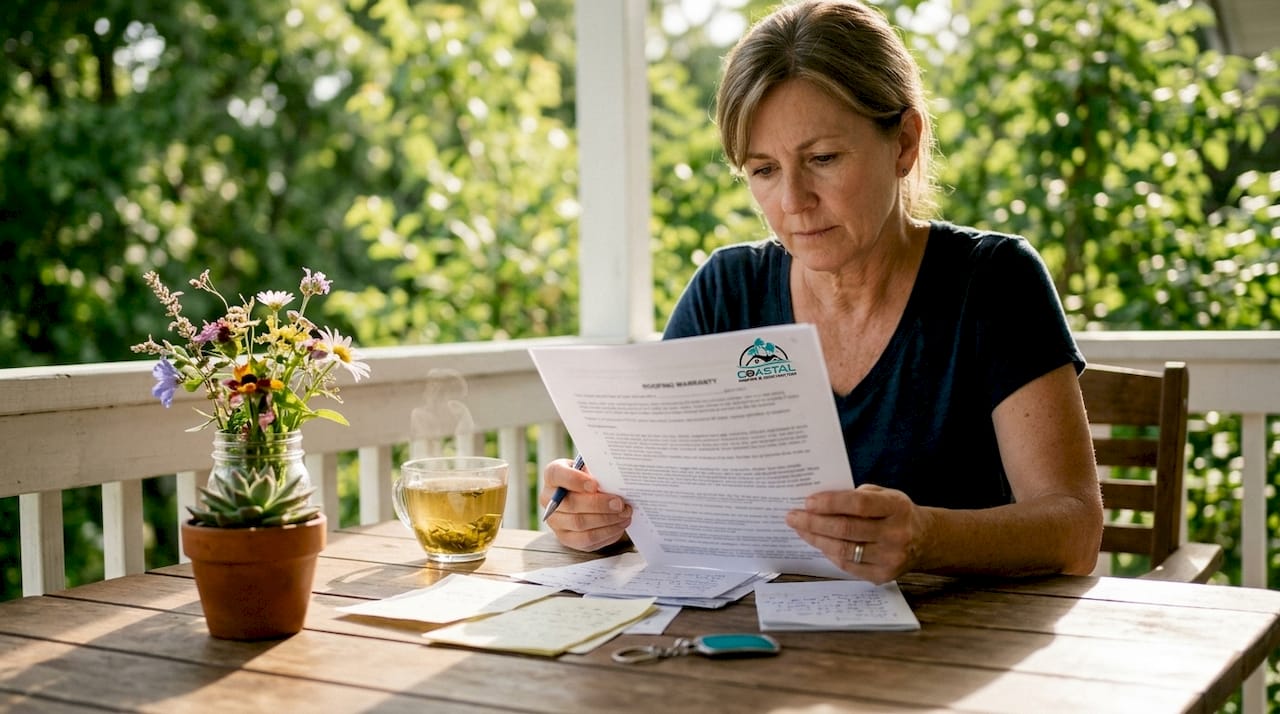
Manufacturer material warranties cover product failures, not installation failures. If a shingle delaminates in year seven on a product rated for 25 years, that is a manufacturer claim. What these warranties do not cover: storm damage (unless a wind or hail rider is explicitly added), installation errors, or damage from foot traffic. Most standard manufacturer warranties are non-prorated for the first 10 years, then coverage prorates annually, sometimes dropping to roughly 20% of replacement value by year 30. The word “lifetime” in a warranty name is largely a marketing term.
Contractor workmanship warranties are only as reliable as the contractor who issued them. A flashing miss, a nail-line gap, a poorly sealed penetration: those are workmanship claims. Coverage typically excludes storm damage, normal wear, and problems caused by the homeowner modifying the roof after installation. The critical limitation: if the contractor goes out of business, the workmanship warranty usually ends with them.
Enhanced system warranties require two conditions: a manufacturer-certified contractor at the top tier, and every component of the roof assembly coming from one brand. Shingles, underlayment, starter strips, hip and ridge, and ventilation must all match. These warranties combine material and workmanship coverage under one document, and crucially, the workmanship coverage is issued by the manufacturer, so it survives contractor closure. Common exclusions across all warranty types include:
- Damage from deferred maintenance or neglect
- Storm damage not covered by a specific rider
- Damage from unauthorized roof modifications
- Failures caused by improper ventilation installed by others
- Normal wear and tear over time
Transferability also varies. Manufacturer warranties typically allow one transfer within a set window, often 5–15 years from installation. Workmanship warranties almost never transfer unless they are manufacturer-backed through a system warranty.
How the warranty claim process works and who is responsible
Filing a warranty claim starts with identifying which type of failure you have. A shingle defect goes to the manufacturer. A leak traced to a flashing error goes to the contractor. Getting this wrong wastes time and can result in a denial.
For manufacturer claims, the process typically involves contacting the manufacturer directly, submitting date-stamped photos, and providing proof of purchase and installation. Some manufacturers, including GAF, may require you to submit shingle samples for laboratory evaluation. GAF allows up to 9 months from opening a claim to submit the necessary documentation and samples. Missing that window can void the claim entirely.
For workmanship claims, you contact the contractor directly. The problem arises when the contractor is no longer in business. Standard workmanship warranties become unenforceable at that point. Enhanced system warranties solve this: because the manufacturer issues the workmanship coverage, you file directly with the manufacturer regardless of what happened to the contractor.
Pro Tip: Register your warranty with the manufacturer immediately after installation. Many manufacturers require registration within a specific window after the job is completed, and failing to register can reduce your coverage tier or void enhanced warranty benefits entirely.
Homeowner responsibilities that keep a warranty valid:
- Schedule regular roof inspections and keep written records
- Address minor repairs promptly rather than deferring them
- Avoid unauthorized modifications to the roof assembly
- Retain all contracts, invoices, and installation documentation
Questions to ask your contractor before signing anything
Most homeowners find out what their warranty does not cover after a problem appears. Asking these questions upfront prevents that.
- What warranty types are you offering? Confirm whether you are receiving a manufacturer material warranty, a workmanship warranty, or an enhanced system warranty, and get each in writing.
- What is the non-prorated coverage window? Ask specifically how many years the warranty pays full replacement value before proration kicks in.
- Is the workmanship warranty manufacturer-backed? A contractor-only workmanship warranty disappears if the company closes. A manufacturer-backed version does not.
- Are you certified to offer enhanced warranties? Contractor certifications from Owens Corning, GAF, or CertainTeed at the top tier are required to unlock premium system warranties. If the contractor is not certified, those warranties are simply not available.
- Is the warranty transferable, and under what conditions? Ask whether the new owner receives the same coverage and whether there is a fee or paperwork deadline.
- What documentation will I receive at completion? You should get signed copies of every warranty document, the manufacturer registration confirmation, and the contractor’s written workmanship terms.
- How are claims handled? Ask for the specific process: who to contact, what documentation is required, and what the typical resolution timeline looks like.
Reviewing your roofing contract before signing is the best place to confirm these answers are actually reflected in writing, not just spoken promises.
Warranty coverage versus maintenance: they are not the same thing
Warranties cover defects and installation errors. They do not cover the consequences of neglect. Confusing the two is one of the most common reasons claims get denied.
Roof warranties are voided when a homeowner fails to maintain the roof or cannot prove proper upkeep. A clogged gutter that causes water to back up under shingles is a maintenance failure, not a manufacturer defect. A cracked flashing that went unrepaired for two seasons before causing a leak is a maintenance issue, not a workmanship claim. The distinction matters because manufacturers and contractors will investigate the cause of failure before approving any claim.
Warranty coverage handles:
- Manufacturing defects in materials
- Installation errors by the contractor
- Premature product failure within the warranted lifespan
Homeowner maintenance responsibilities include:
- Annual or biannual roof inspections
- Gutter cleaning and drainage maintenance
- Prompt repair of minor damage after storms
- Keeping tree limbs trimmed away from the roof surface
Homeowners insurance covers storm damage, not warranty failures. Warranty claims and insurance claims are separate processes with separate documentation requirements. Mixing them up, or assuming one covers what the other does not, leads to gaps in protection. Keep inspection reports, contractor invoices, and photos organized in one place. That paper trail is what validates a claim when the time comes.
Coastal Roofing & Construction brings manufacturer-backed warranty coverage to Tampa Bay homeowners
When you invest in a new roof in Florida’s coastal climate, the warranty behind it matters as much as the materials on top of it. Coastal Roofing & Construction is manufacturer-certified with Owens Corning and GAF, which means Tampa Bay homeowners can access the top tier of system warranties that most local contractors simply cannot offer. That includes manufacturer-backed workmanship coverage that stays in force regardless of what happens to any individual contractor.

Coastal Roofing & Construction installs architectural shingles, standing seam metal, tile, and flat roofing systems across Pinellas, Hillsborough, and Pasco counties, with every project backed by the strongest warranty documentation available for that system. Whether you are replacing an aging shingle roof or investing in a premium metal roof for a waterfront home, the team walks you through every warranty layer before the first nail goes in. See completed projects and recent roof replacements to get a sense of the work, then reach out for a free estimate and a clear explanation of exactly what warranty protection comes with your specific roof.
Key Takeaways
Roofing warranty coverage comes in three distinct layers, and the strongest protection requires a manufacturer-certified contractor installing a complete single-brand system.
| Point | Details |
|---|---|
| Three warranty layers exist | Manufacturer material, contractor workmanship, and enhanced system warranties each cover different failures. |
| “Lifetime” has limits | Most standard warranties are non-prorated for 10 years, then prorated, sometimes to roughly 20% of value by year 30. |
| Workmanship warranties can disappear | A contractor-only workmanship warranty ends if the contractor closes; manufacturer-backed versions survive. |
| Documentation protects your claim | Registration, inspection records, and photos are required to file and win a warranty claim. |
| Coastal Roofing & Construction | Certified with Owens Corning and GAF, offering Tampa Bay homeowners access to top-tier system warranties on every qualifying install. |