
Roofing certifications are formal credentials that prove a contractor meets specific quality, safety, and manufacturer standards required for a durable, code-compliant roof. The roofing certifications that matter most fall into three categories: state-issued licenses, manufacturer-backed credentials, and third-party performance designations. Each type protects you differently. A state license confirms legal authority to work on your home. A manufacturer certification unlocks enhanced warranties. A third-party designation like FORTIFIED Roof can reduce your insurance premiums by 15%–55%. Coastal Roofing & Construction holds all three types, including manufacturer certifications with Owens Corning, GAF, and Tri County Metals.
1. What roofing certifications actually matter?
Contractor credentials in the roofing industry fall into two broad groups: legally required licenses and voluntary quality certifications. Both matter, but for different reasons. A license tells you the contractor is legally allowed to work. A quality certification tells you they know how to do it right.
Skipping the verification step is the most common mistake homeowners make. A contractor can carry a valid license and still lack the manufacturer training needed to install a specific roofing system correctly. The reverse is also true: a contractor with impressive manufacturer credentials but no valid state license is operating illegally. You need both.
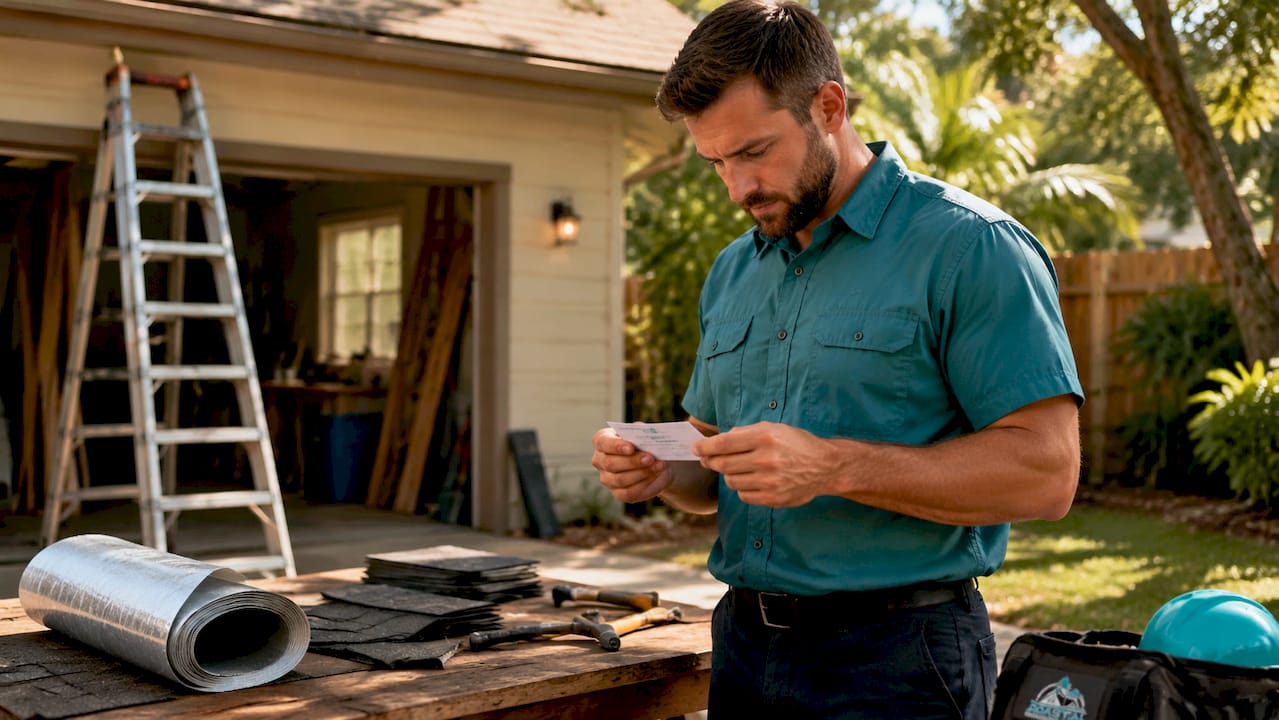
2. State and local roofing licenses: what to verify first
Florida state law requires roofing contractors to hold either a statewide Certified Roofing Contractor (CCC) license or a county-specific Registered Roofing Contractor (RR) license. The CCC license allows work anywhere in Florida. The RR license restricts the contractor to the county where it was issued. This distinction matters if you live in Pinellas County and hire a contractor licensed only in Hillsborough.
You can verify any Florida roofing license in minutes through the Florida Department of Business and Professional Regulation (DBPR) website. The lookup tool shows license status, expiration date, and any disciplinary history. Always check this before signing a contract.
Beyond the license itself, confirm the contractor carries:
- General liability insurance covering property damage during the project
- Workers’ compensation insurance protecting you if a crew member is injured on your roof
- A current certificate of insurance naming you as the certificate holder
Hiring an unlicensed contractor exposes you to substandard work, voided warranties, and zero legal recourse if something goes wrong. The financial risk is not worth the lower quote.
Pro Tip: Ask for the contractor’s license number before the first meeting. Run it through the DBPR lookup tool yourself. A legitimate contractor will give you the number without hesitation.
3. Manufacturer certifications: the warranty connection
Manufacturer certifications confirm that a contractor has completed factory training and met defined installation standards for a specific roofing system. This is not a participation trophy. Certified installers are tested on system-specific techniques, product knowledge, and quality benchmarks set by the manufacturer.
The direct benefit to you is warranty strength. Certified contractors are eligible to offer enhanced manufacturer-backed warranties that non-certified installers cannot provide. These enhanced warranties often cover both materials and labor for significantly longer periods than standard coverage.
What separates a certified installer from an uncertified one:
- Factory training on system-specific installation sequences
- Performance assessments measuring workmanship quality
- Ongoing evaluations to maintain certified status year over year
- Customer satisfaction metrics tracked by the manufacturer
Certification programs require rigorous training and proven quality workmanship, not just a one-time test. Coastal Roofing & Construction holds active manufacturer certifications with Owens Corning, GAF, and Tri County Metals, which means homeowners receive the strongest warranty options those manufacturers offer.
Pro Tip: Go to the manufacturer’s website and use their “find a certified contractor” directory. If the contractor you are considering does not appear, their certification claim is unverified.
4. FORTIFIED Roof designation: third-party verification with real insurance savings
The FORTIFIED Roof designation is a third-party certification issued by the Insurance Institute for Business and Home Safety (IBHS). It requires construction methods that exceed minimum building code, verified by trained independent evaluators during and after installation. This is not a self-reported credential. An outside inspector confirms the work meets the standard before the designation is issued.
The FORTIFIED designation qualifies homeowners for insurance premium discounts ranging from 15% to 55% in select Gulf Coast states. The designation is valid for five years. That discount range is significant on Florida coastal properties where wind coverage premiums are already high.
The FORTIFIED designation’s value lies in its verification of installation processes, not just product choice, through independent third-party evaluation. A contractor can use FORTIFIED-approved materials and still fail the designation if the installation method does not meet the standard.
Inspectors verify specific installation details during the project, not just at the end. Key inspection points include:
- Sealed roof deck with ring-shank nail spacing
- Underlayment sealing at all laps and edges
- Edge metal attachment meeting engineered plans
- Penetration sealing at all roof penetrations
- Clip and screw patterns on metal roofing panels
Independent evaluators audit roofing projects during and after installation, providing documented proof of quality for both homeowners and insurers. That documentation becomes part of your permanent home record and supports future insurance claims.
Pro Tip: Ask your insurance agent whether a FORTIFIED Roof designation would reduce your wind or hurricane premium before your roof replacement. In many Florida coastal communities, the savings over five years can offset a meaningful portion of the project cost.
5. UL and ASTM performance standards: what the test marks mean
UL and ASTM test marks appear on roofing products and installation assemblies. They are not brand approvals. They are performance certifications confirming a product or system met a specific test under controlled conditions.
UL 580 tests wind uplift resistance. UL 2218 tests impact resistance from hail. ASTM E1592 tests metal roofing panel systems under simulated wind pressure. These marks matter because permit inspectors often require documentation linking the installed assembly to a recognized UL or ASTM design specification before approving the project.
Metal roofing systems tested to UL 580 and ASTM E1592 can withstand sustained wind speeds of 120–180+ mph when properly installed. That performance level corresponds to Category 4 and 5 hurricane conditions. The “properly installed” qualifier is where contractor certification becomes critical. The test mark on the product means nothing if the installation assembly does not match the tested configuration.
For homeowners investing in metal roofing certifications or standing seam systems, ask your contractor to provide the UL or ASTM listing number for the specific assembly they plan to install. A certified contractor can produce this document without delay.
6. How to verify roofing certifications before you hire
Verification takes less than 30 minutes and protects you from the most common contractor fraud scenarios. Start with the state license, then move to manufacturer credentials, then request third-party documentation.
Follow this sequence:
- Look up the license number on the Florida DBPR website. Confirm active status and no disciplinary actions.
- Request a certificate of insurance and call the insurer directly to confirm the policy is current.
- Search the manufacturer’s contractor directory online. Confirm the contractor appears under their certified installer program.
- Ask for the FORTIFIED Roof designation number if the contractor claims FORTIFIED experience. Verify it through the IBHS website.
- Request UL or ASTM listing documentation for the specific roofing assembly, especially for metal roofing projects.
- Ask for past inspection reports from completed projects. Legitimate contractors keep these on file.
Red flags that signal a problem: a contractor who cannot provide a license number on request, who asks you to pull your own permit, or who cannot name the specific manufacturer certification they hold. Each of these is a warning that the credentials may not exist.
The Tampa Bay roof replacement guide from Coastal Roofing & Construction covers additional homeowner-centered advice on choosing licensed contractors and understanding what each credential means for your specific project type.
Pro Tip: Florida homeowners can also verify contractor licensing through the state disclosure process that applies to licensed home improvement contractors. The same DBPR system covers multiple trade categories.
7. Why certifications matter more in Florida than most states
Florida’s climate creates roofing conditions that most of the country never faces. Hurricane-force winds, intense UV exposure, salt air corrosion, and heavy rain cycles stress roofing systems year-round. A roof installed to minimum code standards in a mild climate may fail within years in a Gulf Coast environment.
Florida’s building codes are among the strictest in the nation precisely because of this climate reality. The Florida Building Code requires specific wind resistance ratings for roofing assemblies based on geographic wind speed zones. Pinellas County, Hillsborough County, and Pasco County all fall within high-velocity wind zones that demand certified installation methods.
Manufacturer certifications and third-party designations like FORTIFIED exist specifically to close the gap between minimum code compliance and real-world performance. A contractor certified by a major manufacturer and trained in FORTIFIED installation methods is not just meeting the legal minimum. They are building a roof designed to outlast the standard.
The long-term value of investing in certified contractors extends beyond the roof itself. Certified installations protect the structural integrity of the entire home, which matters especially in Florida’s coastal environment where moisture intrusion and wind damage compound quickly.
Key takeaways
The most important roofing certifications are state licenses, manufacturer credentials, and third-party designations like FORTIFIED Roof. Together, they confirm legal compliance, installation quality, and warranty eligibility.
| Point | Details |
|---|---|
| Verify state license first | Check the Florida DBPR website for active CCC or RR license status before any other step. |
| Manufacturer certification unlocks warranties | Only certified installers can offer enhanced manufacturer-backed warranties covering both materials and labor. |
| FORTIFIED Roof saves on insurance | The designation qualifies homeowners for premium discounts of 15%–55% in Gulf Coast states. |
| UL and ASTM marks confirm tested performance | These marks validate that a specific roofing assembly met wind and impact resistance standards under controlled testing. |
| Documentation protects your investment | Inspection reports and certification records support future warranty and insurance claims. |
Why I take certifications more seriously than most contractors do
Certifications are not paperwork. They are the difference between a roof that performs and one that fails when it matters most.
I have seen what happens when a homeowner hires based on price alone. The contractor shows up, installs the materials, and leaves. No manufacturer certification means no enhanced warranty. No FORTIFIED designation means no insurance discount and no independent verification that the installation was done correctly. When the next hurricane season arrives, the homeowner finds out the hard way.
The contractors who resist certification requirements are usually the ones who cannot meet them. Factory training, ongoing evaluations, and third-party inspections require consistent quality. That consistency is exactly what you want on your roof.
My honest recommendation: treat certifications as a minimum requirement, not a bonus. If a contractor cannot show you a valid state license, a manufacturer certification, and proof of insurance before you sign anything, walk away. The roofing industry has no shortage of qualified, certified contractors. You do not need to settle.
— Ryan
Coastal Roofing & Construction: certified credentials you can verify
Coastal Roofing & Construction holds active manufacturer certifications with Owens Corning, GAF, and Tri County Metals, a valid Florida Certified Roofing Contractor license, and full general liability and workers’ compensation insurance.
Every certification Coastal Roofing & Construction carries is verifiable. You can look up the state license on the DBPR website, confirm manufacturer credentials through each manufacturer’s certified contractor directory, and review completed certified roofing projects in the project portfolio. For homeowners in Pinellas County, Hillsborough County, and Pasco County considering a roof replacement, Coastal Roofing & Construction provides full documentation at every stage of the project.
FAQ
What is a Certified Roofing Contractor (CCC) license in Florida?
A CCC license is a statewide Florida credential issued by the DBPR that authorizes a contractor to perform roofing work anywhere in the state. It requires passing a state exam, proof of insurance, and demonstrated experience.
How do manufacturer certifications affect my roof warranty?
Certified contractors are authorized to offer enhanced manufacturer-backed warranties that non-certified installers cannot provide. These warranties typically cover both materials and labor for longer periods.
What is the FORTIFIED Roof designation and how does it save money?
The FORTIFIED Roof designation is a third-party certification verifying that a roof was built to exceed minimum code standards. It qualifies homeowners for insurance premium discounts of 15%–55% in select Gulf Coast states, including parts of Florida.
What do UL 580 and UL 2218 mean for my roofing project?
UL 580 tests wind uplift resistance and UL 2218 tests hail impact resistance. Both marks confirm the roofing product or assembly met specific performance thresholds under controlled laboratory conditions.
How do I verify a roofing contractor’s certifications in Florida?
Check the contractor’s state license on the Florida DBPR website, search the manufacturer’s online certified contractor directory, and request a current certificate of insurance. For FORTIFIED credentials, verify the designation number through the IBHS website.